The Geopolitical EconomistIn global geopolitics, truth is one, but the wise interpret it differently.

Home / Research / Trackers

Tracker · India and US trade

India’s Russian-Oil Tariff Tracker

What the US charges on Indian goods today, what it charged during the 2025 Russian-oil duty, and what a duty under the new Russia sanctions law would hit, product by product, with sources. Updated on every official move.

Duty waived

No duty under the Act. An executive order of 16 October 2026 sets a 100 per cent duty on goods from the five largest importers of Russian crude oil and gas that make new purchases from 18 October, and waives it in the same order (Sec. 2(b) and 4). The waiver has no end date; Secretary of State Rubio said on 17 October that the President will take up to 60 days to weigh the measures. Indian goods pay a 10 per cent extra US duty today.

Last checked 21 October 2026, 08:20 IST · Latest update: Published the full report, part 2 of the project: Will the US Switch On Its Waived 100% Russian-Oil Tariff, and Which Indian Exports Would Pay? Added Rubio’s statement of 17 October that the President will take up to 60 days to weigh the waived measures, with the end of that period, about 15 December, as the next date; Bloomberg’s report that Indian refiners cut November purchases of Russian crude on price; analysts’ view that India will keep buying near current levels; Rubio’s remarks in Mumbai on the trade deal; and a conditional April 2027 date for the first redetermination of the five largest importers.

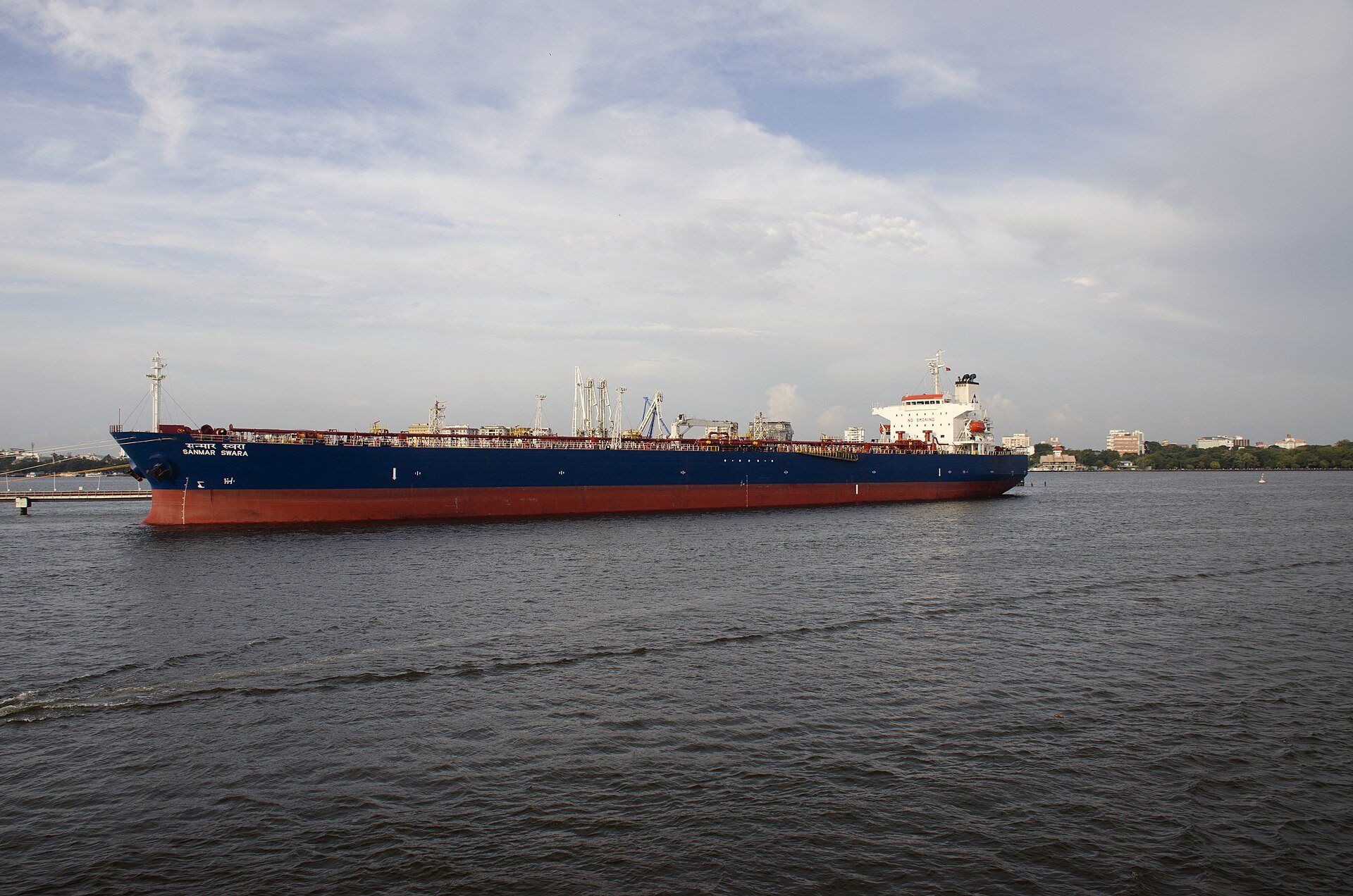
Photo: An oil tanker at the Cochin Oil Terminal, Kochi, 6 September 2026. Rangan Datta Wiki via Wikimedia Commons, CC BY-SA 4.0.

Extra US duty on Indian goods today
10%

Section 301, since 24 July 2026. Phones, medicines and fuel pay none; steel, aluminium and autos pay Section 232 rates instead.

Federal Register, 28 July 2026 · CBP exempt list · PIB, 25 July 2026

Duty under the Russia sanctions Act
Waived

Set at 100% on goods from the five largest importers of Russian crude oil and gas that buy from 18 October, and waived in the same order on 16 October. The order names no country.

Executive order, 16 October 2026 · Sec. 115 of the Act

How long the waiver lasts
No end date

Until the President or the Secretary of State, consulting the Treasury and the US Trade Representative, decides that “further action is appropriate” (Sec. 4(d)). The Act sets no time limit on waivers. Rubio said on 17 October that the President will use up to 60 days to assess the measures, to about 15 December.

Executive order, Sec. 4(d) · Sec. 115 of the Act · Reuters, 17 October 2026

India’s Russian crude, September (Kpler)
1.82mb/d

29% below July’s 2.57 million barrels a day; October is expected at 1.8 to 1.9 million. CREA says crude imports fell 13% from August, to the lowest since April.

Kpler via PTI, 14 October · CREA, September 2026

Summary

Key takeaways

  1. 1

    No duty under the Act. On 16 October the President set a duty of 100 per cent on goods from the five largest importers of Russian crude oil and gas that make new purchases from 18 October, and waived it in the same order. The order names no country and gives the waiver no end date.

    Executive order, 16 October 2026 · Sec. 115 of the Act

  2. 2

    The waiver can be ended by the President, or by the Secretary of State consulting the Treasury and the US Trade Representative, once they “determine that further action is appropriate”. The Trade Representative monitors purchases of Russian crude and gas and reports to the President. Rubio said on 17 October that the President will take “the 60-day period of time” to analyse what imposing the sanctions and tariffs would mean; the order itself sets no period.

    Executive order, Sec. 3, 4(d) and 5 · Reuters, 17 October 2026

  3. 3

    India’s Russian crude purchases have fallen since July: 1.82 million barrels a day in September, 29 per cent below July, by Kpler’s count, which expects October at 1.8 to 1.9 million. CREA puts September’s crude imports at the lowest since April.

    Kpler via PTI, 14 October · CREA, September 2026

  4. 4

    India meets the Act’s volume test. It was the first or second largest buyer of Russian seaborne crude in every month of the twelve the Act looks at, and it discharged 1.77 million barrels a day on average.

    KSE Institute, September 2026 edition

  5. 5

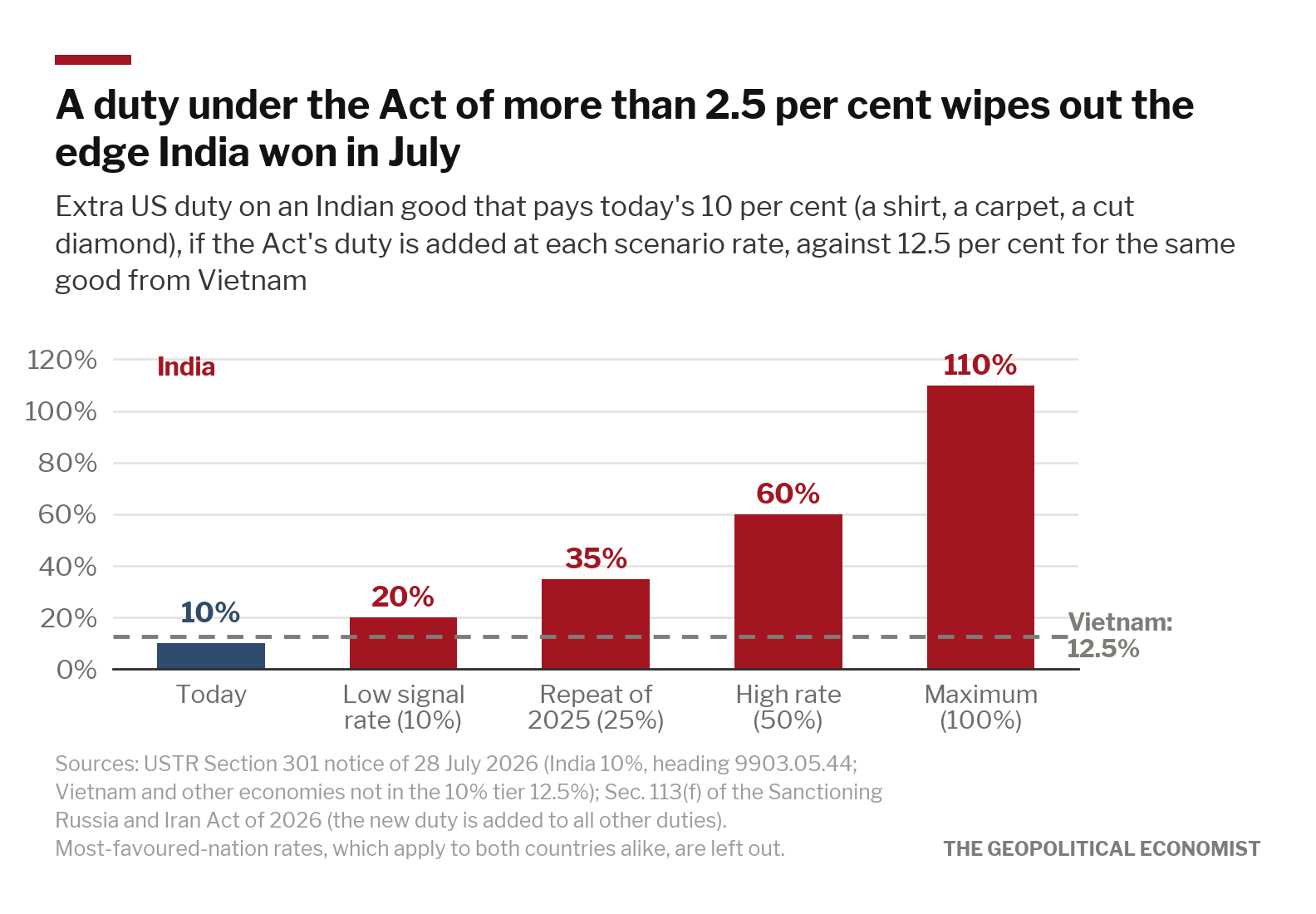
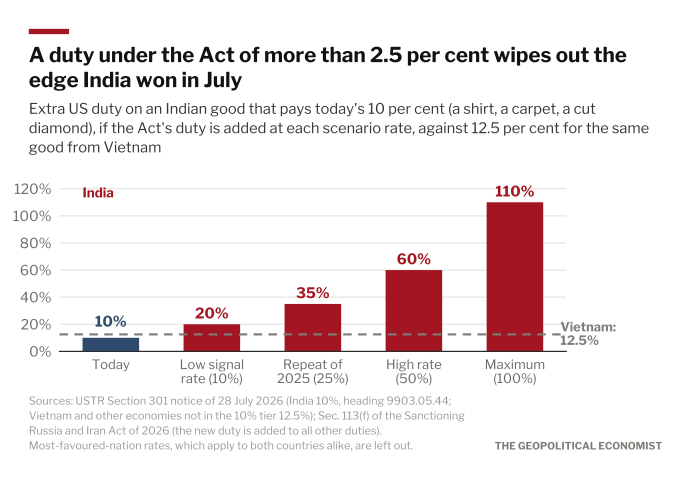
    If the waiver ends, any duty above 2.5 per cent would wipe out the edge India won in July, when its Section 301 rate was set at 10 per cent against 12.5 for Vietnam.

    USTR notice, 28 July 2026

  6. 6

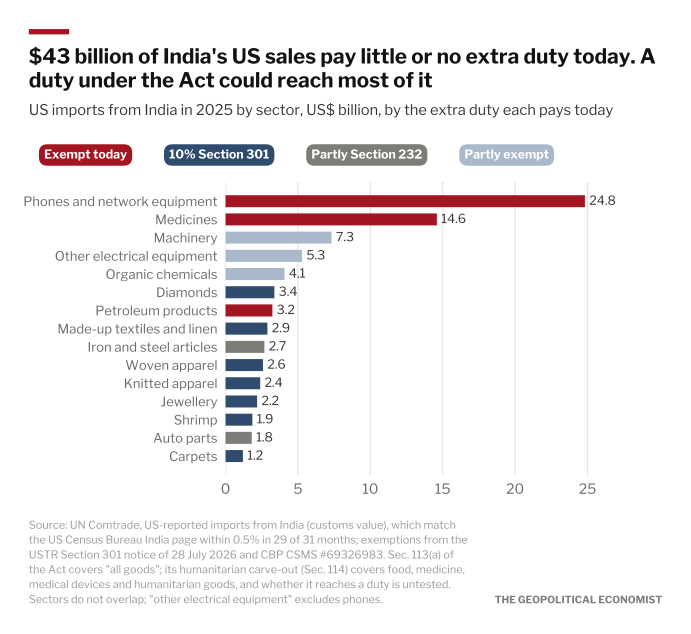
    $43 billion of India’s 2025 sales to the US, in phones, medicines and fuel, pay little or no extra duty today. The Act applies to “all goods”, with no list of exempt products.

    Our dataset · Sec. 113(a)

The precedent

What happened under the 2025 oil duty

In August 2025 Washington added 25 per cent to Indian goods by executive order because India bought Russian oil. Some goods were exempt, and the duty was lifted in February 2026.

Step by step

  1. Executive Order 14329 adds 25% to Indian goods, finding that India “is currently directly or indirectly importing Russian Federation oil”.

    Executive Order 14329

  2. The 25% takes effect on top of the 25% reciprocal tariff: 50% in all on goods that were not exempt.

    Executive Order 14329, sec. 2 and 3(d) · ICRIER Policy Brief 74

  3. Executive Order 14384 lifts it, saying India “has committed to stop” importing Russian oil, and tells the Commerce Department to “monitor whether India resumes”.

    Executive Order 14384

  4. The Supreme Court rules that the emergency-powers law does not allow tariffs. The same day an executive order ends the duties imposed under it, including the reciprocal tariff.

    Supreme Court, Learning Resources v. Trump · Executive Order 14389

  5. A temporary 10% surcharge under Section 122 starts and runs for 150 days, to 24 July.

    Proclamation 11012

  6. A 10% Section 301 duty applies to Indian goods, with about 45% of India’s exports to the US exempt.

    Federal Register · PIB

What was exempt

Why goods get exempted. Washington spares goods it cannot easily do without. When the 10 per cent was set in July 2026, the President’s memorandum, quoted in the trade office’s notice, limited exemptions to goods whose tariffs “could lead to the unavailability of domestic supply”, “could cause economy-wide disruptions” or that “cannot be grown or produced in sufficient quantities in the United States”.

Presidential memorandum of 23 July 2026, in the Federal Register notice

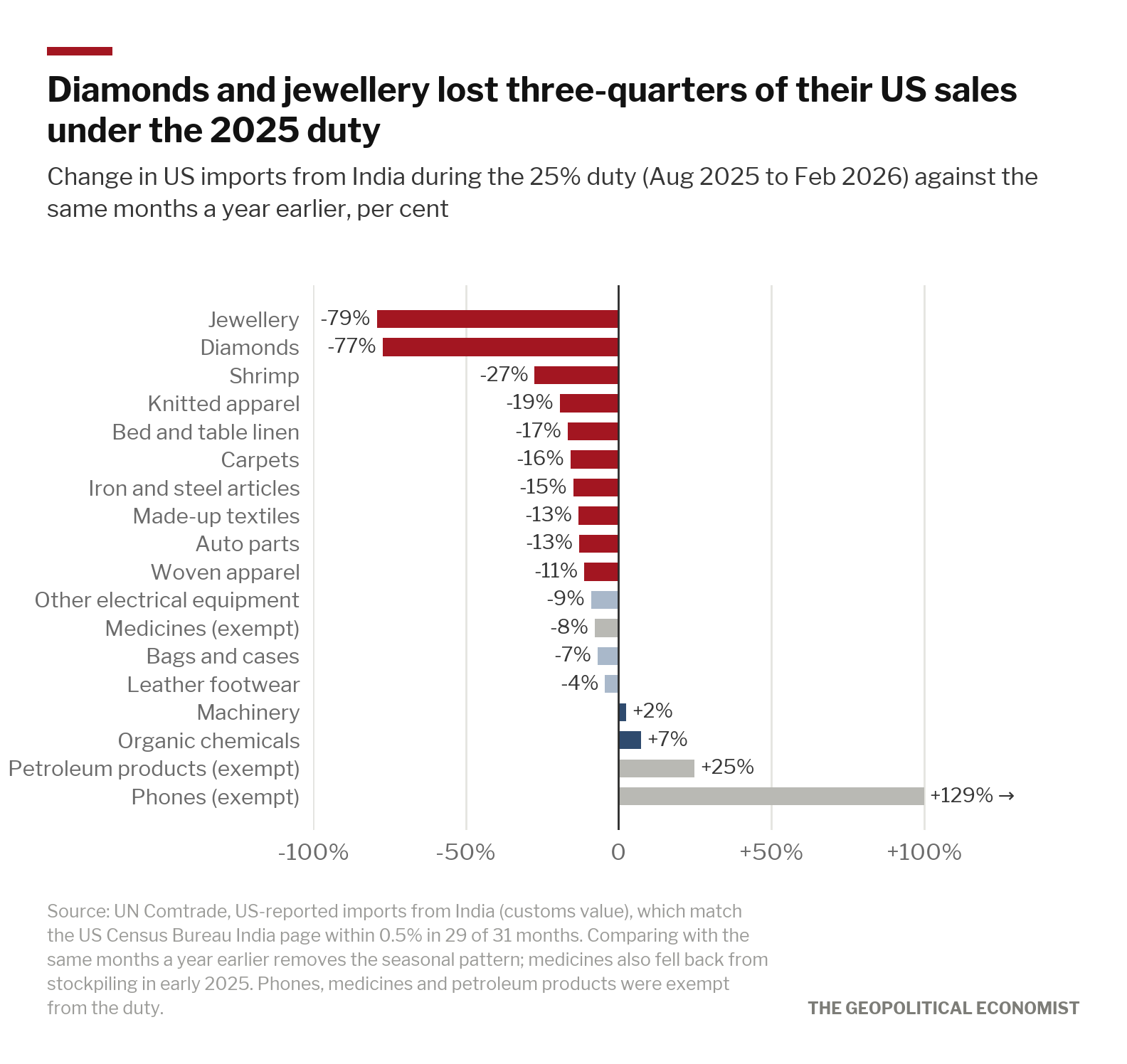
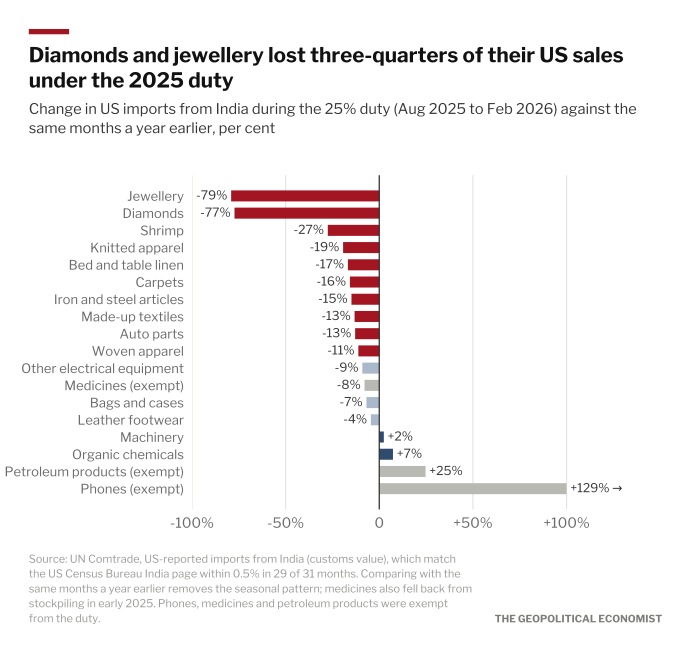
While Indian goods paid 50 per cent in extra duties, phones, medicines and fuel grew by more than half and everything else fell by a fifth. Diamonds and jewellery lost three-quarters of their US sales.

Diamonds and jewellery lost three-quarters of their US sales under the 2025 duties
Download this chart: PNG · SVG

What a new duty would reach

$43bnof $104bn

  • Phones and network equipment $24.8bn
  • Medicines $14.6bn
  • Petroleum products $3.2bn
  • Everything else $61.2bn

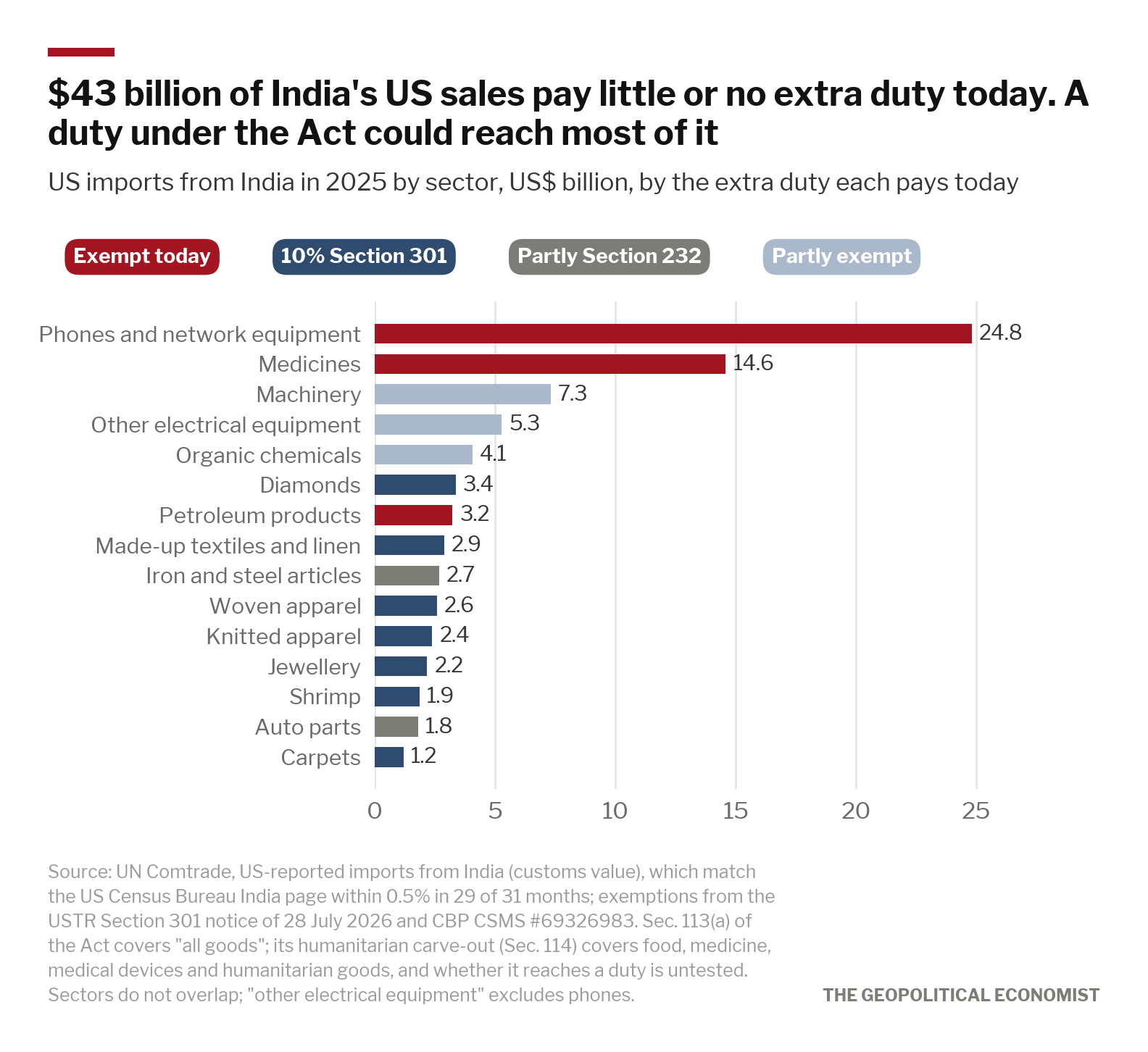
Of the $104 billion the US bought from India in 2025, $43 billion was phones, medicines and fuel, which pay little or no extra US duty today. A duty under the Act would apply to “all goods”, with no list of exempt products.

Our dataset (UN Comtrade, US-reported imports) · Sec. 113(a) of the Act

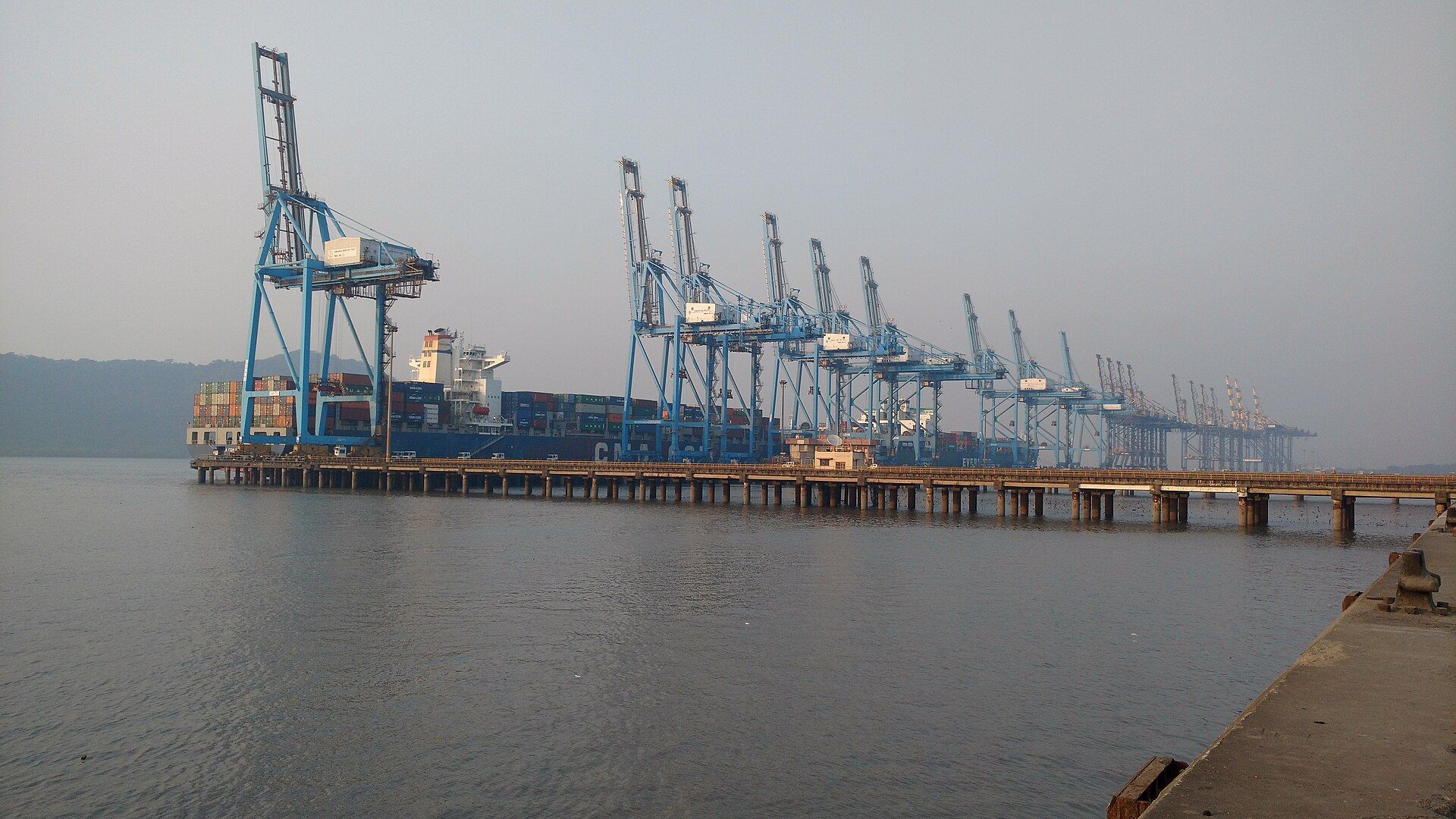
Photo: Container cranes at Jawaharlal Nehru Port, Navi Mumbai, 29 November 2017. Ccmarathe via Wikimedia Commons, CC BY-SA 4.0.

Exposure

Which products a new duty would hit, and which could be exempted

The Act applies the duty to “all goods” from a covered country (Sec. 113(a)) and adds it on top of every other duty, including Section 232 (Sec. 113(f)). Unlike 2025, it has no list of exempt products. The table compares each product group across the three regimes.

ProductThe 2025 oil dutyTodayIf the Act’s duty comesCould it be exempted?
Smartphones and network equipment$24.8bn of US imports in 2025Exempt: counted as “semiconductors” from April 2025US imports +129%ExemptCoveredWaiver onlyThe Act has no product exemptions. Washington exempted phones in 2025 and again in July 2026, so a waiver would have precedent.
Medicines$14.6bn of US imports in 2025Exempt: pharmaceuticalsUS imports −8%ExemptCovered, unless the humanitarian clause appliesPossibleSec. 114 names “medicine”. Whether it reaches a tariff is untested.
Petroleum products$3.2bn of US imports in 2025Exempt: energy productsUS imports +25%ExemptCoveredWaiver onlyNo exemption in the Act. Exempted in 2025 and again in July 2026.
Machinery and electrical goods$12.6bn of US imports in 202550% in all on most lines; computers exemptUS imports +2% and −9%10% on most lines; computers and semiconductors exemptCoveredNoneNo exemption in the Act for these lines.
Clothing, home textiles and carpets$9.1bn of US imports in 202550% in allUS imports −11% to −19%10%Covered, on top of the 10%NoneNo exemption in the Act, and never exempted so far.
Diamonds and jewellery$5.6bn of US imports in 202550% in allUS imports −77% and −79%10%; jewellery also pays a 5.5 to 6% MFN dutyCovered, on top of the 10%NoneNo exemption in the Act. In February the US said it would remove the reciprocal tariff on gems and diamonds once an interim agreement was concluded. That tariff has since ended, and the promise never covered today’s 10% or a duty under the Act.
Steel articles and auto parts$4.5bn of US imports in 2025Section 232 goods paid those rates only; other lines paid 50%US imports −15% and −13%Section 232 rates on listed goods (50% steel, 25% auto parts); 10% on the restCovered, and added on top of Section 232NoneUnlike 2025, Section 232 gives no shelter: the Act’s duty comes on top (Sec. 113(f)).
Chemicals$4.1bn of US imports in 202550% in all on most linesUS imports +7%10%; pharmaceutical ingredients exemptCoveredUnclearPharmaceutical ingredients might count as “related to” medicine under Sec. 114; untested.
Shrimp$1.9bn of US imports in 202550% in all, plus anti-dumping and countervailing dutiesUS imports −27%10%, plus anti-dumping and countervailing dutiesCovered, unless the humanitarian clause appliesPossibleSec. 114 names “food”. Whether it reaches a tariff is untested.

US imports from India in 2025, US$ billion; the change is US imports from August 2025 to February 2026, while non-exempt Indian goods paid 50% in extra duties, against the same months a year earlier. MFN is the most-favoured-nation duty every supplier pays.

How a product could still escape a new duty

Food and medicine, possibly
Sec. 114 says sanctions and other measures under the title “shall not apply to” transactions for “the provision of agricultural commodities, food, medicine, medical devices”. Whether a tariff counts is untested.
Anything, by waiver
The President may waive “any duty under this title” by certifying to Congress that it is “in the national interests of the United States” (Sec. 115). The Act does not say whether a waiver can cover some products and not others.
Cargo at sea, perhaps
In 2025 goods already in transit were spared. The Act says nothing about them, so the implementing order would decide.
Not steel, aluminium or autos
In 2025 goods under Section 232 tariffs were spared the oil duty. This time the duty comes on top of Section 232 (Sec. 113(f)).

Source: The enrolled text of the Act, Sec. 113, 114 and 115.

$43 billion of India's US sales pay little or no extra duty today. A duty under the Act could reach most of it
Download this chart: PNG · SVG

The full table of eighteen sectors, with each sector’s dependence on the US market and its rivals’ duties, is in the brief and in the dataset. Read the brief · Open the dataset

The decision

16 Oct2026

On this date the President set the duty at 100 per cent on goods from the largest buyers of Russian crude oil and gas, and waived it in the same order, two days before the deadline. The waiver lasts until the President or the Secretary of State decides that “further action is appropriate”.

Executive order, 16 October 2026 · Sec. 113 and 115 of the Act

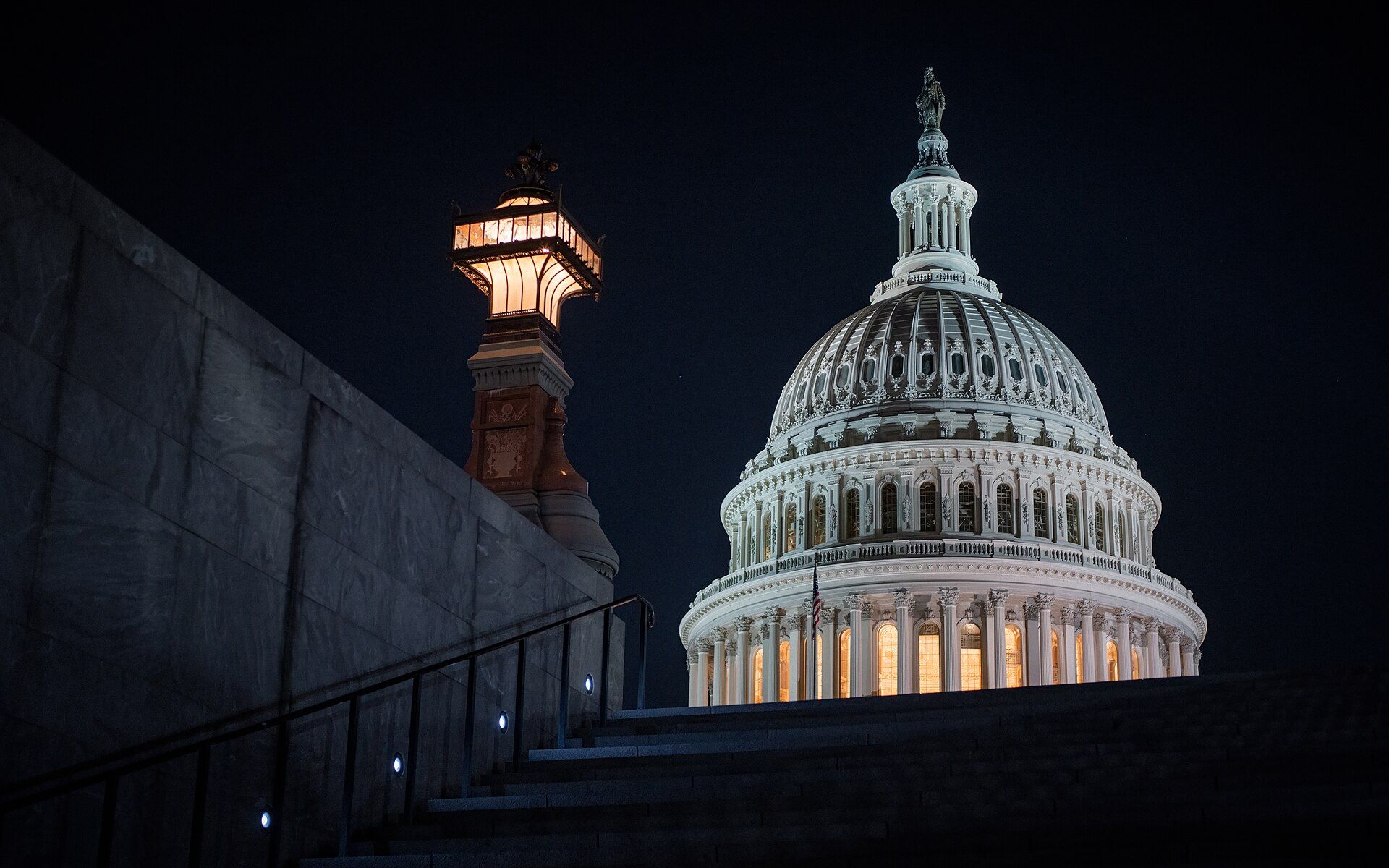
Photo: The US Capitol at night, 8 December 2023. John Brighenti via Wikimedia Commons, CC BY 2.0.

Outlook

What happens next

How likely we judged each outcome, on 4 October

  • A. No new duty 50%
  • B. A low signal rate 25%
  • C. A 25 per cent duty, as in 2025’s oil penalty 20%
  • D. A high rate 5%

The four scenarios

A

No new duty

Roughly even chance (about 50%)

What happened on 16 October

What happens
India is named as a top buyer but the President waives the duty under Sec. 115 or holds it back, tied to the trade deal or to cuts in Russian purchases; or India is left off the list, including because it makes no new purchases.
Signs it is coming
A waiver certification sent to Congress. Progress on the interim trade deal. Refiners booking fewer Russian cargoes.
What it means for exporters
No new duty now. A waiver can be withdrawn, and the list is redrawn every 180 days once any country pays the duty.
B

A low signal rate

Unlikely (about 25%)

What happens
A duty above zero and up to 15 per cent is added to keep pressure on.
Signs it is coming
A justification to Congress with a modest rate. Officials stressing the steps India has taken.
What it means for exporters
The July edge over Vietnam is gone; margins are squeezed; few orders move.
C

A 25 per cent duty, as in 2025’s oil penalty

Unlikely (about 20%)

What happens
A duty above 15 and below 50 per cent.
Signs it is coming
Trade talks stall. Officials cite the February pledge. Russian imports stay near 2 million barrels a day.
What it means for exporters
Orders move in price-sensitive sectors, and this time smartphones pay too. The 2025 losses came at 50% in all; 25% now would mean 35% with today’s duty.
D

A high rate

Very unlikely (about 5%)

What happens
A duty of 50 to 100 per cent is added.
Signs it is coming
An open break in talks. Pressure from Congress to enforce. No fall in Russian imports.
What it means for exporters
Most price-sensitive exports to the US stop being viable.

The order’s duty reaches only a top-five importer that “knowingly makes new purchases” of Russian crude or gas from 18 October (Sec. 2(b)). India is still buying, and Kpler expects 1.8 to 1.9 million barrels a day in October, so India would be within its reach if the waiver ended.

Likelihoods use the US intelligence community’s scale (ICD 203): very unlikely 5–20%, unlikely 20–45%, roughly even chance 45–55%, likely 55–80%. They were judgements on the evidence to 4 October 2026, not predictions, and the reasons are set out in the brief. What happened: Scenario A, on 16 October, two days before the deadline. We rated it a roughly even chance. What we got wrong: we expected a list of countries naming India, and a waiver tied to India’s trade deal or to cuts in its Russian purchases. The order names no country and waives the duty for every country, without conditions.

A duty under the Act of more than 2.5 per cent wipes out the edge India won in July
Download this chart: PNG · SVG

Record

Signals log

Official actions and statements, market data and business reactions, newest first. Each entry gives who, what happened, the words used where there are any, and the source. Download the log as CSV.

  1. Statement

    Secretary of State Marco Rubio. In Mumbai, after meeting External Affairs Minister S. Jaishankar, Rubio says the trade agreement is close, with a small number of items left.

    “We’re very, very close. I would say we’re about as close as you can be without having executed the agreement”

    AP via Washington Times, 20 October 2026

  2. Deadline

    President Trump. Day 30 after enactment. Under the executive order of 16 October, new purchases of Russian crude or gas from this day would bring the 100% duty, but the duty is waived (Sec. 2(b) and 4 of the order).

    “if the country knowingly makes new purchases”

    Executive order, White House, 16 October 2026

  3. Statement

    Secretary of State Marco Rubio. Rubio says the President will take up to 60 days to assess what imposing the waived sanctions and tariffs would mean for the global and US economies. The order itself sets no period.

    “the president wants to take the 60-day period of time to sort of analyze what imposing both sanctions and tariffs will mean to the global economy”

    Reuters via Yahoo News, 17 October 2026

  4. Market data

    Analysts, as reported by PTI. Analysts expect India to keep importing Russian crude at close to current levels after the waiver.

    PTI via Deccan Herald, 17 October 2026

  5. Official action

    President Trump. An executive order sets a 100% duty on goods from the five largest importers of Russian crude and gas that make new purchases from 18 October, and waives it in the same order, together with the 500% duty on Russian goods and most of the Act’s sanctions. It names no country; the waiver lasts until the President or the Secretary of State decides further action is appropriate.

    “I hereby waive the application of any duties provided for in sections 112 and 113 of the Graham Act or this order”

    Executive order, White House, 16 October 2026

  6. Market data

    CREA. India was the second-largest buyer of Russian fossil fuels in September, at EUR 4.1 billion, of which crude EUR 3.6 billion. Its crude imports fell for a second month, by 13%, to the lowest since April; Vadinar overtook Jamnagar as the largest importer.

    CREA, September 2026 monthly analysis

  7. Statement

    US Ambassador to India Sergio Gor. Gor says the President must make a determination under the Act within about ten days, that its measures target no single country, and that India falls in one of its categories.

    “He has to make a determination in the next I believe 10 or so days”

    Business Today, 15 October 2026

  8. Market data

    Ministry of Commerce and Industry. India’s merchandise exports to the US rose 11.1% to $50.81 billion in April to September 2026, and imports from the US rose 26% to $32.33 billion. Commerce Secretary Rajesh Agrawal says the trade deal will be signed once the US tariff structure is settled.

    “The deal has to be signed when the overall tariff structure is getting formalised”

    ANI via Deccan Chronicle, 15 October 2026

  9. Market data

    Kpler (as reported by PTI). India imported about 1.82 million barrels a day of Russian crude in September, 29% below July’s 2.57 million, against 1.49 million for China; October imports are expected at 1.8 to 1.9 million.

    PTI via ETV Bharat, 14 October 2026

  10. Statement

    State Department. Secretary of State Rubio will travel to Samarkand, Mumbai and Jamnagar from 17 to 22 October; in India he will meet officials and business leaders.

    “discuss prospects for enhanced energy cooperation”

    State Department media note, 13 October 2026

  11. Statement

    Treasury Secretary Scott Bessent. Bessent tells Fox News that the diesel deal Trump announced on 9 October will go ahead under existing authority, and that neither an older law nor the Graham Act bars it.

    “Anyone in Congress who says that either it’s an old bill or the Lindsey Graham bill that prohibits us from doing it, they’re wrong”

    Reuters via Cyprus Mail, 11 October 2026

  12. Official action

    Treasury (OFAC). General License 135 authorises transactions in Russian-origin diesel, including importation into the United States, until 7 April 2027.

    “including importation into the United States”

    OFAC General License 135, 9 October 2026

  13. Deadline

    President Trump. Last day for the written justification to Congress if a duty is to start on 18 October (Sec. 113(g)(1)).

    “not later than 10 days before imposing a duty”

    Enrolled text of the Act

  14. Market data

    Bloomberg (Rakesh Sharma, Yongchang Chin). Bloomberg reports that Indian refiners cut Russian crude purchases for November delivery because Russian crude is offered at premiums of more than $10 a barrel to Dated Brent; Russia’s share of India’s crude imports fell to about 35% in September from as much as 56% in July (Kpler). Its sources say New Delhi has not asked refiners to cut.

    “premiums of more than $10 a barrel to Dated Brent”

    Bloomberg via gCaptain, 8 October 2026

  15. Statement

    Finance Minister Nirmala Sitharaman, as reported by Reuters. Reuters reports that Sitharaman said the trade talks had reached a plateau with little room for manoeuvre, after Greer said a deal was not imminent; it adds that Rubio is expected to visit India later this month.

    “plateau”

    Reuters via Investing.com, 6 October 2026

  16. Market data

    US Census Bureau. US imports from India in August, the first full month under the 10% duty: $9.17 billion, 4.3% below July and 16.2% above August 2025, when the 2025 duties began. January to August: $68.0 billion, 7.2% below the same months of 2025.

    US Census Bureau, Trade in Goods with India

  17. Statement

    Commerce Minister Piyush Goyal. Goyal meets Trade Representative Jamieson Greer at the G20 trade ministers’ meeting in Milwaukee; Business Standard notes no decision yet on the tariff’s rate or coverage.

    “Had a productive discussion with USTR Greer towards early conclusion of a mutually beneficial interim agreement under the India-US Bilateral Trade Agreement”

    Business Standard, 1 October 2026

  18. Statement

    US Trade Representative Jamieson Greer. Greer says his office must report within 30 days and name countries, and that the President will decide what to do.

    “we have to name names — so we’ll be doing that. What kind of action we’ll take is for the president to decide”

    Semafor, 1 October 2026

  19. Statement

    US Trade Representative Jamieson Greer. Greer says the India talks are near the end but no deal is imminent.

    “in the short strokes, so I think we’re toward the end of it”

    IANS, 2 October 2026

  20. Statement

    Ministry of Finance (Monthly Economic Review for September). The finance ministry’s monthly review says trade relations with the US remain unsettled now that the Act has passed and been signed.

    “Trade relations with the United States remain unsettled with the passage of the Graham Bill through the Congress and its Presidential assent”

    Swarajya, 1 October 2026

  21. Statement

    Prime Minister Narendra Modi. Modi and President Trump speak by phone about trade, defence, energy and technology.

    “We reviewed our bilateral cooperation in trade, defence, energy, critical technologies and other areas.”

    ETV Bharat, 30 September 2026

  22. Statement

    Senior State Department official, as reported by IndraStra. The official says Washington bears no grudge over India’s reaction, pitches US energy supplies, and says Rubio plans to visit in October; no date given.

    “no sort of hard feelings”

    IndraStra, 28 September 2026

  23. Statement

    Foreign Secretary Vikram Misri. Misri raises India’s concerns about the Act with a US congressional delegation led by Brian Mast.

    “conveyed our concerns about the SRIA legislation”

    ThePrint (PTI), 29 September 2026

  24. Statement

    Senior State Department official (ANI). A senior official says the Act gives the President a new tool and a broad waiver, and need not be used at once.

    “Congress gave the President another tool in his toolkit. That doesn’t mean necessarily that he’s going to implement that tomorrow”

    The Tribune (ANI), 25 September 2026

  25. Statement

    Commerce Minister Piyush Goyal. Goyal says the trade deal with the US is almost finished and needs only a tariff advantage over India’s competitors.

    “We just have to find the right comparable competitive advantage over our competitor so that we can quickly execute the agreement”

    Business Today, 25 September 2026

  26. Statement

    Chinese officials. Chinese officials criticise the Act before President Xi meets President Trump in Washington.

    Sullivan & Cromwell memo, 29 September 2026

  27. Statement

    Secretary of State Marco Rubio. Rubio meets External Affairs Minister S. Jaishankar in New York; they discuss sanctions on states that deal with Russia and Iran.

    “the United States remains well-positioned to help regional partners address their energy security challenges”

    State Department readout, 23 September 2026

  28. Statement

    External Affairs Minister S. Jaishankar. Jaishankar says on X that he raised India’s concerns about the Act with Rubio.

    “Reiterated India’s interests and concerns with regard to SRIA”

    Business Standard (Bloomberg), 24 September 2026

  29. Statement

    President Trump. At the UN General Assembly the President says the Act gives him new tariff powers that he will use if necessary, naming no country, rate or date.

    “enormous new tariff authorities”

    Sullivan & Cromwell memo, 29 September 2026

  30. Market data

    Reuters trade data and Kpler, via Oilprice. Reuters trade data put India’s Russian crude imports at 2.1 million barrels a day in August, down 16.5% on July, and Kpler’s preliminary September figure was 1.9 million; the crude import bill for April to August was $74.8 billion, up 48.4%.

    Oilprice, 22 September 2026

  31. Market data

    Indian refiners, as reported by Bloomberg. Refiners look for alternatives to Russian cargoes; Argus puts Urals delivered to India at about $133 a barrel.

    “have begun to look seriously for alternative cargoes”

    Bloomberg via Business Standard, 21 September 2026

  32. Business

    Retail Industry Leaders Association. The retail lobby asks how rates will be set and how often they could change.

    RILA blog, 21 September 2026

  33. Statement

    Commerce Minister Piyush Goyal. Goyal says the government is studying the details of the US tariffs on buyers of Russian oil.

    Business Standard, 21 September 2026

  34. Business

    CITI chairman Ashwin Chandran. India’s textile industry body warns that more US duties would hurt its members and calls for a balanced trade deal.

    “Any additional tariffs under this Act will be very difficult to absorb for the MSME-dominated Indian textile and apparel sector”

    Business Standard, 19 September 2026

  35. Statement

    MEA spokesperson Randhir Jaiswal. India says its energy purchases follow its national interest and that it has conveyed the Act’s implications to the US administration.

    “meeting the energy requirements of our 1.4 billion people is an imperative”

    The Tribune (ANI), 18 September 2026

  36. Official action

    President Trump. The President signs H.R. 5334, the Lindsey O. Graham Sanctioning Russia and Iran Act of 2026; the 30-day clock for duties runs to 18 October.

    “authorizes and expands statutory sanctions, tariffs, and prohibitions on Russia and extends existing sanctions on Iran”

    White House statement, 18 September 2026

  37. Official action

    US House of Representatives. The House agrees to the Senate text, 262 to 159.

    Sullivan & Cromwell memo, 29 September 2026

  38. Official action

    Rep. Steny Hoyer. Hoyer offers an amendment in the House Rules Committee to name target countries directly; the enacted Act keeps the top-five tests (Sec. 113(c)).

    Akin Gump client alert, 23 September 2026

  39. Business

    American Apparel and Footwear Association and 36 others. Thirty-seven US trade associations write to House leaders opposing the tariff authority.

    Joint association letter, 11 September 2026

  40. Official action

    US Senate. The Senate passes the Sanctioning Russia and Iran Act, 86 to 11, as part of H.R. 5334.

    Sullivan & Cromwell memo, 29 September 2026

  41. Official action

    US Trade Representative. A 10% Section 301 duty on Indian goods takes effect; about 45% of India’s exports to the US are exempt.

    USTR notice, Federal Register, 28 July 2026; PIB, 25 July 2026

  42. Official action

    White House. The 2025 Russian-oil duty on India ends, and the Commerce Department is told to monitor whether India resumes buying Russian oil.

    “India has committed to stop directly or indirectly importing Russian Federation oil”

    Executive Order 14384, Federal Register, 11 February 2026

  43. Official action

    United States and India. A joint statement sets an 18% reciprocal rate and records India’s intention to buy $500 billion of US goods over five years; it does not mention Russia.

    United States-India Joint Statement, White House, 6 February 2026

  44. Official action

    White House. A 25% additional duty on Indian goods over Russian oil takes effect, on top of the 25% reciprocal tariff.

    Executive Order 14329, Federal Register, 11 August 2025

Method

Data, method and sources

Data files

  • Signals logCSV

    Every official action, statement, market figure and business reaction since the 2025 duty: date, who, what happened, their words, and the source.

  • Sector exposure tableCSV

    Eighteen export sectors: US imports in 2025, how much of each sector’s exports go to the US, the change in 2025-26, today’s US duty and rivals’ duty, and an exposure rating.

  • US imports from India by monthCSV

    January 2024 to July 2026, at customs value, checked against the US Census Bureau’s India page.

  • US imports from India by sector and monthCSV

    The eighteen export sectors in the brief, each month.

  • Sector change in 2025-26CSV

    How much each sector’s US sales changed from August 2025 to February 2026, when non-exempt Indian goods paid 50% in extra duties, against the months before and a year earlier.

  • India’s exports to the US by monthCSV

    Commerce Ministry (TradeStat) figures, Jan 2024 to Jul 2026.

All 15 files, the charts and the method note

How this tracker works

  • Checked every weekday until the decision, then on every event and monthly.
  • Every figure links to its primary source: the enrolled text of the Act, the Federal Register, CREA, the KSE Institute, Kpler as reported, the US Census Bureau and India’s commerce ministry. Statements about the law quote the statute, not a memo or a news report.
  • Oil figures name their tracker each time, because ship-tracking firms differ.
  • The tracker maps scenarios and exposure. It does not predict the decision, and it gives no advice on individual securities.

The research project

How to cite. The Geopolitical Economist (2026). India’s Russian-Oil Tariff Tracker. Updated 21 October 2026. https://geopoliticaleconomist.com/research/trackers/india-russian-oil-tariff

Change log

  1. Published the full report, part 2 of the project: Will the US Switch On Its Waived 100% Russian-Oil Tariff, and Which Indian Exports Would Pay? Added Rubio’s statement of 17 October that the President will take up to 60 days to weigh the waived measures, with the end of that period, about 15 December, as the next date; Bloomberg’s report that Indian refiners cut November purchases of Russian crude on price; analysts’ view that India will keep buying near current levels; Rubio’s remarks in Mumbai on the trade deal; and a conditional April 2027 date for the first redetermination of the five largest importers.

  2. The decision: an executive order of 16 October sets a 100% duty on the largest importers of Russian crude and gas that buy from 18 October, and waives it, with no end date. Scenario A is marked, and the note under the scenarios says what we got wrong. Also added: Kpler’s September figure of 1.82 million barrels a day (1.74 was preliminary), CREA’s September analysis and five log entries from 9 to 15 October. The April 2027 review date is removed; it applied only if a duty started on 18 October.

  3. Added the US trade figures for August: imports from India of $9.17 billion, 4.3% below July and 16.2% above August 2025. Also added the finance ministry’s September review and Reuters’ report that the trade talks have reached a “plateau”. No official US action under the Act by 7 October; a written justification to Congress is due by 8 October if a duty is to start on 18 October. Sector detail for August will be added when it is published.

  4. Published, with the research brief.

Corrections: write to [email protected] with the line and your source. Analysis for information; not legal or investment advice.