
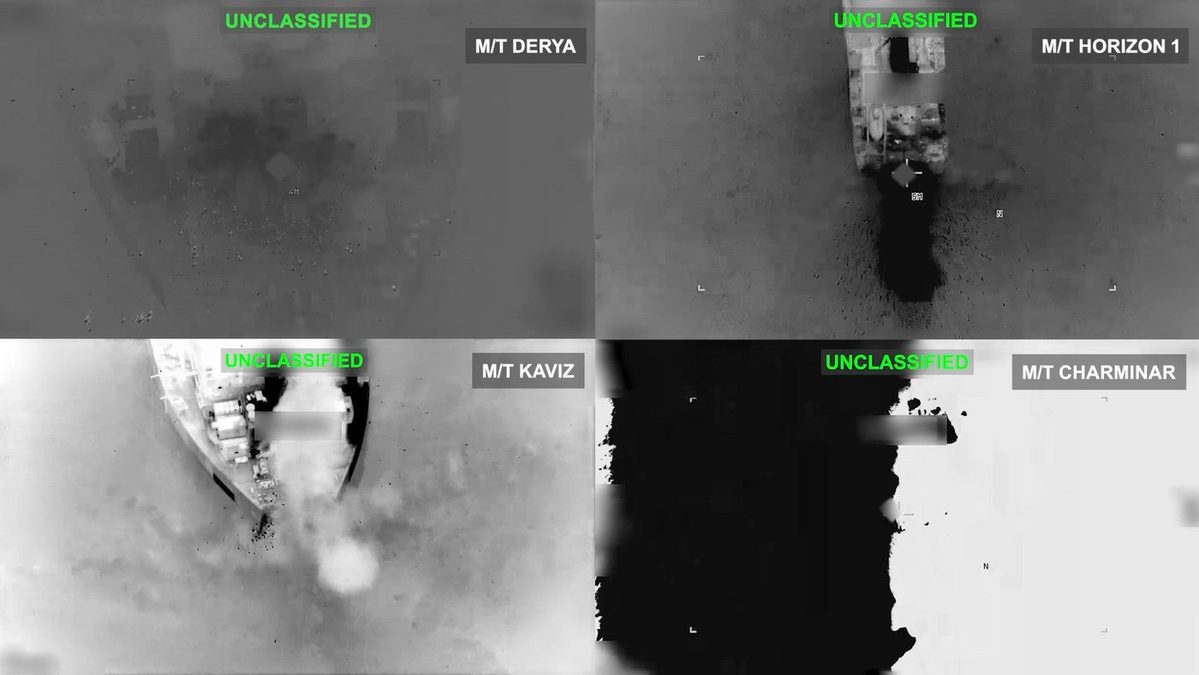
On Tuesday night the United States destroyed five Iranian oil tankers, the Kaviz, Charminar, Horizon 1, Riesco and Derya, in the Gulf of Oman and off Kharg Island.
Iran answered within hours. The Revolutionary Guards fired 20 ballistic missiles at the Al-Azraq base in Jordan, attacked ten ships near the Strait of Hormuz, and went after two U.S. destroyers.
By Wednesday morning, Brent crude was trading above $100 a barrel.
Most of the coverage is about the ships. This article is about something else: the American bond market, which is now the real battlefield of this war.
Here is why I say this.
Rubio's exchange rate
Secretary of State Marco Rubio put the new doctrine in one sentence: "Iran continues to try to hit U.S. naval ships. And for every time they do that or try to do that, they're going to lose tankers."
A missile for a tanker. That is now the official exchange rate.
Over the weekend, the U.S. destroyed three tankers; Iran hit six commercial vessels. Then five more tankers; Iran hit ten ships. Tehran has since declared a new "maritime restricted zone" stretching from Chabahar into the Gulf of Oman and the Arabian Sea.
Read that again. Every round of this exchange takes oil off the water. The U.S. is burning Iranian crude, Iran is scaring everyone else's crude, and the world pays the difference at the pump.
Remember one thing: before this war, roughly 21 million barrels a day, about 21% of everything the world consumes, moved through the Strait of Hormuz. Iran closed it on February 28, the first day of the war that the U.S. and Israel launched, and has kept it mostly shut ever since.
Washington's answer was a naval blockade of every Iranian port, from April 13. The Pentagon bragged that it cost Iran $4.8 billion in oil revenue in the first three weeks alone.
The blockade was lifted after the June 17 ceasefire memorandum. The memorandum collapsed on August 17. And now, six months in, we are back to a straight war on oil supply.
We have been here before, at $15 oil
For those who don't know, this is not the first time the U.S. Navy has fought Iran over tankers.
On April 18, 1988, after the frigate USS Samuel B. Roberts hit an Iranian mine, the Navy launched Operation Praying Mantis. In one day it destroyed two Iranian oil platforms, sank two Iranian ships and crippled a third. It remains the largest U.S. surface action since World War II.
Praying Mantis worked. Iran accepted a ceasefire with Iraq within months.
But look at the conditions. Oil was under $20. America was the world's biggest creditor only a few years earlier. Federal interest costs were a rounding error. Washington could fight a tanker war because its own economy could absorb the shock.
That is the part everyone forgets when they cite 1988 as the model for 2026.
The mechanism: how a tanker fire becomes a Treasury auction
Here is the chain that the headlines skip.
- Oil goes up. Brent touched $99.46 on Tuesday and crossed $100 on Wednesday. It is roughly 30% above its pre-war level.
- Inflation refuses to fall. U.S. consumer prices were up 3.4% in the year to July; the Fed's preferred measure was at 3.7%. The target is 2%.
- The Fed turns hawkish. At Jackson Hole, Chair Kevin Warsh said "the Fed's predominant focus right now should be on prices." Markets now put the odds of a rate hike at the September 16 meeting at 65 to 68%. A hike. In wartime. With a slowing jobs market.
- Yields spike. The 10-year Treasury closed Tuesday at 4.796%, near a two-decade high. The 30-year has touched 5.32%, a 19-year high.
- The debt bill explodes. Federal interest payments have already reached $931 billion in the first ten months of this fiscal year, up 11% on last year, on a national debt near $40 trillion. Interest is now the third-largest item in the U.S. budget, behind only Social Security and Medicare.
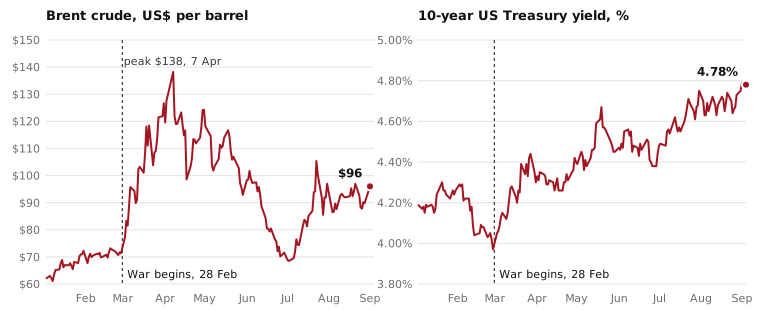
Put simply: every tanker the U.S. sinks pushes oil up, which pushes inflation up, which pushes the Fed up, which pushes the cost of America's own debt up.
Washington is bombing its own bond market.
The numbers nobody in the Situation Room is reading
Interest on the debt was $345 billion in 2020. It was $970 billion in 2025. This year it passes $1 trillion, nearly $87 billion every month.
The Congressional Budget Office expects it to reach $2.1 trillion a year by 2036, $16.2 trillion over the decade.
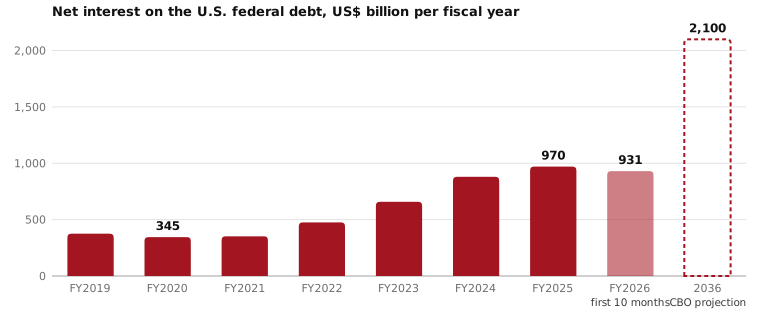
Those projections were made before oil hit $100. They assume yields drift down. They do not assume a Fed chair telling the world that inflation, not growth, is the problem, while the Navy sets fire to the world's oil supply.
Now compare. The Pentagon says the blockade cost Iran $4.8 billion in under three weeks. The U.S. Treasury pays more than that in interest every two days.
Who is really being squeezed here?
Exorbitant privilege, explained
To understand why this matters more for America than for anyone else, you need one idea from international economics.
In the 1960s a French finance minister called the dollar's role an "exorbitant privilege." The economist Barry Eichengreen made the phrase famous. The privilege is simple: because the world holds dollars and Treasuries as its savings, America can borrow at lower rates than anyone else and run deficits no other country could survive.
The same paper explains the catch, known as the Triffin dilemma: the country that issues the world's money must keep running deficits to supply it, and at some point those deficits start to undermine confidence in the money itself.
That is the line the United States is now approaching.
The privilege depends on one thing: trust that Treasuries are the safest asset on earth. When the 10-year yields nearly 4.8% and the 30-year more than 5.3% during a shooting war, the market is not saying "safe haven." It is saying "pay me more to hold this."
And it is not only America. Japan's 10-year is at 3% for the first time since 1996; British gilts are above 5.2%. The whole Western debt machine is being repriced at once, and the war in the Gulf is the match.
The copper signal
One more number from Tuesday's session that tells you where this is going. Copper hit a record $14,510 a ton.
Why? Because at the same time as the Gulf war, the White House is running a trade war with its own neighbour. New import bans and 50% tariffs on Canadian goods take effect on September 29.
War inflation plus tariff inflation plus $1 trillion in interest. The Fed cannot cut into that. So it hikes. And the debt gets more expensive again.
Gold, meanwhile, sits above $4,400 an ounce. Central banks are not buying gold because they love shiny metal. They are buying it because they are less sure than they used to be about the alternative.
The counter-argument: maybe Washington can afford this
Now let me argue against myself, because the case for the tanker strategy is not stupid.
First, America is a net energy exporter. At $100 oil, Texas and North Dakota make money. The pain of Hormuz lands mostly in Asia: 82% of the crude that passes through the strait goes to Asian markets, and China, India, Japan and South Korea take two-thirds of it. From this angle, a Gulf oil shock is a weapon against Beijing more than against Washington.
Second, a Fed hike can be read as a show of strength. Higher U.S. rates pull capital into dollars. In every past crisis the dollar rose, not fell. Trust in Treasuries has survived 2008, 2020 and 2023.
Third, Iran's position is far worse. The IAEA says it can no longer verify Iran's enriched uranium stockpile, the Security Council is deadlocked on whether sanctions even exist, and the Treasury added 36 more sanctions this week to ground Mahan Air. As intelligence briefings this morning noted, Washington is even studying how to strike Iran's deepest underground sites. Iran is losing tankers it cannot replace.
All of this is true. And none of it answers the central problem.
Because the 1988 lesson cuts both ways. Praying Mantis was cheap for a creditor nation at $15 oil. Today the same tactic is being used by a debtor nation with $40 trillion of obligations, at $100 oil, with its own central bank hiking against it. Iran can lose a tanker a day and still exist. America cannot lose the trust of the bond market and still be America.
Shale profits and a strong dollar are consolation prizes. The interest bill is the war.
The real front line
In 1956, when Britain and France went to war over the Suez Canal, it was not tanks that stopped them. It was the U.S. Treasury threatening to dump its sterling holdings. Money ended that war, and ended Britain as a great power, in a week.
Nobody holds that power over the United States today. Not China, not the Gulf, not Europe. But there is a slower version of the same weapon, and it is being fired now. It is called the yield curve.
Every basis point that the 10-year rises is a small vote of no confidence. Every rate hike forced by wartime oil makes the next trillion of debt more expensive. Every tanker fire in the Gulf of Oman makes the next Treasury auction harder.
I wish things never escalate. But the escalation is already happening, not only between American destroyers and Iranian missiles, but between American war policy and American solvency.
Iran is fighting for survival in the Strait of Hormuz. The United States is fighting for its exorbitant privilege on the bond market. And of the two, it is Washington that has more to lose.
In the end, this is not a war about tankers. It is a war about trust, and trust, once repriced, does not come back at the old rate.
Update, 14 September 2026. On 11 September Saudi Arabia shut the East–West pipeline, the only large route carrying oil past the Strait of Hormuz, after drones launched from Iraq struck its pump stations. Brent has since traded above $107 and the ten-year Treasury yield has reached 4.97%. The chain described above has tightened at every link: The Last Way Around Hormuz Is Closed.
Update, 22 September 2026: on the fiscal pressure that this war cost creates at the Trump-Xi summit, see Why China Will Get What It Wants From Trump.

Comments
No comments yet. Be the first.
Comments are closed on this article.