
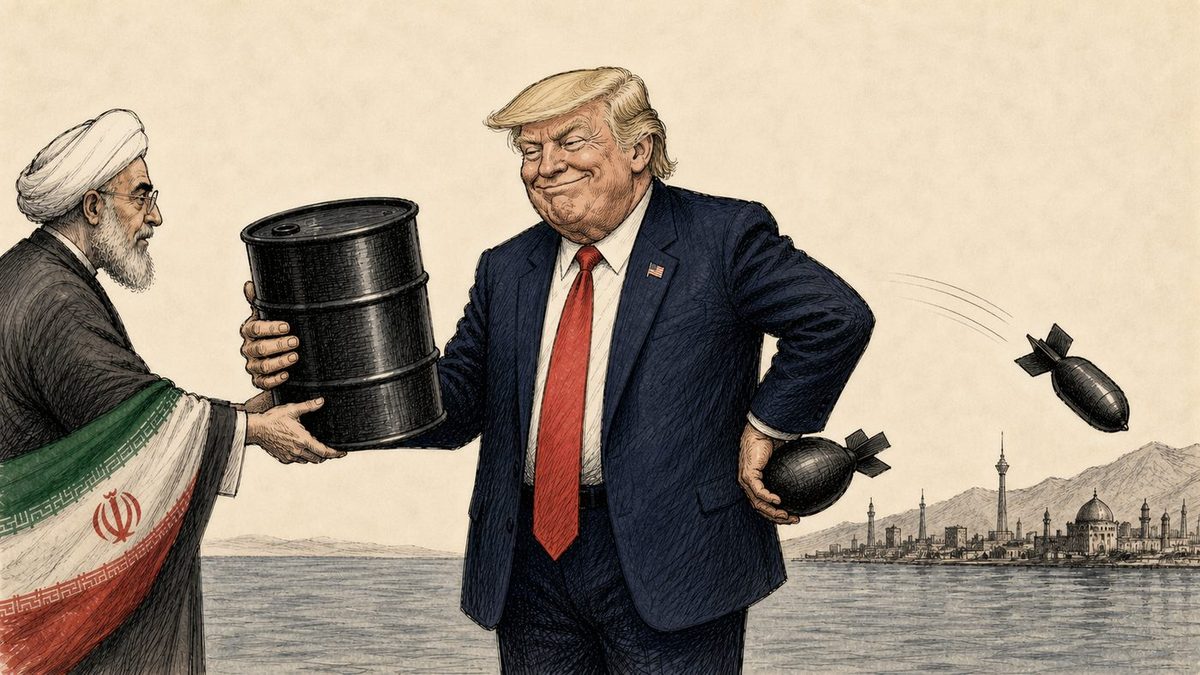
The United States is bombing Iran, intercepting its missiles, and showcasing and trying to maintain pressure on others to stop supporting the Iranian government
But at the same point in time between this
For one month this spring, the US government also allowed Iranian crude oil to enter American ports.
It was not smuggled or disguised through a chain of ship-to-ship transfers. It was legal: authorised in writing by the US Treasury.
But the permission is in a technical document that almost nobody outside specialist law firms seems to have read.
That matters because it complicates the simple story of this war:
America bombs Iran on one side, and economically isolates it on the other.
Over the weekend of 30 August, American forces struck two Iranian rocket launchers on Larak Island that were scattering sea mines in the Gulf. Iran’s Revolutionary Guards fired back at air bases in Jordan and the UAE; Jordan says it intercepted eight incoming missiles.
That same weekend, Treasury Secretary Scott Bessent said the US would begin imposing new secondary sanctions every week, beginning with banks.
The thing which is hidden from you is
Five months earlier, on 20 March 2026, the United States Treasury issued a document called General License U. In plain English, it authorised the sale and delivery of Iranian crude oil — and, explicitly, “the importation of Iranian-origin crude oil or petroleum products into the United States.”
Iranian oil. Into America. For the first time in decades. During a shooting war with Iran.
140 million barrels, and a month to sell them
The licence ran for exactly thirty days, from 20 March to 19 April.
It covered oil already loaded onto ships before the deadline — roughly 140 million barrels of sanctioned Iranian crude floating at sea, according to the Foundation for Defence of Democracies.
And read what else it authorised, because this is the part that matters more than the oil: bunkering, crewing, vessel management, insurance, classification, salvage and port services.
Not just the cargo. The ships. The insurers. The classification societies. The whole machinery that makes a tanker legitimate rather than a floating liability.
For thirty days, the entire service stack of the sanctions-evasion economy was legal.
Max Meizlish of the FDD wrote the sharpest line about it: “GL U is meant to fight a different battle — a battle for the market.” He noted the licence carried no reporting requirement on who bought the oil or who sold it, and no escrow mechanism of the kind attached to the Venezuelan licences.
Bessent’s argument was that Iran “will have difficulty accessing any revenue generated.” Perhaps. But the barrels moved, the ships got paid, and the insurers wrote the cover.
For four years, the assumption behind every sanctions package has been that the traffic runs one way. You sanction a ship, it leaves the legitimate market, it joins the shadow fleet, and it never comes back. A one-way door into an underworld.
In 2026, the door started swinging the other way.
Lloyd’s List has been tracking vessels that spent years in the shadow trade and are now quietly moving back into compliant business. One tanker, the Skage, returned to the Caribbean in early February after Washington changed its Venezuela policy.
The explanation given is worth reading twice: “Geopolitical turmoil has rapidly reshaped the risk landscape in critical energy markets, creating the opportunity for risk-tolerant shadow fleet tankers to revert to compliant trades.”
Translate that. The ships did not reform. The ships did not get caught. The legitimate market simply started selling the same barrels they had been smuggling, so they went and did the legal version of their existing job.
Washington issued a coordinated run of general licences across all three of its sanctioned oil producers in the space of eight weeks.
Venezuela: GL 52 on 18 March, then 51A, 54 and 55 on 27 March, then 56 and 57 in April, then 58 in May, covering everything from crude lifting to gold to restructuring $60 billion of defaulted debt. Iran: GL U. Russia: GL 134B and 134C, keeping cargoes loaded before 17 April moving.
On 1 April, Venezuela’s acting president, Delcy Rodríguez, was removed from the US sanctions list entirely.
The official framing was that all of this “preserves the underlying sanctions architecture.”
It does. The architecture is fully intact. It just has a tap on it now, and the tap is turned by the month.
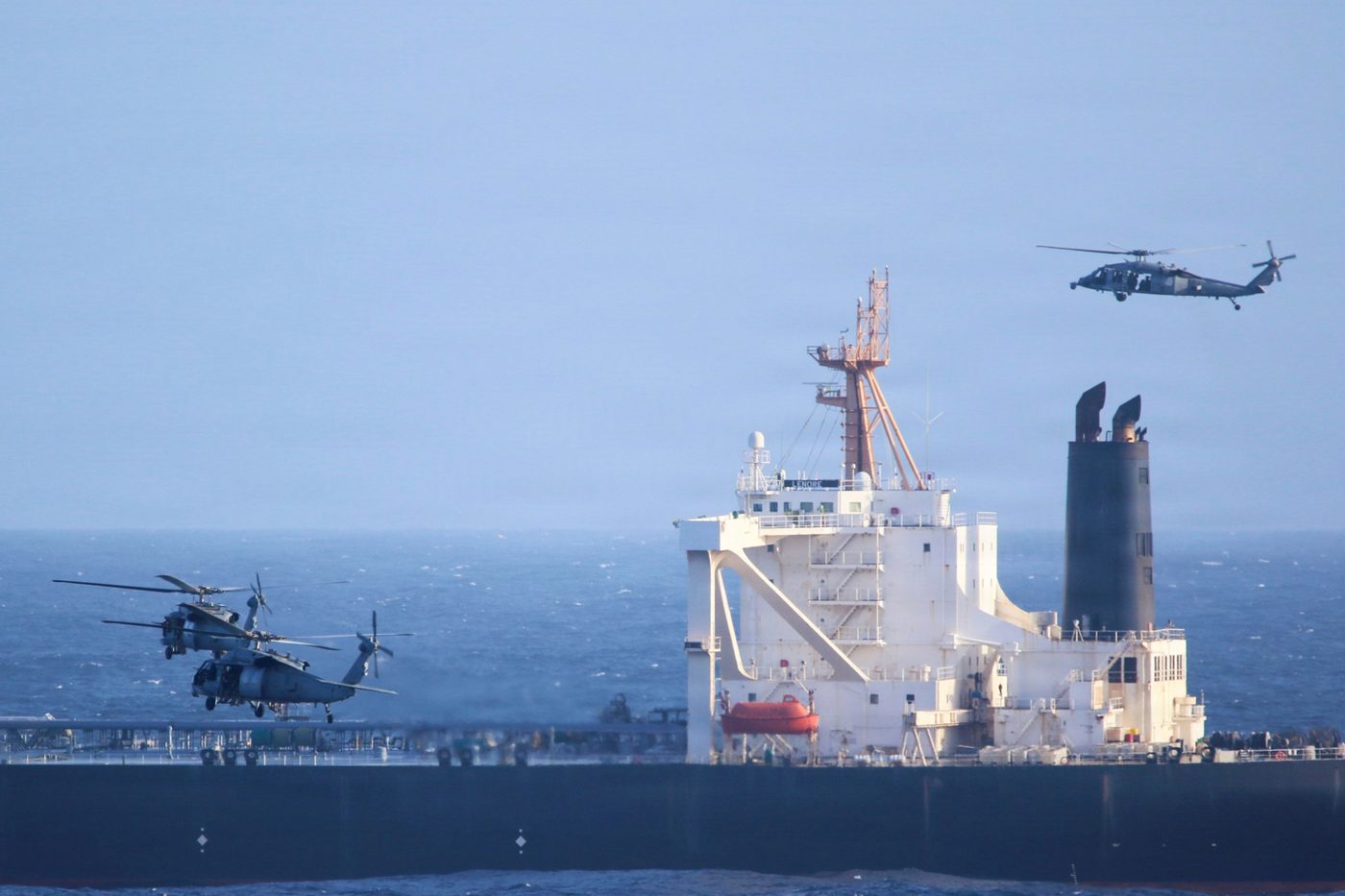
What the shadow fleet actually is
A fleet that did not exist five years ago now moves a fifth of the world’s oil
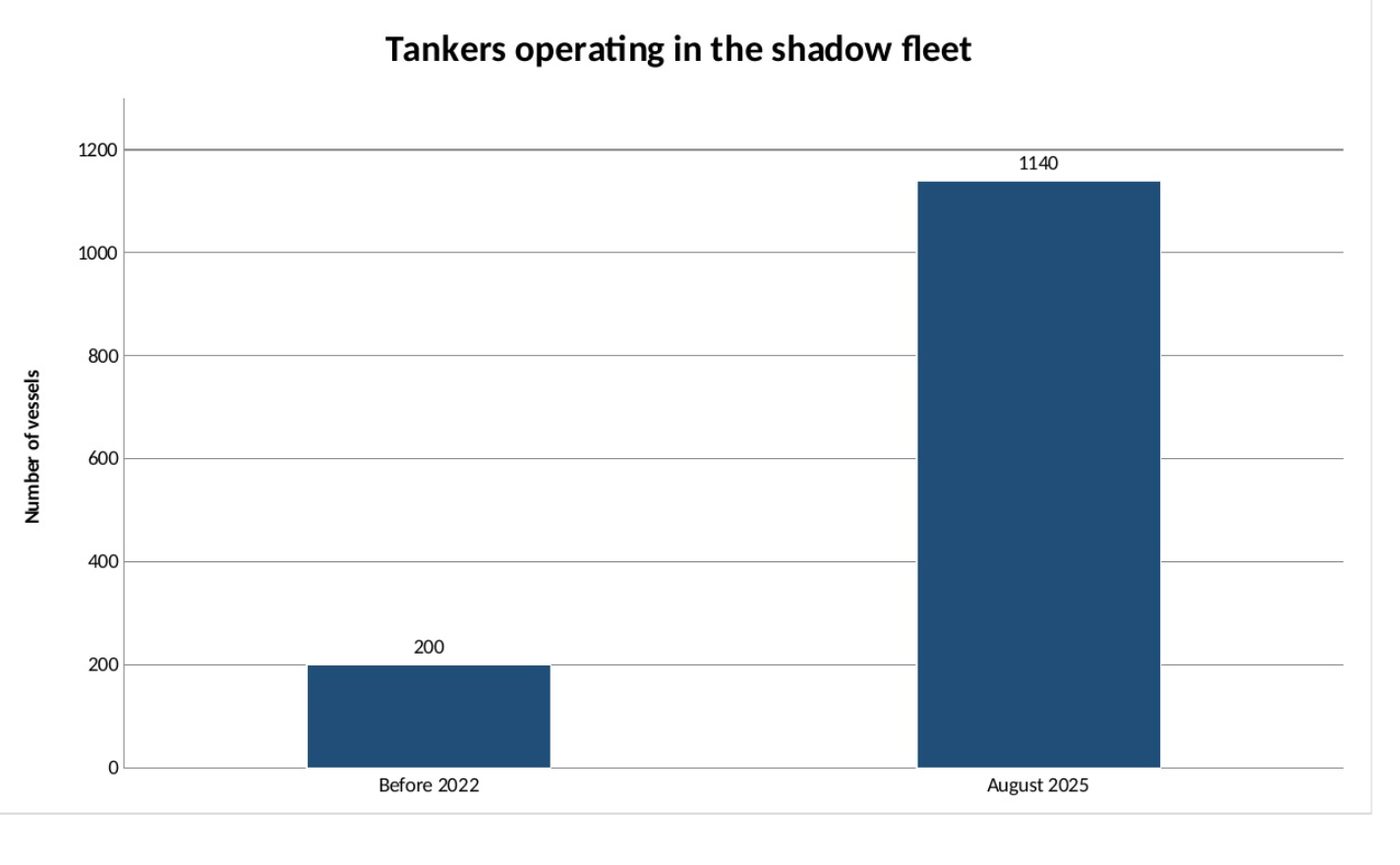
Before 2022, roughly 200 tankers operated outside the normal system of flags, insurance and traceable ownership. A rounding error.
By August 2025 there were 1,140 shadow oil tankers — more than 18 per cent of the entire global tanker fleet, according to Elisabeth Braw’s research for the Atlantic Council.
Nearly one tanker in five.
By February 2026, more than 500 ships were sailing with no valid flag registration at all. Not a fake flag. No flag. Stateless vessels carrying crude across the world’s shipping lanes, with no state responsible for inspecting them and no insurer standing behind them if something goes wrong.
Something already has. On Christmas Day 2024, the Eagle S dragged its anchor across the Gulf of Finland and struck five undersea cables. The repair bill for the EstLink 2 interconnector alone came to around €60 million. A modelling exercise in February 2026 estimated the effect of a 48,000-tonne Urals crude spill in the Baltic over thirty days and used the word “devastating.”
And now the number that explains everything
The enforcement rate, in one picture. Denmark is not careless — its waters are among the most closely watched on earth.
Therefore, Denmark watched 292 sanctioned tankers sail past. It stopped at five.
Sanctioned-vessel transits through Danish waters in 2025, against the number of vessels actually detained.
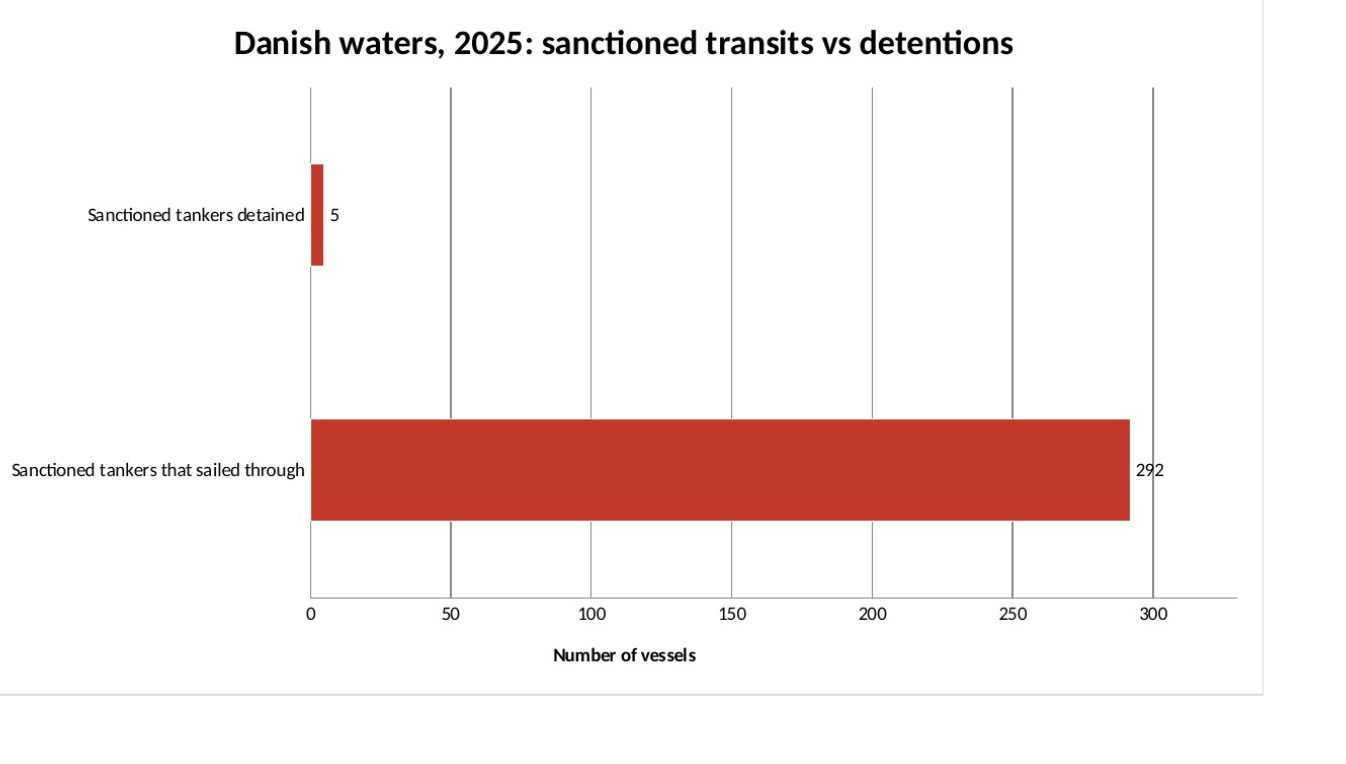
That is the enforcement rate. About 1.7 per cent. Not because Denmark is careless — Danish waters are among the most closely watched on earth, and the Danes have been among the loudest voices demanding action. It is because stopping a ship at sea is legally fraught, physically dangerous, and increasingly likely to be met by a Russian naval escort.
The pattern repeats everywhere. Estonia sent out more than 500 insurance verification requests in April 2025.
Britain checked over 600 suspected shadow vessels in January 2026. Checked. Requested. Verified.
Roughly 400 ships now carry sanctions from the EU, UK, US and Canada combined, and around 600 sit on EU port-access ban lists.
They keep sailing. There are more of them than there are ways to stop them.
Six hundred ships in one traffic jam
Which brings us back to the Gulf this week.
More than 600 cargo vessels are currently stuck in the Middle East Gulf, unable to move because of the war. Of those, 325 are tankers. Of the tankers, 154 are laden with cargo. Forty-three are sanctioned. Eighty-one are in the shadow fleet.
Sit with that composition for a moment.
The sanctioned ships, the shadow ships and the entirely legitimate ships are stuck in the same water, in the same queue, waiting for the same mines to be cleared by the same navies. Nobody is sorting them. Nobody can.
Clearing the backlog will take weeks, even if the shooting stops tomorrow.
The counter-argument: sanctions are working
There is a serious case on the other side, and it comes from the people with the most at stake.
On 12 August 2026, Vladyslav Vlasiuk, Ukraine’s presidential commissioner for sanctions policy, said that of roughly 700 vessels sanctioned for carrying Russian oil, about half have stopped.
Half. Three hundred and fifty ships were taken out of the trade. That is not nothing — that is one of the largest disruptions of a commercial fleet in peacetime history, and the operators who remain can now do business in only a handful of jurisdictions.
The FDD critique cuts the same way from the opposite direction. Their objection to General License U is not that sanctions are futile. It is that they work, which is exactly why suspending them for thirty days without reporting requirements hands the target real leverage that Washington “may not soon recover.”
Both of those are fair. Sanctions clearly bite. The shadow fleet exists precisely because they bite — you do not build 1,140 ghost tankers to evade a policy that does nothing.
But notice what neither argument disturbs. Half of a sanctioned fleet stopped. The other half did not, and no coastal state has found a way to make it. And the moment Washington needed barrels on the water because the Strait of Hormuz was mined, the distinction between the compliant and the non-compliant fleet was suspended by memorandum.
A fleet is not a category. It is a status.
The mistake in almost all the coverage is treating the shadow fleet as a place, a criminal underworld that ships fall into and stay in.
It is not a place. It is a status, and it is reversible, and the switch is in US.
A tanker becomes a shadow vessel when carrying a particular barrel is illegal. It becomes a normal vessel again when a general licence makes that barrel legal, or when the sanctioned producer’s oil is suddenly needed on the market. Same hull, same crew, same owner, same registry games. Different month.
Which means the number that everyone quotes — 1,140 ships, 18 per cent of the world fleet — is not really a measure of criminality.
It is a measure of how much of the world’s oil trade is currently illegal. Change what is illegal, and the number moves without a single ship changing hands.
Elisabeth Braw calls the shadow fleet “the most pronounced example of the breakdown of the rules-based international order.” I would put it slightly differently, and less comfortably.
The fleet is not evidence that the rules broke down. It is evidence of what the rules were always resting on: the assumption that the country writing them would keep wanting them enforced.
Take that away for thirty days, because oil is short and a strait is mined and an election is coming — and a fifth of the world’s tankers turn out to have been waiting for permission all along.
They did not need to be caught. They needed a market. the US just shows it’s self intrest and gave them one, in writing, and called it preserving the architecture.
The oil moved. The ships got insured. The bombing continued.
Nobody had to break a single rule.

Comments
No comments yet. Be the first.
Comments are closed on this article.