
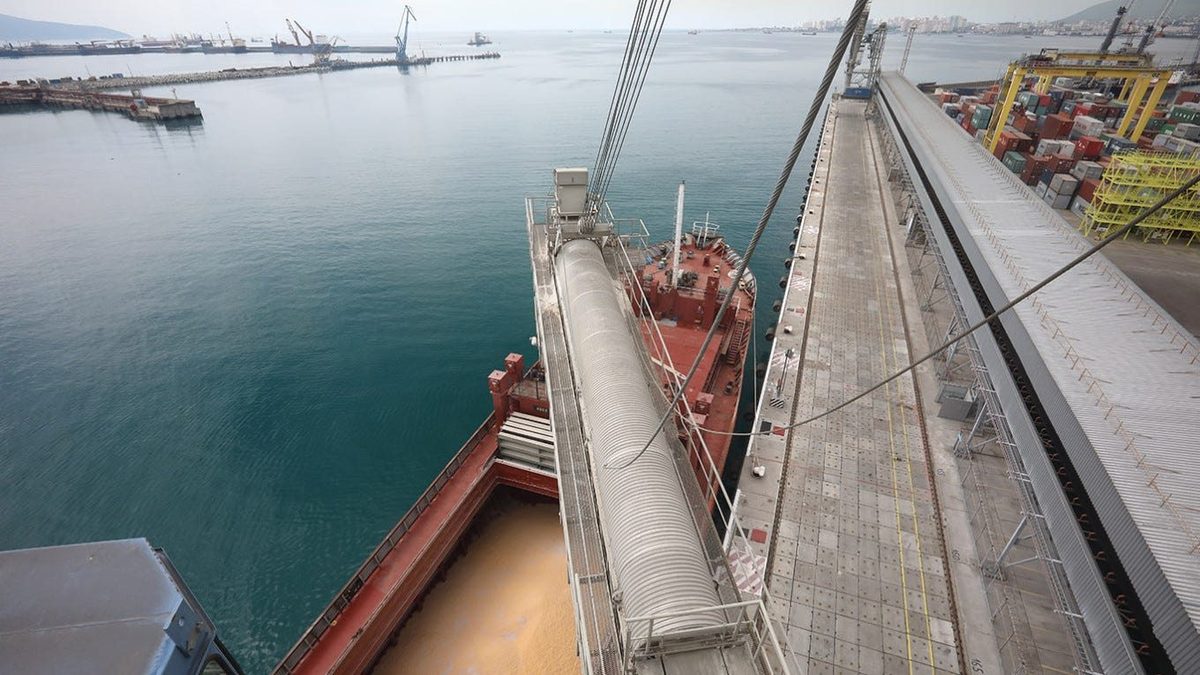
On Monday the Kremlin held a press briefing to reassure the world about food.
“Measures have been identified and will be further developed, ensuring that all grain intended for export is shipped on time and in full.”Dmitry Peskov, Kremlin spokesman, 24 August 2026
Major agencies in the world are saying the same thing.
The World Bank, in its April Commodity Markets Outlook, projects the fertilizer price index to rise more than 30% in 2026, with urea up nearly 60%, and warns that risks are tilted upward if Hormuz disruption runs past the third quarter. It has.
The FAO reported its food price index at 131.1 points in July, a three-year high, with wheat up 5.8%, and now names El Niño in its monthly release. Its chief economist, Máximo Torero, told Reuters this month that food prices will rise by year-end and rise further next year.
JPMorgan, in a report titled Food Security Is National Security: A Compounding Storm, expects global food inflation to accelerate from 2.8 percent in the first half of 2026 to 5% in the first half of 2027, and calls it “not a short-lived shock.”
It's estimated that this year’s energy shock roughly doubles the inflationary impact of a super El Niño — about 1.5 percentage points on global food CPI against a historical 0.7.
The Biggest El Niño Since 1877 Could Hit Harder
This time, we have 18 months’ warning — and still no plan.
None of these is an activist organisation. All three are forecasting the same thing on the same timeline.
To see why, you have to follow the supply chain backwards.
First, the Trump war on Iran takes a quarter of the world's area within it.
The Strait of Hormuz carries roughly a third of global fertiliser shipments and 24% of the world’s ammonia.
Behind that blockade, the plants stopped. The World Bank recorded that Iran halted ammonia production, Qatar suspended urea, ammonia and sulfur output after damage to key facilities, and India cut its own urea and ammonia production because it could not get the gas.
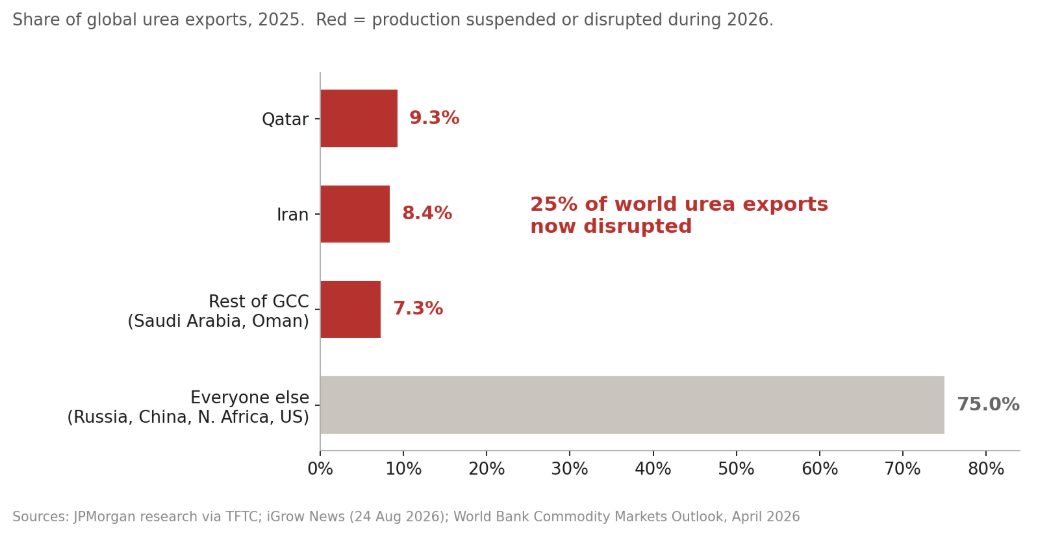
Qatar and Iran alone accounted for 9.3% and 8.4% of global urea exports in 2025. Add the rest of the GCC and roughly a quarter of the world’s nitrogen trade is behind the blockade.
This is where an energy war became an agricultural one — not through diesel or freight, but through the chemistry itself. Ammonia is made from natural gas. No gas, no nitrogen. No nitrogen, no yield.
The countries that grow the food don’t make the inputs
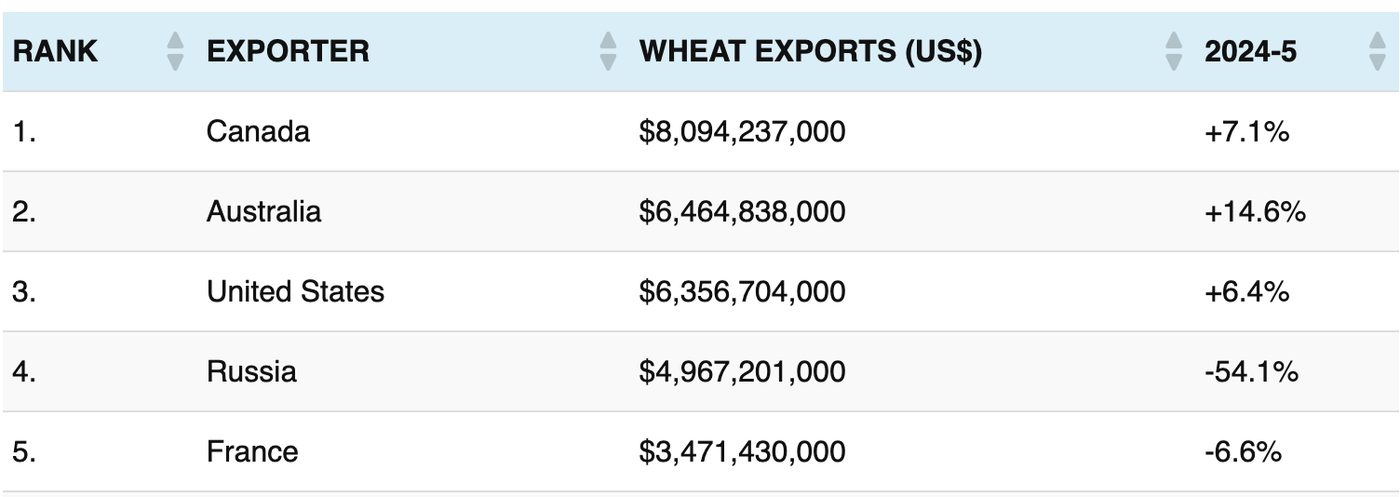
Global food trade is not a broad market. Five countries — Russia, Canada, Australia, the United States and France — account for roughly three-fifths of world wheat exports.
Brazil is the largest exporter of soybeans, maize, coffee, sugar and beef. About eight countries grow a surplus; roughly a hundred and fifty buy it.
Now look at what those exporters actually control.
Brazil consumed about 49 million tonnes of fertilizer in 2025, of which 43.3 million tonnes were imported against domestic production of roughly 7 million. Even phosphate, its strongest nutrient, runs at 72 percent imported.
India is the world’s second-largest fertilizer consumer and second-largest importer, taking around 15 percent of all globally traded fertilizer, with imports set to exceed 41 percent of consumption this fiscal year.
The United States looks comfortable on nitrogen — 13 percent imported — but buys 95 percent of its potash abroad, 79 percent from Canada and 12 percent from Russia.
The world’s breadbaskets are, in input terms, colonies.
India escaped the war zone, straight into the next wall
India did what a competent state should. Two-thirds of its urea came through Hormuz in 2024–25.
Within a year, New Delhi cut hard: the Gulf share of Indian urea imports fell from 75% to 38%.
The replacement came from China and Russia, whose combined share rose to nearly 40%. China’s share went from 1.5% to 20% in a single year.
Then China itself closed the export of Urea.
Now the country which need most area in the world with the most population has only one option- Russia
And things did not stop here.
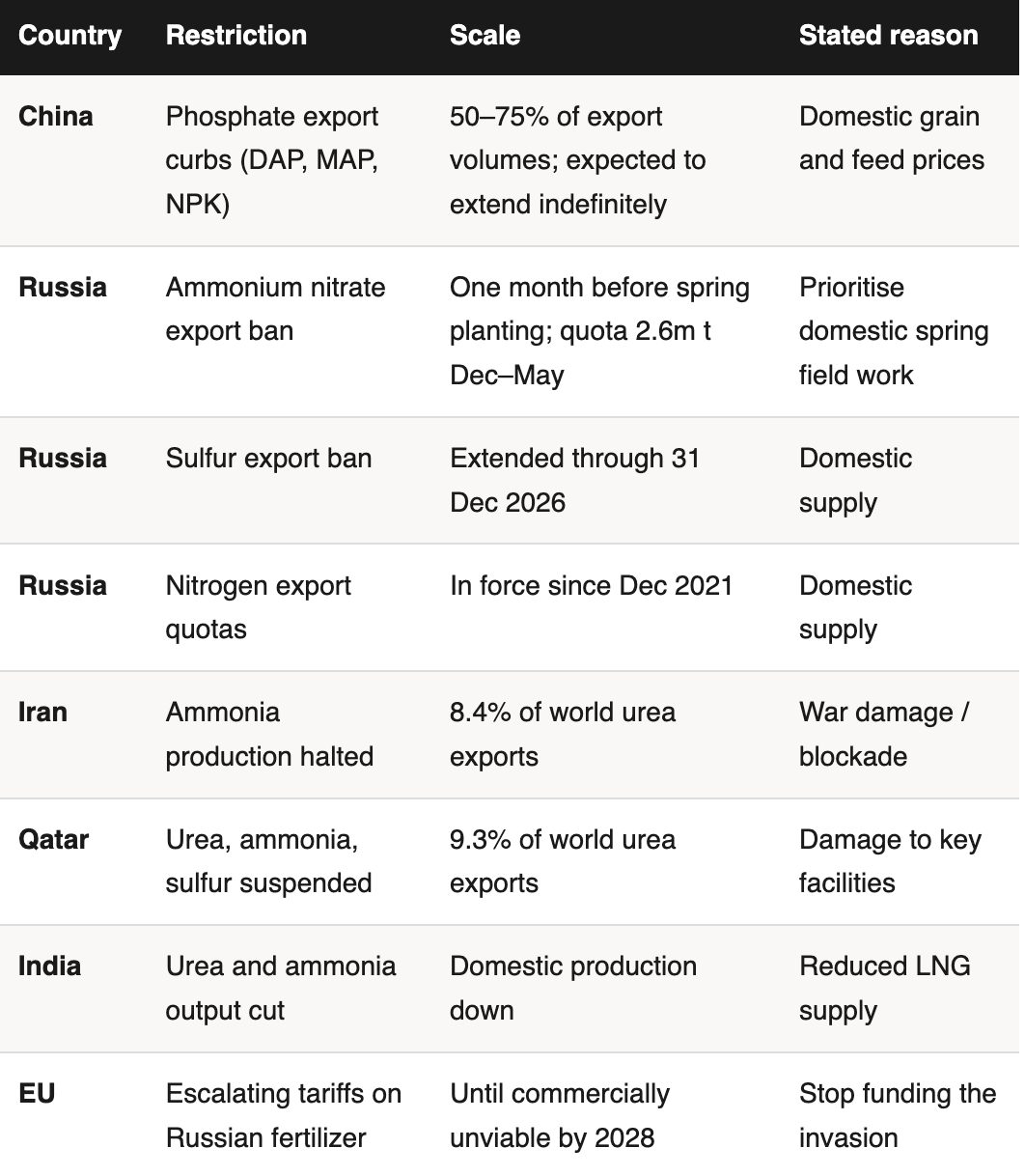
And the chains start expanding in each country as it starts protecting its own people, their own farmers, and gradually restricts the export to meet the domestic demand.
It has also, unlike anyone else, been stockpiling food, fertiliser, energy and industrial metals for years, while Western states drew down oil reserves and built no fertiliser buffer at all. There is a strategic petroleum reserve. There is no strategic urea reserve anywhere on earth.
Why do people still misunderstand urea?
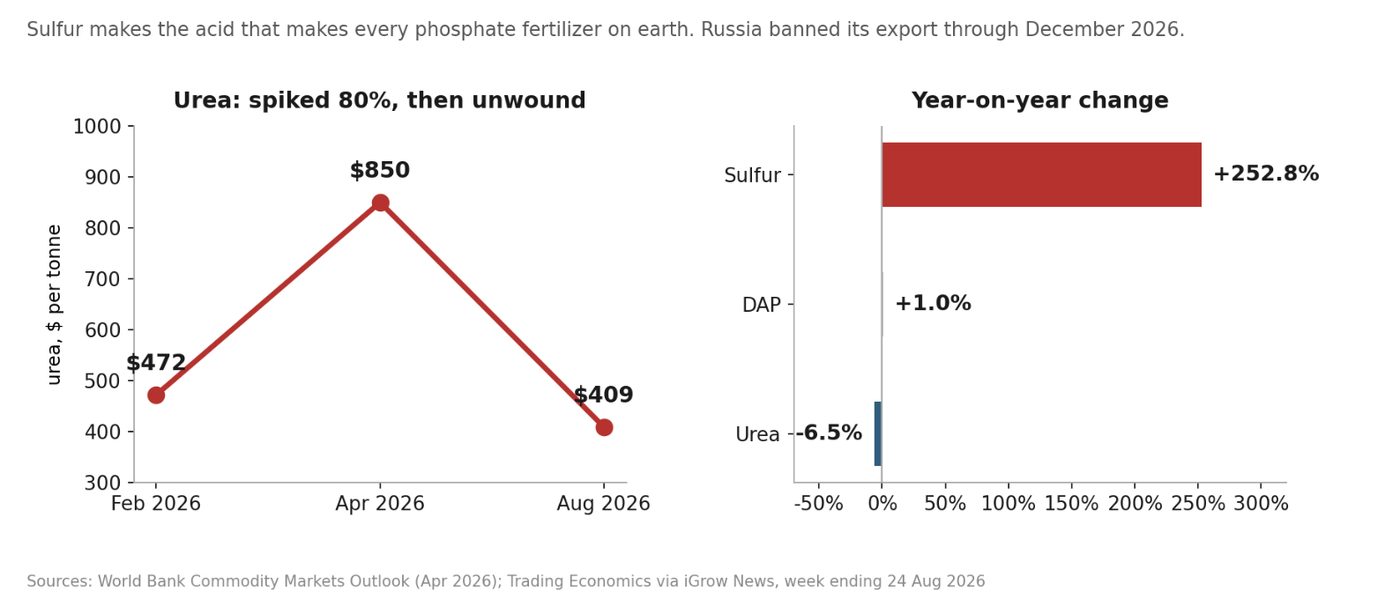
Urea trades at $409 a tonne, down 6.51% ear on year. On that number, the crisis is over.
Sulfur is up 252.82%.
Looking at this chart, you might think the crisis is over, and prices have returned toward normal. But that is an illusion.
The war is still ongoing, and fertiliser plants across the Middle East face severe disruption.
Supply chains are broken, oil prices remain high, and natural gas stockpiles in major agricultural nations are depleted, severely restricting fertiliser production. Combined with shifting El Niño weather patterns, the compounding shock will hit harder than ever.
India, one of the world's largest producers of food, is already in crisis.
India’s fertiliser subsidy bill has reached Rs 1.7 trillion — about $15.6 billion — and its agricultural growth is projected to slow to 2.4% this fiscal year from 4.2%, with international fertiliser prices up 46% between December and April and Indian firms booking phosphate 40% above pre-war levels.
Now the major question is how this problem would be solved and who is going to bear the burden, because the coming time would not be easy.
Which leaves exactly one country
The Gulf is blockaded. China is closed by policy and stockpiling. India is a net importer.
Morocco is phosphate, not nitrogen, and has pulled maintenance forward. Europe cannot — its own gas costs make it the world’s highest-cost producer. The United States barely produces enough to meet its own needs and imports almost all its potash.
That leaves Russia, and the numbers are not close.
Russia is the world’s largest exporter of nitrogen fertiliser. It produces a quarter of the world’s ammonium nitrate.
It supplies over a fifth of global potash, more than a quarter of EU nitrogen imports, 12% of American potash, and a rising share of India’s urea.
In the recent visit of the Indian Foreign Minister to Russia, S. Jayshankar, Putin assured India that their agricultural need would be met by Russia
Russia sits on some of the cheapest stranded natural gas on the planet — the one input everyone else is short of.
And it is simultaneously the world’s largest wheat exporter, selling to Egypt, Turkey, Sudan and Kenya: precisely the countries least able to absorb a price shock.
Russia occupies both ends of the food chain at once. It sells the grain that import-dependent countries eat, and the chemicals everyone else needs to grow their own. No other state is positioned that way.
That is what makes it the last resort. by— arithmetic.
What “Russia saves the world” would actually require
because I am saying Russia could solve this is not the same as saying it will.
Four things would have to happen, and they are not equally plausible.
1. Russia would have to lift its own restrictions. It is not currently behaving like a supplier of last resort. It banned ammonium nitrate exports in March, with the Agriculture Ministry explaining:
“Suspending shipments of nitrogen fertilizers abroad amid rising export demand will allow us to prioritize the domestic market during spring field work and ensure its uninterrupted progress.”*— *Russian Ministry of Agriculture, 24 March 2026
Quotas have been in force since December 2021, and the sulfur ban runs to December.
Moscow controls this lever entirely and is currently pulling it the wrong way.
2. The plants would have to stop burning. A drone strike hit Acron’s Dorogobuzh plant in Smolensk region, killing at least seven people and halting a facility responsible for about 11% of Russia’s ammonium nitrate output.
Nevinnomyssk Azot, a million tonnes of ammonia a year, burned in May. KuybyshevAzot has been struck repeatedly. Output is down 9% year on year, with ammonia down 7.5%.
This will not stop, and it should not be expected to. Ammonium nitrate is an explosive precursor. A state fighting for its survival owes the global fertiliser market nothing.
So the continuous Ukrainian strikes on Russian refineries, chemical plants, and logistical hubs make a supply recovery theoretically possible, but practically unrealistic at the same time.
Why you will not see this coming
Because agriculture runs eighteen months behind the news.
The World Bank was explicit about why 2026 prices did not spike like 2022’s. Its decisive reason: growers in the Northern Hemisphere had already secured much of their fertiliser supply.
They had already bought it — before the strait closed, before the plants burned, before China shut.
This year’s harvest was purchased under last year’s conditions. The buying season for the 2027 crop is happening right now, into all of the above, with El Niño forecast to land on the same harvest.
Properly used, the word tragedy does not describe a story where a villain does something wicked. It describes one where every character honours a legitimate obligation, and the result is ruin anyway.
Iran imposes costs on a power blockading it, and a quarter of the world's urea supply goes offline. Ukraine fights for survival, and a quarter of the world's ammonium nitrate capacity burns. Moscow answers to Russian farmers, so exports stop before spring planting. Beijing answers to Chinese food security, so the phosphate stays home. Brussels refuses to fund an invasion, so it taxes the cheapest fertiliser its own farmers buy.
Five governments. Five defensible decisions. One outcome.
The only producer capable of absorbing the shock is simultaneously on fire and closed for business, during the buying season that sets the 2027 harvest, and the bill will be paid by a maize farmer in Nigeria, a bakery in Cairo buying Russian wheat, and a household in Dhaka, eighteen months later, when nobody is still connecting the two.
There is no villain here to stop.
That is exactly the problem. Wars end when somebody wins. This does not end at all, because nothing in it is anyone’s fault.
Comments
No comments yet. Be the first.
Comments are closed on this article.