
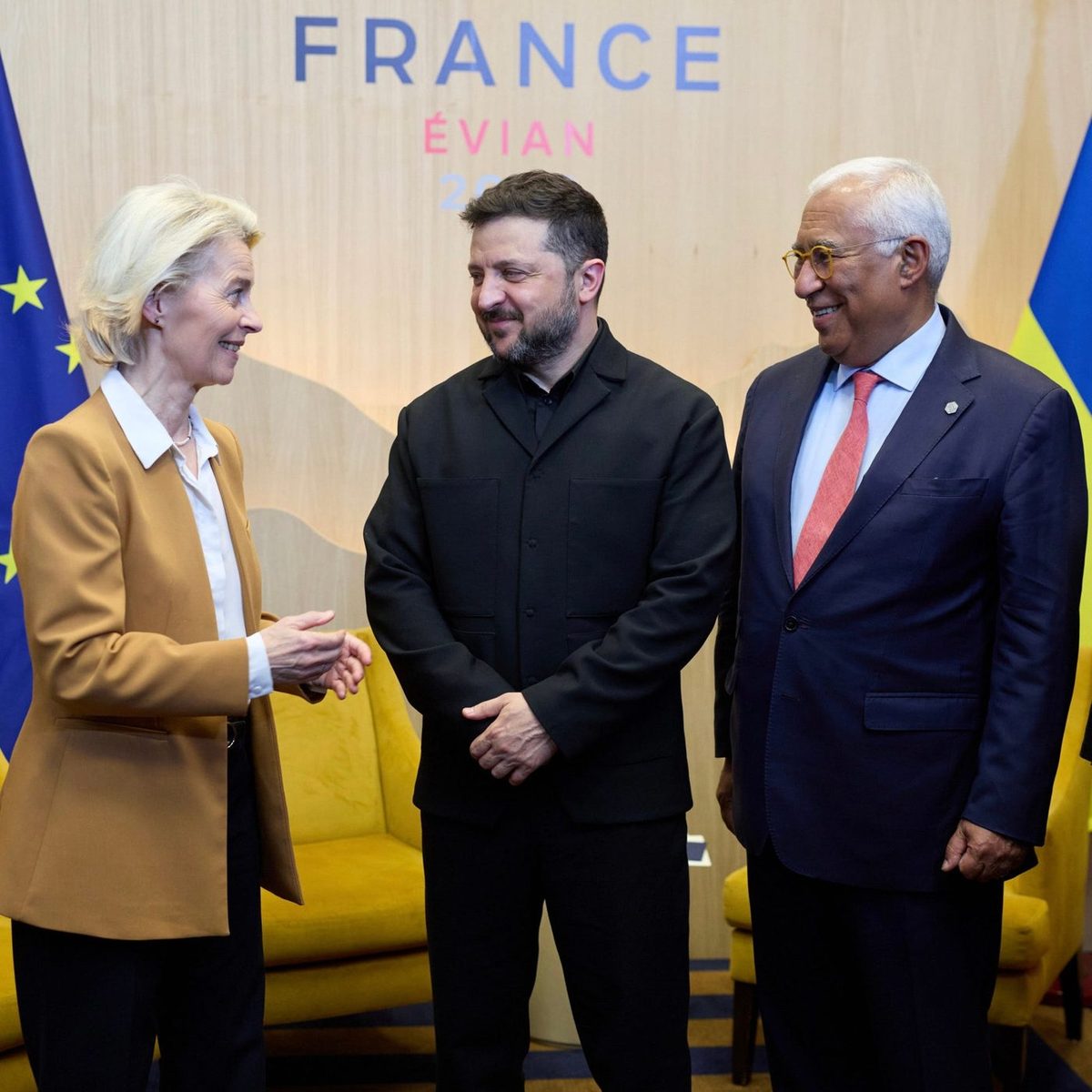
This week, the Ukraine Recovery Conference wrapped up in Gdańsk, Poland. Five thousand participants from 70 countries. 160 deals worth €10 billion signed.
The EU handed over the first €3.2 billion tranche of its massive new loan package. Ukrainian Prime Minister Denys Shmyhal called it “great news.” German Chancellor Friedrich Merz said private capital would also be needed.
European Commission President said the future was bright.
But here’s what nobody on that stage said out loud:
Europe is broke.
Not “struggling.” Not “tightening its belt.” Broke. The continent is trying to fund three things simultaneously: Ukraine’s survival, its own rearmament, and its collapsing welfare state and the math doesn’t add up.
The IMF has already said so. The European Commission’s own forecasts say so. The bond markets are starting to say so.
And yet, every few months, Brussels announces another multi-billion-euro package for Ukraine as if the money grows on trees in the Berlaymont building.
So let’s look at where it’s actually coming from, how much has actually been given, and why Europe is approaching a fiscal cliff that nobody wants to talk about.
The Bill So Far: €204 Billion and Counting
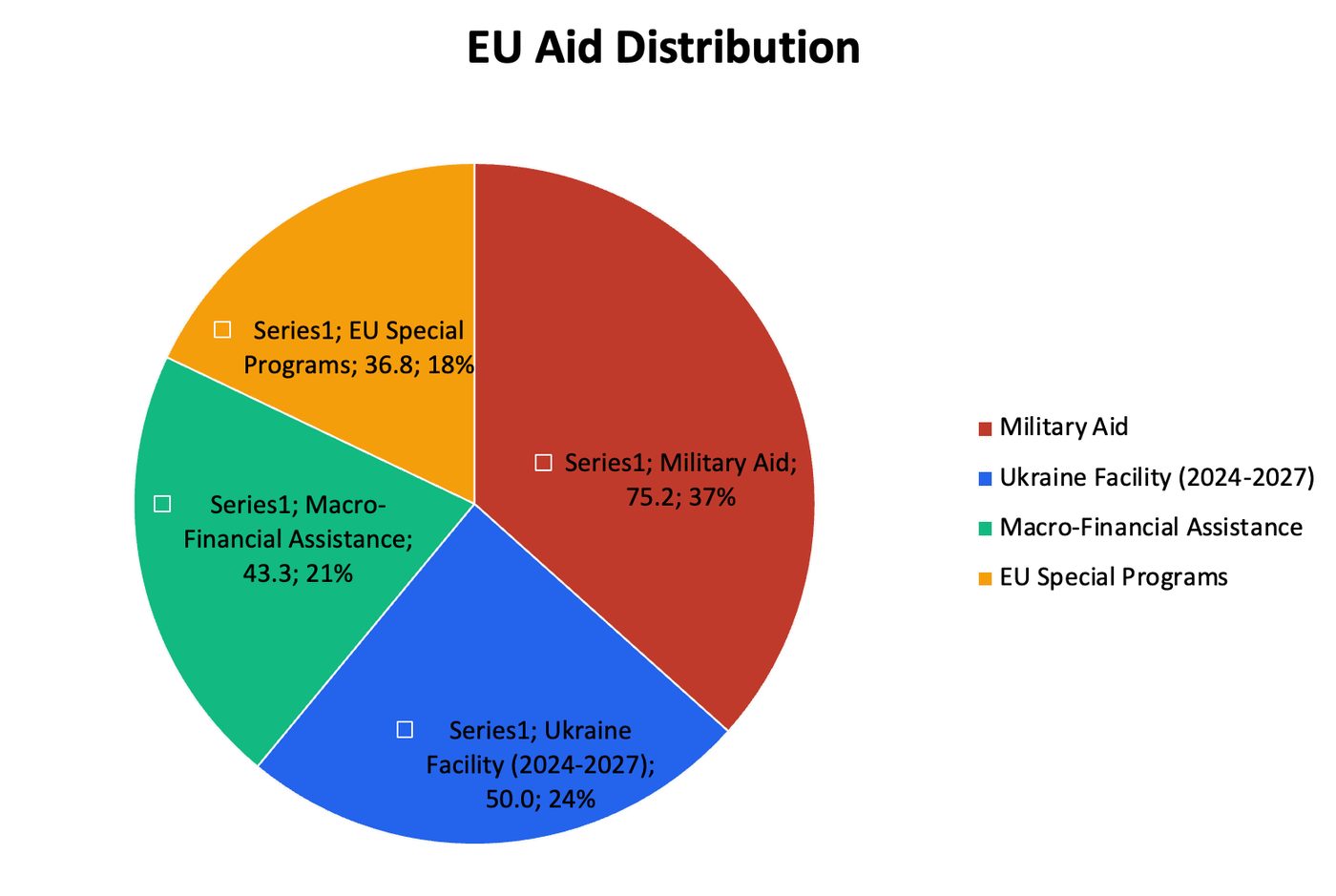
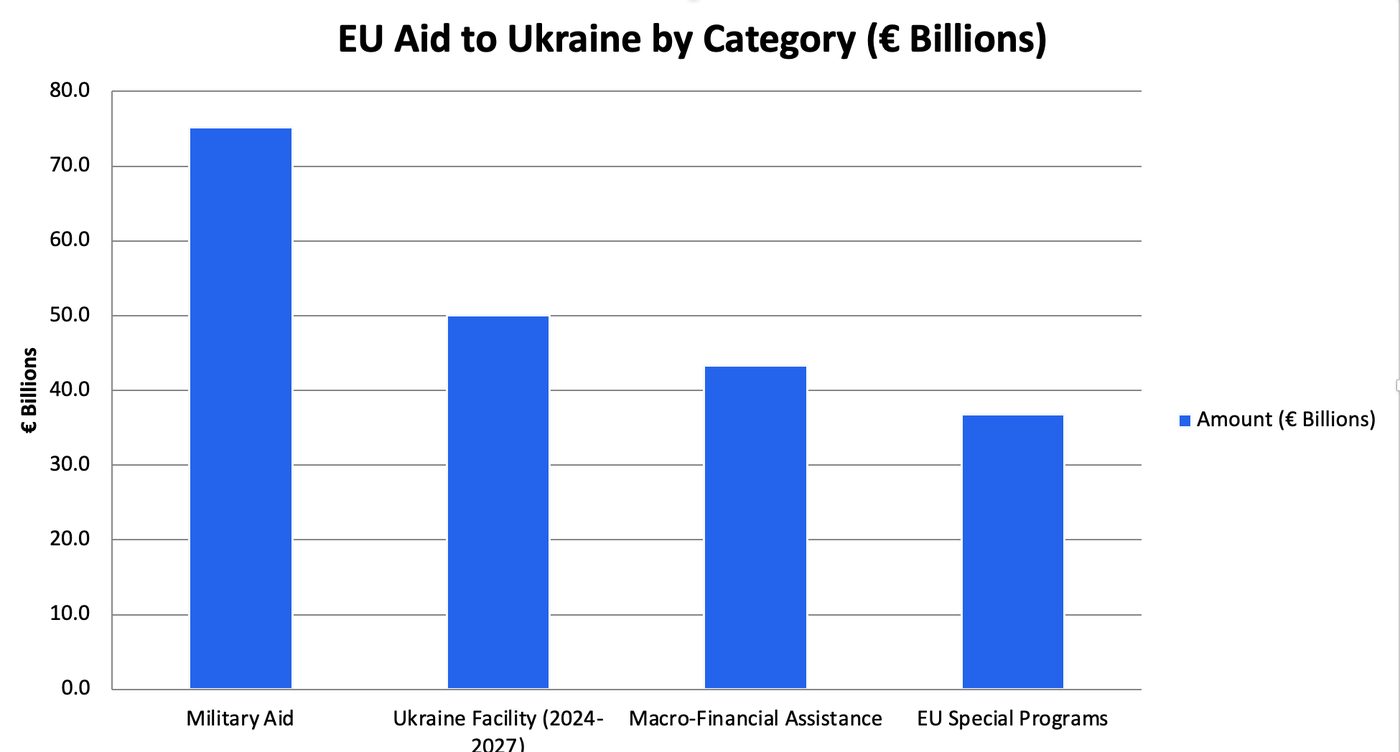
Let’s start with the raw numbers. According to the Kiel Institute’s Ukraine Support Tracker and the European Council’s own figures, the European Union and its member states have committed approximately €204.8 billion in total assistance to Ukraine between February 2022 and mid-2026.
That includes military aid, macro-financial assistance, humanitarian support, refugee costs, and the proceeds from frozen Russian assets. Europe has now overtaken the United States as Ukraine’s primary backer — allocating more than €200 billion compared to roughly €115 billion from Washington.
And now, on top of all that, the EU approved a €90 billion loan in April 2026 — €30 billion for economic support, €60 billion for military assistance — to cover 2026 and 2027. The Gdańsk conference added another €10 billion in signed deals on top of that.
Here’s the question nobody asked at Gdańsk: Where is this money coming from?
From Countries That Are Already Drowning in Debt
The EU’s fiscal situation right now is, to put it diplomatically, terrible.
The eurozone’s average debt-to-GDP ratio stands at 88% and is climbing — forecast to hit 89.8% by the end of 2026. The EU’s own fiscal rules say debt shouldn’t exceed 60% of GDP. Almost nobody meets that target.
let’s look at how the biggest EU economies actually look like:
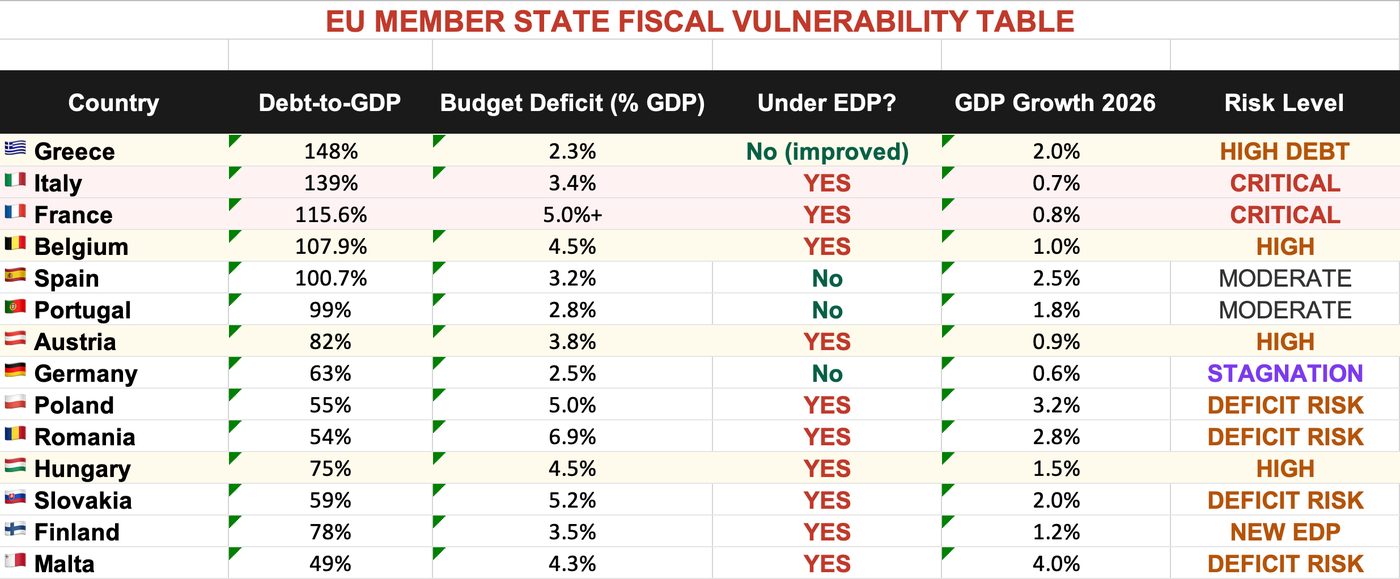
Read that table carefully. France — the EU’s second-largest economy — has a deficit that exceeds 5% of GDP, nearly double the EU’s 3% limit. French government bond yields have risen sharply, at times surpassing those of Italy and Greece.
Is France too big to fail, or too big to save?
Germany, which has historically been Europe’s fiscal anchor, grew by 0.6% in 2026 after two consecutive years of recession.
Exports have contracted for three straight years. The country that’s supposed to bankroll Europe’s Ukraine commitments can barely bankroll itself.
And ten EU member states are currently under Excessive Deficit Procedures — formal disciplinary processes for violating fiscal rules. France, Italy, Belgium, Poland, Romania, Slovakia, Malta, Hungary, Finland, and Austria. That’s not a fringe problem. That’s most of Europe’s major economies.
The IMF Already Said the Quiet Part Out Loud
In November 2025, the International Monetary Fund published a report with a title that should have been a wake-up call for every European finance minister: “How Can Europe Pay for Things It Cannot Afford?”
The answer, according to the IMF, is devastating: it probably can’t.
IMF
International Monetary Fund
November 2025 Report
“Unless Europe acts decisively to lift growth to a higher level, traditional fiscal consolidation measures will not be enough to prevent debt levels from becoming explosive, putting Europe’s social model at risk.”
The numbers in the IMF report are terrifying. Under current policies, the average debt ratio across European countries would reach 130% of GDP by 2040.
Additional spending on defence, pensions, healthcare, and energy security is estimated at 4.5% of GDP over the next 15 years. The required deficit reduction to stabilise debt would be almost 1% of GDP per year for five consecutive years, which, as the IMF notes, “far exceeds what past European consolidation efforts have achieved.”
In plain English:
Europe needs to cut spending by more than it has ever managed to cut spending. While simultaneously increasing spending on defence, Ukraine, healthcare, pensions, and climate. At the same time.
The European Commission’s Spring 2026 forecast paints a grim picture. EU GDP growth has been cut to 1.1% — down from 1.4% projected just six months ago. Inflation has jumped to 3%, driven by the Middle East energy shock. Consumer confidence is falling. Private investment is weakening. Precautionary saving is rising.
These aren’t the economic conditions of a continent that can afford to write €90 billion checks. These are the economic conditions of a continent that’s one recession away from a debt crisis.
The €588 Billion Nobody Wants to Talk About
Now for the number that should terrify everyone at the Gdańsk conference.
World Bank Estimate: Total Ukraine Reconstruction Cost
€588B
Over the next decade, and rising 12% per year as the war continues. Only €20B of this has been addressed so far.
In February 2026, the World Bank, the European Commission, and the UN jointly assessed Ukraine’s reconstruction costs at $588 billion (over €500 billion) over the next decade. That’s up 12% from the previous estimate just a year earlier. And the war is still going. Every missile Russia fires adds to the tab.
How much of that €588 billion has been addressed? About €20 billion. That’s 3.4%.
The Gdańsk conference signed €10 billion in deals. That sounds impressive until you realize it’s 1.7% of the total need. At this rate, it would take 59 more conferences like Gdańsk just to cover the cost. And the cost keeps growing.
What Ukraine Needs
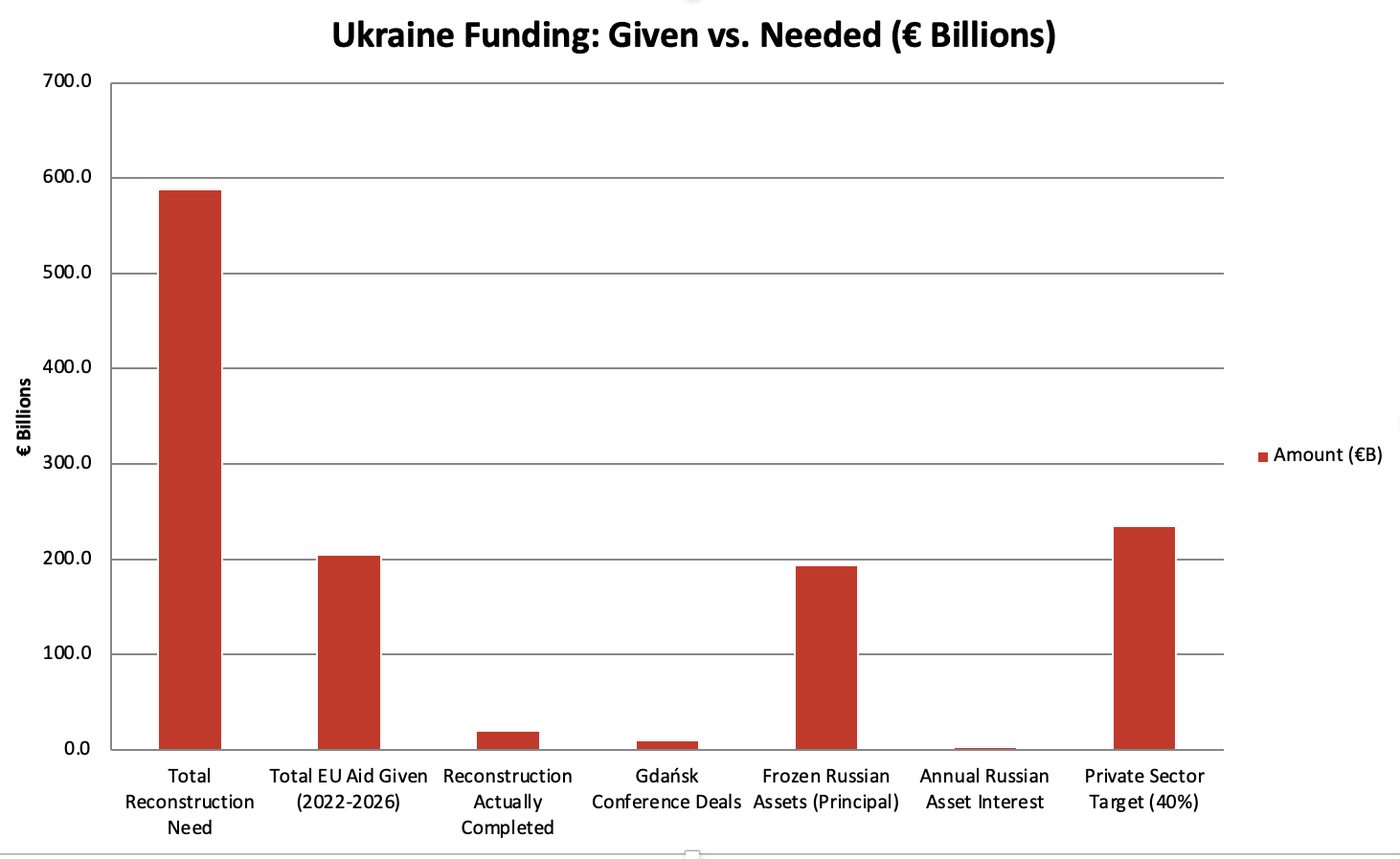
The private sector is supposed to cover 40% of reconstruction costs. But which private company is going to invest billions in a country where Russian missiles might destroy the factory the day after it opens? Insurance companies won’t cover war zones. Banks won’t lend at rates that make sense. The 40% private sector target is a number on a slide deck, not a business plan.
The €194 Billion That Could Change Everything, But Won’t
There is one pot of money that could transform Ukraine’s finances overnight: the €194 billion in frozen Russian sovereign assets sitting at Euroclear in Belgium.
That’s Russian Central Bank money, immobilized by EU sanctions since 2022. It’s just sitting there. Every year, it generates roughly €3 billion in interest income, which the G7 agreed to use for a $50 billion loan to Ukraine.
But the principal — the actual €194 billion — remains untouched. Ukraine wants it confiscated. Many European leaders want it confiscated. The legal case for confiscation has been made by dozens of international law scholars.
So why hasn’t it happened?
Because Belgium is terrified. Euroclear holds 85% of all immobilized Russian assets. If the EU confiscates the principal, it sets a precedent that sovereign assets can be seized. Every country with money in European institutions — China, Saudi Arabia, India, the Gulf states — would immediately start moving their assets elsewhere. The euro’s status as a reserve currency could be damaged. Belgium’s entire financial sector could face instability.
So Europe has €194 billion that could rebuild half of Ukraine. And it’s too scared to touch it.
The €800 Billion Defence Bill That Also Needs Paying
As if funding Ukraine wasn’t enough, Europe simultaneously needs to rearm itself.
The ReArm Europe / Readiness 2030 plan targets €800 billion in new defense spending. This includes €650 billion through relaxed fiscal rules (allowing member states to borrow more for defence) and a €150 billion SAFE loan instrument.
The 2026 US National Defence Strategy literally told Europe it can’t “depend on the U.S. to deter Russia” and must “take direct ownership” of its defence.
NATO allies are now debating whether even the 2% of GDP target is enough — 3% is increasingly discussed.
Add it up. Ukraine: €45 billion a year. Defence rearmament: €150–200 billion a year. Pensions and healthcare: growing at 1.5% of GDP per year. Green transition: €100 billion+ a year. All funded by an economy growing at 1.1%.
It’s technically a loan. Ukraine is supposed to pay it back. But the repayment condition is this: Ukraine only has to return the money if Russia agrees to pay war reparations.
Russia has categorically refused to pay reparations. It has never acknowledged the invasion as illegal. It will never voluntarily compensate Ukraine. Everyone knows this.
So the €90 billion “loan” is, in reality, a grant. Europe is giving Ukraine €90 billion and calling it a loan to make the politics easier. Because telling European taxpayers “we’re giving away €90 billion to another country” while your deficit is at 5% and your pensions might get cut is politically suicidal.
The Accounting Fiction
The €90B is classified as a loan on EU books, backed by the EU’s common budget. This means it doesn’t count against individual member states’ deficits under fiscal rules. Clever accounting? Yes. Sustainable? The IMF has warned against further relaxation of eurozone fiscal rules, noting that the “defense exception” already risks undermining the credibility of the new fiscal framework before it even takes effect.
Five Reasons Europe Can’t Keep Writing These Checks
The Fiscal Reality Check
There is no growth to pay for it. EU GDP growth is 1.1%. Germany is at 0.6%. France is at 0.8%. You can’t fund a multi-hundred-billion-euro commitment with an economy that’s barely moving. Tax revenues are stagnating while spending commitments multiply.
Debt is already explosive. The IMF says European debt is heading to 130% of GDP by 2040 under current policies. The required fiscal adjustment — 5% of GDP in cuts over five years — has never been achieved by any European consolidation effort. Ever.
The defence bill comes due at the same time. ReArm Europe needs €800 billion. You can’t rearm against Russia, fund Ukraine’s war against Russia, and keep your welfare state running with the same shrinking budget. Something has to give.
Political support is eroding. Hungary blocked the €90B for two months. Slovakia’s government is sceptical. Poland and Ukraine are in a diplomatic crisis. Far-right parties across Europe are gaining votes by opposing Ukraine's spending. The consensus is cracking.
The US isn’t coming back. American aid dropped to effectively zero in 2025 — just €0.4B in military aid. Trump’s 2026 NDS told Europe to handle its own defence. There is no cavalry. Europe is alone, and Europe is broke.
What’s Been Given vs. What’s Needed
Europe has given €204 billion. Ukraine needs €588 billion just for reconstruction — not including ongoing military costs, which run tens of billions per year.
Only €20 billion in reconstruction has actually been completed. The biggest single source of funds — €194 billion in frozen Russian assets — is locked behind legal and political fears.
The gap between what Europe promises and what Ukraine needs is not closing. It’s widening. Every month the war continues, Russia destroys another €5–10 billion in Ukrainian infrastructure. The tab keeps growing. Europe’s ability to pay it doesn’t.
Europe’s leaders stood at podiums this week and pledged billions more for Ukraine. They talked about investment. They talked about a partnership. They talked about Europe’s future.
How long can a continent with 1.1% growth, 88% debt-to-GDP, ten countries under fiscal discipline, a defence rearmament that needs €800 billion, and a welfare state that’s already underfunded keep writing checks that get bigger every year?
The IMF already answered: not long. Not without growth that Europe hasn’t seen in a decade. Not without reforms that Europe has never managed to deliver.
Europe’s support for Ukraine is morally right. Strategically necessary. Fiscally… on borrowed time. Literally.
The checks are getting bigger. The bank balance isn’t. And sooner or later, the numbers win.


Comments
No comments yet. Be the first.
Comments are closed on this article.