
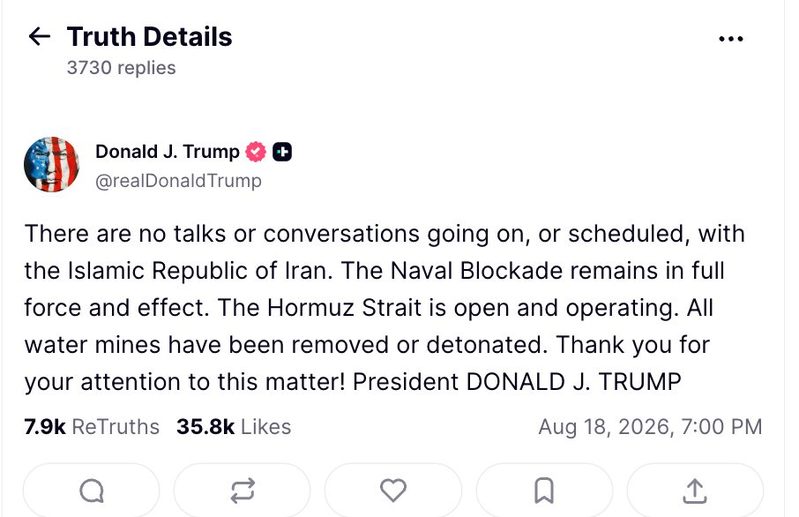
On Monday, Trump said his administration had opened a back channel to Iran’s Islamic Revolutionary Guard Corps.
The IRGC denied it.
On Tuesday, Trump posted this:
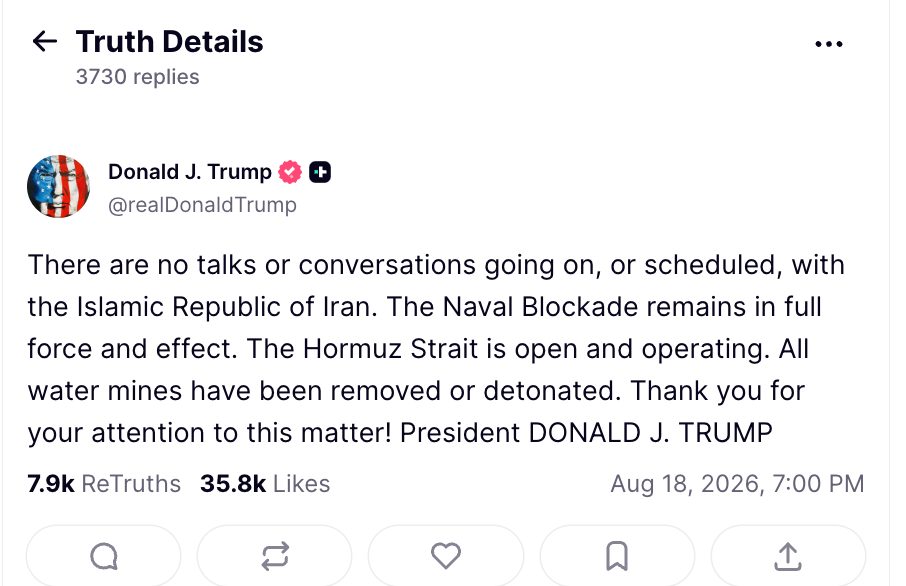
The Strait is not, in any commercially meaningful sense, open and operating.
MarineTraffic data logged at least seven commercial ships through Hormuz in the 24 hours to Wednesday morning. Before the war the daily average was roughly 110. GPS spoofing around the channel has continued for months, throwing reported positions off by tens of miles.
Six per cent of normal traffic. Six months in.
Now hold that against an American calendar. The midterm elections are on 3 November. Eleven weeks.
Iran is not failing to reach a settlement. It is declining to reach one, on a schedule, and it has run this exact play against an American president before.
The 1980 precedent, which is not a metaphor
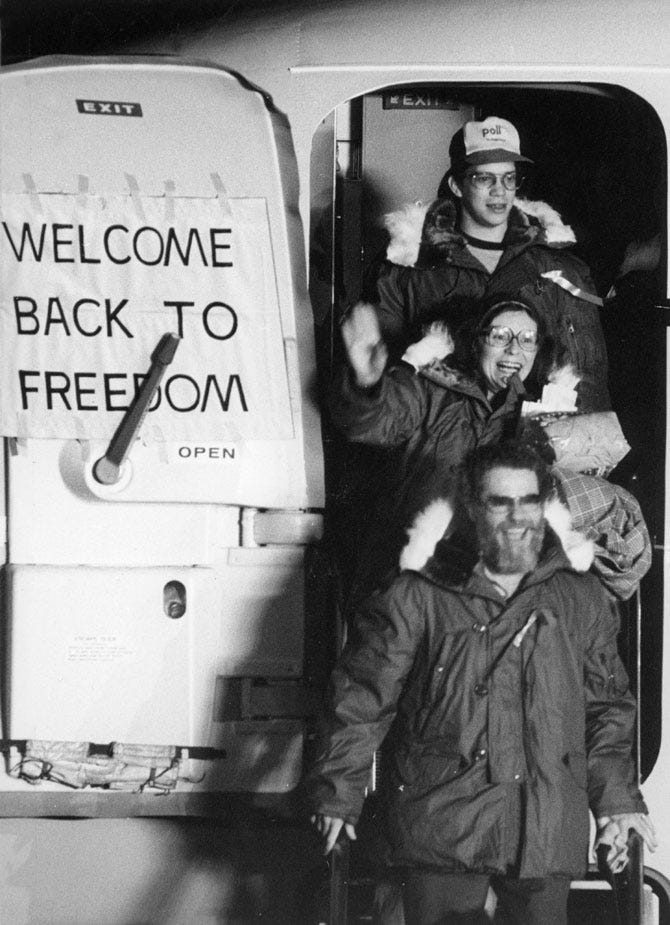
Fifty-two Americans were held in Tehran for 444 days.
Jimmy Carter lost the presidency in November 1980, in significant part because of it.
Then something happened that ought to be taught in every course on coercive bargaining. Washington and Tehran reached agreement in December 1980. The deal was done. And Iran held the hostages for another six weeks.
They were released on 20 January 1981, minutes after Ronald Reagan finished taking the oath of office — carried live on a split screen, so that the country could watch the two events at once.
Iran gave up nothing by waiting. It gained nothing material. The extra six weeks bought exactly one thing: the certainty that Jimmy Carter would never stand in front of a camera with those hostages behind him.
That was a regime spending real leverage to influence how an American president was remembered.
The Islamic Republic has been reading American electoral calendars since the month it was founded.
The transmission belt: Hormuz to the pump to the polls
The reason the clock matters this time is that the war reaches American voters through a mechanism that is unusually direct.
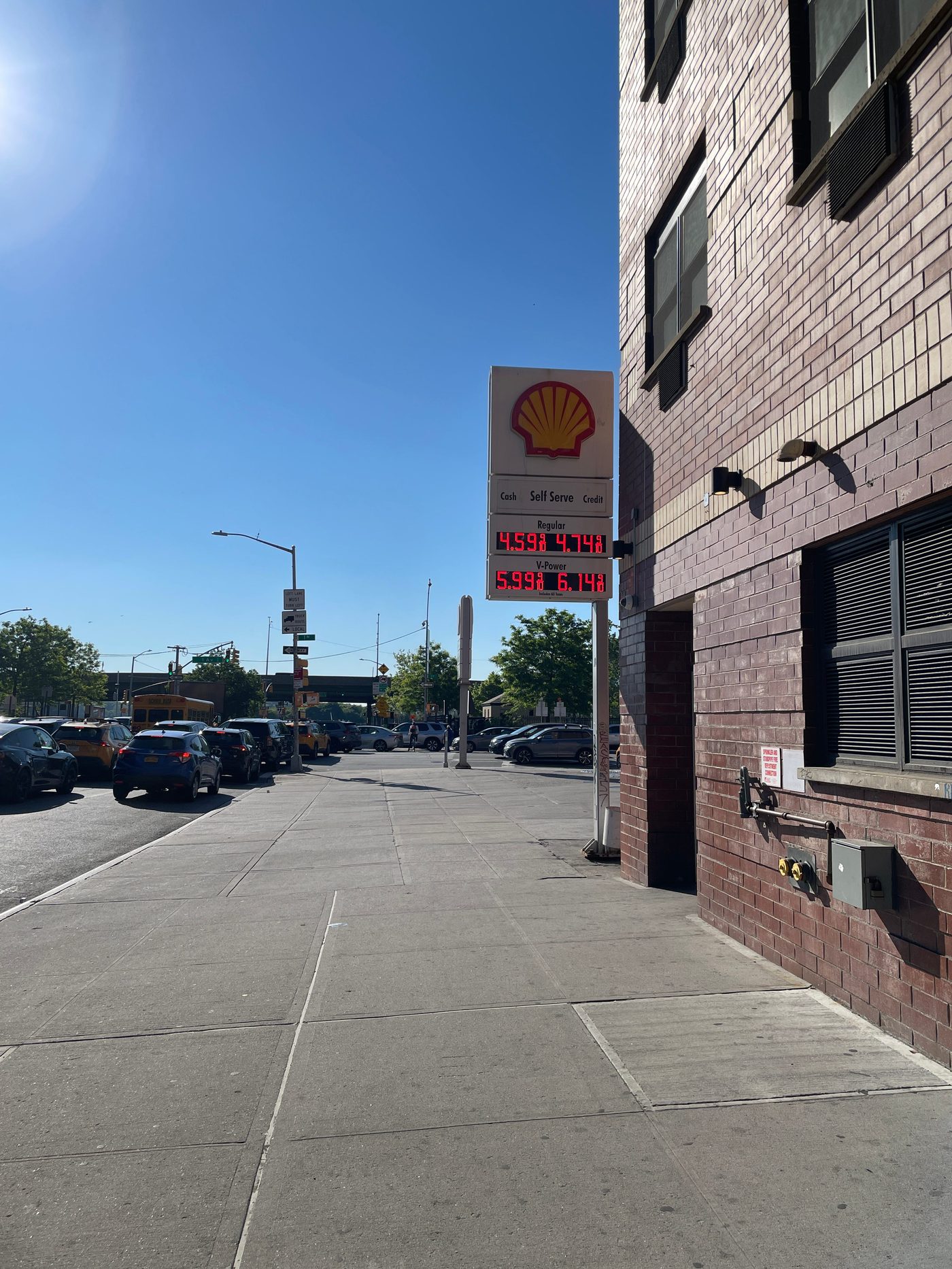
Hormuz carries roughly a fifth of the world’s seaborne oil. Choke it and crude rises. Crude rises and petrol follows, with a lag of weeks. And petrol is the single most visible price in American life — displayed in metre-high numerals on every arterial road in the country.
The transmission has worked exactly as you would expect.
Pump prices have reached about $4.30 a gallon, the highest since 2022. Oil hit its highest level since July this week as hopes of a settlement faded.
And the political damage is now measurable rather than speculative.
- Trump’s approval average sits at roughly 39.9%, a net of about minus 17.
- On inflation specifically, he runs about 29% approve against 71% disapprove — a net of minus 33, his worst issue by a distance.
- On the economy overall, he is around minus 21.
- Just 24% of Americans rate the economy as excellent or good, down eight points in a year.
- And voters now trust Democrats over Republicans on the economy for the first time since 2010.
That last line is the one that should concentrate minds in the White House. The Republican advantage on economic management has been a fixture of American politics for a generation. It has gone.
What Tehran’s negotiator is actually saying
You do not have to infer Iran’s posture from behaviour alone. Its chief negotiator posts it.
Mohammad Bagher Ghalibaf is the speaker of the Iranian parliament and Tehran’s lead man on the talks. On Tuesday, he wrote on X:
He described the US Treasury Secretary and Defence Secretary as “way out of their league.” The same day, he issued another list of conditions Washington must satisfy before Iran reopens the Strait.
This is not the vocabulary of a party that believes it needs a deal. It is the vocabulary of a party that believes the other side needs one more.
Meanwhile, Tehran’s consulate in Hyderabad responded to Trump’s post, labelling Hormuz “New US Territory,” by publishing a map of the United States with California marked “NEW TERRITORY OF ISLAMIC REPUBLIC OF IRAN.”
Governments under acute pressure to settle do not troll.
There is a clean piece of bargaining theory underneath all of this.
In any war of attrition, the outcome is determined less by relative strength than by relative patience. The side with the lower cost of waiting can hold out for better terms, and both sides know it, which is why the impatient party concedes.
Now compare the two clocks.
Trump’s cost of waiting is denominated in petrol prices, inflation prints and approval points, running against a fixed date he cannot move. Every week without a settlement is measured on a scoreboard the American electorate consults in November.
Iran’s cost of waiting is denominated in absorbed damage — severe, but attached to no date at all. The Islamic Republic holds no election in which its rulers can be removed. Its September parliamentary politics do not threaten the system. There is no November for Tehran.
This asymmetry is the oldest structural weakness of democracies in protracted conflict, and adversaries have exploited it repeatedly — Hanoi through 1968 and 1972, insurgents in Iraq through the 2006 midterms. It requires no genius. It requires only a calendar and the ability to endure.
What makes the current case unusually sharp is that Trump has publicly tied himself to a quick resolution. He has repeatedly promised the Strait would open, threatened overwhelming force, and then not delivered it. Each unfulfilled deadline transfers a little more bargaining power to the party that never set one.
What November actually decides
An American president promised to reopen the world’s most important waterway, has spent six months failing to, and is now watching the resulting price appear at every filling station in a country that votes in eleven weeks. His worst polling number is on inflation. His party has lost the economic-competence advantage it held for sixteen years.
Iran did not create American inflation. Tariffs, deficits and energy policy did much of that work without help. But Iran holds the one lever that reaches an ordinary voter fastest, and it has declined to release it while a clock it does not have to obey runs down for someone who does.
Whether that is strategy or stubbornness, the effect is identical.
And the historical record contains a plain answer to the question of what the Islamic Republic will do when it finally has a deal in hand.
In December 1980, it had one. It held on for six more weeks.
It waited for the split screen.
Comments
No comments yet. Be the first.
Comments are closed on this article.