
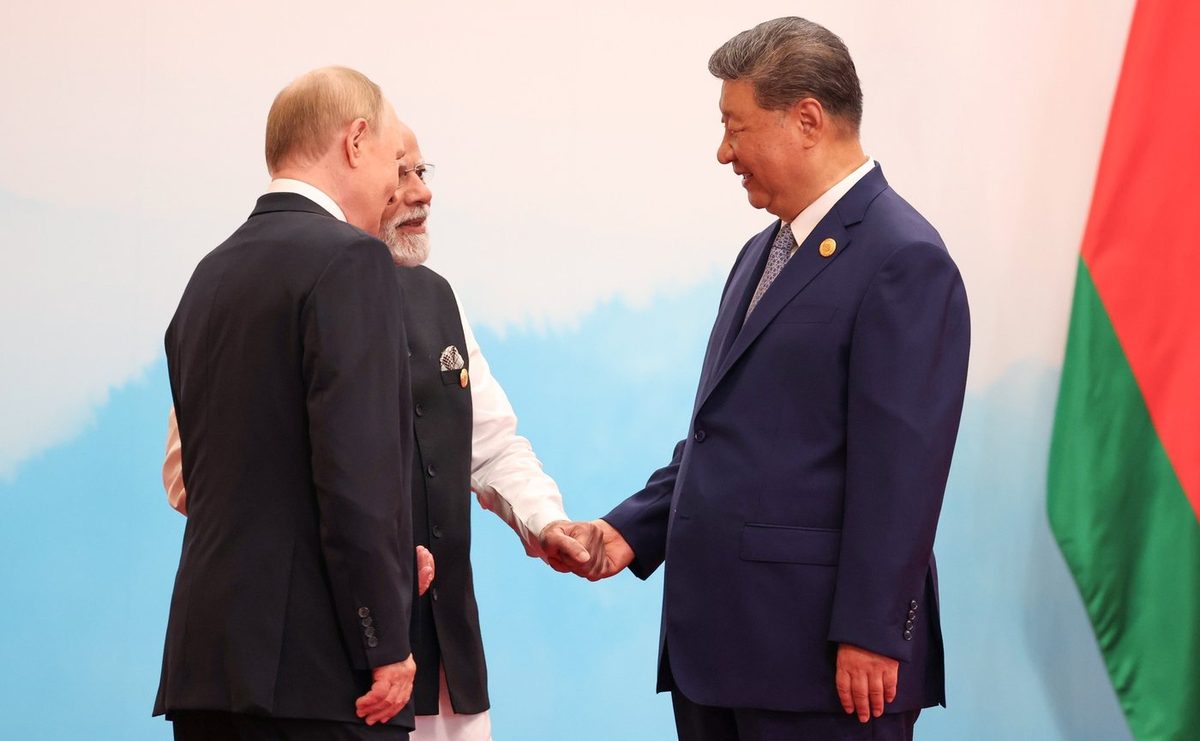
Vladimir Putin landed in New Delhi this morning. Xi Jinping arrives tomorrow, his first visit to India since 2019. Iran's Masoud Pezeshkian flies in from a country at war.
The 18th BRICS summit begins at Bharat Mandapam on Saturday, and the headline item on India's agenda is a plan to link the central bank digital currencies of the eleven members for cross-border payments.
At every BRICS summit for a decade, you have heard the same story: the Global South is building an exit from the dollar. Washington believes it too. Trump has threatened 100% tariffs on any BRICS country that backs a rival currency.
Now listen to what the host actually said today. Modi met Putin this afternoon and posted the agenda himself: trade, energy, infrastructure. Not one word about currency.
"Delighted to meet President Putin in Delhi, less than two weeks after our meeting in Bishkek. During today's meeting we talked about: closer trade ties, including implementation of the Programme for Economic Cooperation 2030. Cooperation in areas like infrastructure, energy, technology, defence, culture and more. India's efforts during our BRICS Presidency aimed at furthering the welfare of our planet." Narendra Modi, on X, 11 September 2026
So let us look at why India and China do not want to replace the dollar. They cannot afford to. And the numbers released this very week prove it.
Look at the reserves, not the speeches
Three days before Putin's plane touched down, Beijing published its August reserve figures: $3.44 trillion, the highest since 2015, up $19.5 billion in a month.
The same week, the Reserve Bank of India reported that its reserves had jumped $45 billion in seven days to a record $785.7 billion, with $648 billion of that in foreign currency assets.
Ask yourself a simple question. What currency are those assets in?
China earns its surplus around the world, and that surplus itself is in US dollars. So: mostly dollars. The IMF's latest data puts the dollar at 57% of global reserves, and the share actually rose in the first quarter of 2026. The yuan, the supposed challenger, sits at 1.99%. Not 19. Not 9. Under 2.
And China's own dollar exposure is bigger than it looks. Brad Setser at the Council on Foreign Relations has traced how Beijing's Treasury holdings moved to custodians in Belgium and Luxembourg after the G7 froze Russia's reserves in 2022. They did not disappear. They were hidden. US assets still make up 50 to 55% of China's reserve portfolio.
Remember one thing: a country that wants to leave the dollar sells dollars. Neither of these countries is selling. They are buying.
The surplus trap
Both countries run their economies on exports, and exports are paid in dollars.
China closed 2025 with a trade surplus of $1.19 trillion, the largest of any country in history, four times Germany's best-ever year. That surplus arrives as dollars. Beijing can convert it into gold, into yuan, into Belgian custody accounts, but it arrives as dollars first.
India's case is more subtle but even more revealing. In 2025–26, India ran a $34 billion surplus with the United States and a $112 billion deficit with China. China became India's largest trading partner this year, and India pays for that in the currency China accepts, which, for Indian importers, is overwhelmingly the dollar.
Now imagine BRICS actually succeeds. Trade settles in local currencies. India pays China in rupees.
Why would Beijing accept $112 billion a year in a currency it cannot spend?
We already know the answer, because Russia tried it. Moscow sold India discounted oil for rupees after 2022 and ended up with, in Sergey Lavrov's own words, "billions of rupees accumulated in Indian bank accounts that so far cannot be used." The rupee-rouble experiment died quietly. Russia went back to dirhams and yuan, and India went back to dollars.
BRICS has tried to design an alternative. A few years ago the idea of an "R5" currency did the rounds: a basket built from the five original members' currencies, all of which happen to begin with R: the real, the rouble, the rupee, the renminbi and the rand. It never got beyond the idea.
One thing must be admitted, though. The yuan's rise is real, and it has a specific cause: the war in Ukraine. Cut off from dollars and euros, Russia now settles most of its trade with China in yuan. Some Gulf states have begun accepting it for oil. Pakistan pays for Chinese imports in it.
India will never accept the yuan
Not for oil, not for electronics, not for anything. India would rather pay Beijing in dollars, a currency issued by a country that just threatened it with tariffs, than hold the currency of its own largest trading partner. That tells you everything about how much trust exists inside this bloc.
Jim O'Neill, the Goldman Sachs economist who coined the term "BRIC" in 2001, has said it himself: the biggest obstacle to BRICS is BRICS. India and China do not work together. If they ever did, the dollar's dominance would face a real challenge, because between them they hold over four trillion dollars in reserves and run the world's largest surpluses.
There is an irony here. Trump's tariffs are doing more to push India and China toward each other than any BRICS summit ever has. Washington is trying to punish both, and in doing so is giving them a reason to cooperate.
But pressure from outside cannot fix the rivalry on the inside. Their ambitions collide. Their political goals diverge. Their geopolitical strategies, China's push into the Indian Ocean, India's alignment with the Quad, the unresolved border in the Himalayas, make them natural rivals, not natural partners.
Triffin's curse is the reason nobody wants the job
In 1960, the economist Robert Triffin identified the trap at the heart of any reserve currency. The ECB summarised it neatly: if the issuer "refused to provide other countries with US dollars, trade would stagnate", but if it supplied unlimited dollars, confidence in the currency would erode.
Put simply: the country that issues the world's money must run permanent deficits, so that everyone else can hold its currency. It must export its money and import everyone else's goods.

Now look at the two BRICS giants again. China exports $3.77 trillion a year and imports $2.58 trillion. Its entire model is built on selling more than it buys.
For the yuan to replace the dollar, China would have to flip that model: run trade deficits, open its capital account, and let foreigners take yuan out of the country freely. Beijing knows exactly what happens when it loosens the leash. In 2015–16 a 3 percent devaluation triggered such panic that reserves fell by roughly $1 trillion as households rushed for the exits. The capital controls went back up and have never come down.
A currency you cannot take out of the country cannot be a reserve currency. That is not a Western talking point. It is arithmetic.
Why the dollar is a network, not a flag
Barry Eichengreen, author of Exorbitant Privilege, explains the dollar's staying power in one line: "Everyone else is quoting prices in dollars, it makes sense for you to continue doing so."
Oil, copper, wheat, shipping, insurance, the bonds that Indian and Chinese banks hold: all priced in dollars, all cleared through the deepest market on earth. Switching is not a political decision. It is a coordination problem involving millions of firms, and the country that switches first pays the highest price.
That is why India's real proposal for this summit is so modest. Read the fine print of the CBDC plan, and you find a source telling Reuters that "India has no interest in replacing the dollar." The aim is to make payments "easier and faster." Even this plumbing is stuck: the UAE has cut financial ties with Iran, India blocked Alipay+ over Chinese security concerns, and earlier CBDC talks made "little headway."
Former diplomat Srikumar Menon calls India's approach "calibrated multi-alignment": using BRICS as leverage inside an American-led system, not building a post-American one. New Delhi has explicitly rejected a common BRICS currency and an anti-dollar agenda.
And Xi? He leaves Delhi for a September 24 summit with Trump in Washington, where Beijing wants tariff cuts on $30 billion of goods before the truce expires on November 10. You do not fly to Washington to negotiate market access while plotting to destroy the market's currency.
A club where the members are at war
There is a second reason the de-dollarisation story fails, and it is sitting at the summit table.

Iran is a BRICS member. So are Saudi Arabia and the UAE. Iranian-backed Houthis are striking Saudi cities, and the UAE suspended all trade and financial transactions with Iran in August after missile attacks. In May the bloc's foreign ministers could not even agree a joint statement; India issued a chair's note admitting "differing views."
Pezeshkian will arrive demanding a strong stand against the United States. Riyadh and Abu Dhabi will resist. ORF's Harsh Pant told Euronews that expansion, "seen until last year as an achievement," now "looks like a big constraint."
A common currency requires common trust. The AP's summary of the summit's fault lines, India–China, Iran–Saudi, Egypt–Ethiopia, reads like a list of reasons not to share a central bank. Even the official membership list is contested: Saudi Arabia has never publicly confirmed it joined.
Who really wants out of the dollar? The sanctioned. Russia, because the G7 immobilised its reserves in 2022. Iran, because it is blockaded. For everyone else, as WION put it, the question is whether BRICS should confront America or simply make the world "less dependent on any one power." Those are very different projects, and only the second one has a majority.
The dollar's only real enemy
Strip it down, and the picture is this. India and China are the two largest creditors of the dollar system outside Japan. Their wealth is denominated in it. Their exports are paid in it. Their leverage in every negotiation with Washington, including Xi's on September 24, depends on the value of the dollars they hold.
A creditor does not burn down the bank. A creditor wants the bank to stay open, honour its deposits and stop behaving erratically.
That last part is the real story. The only force that has ever cut the dollar's share is Washington itself: freezing reserves, weaponising SWIFT, threatening 100% tariffs on countries for the crime of talking about alternatives. Menon's warning is precise: excessive pressure "will simply fragment global finance and gradually erode American economic leverage."
Even the host's own framing of the summit is about growth inside the system, not exit from it. Here is the Ministry of External Affairs on Modi's Business Forum speech this evening:
"PM highlighted that in the last 20 years, while the world GDP has increased 2.5 times, GDP of BRICS countries has grown by 4.5 times. PM also underlined that the collective strength of BRICS should be leveraged to find global solutions." Ministry of External Affairs, India, on X, 11 September 2026
Grown 4.5 times, measured, of course, in dollars.
So when the Delhi declaration comes out on Sunday, read it carefully. It will call for "reformed multilateralism" and "resilient payment systems." It will not announce a currency. Because the two countries that could build one are the two with the most to lose.
The dollar does not survive because the world loves America. It survives because the world's biggest savers have their savings in it, and because, in the end, money is not about flags or blocs. It is about trust, and about who you would rather owe you.
Update, 15 September 2026: for how these commitments now reach smaller economies, see Bangladesh's BRICS absence by Kawsar Mia and Abdul Momen.

Comments
No comments yet. Be the first.
Comments are closed on this article.