
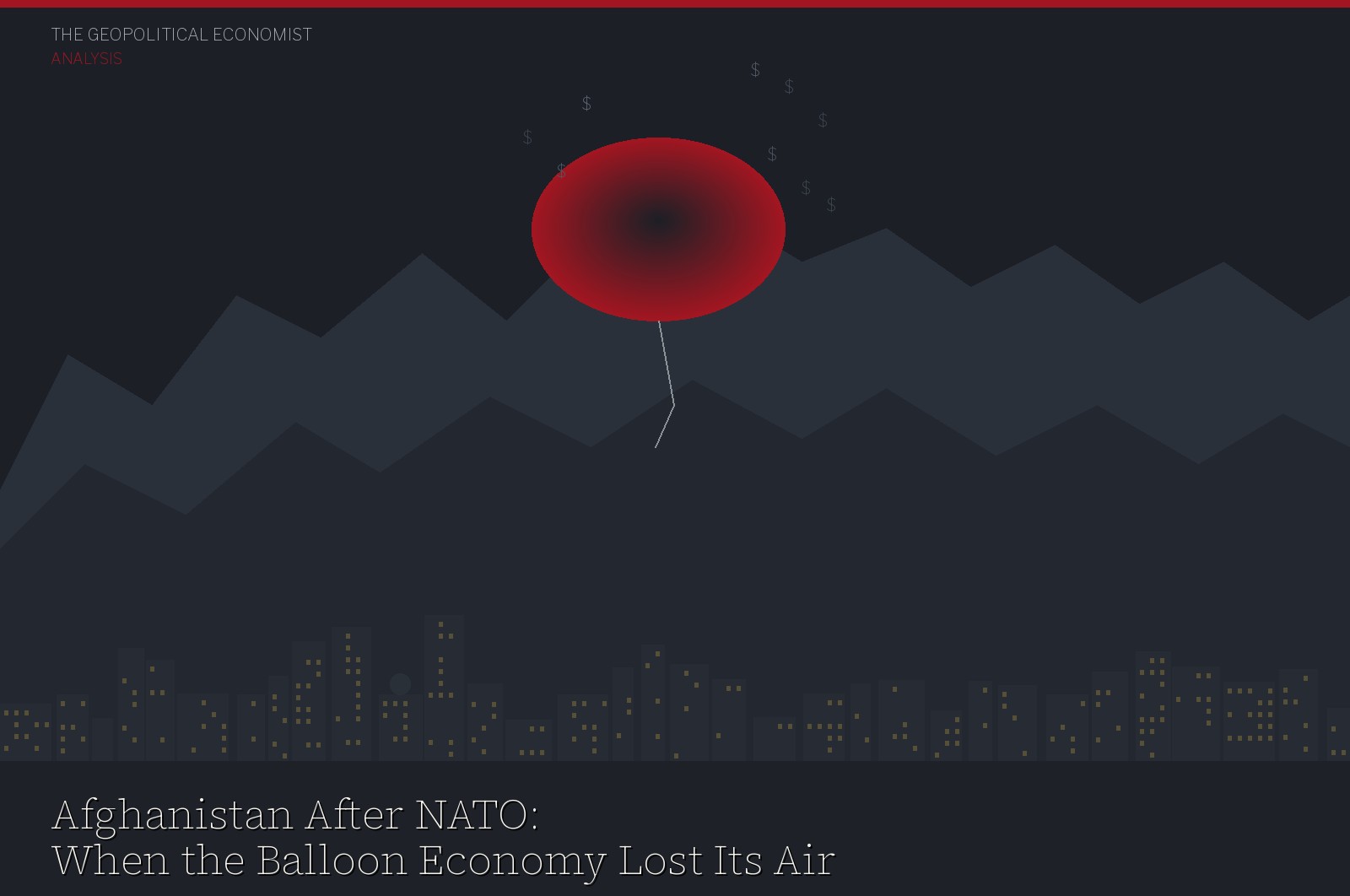
Afghanistan has always been more than a country on a map. It has been a meeting point of empires, civilizations, trade routes and competing geopolitical ambitions. Yet few periods transformed it as profoundly as the quarter-century following September 11, 2001.
The American-led intervention began with a security objective: dismantling al-Qaeda's sanctuary and preventing Afghanistan from becoming a base for international terrorism. NATO subsequently became deeply involved. From 2003 it led the UN-mandated International Security Assistance Force, and from 2015 operated the Resolute Support Mission to train, advise and assist Afghan security institutions. The mission ended with the withdrawal of international forces in 2021.
But Afghanistan's story did not remain a military story. It became an enormous experiment in state-building, democracy, development, security and international aid.
What Was the "Balloon Economy"?
Between 2001 and 2021, enormous flows of foreign assistance and military expenditure entered Afghanistan. International money financed government institutions, security forces, roads, schools, hospitals, NGOs, contractors, telecommunications and a rapidly expanding urban service economy.
These resources produced real achievements. Education and health services expanded, telecommunications transformed society, infrastructure improved, universities multiplied and a new generation entered professional and public life.
Yet the central weakness was structural: a substantial part of the economy depended on money generated outside Afghanistan.
This is what I describe as the "balloon economy."
The balloon became larger because external financial resources continuously pumped air into it. But a larger balloon does not necessarily mean a stronger foundation.
The fundamental distinction was between economic expansion and economic self-sufficiency.
Can Democracy Survive Without Economic Independence?
The international community also attempted to construct a democratic political order. Afghanistan adopted a new constitution, held elections, developed parliament and political institutions, expanded civil society and experienced unprecedented media growth.
But democracy requires more than elections. It requires institutions capable of surviving political competition, raising domestic revenue, delivering services and maintaining legitimacy without permanent external financing.
Afghanistan struggled to achieve that independence.
The security architecture was similarly dependent on foreign financing, logistics, intelligence and air support. When that external pillar disappeared, the weakness of the entire structure became visible.
2021: When the Balloon Lost Its Air
The collapse of the Islamic Republic in August 2021 was one of the most dramatic geopolitical events of the post-9/11 era.
The Taliban entered Kabul. The government disappeared. Afghan security forces collapsed, and the international financial system supporting the previous order was severely disrupted.
NATO records that more than 120,000 people were evacuated from Kabul during the August 2021 airlift.
For two decades, enormous resources had been invested in constructing a state expected eventually to stand on its own. When the international military presence disappeared, the political structure collapsed with remarkable speed.
The balloon had lost its air.
But Afghanistan itself did not disappear.
Is the Economy Recovering — or Just Growing?
The post-2021 story is more complicated than permanent economic collapse.
Afghanistan has demonstrated a degree of economic resilience. The World Bank reports that GDP grew by 2.5 percent in 2024 and projects 4.3 percent growth for 2025, supported by agriculture, mining, construction and services. Yet declining aid, a fragile banking sector, a widening trade deficit, rapid population growth and high youth unemployment continue to constrain the economy.
This creates a crucial paradox:
GDP can grow while ordinary people remain poor.
UNDP's latest 2026 socioeconomic assessment reports that the economy grew by only 1.9 percent in 2025, too slowly to keep pace with population growth. Around 74 percent of Afghans remained unable to meet basic subsistence needs, while nearly 2.9 million Afghans returned to the country during 2025, placing additional pressure on jobs, housing and public services.
Thus, the challenge is no longer simply economic growth.
It is productive employment, investment, exports, human capital and domestic revenue.
From NATO's Afghanistan to the Region's Afghanistan
Perhaps the most important transformation is geopolitical.
During the NATO era, Afghanistan's political economy was heavily connected to Western governments, international donors and security institutions.
The emerging Afghanistan is increasingly connected to its neighbourhood: Pakistan, China, Iran, Russia and Central Asia.
The strategic question is gradually changing from:
How do we defeat the Afghan insurgency?
to:
How can Afghanistan become economically viable and regionally connected?
Afghanistan sits between Central Asia and South Asia. Its mineral resources, agricultural potential and geographical position could make it a bridge between regional markets.
The geography that once made Afghanistan a battlefield could potentially become an economic asset.
Can Minerals and Agriculture Build a Real Economy?
Afghanistan possesses considerable mineral potential, but minerals alone will not rescue the country. Mining requires infrastructure, investment, technology, transparent contracts, skilled labour and environmental management.
The greater opportunity may be to transform raw resources into value-added production.
Agriculture is equally important. Afghanistan can develop commercial value chains in fruits, nuts, saffron, dry fruits, livestock and food processing.
The objective should be:
production → processing → packaging → transportation → export.
That would create more domestic employment and value than simply exporting raw commodities.
What Happens When You Ban the Poppy but Build No Alternative?
The sharp reduction in poppy cultivation following the Taliban's ban illustrates another contradiction.
UNODC documented a dramatic decline in opium cultivation after the ban. From the perspective of narcotics control, this was a major transformation. From the perspective of rural economics, however, it removed a significant source of income for farmers.
The lesson is clear:
Destroying an illicit economy is easier than creating a legal economy capable of replacing it.
Successful narcotics control therefore requires alternative livelihoods, agricultural investment and access to markets.
What Does It Cost to Exclude Half the Workforce?
Afghanistan's economic future is also closely connected to women.
UNDP reports that Afghanistan remains the only country where girls are barred from secondary and tertiary education. It estimates girls' school attendance at around 42 percent compared with 73 percent for boys, while restrictions on women's employment and movement continue to limit economic participation.
This is not only a social question.
It is an economic question.
No country can fully utilize its human capital while a large part of its potential workforce is excluded from education and employment.
Afghanistan needs doctors, teachers, engineers, accountants, entrepreneurs, researchers and skilled workers.
Its future economic capacity will therefore depend heavily on how it develops human capital.
Climate: The Next Economic Shock
Afghanistan's political economy is also being reshaped by climate stress.
UNDP reports that drought affected nearly two-thirds of households in 2025, while declining international assistance added further pressure to already fragile communities.
This creates a dangerous combination:
population growth + poverty + unemployment + water scarcity + drought + declining aid.
Climate change in Afghanistan is therefore not merely an environmental issue. It is increasingly an issue of food security, migration, employment and political stability.
Why Pakistan Cannot Ignore the Afghan Economic Equation
For Pakistan, Afghanistan cannot be separated from security, trade, migration and regional connectivity.
Afghanistan needs access to international markets and seaports, while Pakistan has an important geographical position linking Afghanistan and Central Asia with the Arabian Sea.
The potential economic corridor is straightforward:
Central Asia → Afghanistan → Pakistan → Arabian Sea.
Whether this becomes a viable commercial corridor will depend on security, customs, infrastructure and political relations.
If these improve, geography becomes an economic advantage.
If they deteriorate, geography becomes a barrier.
Another Balloon — or a Real Economy?
This is the great question facing Afghanistan.
Will the country construct another economy dependent upon external financial injections, or will it gradually build a productive domestic economy?
The transformation required is from:
- aid to investment;
- consumption to production;
- imports to exports;
- raw materials to value addition;
- informal labour to skilled employment.
The international community faces a difficult balance. Complete disengagement could deepen humanitarian and economic pressures, but simply recreating the aid-dependent model of the previous two decades would not resolve the structural problem.
A more sustainable approach would support productive capacity: agriculture, water, renewable energy, small businesses, vocational education, health, infrastructure, trade corridors and legitimate private investment.
Afghanistan does not need another artificial balloon.
It needs an economic foundation.
A Country Between Its Past and Its Future
Afghanistan's post-9/11 history should not be reduced to a simple story of military success or failure.
The international period produced genuine social and economic changes, but also extraordinary dependency.
The Taliban's return demonstrated the limits of externally supported state-building. Yet the post-2021 period has demonstrated another fact: Afghanistan has not disappeared, nor has its economy ceased to function.
Instead, another transformation is underway.
The Western military era has ended.
The humanitarian challenge continues.
The regional economic era is emerging.
The future Afghanistan may increasingly be shaped not by NATO headquarters but by Kabul, Islamabad, Beijing, Tehran, Moscow and the capitals of Central Asia.
Its geography gives it opportunity. Its young population gives it potential. Its minerals and agriculture give it possibilities.
But poverty, institutional weakness, climate vulnerability, unemployment and restrictions on women remain formidable obstacles.
The lesson of the last twenty-five years may therefore be simple:
A country cannot live permanently on borrowed money, borrowed security or borrowed political legitimacy.
The international community can provide capital, technology and expertise. But ultimately, a nation must build the capacity to sustain itself.
Afghanistan's first post-9/11 balloon has deflated.
The question now is whether Afghans, their neighbours and the wider international community can build something stronger in its place:
Not another balloon, but an economy with foundations.
| Indicator | Figure | Source |
|---|---|---|
| GDP growth (2024) | 2.5% | World Bank 2026 |
| GDP growth (2025) | 1.9% | UNDP 2026 |
| Projected GDP growth (2026) | ~4% | World Bank 2026 |
| GDP per capita change (2025) | -5.6% | World Bank MPO 2026 |
| Population unable to meet basic needs | 74% | UNDP 2026 |
| Afghans returned (2025) | ~2.9 million | UN News 2026 |
| Opium cultivation (2025) | 10,200 ha (from 232,000 in 2022) | UNODC 2025 |
| Evacuated from Kabul (Aug 2021) | 120,000+ | NATO |
| Girls' school attendance | 42% (vs 73% boys) | UNDP 2026 |
| Households affected by drought (2025) | ~66% | UNDP 2026 |
Comments
No comments yet. Be the first.
Comments are closed on this article.