
Key judgements
- Canada is not going to join the European Union, and is not asking to. Article 49 of the Treaty on European Union limits membership to "any European State". No plausible reading of the treaties, and no political appetite in any capital, changes that.
- What is under discussion is a new category of association, floated by EU officials rather than by Ottawa, that would go beyond the trade agreement Canada already has without granting the four freedoms of the single market. We assess the most likely outcome (55%) as a branded partnership assembled from sectoral agreements: energy, critical minerals, defence procurement, research, digital infrastructure and mobility. A formal association agreement with partial single-market access is possible but slower (30%). A stall is less likely than the noise suggests (15%).
- The binding constraint is not Brussels but ratification. Canada's existing trade agreement with the EU has waited nine years for ten member states to ratify it. Anything grander faces the same twenty-seven parliaments.
- The driver is Washington. The United States took 71.7% of Canada's goods exports in 2025, the lowest share in four decades and still seven dollars in ten. A 50% tariff on C$27.6 billion of Canadian goods took effect in August; a 50% tariff on Canadian vehicles is threatened for 1 January 2027; and the joint review of the North American trade agreement in July ended without an American commitment to extend it. Europe is not an alternative to that exposure. It is a hedge against it, and should be priced as one.
What happened
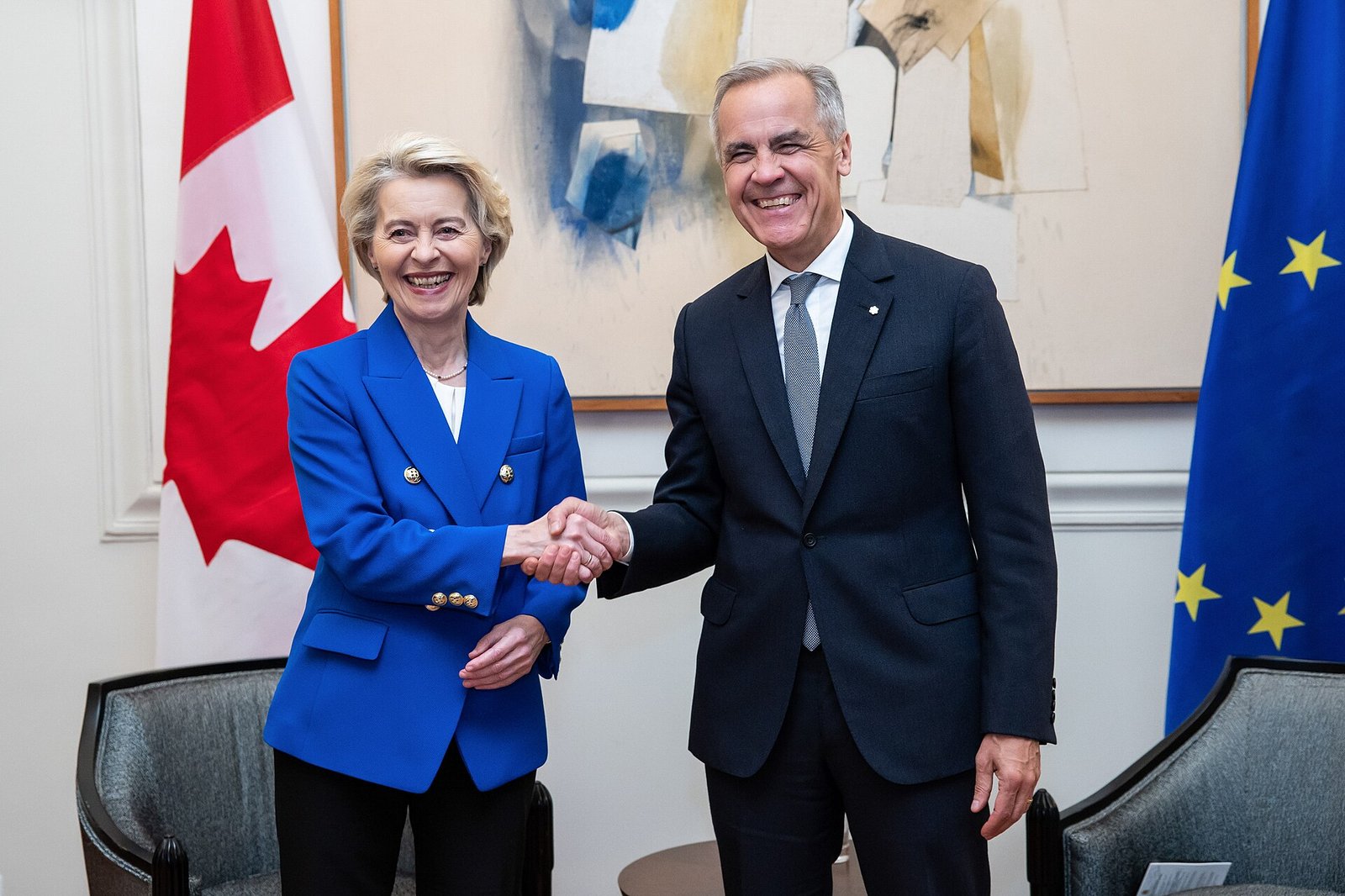
On 13 September the Wall Street Journal reported that Prime Minister Mark Carney is exploring whether Canada could become an "associate member" of the European Union, and that officials on both sides were open to creating a status that does not currently exist. The European Commission declined to comment.
Within a day the Canadian side had reframed it. Carney told reporters that Canada is "not looking to become a member of the European Union" and that the talks starting this autumn are about a "unique alliance". A senior official told the Globe and Mail that the "associate member" label came from the European side, that nothing structural has been agreed, and that Ottawa has specifically rejected the Norwegian model, under which a country adopts EU law without a vote on it.
The calendar now matters. Carney travels to Strasbourg this week to address the European Parliament, with a Canada-EU summit to follow. On 20 September he meets Emmanuel Macron in Saint-Pierre-et-Miquelon, the French territory off Newfoundland that appeared, along with Canada itself, on a map of territorial claims the American president posted online this summer. The venue is not an accident.
Why Ottawa is doing this now
The case for diversification has been made in every Canadian trade speech for fifty years and acted on in none of them, because the economics never justified it. That changed in 2025, and the change is measurable.
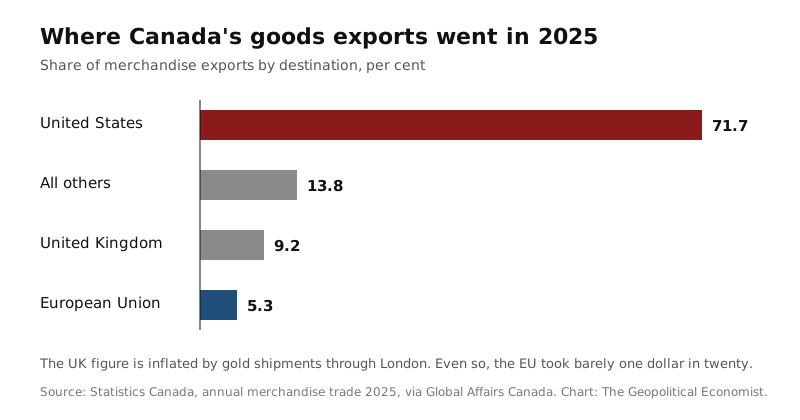
The United States took 71.7% of Canadian goods exports in 2025, down from roughly three-quarters in recent years and the lowest share since the early 1980s. That is the diversification the government advertises. The other side of the chart is the problem: the European Union took 5.3%. Even a doubling of trade with Europe, which would be the fastest reorientation in Canadian history, would replace about a tenth of what a hostile Washington can take away.
And Washington is taking. The sequence since spring:
- 22 August: a 50% United States tariff under Section 338 on C$27.6 billion of Canadian goods.
- 8 September: Canada's dollar-for-dollar reply, tariffs of 15, 25 and 50% on the same value of American goods, targeting steel, dairy, appliances, farm equipment, pulp and paper and electronics.
- July: the six-year joint review of the Canada-United States-Mexico Agreement ended without the United States agreeing to a sixteen-year extension. The Bank of Canada's framing is the correct one: absent agreement, the pact now lives on annual reviews until it expires in 2036, and every one of those reviews is a lever.
- 1 January 2027: the threatened date for a 50% tariff on Canadian vehicles and trucks, the sector most deeply integrated across the border.
A country in that position does not need Europe to replace America. It needs Europe to raise the cost, to Washington, of continuing. That is the strategic logic, and it explains why the Canadian side is relaxed about labels and insistent about substance.
What the treaties allow, and what they forbid
Three legal facts frame everything that follows.
Membership is closed. Article 49 TEU: "Any European State which respects the values referred to in Article 2 and is committed to promoting them may apply to become a member of the Union." Canada is not a European state. Morocco applied in 1987 and was told exactly this. No treaty amendment is conceivable for the purpose, since amendment requires unanimity and ratification by all twenty-seven, several by referendum.
Association is open. Article 217 TFEU allows the Union to conclude agreements "establishing an association involving reciprocal rights and obligations, common action and special procedure". This is the basis of the European Economic Area with Norway, Iceland and Liechtenstein, of the association agreements with Ukraine, Moldova and Georgia, and of the Swiss bilateral web. Its ceiling is high: the EEA extends the whole single market to non-members. Its floor is a trade agreement with a political dialogue attached.
The precedent is being built for someone else. In May, Friedrich Merz proposed an "associate membership" for Ukraine: participation in the European Council, Commission and Parliament without votes or a portfolio, a mutual-assistance clause, and a snap-back mechanism if reforms reverse. He conceded the idea "has no precedent". Kyiv called it a half-measure. But the template now exists in the German chancellery, and the Journal's sources described it as "originally intended for Ukraine but potentially applicable to Canada".
Canada would be taking a status designed as a waiting room and asking to live in it permanently. The EU may find that easier to grant to a G7 economy that does not want the vote than to a candidate that does.
The Norwegian objection is the one to watch. Ottawa's rejection of the EEA model is not a negotiating posture; it is a constitutional fact. No Canadian government can adopt European regulation by automatic transposition, and the official's phrase, "democratic deficit", is the one Canadian courts and provinces would use. Whatever emerges will be narrower than the EEA and deeper than CETA, and the interesting question is which sectors fall on which side of that line.
What is already done
The starting point is further along than the coverage implies, which is why the EU side can talk about a new status without proposing anything radical.
- Trade: the Comprehensive Economic and Trade Agreement has been provisionally applied since 2017, removing 98% of tariff lines. Its investment-court provisions await national ratification in ten member states: Belgium, Bulgaria, Cyprus, France, Greece, Hungary, Ireland, Italy, Poland and Slovenia. The French Senate voted against ratification in 2024.
- Defence: on 14 February 2026 Canada became the first non-European participant in SAFE, the Union's €150 billion defence-procurement loan facility, building on the Security and Defence Partnership signed at the June 2025 summit. Canadian firms count as domestic content under the instrument's rule that no more than 35% of component value may come from outside the EU and its associates.
- Research: Canada is an associated country in Horizon Europe, the Union's research programme, on the same footing as Norway or Israel.
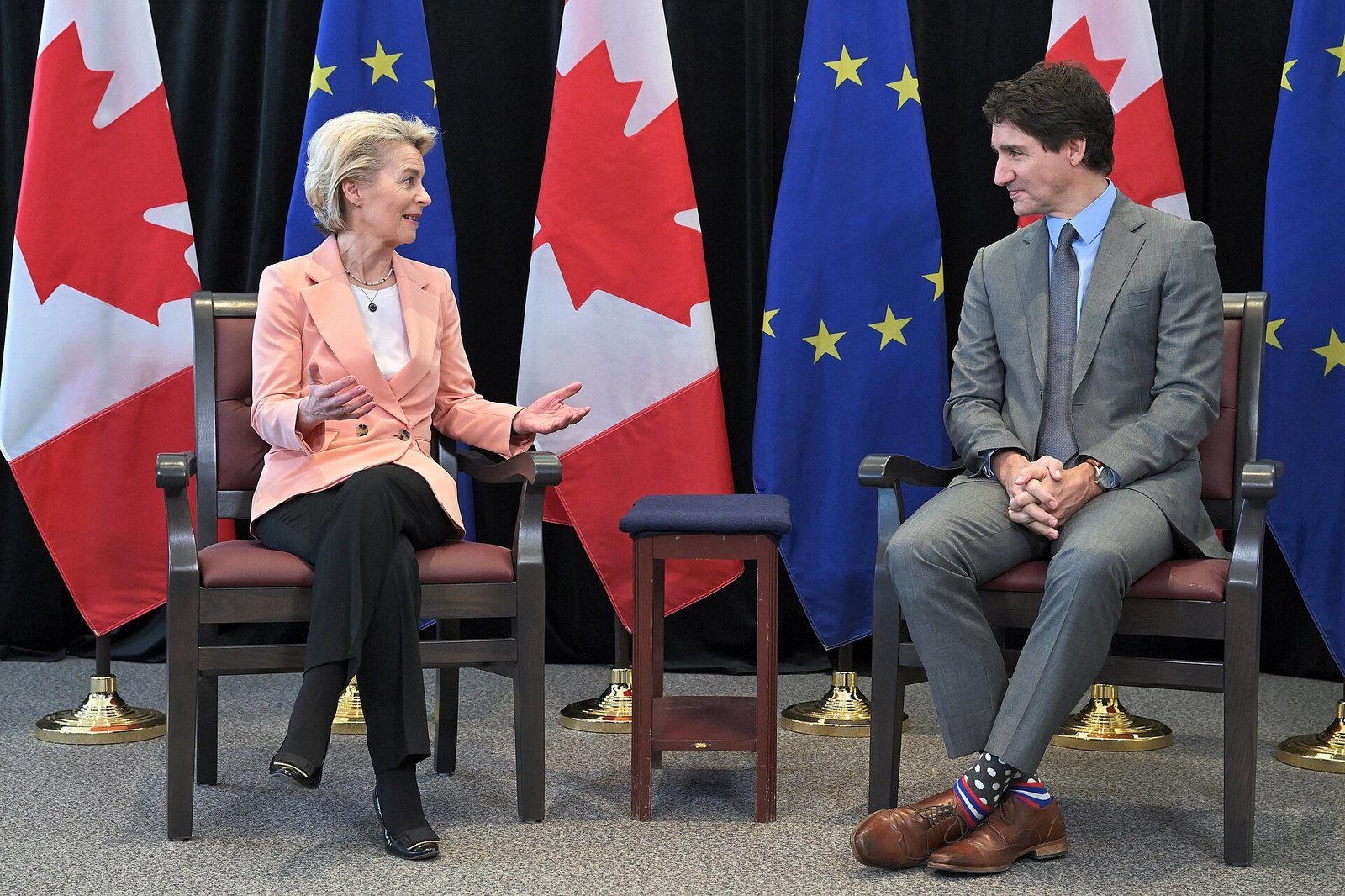
Each of these was an ordinary agreement under an ordinary legal base. Together they already amount to more than most third countries have. An "associate" status, on this reading, is partly a rebranding of what exists and partly a frame for what is being negotiated this autumn.
What is on the table
The agenda described by officials on both sides is specific, and it is worth sorting by how hard each item is.
Straightforward, and likely within eighteen months. An energy corridor for Canadian oil, gas and nuclear fuel to Europe; supply agreements for lithium, graphite and nickel; cooperation on undersea cables, data centres, cloud and satellite networks; expanded student and researcher mobility; a digital-trade chapter. None of these requires a new legal architecture. Most could be done as executive agreements or as protocols to CETA.
Hard, and the real test. Labour mobility, the visa-free right to live and work that Carney has discussed with Macron. Sectoral participation in the single market, for instance mutual recognition of professional qualifications and product standards beyond CETA's current chapters. Any Canadian seat, even without a vote, in EU institutions. Each of these touches the four freedoms, and the four freedoms are where member states' parliaments, and the Court of Justice, become participants.
Off the table. Membership. Free movement of persons in the EEA sense. Adoption of the acquis. Contribution to the EU budget on the Norwegian model, which Ottawa would refuse and which Norway pays for precisely the access Canada has ruled out.
The risk lies in the middle tier. Every item there is a mixed-competence matter under EU law, which means national ratification, which means the same ten parliaments that have sat on CETA for nine years, plus provincial legislatures on the Canadian side for anything touching professions or procurement.
Three scenarios
We assess the outcomes over a three-year horizon as follows. The probabilities are judgements, not measurements, and are given so that readers can disagree with them precisely.
Scenario A. The branded partnership (55%). A "Canada-EU Strategic Association" or similar is declared at a summit, bundling the sectoral agreements above under one name with a standing council and annual leaders' meeting. Energy, minerals, defence, research and digital move quickly; mobility is limited to students and skilled workers under existing visa categories; there is no institutional seat. This is the outcome the Canadian official's language points to, and it is the one the Commission can deliver without asking twenty-seven parliaments for anything. It would be presented as historic and would be, in substance, CETA plus SAFE plus an energy deal.
Scenario B. Association under Article 217 (30%). A formal association agreement, negotiated over two to four years, with sectoral single-market participation, a mobility chapter, observer participation in some EU bodies, and possibly a mutual-assistance clause modelled on Merz's Ukraine proposal. This is what "associate membership" would mean if it meant anything. It is legally available and politically attractive to the Commission, which would gain a G7 partner willing to align on China, critical minerals and Arctic security. Its weakness is time: the ratification round would outlast the current Canadian parliament and probably the current Commission, and every intervening election in a CETA holdout state is a veto point.
Scenario C. The stall (15%). Talks produce a declaration and a working group, then lose momentum as Canadian attention returns to the North American negotiation or as a member state, most plausibly France on agriculture or Hungary on principle, blocks the mandate. We rate this lower than the commentary does, for one reason: both sides are under pressure from the same source, and the pressure is not easing.
The question is not whether Canada gets closer to Europe. It is whether the arrangement is built to survive the moment the American pressure that created it eases, or whether it is a fair-weather hedge that disappears with the first good CUSMA review.
The risks that matter
American retaliation. This is the first-order risk and it is not hypothetical. The White House has treated allied diversification as a hostile act; the tariff on Canadian goods rose after, not before, Ottawa's European outreach began. A European agreement that Washington reads as an attempt to route around the North American pact could accelerate the January vehicle tariff, or produce a demand in the annual CUSMA review that Canada choose. Ottawa's bet is that the threats come regardless, and that a European anchor improves its bargaining position. The bet is reasonable. It is still a bet.
Member-state veto. CETA's history is the base rate. Ten states have declined to ratify a trade agreement for nine years because of an investment-court provision that has never been used. Anything requiring national ratification inherits that problem in full. The mitigation is design: keeping as much as possible in EU-only competence, which is what Scenario A does and Scenario B cannot.
Sovereignty politics in Canada. The opposition has already framed the story as a choice between the United States and Europe, and any mobility or regulatory-alignment chapter will be attacked as importing European rules. The government's rejection of the Norway model is meant to pre-empt this. It also caps what it can accept.
Regulatory cost. Sectoral single-market participation means Canadian producers meeting EU standards for those sectors. For energy and minerals this is manageable. For agriculture it is not, and Canadian agriculture, like French agriculture, votes.
Timelines versus need. Canada's exposure is now. Scenario B delivers in 2029 at the earliest. Even Scenario A's quick wins arrive in 2027. The North American vehicle tariff arrives on 1 January. Europe cannot solve Canada's 2027 problem, and a government that lets the public believe otherwise will pay for it.
What to watch
- This week, Strasbourg. Whether Carney's address uses the word "association", and whether the Commission's response uses "unique" or "new status". Words are commitments in this process.
- 20 September, Saint-Pierre-et-Miquelon. A Franco-Canadian statement on mobility would be the first hard content. France is also a CETA holdout, and its position on both is the same position.
- The Canada-EU summit. A negotiating mandate with a named legal base signals Scenario B; a declaration with a council signals Scenario A.
- The CUSMA annual review. Any American demand linking North American terms to Canada's European agreements moves the probability of Scenario C sharply.
- 1 January 2027. Whether the vehicle tariff is imposed, deferred or traded. This date decides Canadian politics more than anything Brussels does.
- CETA ratification votes. A ratification in any of the ten holdouts, especially France, is the single best leading indicator that Scenario B is achievable.
Assessment
Canada is not joining the European Union, and the phrase "associate member" is doing more work in headlines than it will ever do in a treaty. What is real is a convergence of interests that did not exist eighteen months ago: a Union that wants a G7 partner on minerals, energy and Arctic defence, and a Canada that needs to show Washington it has somewhere else to go.
The likeliest result is a partnership that is deep in sectors and thin in institutions, delivered fast because it asks nothing of national parliaments. That is a good outcome for Canada, provided it is understood as a hedge and not a home. The European Union takes one dollar in twenty of what Canada sells abroad. Nothing agreed this autumn changes that ratio inside the horizon of the American tariffs that prompted it. The collapse of the assumption that Europe can act as a strategic unit is the risk on the European side; the two-tier logic already visible inside the Union is, oddly, what makes a Canadian tier possible. And the same administration that is pressing its allies for soldiers rather than money is the one that will decide, in a January it has already circled, whether Canada's European hedge was worth the cost of taking it.

Comments
No comments yet. Be the first.
Comments are closed on this article.