
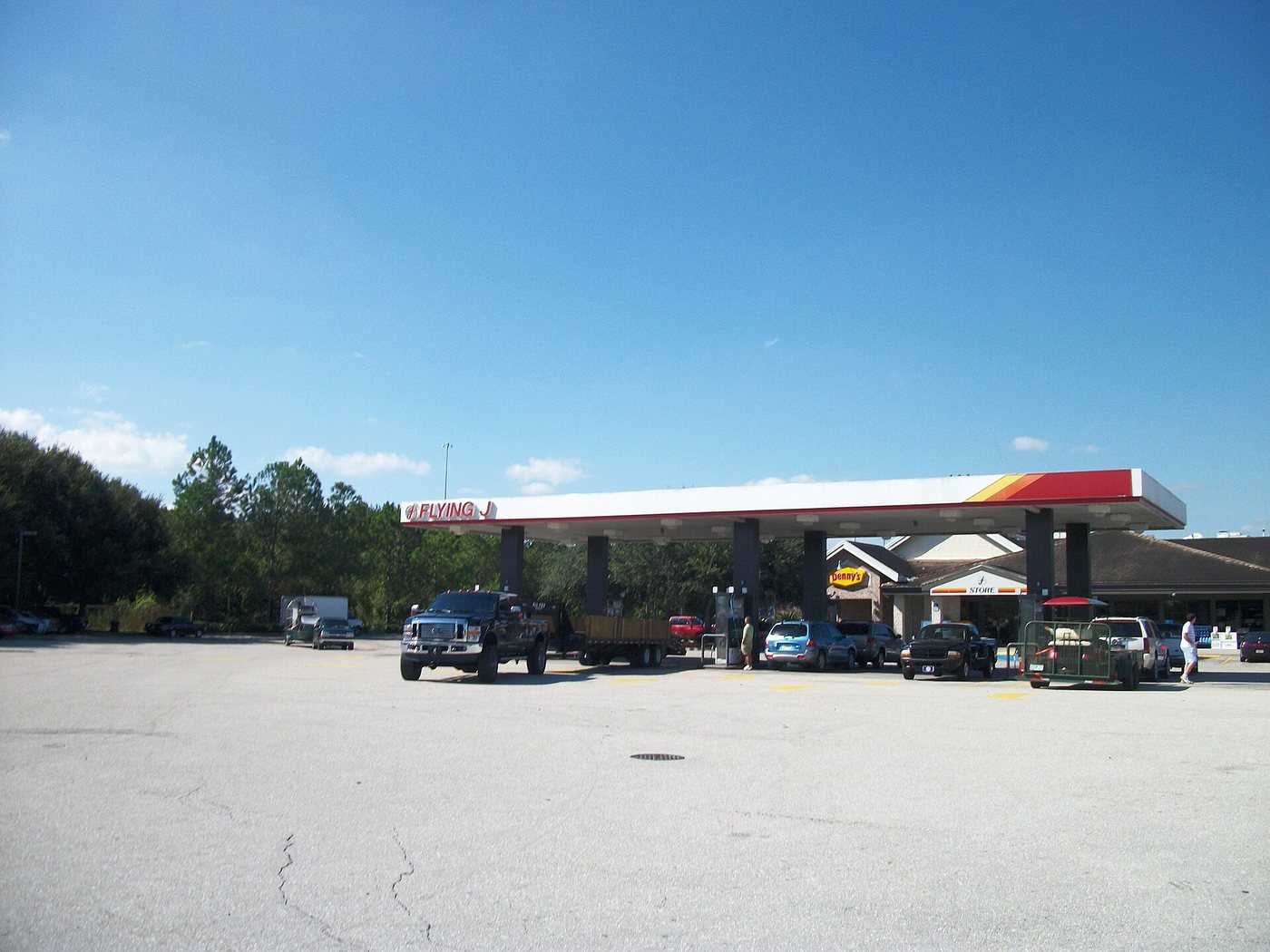
On Friday the average price of a gallon of diesel in the United States reached $6.05, the highest ever recorded. A year ago it was $3.71. In California it is now $7.98.
On Sunday, President Trump was asked about it. His answer was not about Iran, whose tankers the United States Navy has spent the month destroying. It was about Ukraine.
"Mr. Zelenskyy has to do one thing: he has to stop knocking out diesel fuel in Russia." President Donald Trump, 13 September 2026, as reported by Al Jazeera.
Read that slowly, because it describes something that has not happened in modern war. The principal backer of one belligerent has publicly asked it to stop attacking the war economy of the other, on the grounds that the attacks are working.
This article is about how the United States arrived at a position where Russian oil infrastructure is an American interest, what it costs Ukraine, and what it does to sanctions as an instrument of statecraft.
What Ukraine actually built
Start with the campaign Washington now wants stopped, because its scale is not widely understood.
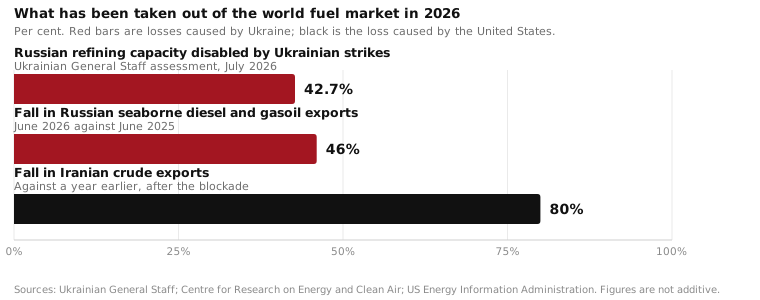
Since the start of the year, Ukraine has conducted more than sixty long-range drone strikes against at least twenty-four Russian refineries. It has hit all eleven of Russia's largest. By July, Ukraine's General Staff assessed that 42.7% of Russia's designed refining capacity had been disabled. Russian Forbes put the share of refineries damaged at 54%.
The effects are measurable in Russian output. Refinery runs fell to a 24-year low. In July, refineries processed about 3.6 million barrels a day, roughly a third below the seasonal norm. Petrol output ran at 75,000 to 80,000 tonnes a day against domestic demand of 115,000 to 120,000. The Moscow refinery at Kapotnya, which supplied a large share of the capital region's fuel, is expected to stay offline into 2027.
This is the most effective thing anyone has done to Russia's war economy in four and a half years, and it is worth being precise about why.
Sanctions attack Russian revenue, and Russia has learned to evade them. The seaborne crude price cap sits at $44.10 a barrel, frozen for twelve months by the EU's twenty-first package. Russia routes around it: by April, sanctioned shadow-fleet tankers carried a record 54% of its fossil fuel exports, and export revenues still ran at roughly half a billion euros a day.
Drones attack Russian capability, and Russia cannot route around a burned distillation column. A refinery is a fixed, expensive, slow-to-repair asset that cannot be reflagged or sold through an intermediary in Dubai.
Sanctions ask other countries not to buy. Drones remove the thing being sold. Only one of those depends on the cooperation of people who do not want to cooperate.
What it did inside Russia
By mid-year the damage had stopped being an industrial statistic and become a domestic political problem.
Fuel rationing was introduced in more than twenty Russian regions. Since June, more than ninety percent of Russian regions have seen shortages or rationing. Queues formed at filling stations across the country, a specific and unwelcome image for a government whose founding claim is competence and order.
Moscow responded by closing its own exports. It banned diesel exports outright, applying the measure to producers as well as traders, and extended the petrol export ban to the end of 2026. Deputy Prime Minister Alexander Novak said the diesel restriction would be lifted only "as the market recovers."
That decision is the hinge of this whole story. Russia accounted for roughly eleven percent of world diesel supply. In June its seaborne diesel and gasoil exports fell forty-six percent against a year earlier. A country that had been forced to stop exporting fuel was, from the world market's point of view, indistinguishable from a country that had been sanctioned into stopping. Except that this time nobody had chosen it, and nobody could reverse it.
Why an American pump price became the deciding number
Diesel is not petrol. Almost nothing in a modern economy moves without it: trucks, trains, ships, tractors, generators, excavators. A petrol price is a household grievance. A diesel price is an input cost that passes into food, construction, freight and every delivered good, with a lag of weeks.
Two shocks hit that one product at once in 2026.
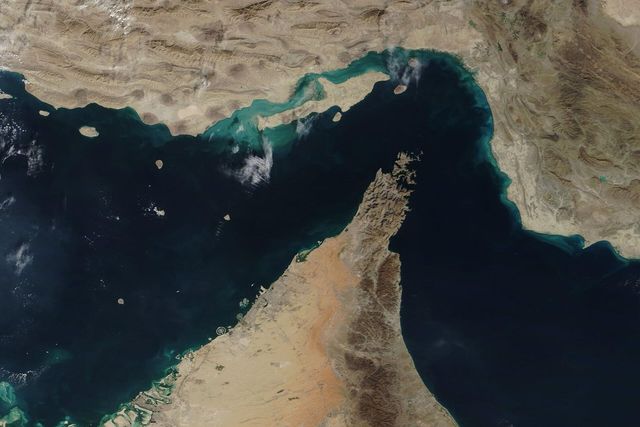
The first was the Iran war. Iran closed the Strait of Hormuz on 28 February; American blockade and strikes cut Iranian crude exports by more than eighty percent against a year earlier; and on 11 September Saudi Arabia shut the East–West pipeline, the only large route carrying oil past the strait, after drones launched from Iraq struck its pump stations.
The second was Ukraine's refinery campaign, which removed Russian refined product from the same market.
Crude and refined fuel are not interchangeable. The world can be moderately supplied with crude and still short of diesel if the refineries that make diesel are on fire or out of reach. That is precisely the position it is in. And the United States, a net exporter of crude, is a marginal importer of distillate on both coasts, which is why a global diesel squeeze shows up quickly on an American forecourt, and from there in the inflation numbers the Federal Reserve is meeting to discuss.
Sixty-three percent in a year, on the fuel that moves everything, seven weeks before a midterm election, is not an energy statistic. It is a political emergency, and it has reordered what Washington wants.
The reversal nobody announced
Trump's statement on Sunday was not the first step in this direction. It was the last step so far in a sequence that began in March and was never presented as a policy change.
When Hormuz closed, the Treasury issued a thirty-day waiver permitting buyers to take Russian-origin crude and products loaded before 12 March, even where sanctioned entities or tankers were involved. Secretary Scott Bessent said the action would "promote stability in global energy markets." The waiver was extended in April and widened to all buyers in an effort to hold prices down. India and Indonesia lobbied for more.
So the position reached by September is this. The United States has spent four years trying to reduce the revenue Russia earns from oil. In March it began licensing that oil into the market because it needed the barrels. In September it asked Ukraine to stop destroying the refineries because it needs the diesel.
Russian oil has completed a journey in six months from the thing America sanctions to the thing America protects. Nobody in Washington ever stood up and said so.
And it happened alongside the opposite policy toward Iran. The same administration is sinking Iranian tankers precisely in order to remove Iranian oil from the market, and has told the world that the pressure will continue until Tehran yields. Two adversaries, two oil industries, two exactly contrary American policies, running in the same week.
The distinction is not strategic. It is arithmetic. Iranian crude has already been substantially removed and its further loss is priced in. Russian diesel is the marginal barrel, and the marginal barrel sets the price. Washington is not choosing between enemies on any principle of statecraft. It is choosing whichever enemy's exports are currently cheapest to lose.
What this costs Ukraine
For Kyiv the request is close to intolerable, and for a reason more fundamental than pride.
Ukraine's position is that refineries are legitimate military targets because Russian oil both funds the invasion and fuels it directly: the same distillate moves Russian armour. Zelensky has tied his own energy strikes to Russia's attacks on the Ukrainian grid, saying that if Russia causes blackouts in Ukraine, "we will try to respond to them in kind." Russia has spent four winters trying to freeze Ukrainian cities.
Consider what compliance would mean. Ukraine would be asked to stop using its single most effective weapon, developed domestically, requiring no Western permission and no Western ammunition, at the exact moment it is working best, in order to protect the enemy's fuel supply, in order to lower petrol prices in a country that is not at war, before an election Ukraine cannot vote in.
It would also be a lesson about leverage. Ukraine's long-range drone programme exists because Western missile supplies came with restrictions on where they could be aimed. The drones were the answer to that: a weapon nobody could veto. If the drones can now be vetoed by a phone call, Ukraine has no unconstrained instrument left.
Refusal has its own cost. American intelligence sharing, Patriot interceptors and the flow of everything Ukraine cannot make are not guaranteed, and this administration has shown it will use them as leverage. That is the trap. The weapon that works is the weapon that annoys the patron.
The counter-case
Three arguments say Trump is right, and they are stronger than Kyiv's supporters concede.
A global public good is being destroyed. Refining capacity is not a Russian asset in the sense that a tank is. Its output reaches Africa, South Asia and Latin America, where a diesel spike is not an inconvenience but a food-price and transport crisis. Poor countries are paying for a Ukrainian strategy they had no part in choosing. That is a serious moral claim.
Escalation risk is real. Russia has answered refinery strikes by attacking Ukrainian energy infrastructure, and last week by striking near the Polish border. A campaign that drives Russian domestic fuel rationing pushes a nuclear-armed state toward a response it has so far avoided.
It may not end the war. Russia's refining problem is severe but not fatal. Crude exports, the actual revenue line, continue. Russia can import fuel from Belarus and China and has done so. A Ukraine that sacrifices its relationship with Washington for a campaign that degrades Russian comfort rather than Russian capability may be trading the strategic for the tactical.
Each of these deserves an answer rather than a dismissal. But notice what none of them is. None is an argument that Ukraine should stop because stopping helps Ukraine. They are arguments that Ukraine should stop because stopping helps everyone else, which is a request for a favour, not a strategy. And a request for a favour has a price, which is the thing Washington has not offered.
What it does to sanctions
The lasting damage here may not be to Ukraine at all. It may be to the credibility of economic coercion as an instrument.
The theory of sanctions is that a coalition accepts shared costs in order to impose concentrated costs on a target, and holds the line because the alternative is worse. What 2026 has demonstrated is the condition under which that theory collapses: when the price of the sanctioned commodity rises far enough, the sanctioning power quietly becomes a customer.
Every government now watching has learned the same three things. American sanctions on energy hold until American fuel prices rise. The exemption arrives without announcement, as a licence rather than a policy. And a target that can make itself systemically important to a market is substantially safer than one that cannot.
That lesson will outlast this war. It will be applied by Beijing when the subject is chips, by Riyadh when the subject is oil, and by anyone calculating how deeply to entangle themselves with the global economy before doing something the United States dislikes. The answer is now clearly: as deeply as possible.
What to watch
- Whether Ukraine complies. The next fortnight will show it. A visible pause in refinery strikes means the leverage worked and Kyiv has accepted a constraint it cannot easily lift.
- Whether Russia lifts the diesel export ban. Novak said it goes when the market recovers. If it goes without a recovery, Moscow has understood that its exports are now a diplomatic asset and will price them accordingly.
- The next Treasury licence. A wider waiver on Russian oil, especially one covering fresh cargoes rather than pre-loaded ones, would confirm that sanctions policy is now subordinate to the diesel price.
- The diesel price itself. If $6.05 keeps rising into October, the pressure on Kyiv will not stay rhetorical.
The shape of it
For four and a half years, the Western position was that Russia's war could be strangled economically. Ukraine took that seriously, found the one method that worked, and applied it with drones costing a few tens of thousands of dollars each against assets worth billions.
The method worked, and it turned out that the West could not afford the result.
Russia has not defeated the sanctions regime. It has outlasted the price tolerance of the countries imposing it, which in the end is the same thing. The refineries will be spared not because the argument for hitting them was wrong, but because diesel is $6.05 and there is an election in November.
Comments
No comments yet. Be the first.
Comments are closed on this article.