
1. Geography creates value. Capability determines who captures it.
Tunisia occupies a strategic position at the intersection of the Mediterranean, North Africa and the wider Arab world. It borders Algeria and Libya and sits close to Europe. Geography therefore gives Tunisia geopolitical value. But geography alone does not determine who captures that value.
Capability matters.
For Europe, Tunisia is a migration and border-management partner on the central Mediterranean route. For the United States, it has long been a security and counterterrorism partner. Washington designated Tunisia a Major Non-NATO Ally in July 2015, making it the sixteenth country to receive that status. The formal designation reflected the strategic importance Washington attached to the bilateral relationship.
The security relationship is not merely symbolic. The U.S. State Department has described Tunisia as a "critical counterterrorism partner" in North Africa and beyond and documented substantial U.S. security assistance since 2011.
China represents a different form of external engagement. In May 2024, Beijing and Tunis established a strategic partnership, with cooperation covering areas including infrastructure, new energy, health, water, agriculture and green development.
The same geography can therefore generate different external demands. What matters is how the Tunisian state negotiates those demands, and what domestic structures emerge from that negotiation.
2. When external demand becomes domestic adaptation
The EU-Tunisia relationship illustrates the mechanism clearly.
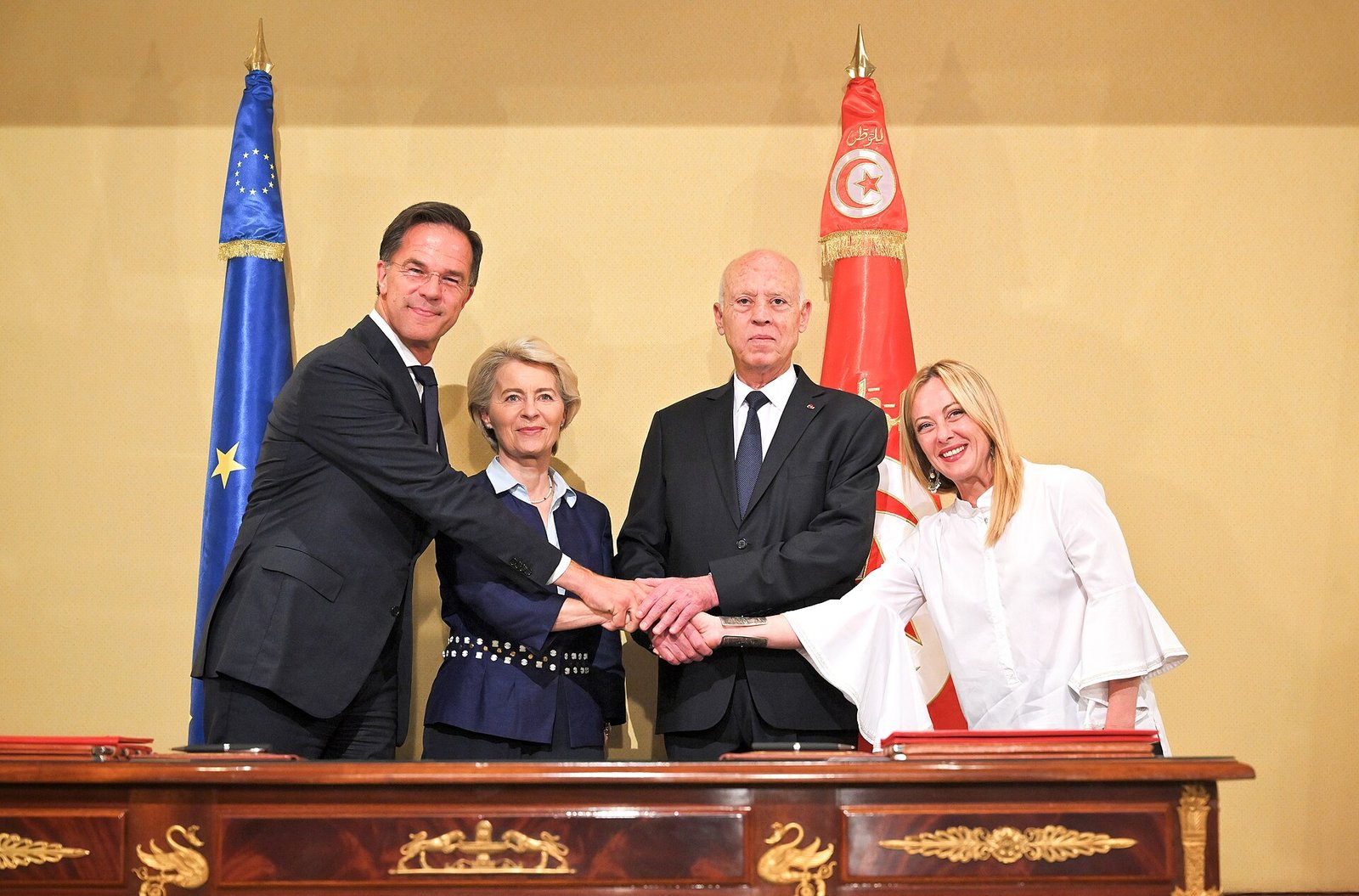
On 16 July 2023, the European Union and Tunisia signed a Memorandum of Understanding based on five pillars: macroeconomic stability, trade and investment, green energy transition, people-to-people contacts, and migration and mobility. The European Parliament's research service identified migration and mobility as the most important pillar and recorded €105 million in immediate aid for the Tunisian coastguard and border management. The same document described €900 million in proposed macroeconomic support and €150 million in direct budgetary support.
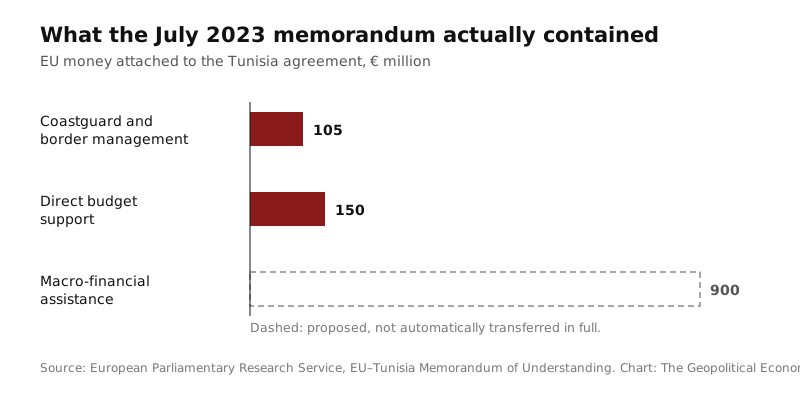
The distinction between these figures matters. The €105 million refers to migration-related assistance; €150 million was direct budget support; and €900 million was proposed macroeconomic assistance rather than money automatically transferred in full.
This is an unequal bargain, but not necessarily an irrational one.
Europe seeks to reduce irregular departures, strengthen border management and limit pressure on its southern frontier. Tunisia seeks financing, economic support, investment and diplomatic room. Each side possesses something the other needs.
The asymmetry arises because Tunisia's economic dependence can make the strategic value of its cooperation greater than its bargaining power over the terms of that cooperation.
This is where external demand becomes domestic adaptation.
A state does not merely receive an external function. It begins to reorganise incentives around that function.
3. From state capacity to regime capacity
The distinction between state capacity and regime capacity is essential.
State capacity is the ability of public institutions to implement policy, provide services, collect revenue, regulate markets and correct failures. Regime capacity is the ability of those in power to preserve political control, suppress challenges and maintain governing continuity.
The two can overlap, but they are not identical.
Tunisia's post-25 July 2021 trajectory demonstrates why the distinction matters. President Kais Saied suspended parliament, dismissed the prime minister and progressively concentrated executive and institutional authority in the presidency. Sarah Yerkes has described the process as a consolidation of power following what she termed Saied's "self-coup."
The analytical question is therefore not simply whether Tunisia became more authoritarian. It is whether the concentration of authority altered the mechanisms through which policy failure could be corrected.
Carnegie's later analysis is particularly relevant to the economic dimension: it argues that the lack of structural reforms and high spending after 2021 contributed to increasingly unsustainable macroeconomic policies, while the break with the IMF reduced Tunisia's traditional financing options.
This produces a crucial distinction:
A government can become more capable of surviving political pressure while the state becomes less capable of correcting economic or institutional dysfunction.
That is the difference between regime capacity and state capacity.
4. Saied's diversification is real, but it is not yet autonomy
Tunisia's move toward greater diplomatic diversification should not be dismissed.
The establishment of a strategic partnership with China in 2024 created additional diplomatic and economic options. Beijing has presented the relationship as one based on mutual respect, cooperation and support for development.
But diplomatic diversification is not synonymous with strategic autonomy.
A state can diversify its diplomatic partners while remaining materially dependent on external financing, markets, investment and security cooperation.
This distinction is especially important for Tunisia because Europe remains deeply embedded in its economy, while Washington retains an important security relationship and China offers an alternative diplomatic and economic channel.
Tunisia may therefore have more external options without yet possessing greater strategic autonomy.
Geopolitical maneuvering is not the same thing as autonomy.
5. Europe and America also participate in the equilibrium
External actors do not simply observe Tunisia's domestic transformation. They participate in the equilibrium through the functions they reward.
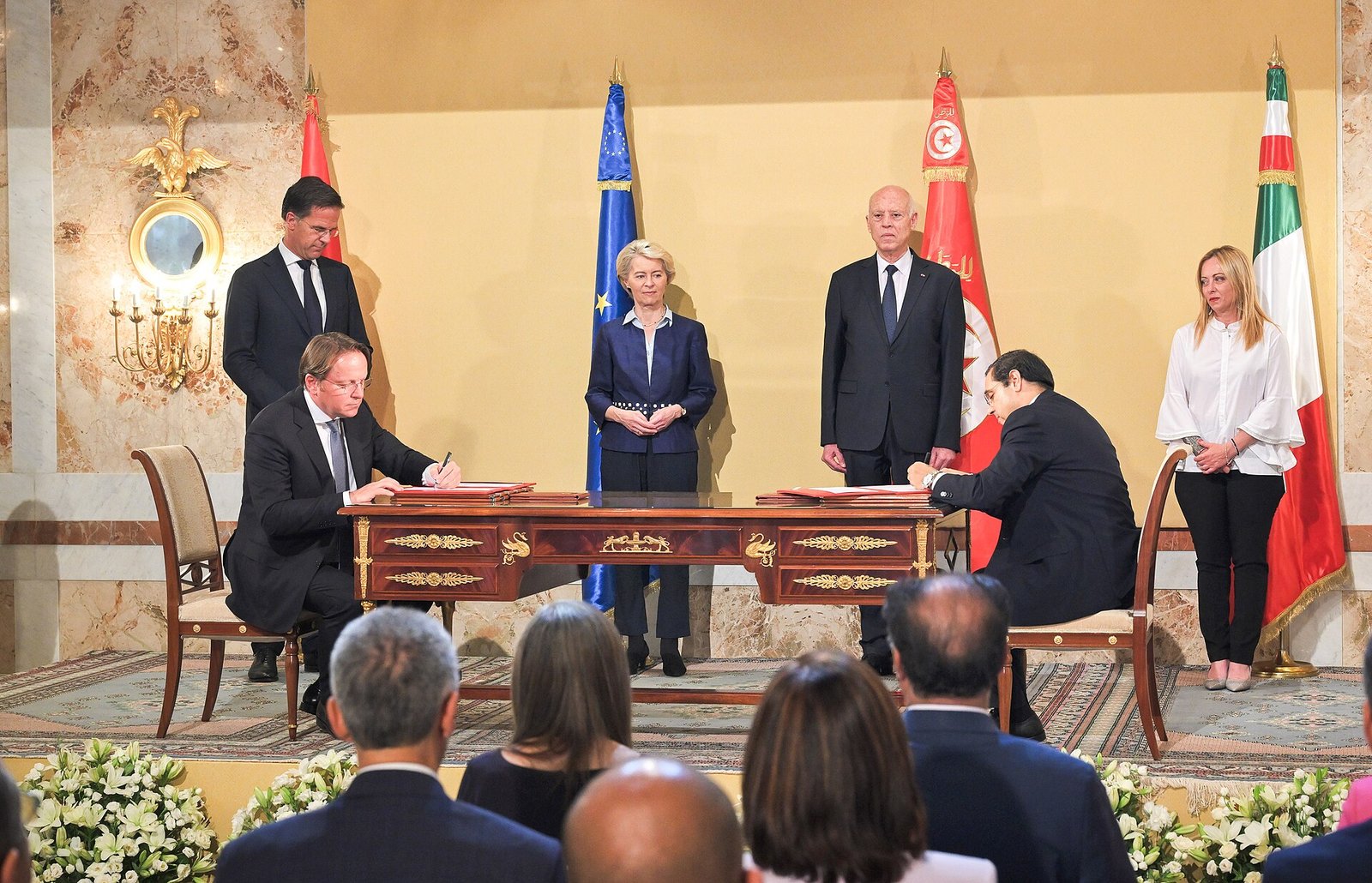
Europe's relationship with Tunisia increasingly connects migration management with financial and political cooperation. The 2023 MoU is an especially clear example because migration, economic support and broader partnership were incorporated into the same framework.
Washington's relationship is structured differently but produces a related strategic logic. Tunisia's MNNA status and long-standing counterterrorism cooperation give the country a defined security function within U.S. regional policy.
Neither relationship requires a conspiracy.
The mechanism is more structural.
External actors prioritise functions they consider strategically valuable. Tunisian governments have incentives to provide those functions. The government that performs them successfully can obtain resources, diplomatic support or political room.
The result can be a form of negative stability.
What is negative stability?
Negative stability is a condition in which a political system remains governable and externally useful because major actors prioritise continuity and risk reduction, while the underlying institutional or economic problems that generate instability remain insufficiently corrected.
It is "stability" because the system does not necessarily collapse.
It is "negative" because stability is achieved primarily by containing symptoms rather than resolving the structural causes of fragility.
In Tunisia's case, migration cooperation, security partnerships and external financial support can reduce immediate risks for both Tunisia and its partners without necessarily producing the institutional reforms, productive investment or economic restructuring required to reduce long-term dependence.
Negative stability is therefore not the absence of instability.
It is the management of instability.
6. Geopolitical value can become a political rent
This creates the missing question in the geopolitical-value argument:
Who actually captures the value generated by Tunisia's strategic position?
The answer is not necessarily "Tunisia" as a whole.
Geopolitical value becomes a political rent when control over a strategically valuable function generates resources, diplomatic support or political advantages without necessarily increasing the productive capacity of the wider economy.
The distribution of that rent can occur through several channels: public institutions responsible for external financing, security agencies implementing cooperation agreements, state-linked economic actors, and political authorities that convert external relationships into domestic legitimacy or political room.
The key issue is not to assume that every external euro or security programme is captured by a particular network. The analytical question is more precise:
Does external assistance expand general state capacity, or does it primarily reinforce the institutions and political arrangements that control strategically valuable functions?
This distinction matters because a government may receive resources for border management while unemployment remains high, or obtain diplomatic support while structural reforms remain incomplete.
The World Bank's current data illustrate the persistence of this contradiction. Public debt declined from 84.9% of GDP in 2024 to an estimated 82.2% in 2025, but remained well above the pre-COVID level of 67.8% in 2019. Unemployment stood at 15.2% in the fourth quarter of 2025.
The point is not that external assistance causes Tunisia's economic problems.
The point is that strategic value can generate short-term resources without automatically generating the structural transformation needed to reduce dependence on those resources.
That is the political economy of geopolitical rent.
7. The feedback loop
The process can therefore be represented as a feedback loop:
Geography → external demand → unequal bargaining → Tunisian adaptation → institutional and economic transformation → political appropriation → external accommodation → new dependence → renewed external demand.
The crucial step is political appropriation.
Once a government becomes the principal channel through which strategically valuable cooperation is organised, external relationships can reinforce the government's domestic position even when they do not resolve the underlying structural problems.
The result is a paradox.
The weaker the economic foundations of the state become, the more valuable certain external functions can become to the government.
Migration control, counterterrorism cooperation and diplomatic positioning acquire greater political value precisely because the state has fewer alternative sources of economic and strategic leverage.
This can produce a self-reinforcing equilibrium: economic weakness increases external dependence; external dependence increases the value of strategic functions; strategic functions generate short-term rents; short-term rents reduce the immediate pressure for structural correction; insufficient correction reproduces dependence.
That is how geopolitical value can gradually become part of the domestic architecture of the state.
8. Who, then, defines Tunisia?
Tunisia formally defines itself.
Its geopolitical environment, however, conditions what that self-definition can become.
Europe does not simply "make" Tunisia a migration state. Washington does not simply "make" it a security partner. China does not simply "make" it a diversification platform.
Rather, Tunisia's institutions, political leadership and external partners continuously negotiate these functions.
This is geopolitical co-production: the idea that a state's geopolitical role emerges through interaction between its own choices and the external demand generated by its strategic environment.
The concept does not imply equal bargaining power.
On the contrary, the most important feature of geopolitical co-production may be the inequality within the process.
Tunisia can formally choose diversification while remaining economically dependent. It can preserve legal sovereignty while possessing limited strategic autonomy. It can gain diplomatic room while losing institutional capacity.
The result is not foreign control in the classical sense.
It is something more subtle: a state increasingly shaped by the functions that external actors find valuable and the political incentives that those functions create domestically.
9. What would change this assessment?
The argument would weaken if Tunisia transformed diversification into measurable autonomy.
That would require more than new diplomatic partnerships.
It would require diversification of export markets, investment sources and financing; stronger productive capacity; reduced dependence on emergency external support; and institutions capable of correcting policy failures regardless of which political faction controls the executive.
If Chinese cooperation, European investment and American security assistance were converted into sustained productivity, infrastructure, human-capital development and stronger institutions, external engagement could increase rather than diminish Tunisia's strategic autonomy.
The decisive test is therefore not how many partners Tunisia has.
It is whether those partnerships increase the state's capacity to choose, or merely increase the number of actors on which it depends.
Tunisia's geopolitical value is real.
But geopolitical value is not the same as geopolitical power.
A country can be strategically important and still strategically constrained.
The central question is therefore not simply who defines Tunisia.
It is who captures the value created by Tunisia's position, through which institutions, and with what consequences for the state itself.
Sources: U.S. White House archival memorandum on Tunisia's MNNA designation, July 2015 · U.S. State Department: Joint Statement with Tunisia, 2015 · Chinese Ministry of Foreign Affairs: Xi Jinping's talks with President Kais Saied, May 31, 2024 · European Parliament Research Service: EU-Tunisia Memorandum of Understanding · Georgetown Journal of International Affairs: Can the International Community Stop Tunisia's Authoritarian Regression? · Carnegie Endowment: Kais Saied's Grip on Tunisia Comes at a High Cost · Chinese Ministry of Foreign Affairs: China–Tunisia strategic partnership · World Bank: Tunisia Economic Monitor, Fall 2025.

Comments
No comments yet. Be the first.
Comments are closed on this article.