
Egypt's economic improvement since 2024, reflected in faster growth, sharply lower inflation and rebuilt reserves, is often described as the payoff from a hard, IMF-backed reform program. Much of that improvement reflects genuine adjustment and reform. But the event that most immediately eased Egypt's foreign-exchange constraint was not a structural reform. It was the sale of development rights to a stretch of Mediterranean coastline to Abu Dhabi. That transaction helped Egypt bridge a period in which one of its most important recurring sources of foreign currency, the Suez Canal, suffered a severe and sudden collapse in revenue. The canal is now recovering, but remains well below its pre-crisis revenue level, and the deal that bought Egypt time was, by its nature, a one-off. The distinction matters because reserves can be rebuilt by financing even when recurring foreign-currency earnings have not yet fully recovered. The open question is not whether Egypt's recovery is real. It is whether the country's recurring capacity to earn foreign currency has actually been restored, or whether an exceptional capital injection is still doing work that structural earnings have not yet taken back over.
A Record Deal, Timed to a Shock
In February 2024, Abu Dhabi's ADQ signed what Egyptian officials called the largest foreign direct investment deal in the country's history: $35 billion, of which $24 billion bought the development rights to Ras El-Hekma, roughly 170 square kilometers of coastline west of Alexandria, with the remaining $11 billion converting UAE deposits already held at Egypt's central bank into project investment. Egypt retained a 35% stake in the development. The payments were heavily front-loaded: about $15 billion was transferred in the initial stage, followed by a further $20 billion within roughly two months, according to Egyptian government statements. That capital inflow helped ease Egypt's external position quickly. The central bank reported that foreign currency inflows to the local market jumped sharply, and net international reserves reached $46.38 billion by the end of June 2024, a record at the time. The government also allowed the Egyptian pound to depreciate sharply in March 2024, bringing the official exchange rate much closer to the parallel-market rate that had distorted the economy for two years. The IMF's own account of the period is telling: the Fund's program with Egypt, originally $3 billion and approved in December 2022, had stalled through 2023 as reform implementation slowed, and it was only after the Ras El-Hekma deal that the Fund's Executive Board approved augmenting the program to roughly $8 billion, in March 2024, alongside its review of Egypt's exchange-rate and fiscal reforms.
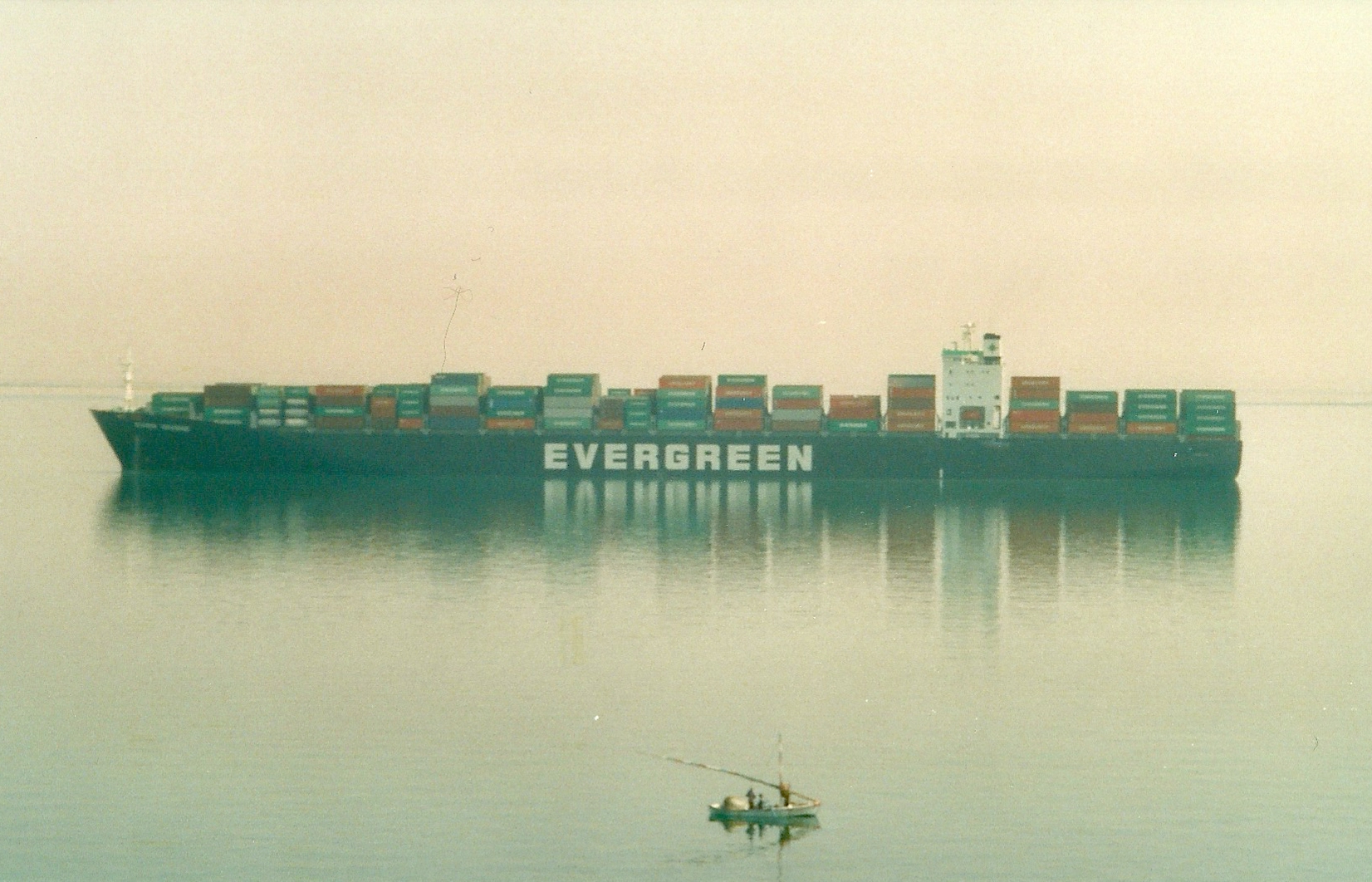
While that deal was closing Egypt's financing gap, one of the country's other major recurring earners of foreign currency was absorbing a severe shock. The Suez Canal generated a calendar-year record of $10.25 billion in 2023, according to the Suez Canal Authority. Houthi attacks on Red Sea shipping, which began in late 2023 in response to the war in Gaza, cut canal revenue to $3.99 billion in 2024, a fall of roughly 61%, as vessel traffic dropped by about half and net tonnage fell by more than 65%. The canal has since begun a partial recovery in revenue. Suez Canal revenues increased during fiscal year 2025/26, while the authority reported that first-half revenues that year were 18.5% above the comparable period a year earlier. The Suez Canal Authority has also projected revenues of roughly $8 billion in fiscal year 2026/27 and $10 billion in 2027/28. Laid out in sequence, the trajectory is stark: a record year, a collapse of roughly 61%, a slow climb back, and a projected return toward the previous peak still two fiscal years away.
What Egypt's Financing Strategy Actually Rests On
It matters, for the strength of any argument built on this comparison, to describe the IMF's current program accurately rather than to overstate it. In its most recent reviews, completed in 2026, the IMF did highlight a plan to reduce Egypt's gross financing needs by roughly 10% of GDP through fiscal year 2026/27. But the Fund's own breakdown shows that reduction coming overwhelmingly from debt management, not asset sales: roughly 2.5% of GDP in fiscal year 2026/27 from extending the maturity of domestic treasury bills, another 2.3% from voluntary liability-management operations, and only about 0.2% from divestments; in 2025/26 the bulk also came from longer maturities, with proceeds from land sales to Qatar adding under 1% of GDP. The IMF's current financing strategy is not fundamentally an asset-sale strategy. That matters because it keeps this article from making a stronger claim than the evidence supports: Egypt's forward financing plan does not, on the Fund's own numbers, depend on repeating Ras El-Hekma-scale transactions.
The more defensible version of the argument is narrower, and, in a way, more interesting: Egypt's 2024 stabilization was materially enabled by an exceptional, one-off foreign-currency injection, arriving at precisely the moment one of its most important recurring earners had suffered a severe shock. Recurring flows and one-off transactions behave differently over time by definition. Canal revenue regenerates every year the canal is usable and competitively priced; a coastal development-rights sale does not repeat unless Egypt sells something comparable again. The improvement in growth and inflation that followed the 2024 stabilization shows that the economy moved away from the immediate crisis conditions. It does not, by itself, tell us whether Egypt's recurring foreign-exchange earning capacity, including that of the canal, has actually been restored to where it stood before the shock. That is a separate question, answerable only by tracking the canal's own recovery path against the debt-service obligations it is meant to help cover.
A Real, if Partial, Diversification
The case for cautious optimism is real and should not be understated. Remittances from Egyptians working abroad, which had increasingly been flowing through informal channels amid the large black-market currency premium before 2024, rose sharply following the exchange-rate unification and reached record levels; the central bank reported a record $47.3 billion in remittances in fiscal year 2025/26, up nearly 30% from the previous year. The unification of the exchange rate reduced the incentive to route remittances through informal channels, which may have contributed to that rise, although other factors, including stronger economic conditions among Egyptians working abroad, were also likely involved. Tourism has continued to grow. The more flexible exchange-rate regime the IMF had pushed for since 2022 has, on the Fund's own account, helped Egypt absorb episodes of portfolio-investor exit from its domestic debt market without triggering a repeat currency crisis, something that would not have been possible under the fixed, dual-rate system in place before 2024. Egypt in 2026 is not a country with no structural earnings at all, propped up entirely by a single transaction that has since been spent. It is a country where two of its most important recurring sources of foreign currency, the canal and remittances, took very different paths after 2024, one collapsing and recovering slowly, the other accelerating, while a single exceptional transaction helped cover the external financing gap created during the adjustment.
A Different Mechanism Than Nigeria's
Nigeria's 2025-26 sovereign rating upgrade illustrates a different mechanism worth noting briefly. There, structural reforms, fuel subsidy removal and currency liberalization were already underway when favorable oil-related developments improved the external position further. Egypt's 2024 stabilization worked differently: an exceptional capital inflow arrived just as a major recurring earner was suffering a severe shock, and the currency reform followed soon after. In Nigeria, an external tailwind reinforced an already-running reform program. In Egypt, a one-off transaction temporarily compensated for the loss of income from a structural earner that had just been hit hard.
What Would Prove This Wrong
The distinction between a temporary bridge and a durable restoration of recurring foreign-currency capacity is testable against specific indicators. If Suez Canal revenue and vessel traffic continue toward their pre-crisis levels by fiscal year 2027/28, in line with the canal authority's own projections; if remittances and tourism receipts continue growing on their current trajectories; and if Egypt's reserve accumulation and external financing needs come to rely progressively less on privatizations and large one-off capital transactions, that combination would indicate the 2024 stabilization was a well-timed bridge that gave a genuine structural recovery time to happen. If instead Suez revenue or traffic stalls materially below that trajectory, and the government continues to generate significant financing from privatizations, land sales and other asset transactions at a scale large enough to remain a material source of foreign-currency financing, that combination would suggest the 2024 transaction did not simply buy time for a recovery already underway, but continues to compensate, on an ongoing basis, for an earnings capacity that has not fully returned. Both sets of indicators are published regularly, by the Suez Canal Authority, Egypt's central bank, and the IMF's own program reviews.
Conclusion
Ras El-Hekma did not replace Suez Canal revenue. It bought Egypt time to absorb the shock of losing it. The growth and inflation improvements that followed are real, and so is the partial recovery of the canal itself. What they do not yet settle is whether Egypt's underlying, recurring capacity to earn foreign currency has been restored. The Suez Canal's own published trajectory over the next two fiscal years, rather than the headline growth number from 2026, will provide the more revealing test.



Comments
No comments yet. Be the first.
Comments are closed on this article.