
In August 2025, the United States imposed a 30% reciprocal tariff on South African goods and, through a combination of new duties and shifting exemptions, significantly eroded the commercial value of the country's preferential access under the African Growth and Opportunity Act. Three months later, President Trump barred South Africa from the 2026 G20 summit in Miami and halted all US payments and subsidies to the country, citing a dispute over unproven claims of persecution against white farmers. By most conventional measures, this should have been a serious economic shock. Instead, the rand closed 2025 up nearly 13% against the dollar, its best year since 2009, and precious metals, a substantial share of South Africa's export base, had one of their strongest years in decades. A few hundred kilometers away, inside the same currency union, Lesotho absorbed the same broad US trade-policy shift and came close to losing its entire garment export industry. The difference between these outcomes is not primarily about politics. It is about what each country sells, how concentrated its markets are, and how much of the value of those exports survives when the buyer changes.
Two Economies, One Currency, One Policy Shift
South Africa, Lesotho, Namibia and Eswatini form the Common Monetary Area, under which the Lesotho loti and the Eswatini lilangeni are pegged one-to-one to the South African rand. All four, plus Botswana, belong to the Southern African Customs Union, which sets a common external tariff. Lesotho is a landlocked enclave entirely surrounded by South African territory. When the United States turned commercially and diplomatically hostile toward the region in 2025, it was, in a narrow sense, moving against the same currency and customs bloc at the same time. The two economies most exposed experienced that shift in almost opposite ways.
South Africa's 30% reciprocal tariff took effect on August 8, 2025, replacing the 10% baseline duty in force since April. But the exposure was uneven from the start: South African trade officials indicated that roughly 35% of exports to the US were exempt from the reciprocal tariff, while automobiles, steel and aluminum fell under separate Section 232 regimes. Crucially, gold and platinum-group metals, among South Africa's most globally traded exports, were exempt altogether. AGOA itself was not repealed; its extension through December 31, 2028, was signed into law in September 2026. What changed was that the new tariffs neutralized much of its practical value for the product categories that remained exposed. Despite this, real GDP growth strung together four consecutive positive quarters through the third quarter of 2025, according to figures President Cyril Ramaphosa cited in his February 2026 State of the Nation address, and the government recorded two consecutive primary budget surpluses. The South African Reserve Bank's own trade data shows the US accounted for just 7.1% of South Africa's total exports in 2025, and that exporters had already begun redirecting volumes elsewhere as the dispute unfolded.
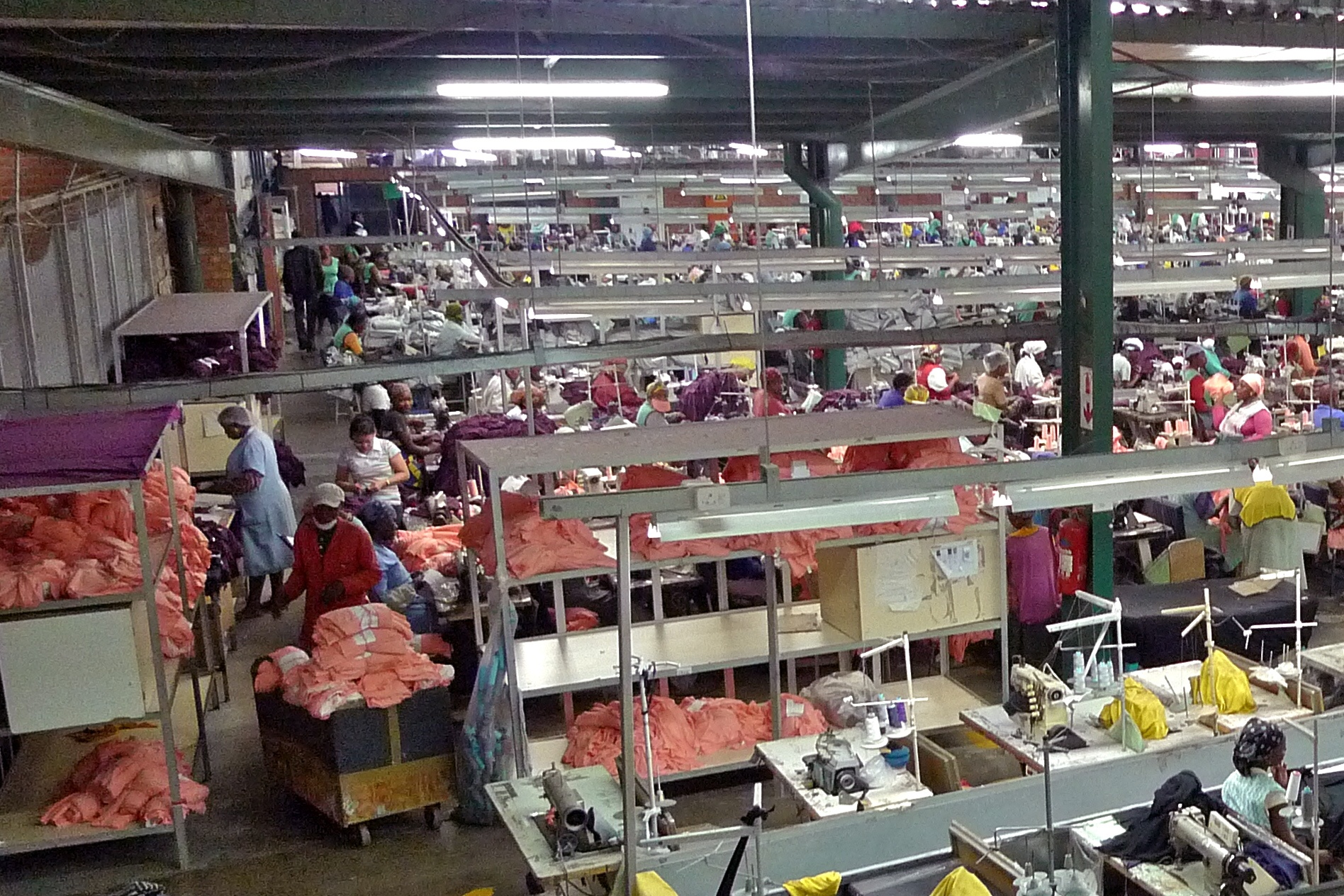
Lesotho's exposure ran through a single, concentrated channel: garments, which made up roughly 80% of its sales to the United States, itself about a fifth of the country's total exports, according to the IMF. Trump's initial "Liberation Day" tariff in April 2025 set Lesotho's rate at 50%, the highest imposed on any country, a figure trade minister Mokhethi Shelile said was "not based on facts." The rate was later reduced to 15% in August 2025, but the damage from months of uncertainty had already been done. American buyers, spooked by the threat of a tariff that could return at any time, halted new orders. The tariff shock did not create Lesotho's vulnerability from scratch; its garment industry had already been losing US market share for years despite AGOA preferences, exposing the limits of a development model built almost entirely around preferential access to one buyer. Factories that had produced denim for Levi's and Wrangler for two decades began shutting down; Lesotho Precious Garments and its subsidiary alone put roughly 5,000 jobs at risk. The IMF estimated the shock could cut Lesotho's US exports by half within a year and by up to 70% over the medium term, a permanent 0.5 percentage point hit to GDP growth in a country of roughly 2.3 million people. The government declared a two-year national state of disaster in July 2025.
Value That Travels, and Value That Does Not
The temptation is to explain this divergence in political terms: South Africa is a G20 economy with diplomatic weight, Lesotho is a small, dependent neighbor with none. That is part of the story, but it does not explain why South Africa's resilience held up even as relations with Washington deteriorated further. The more useful question is not how dependent a country is on a given market, but how much of the value of what it sells depends on continued access to that specific market. Two countries can each send a fifth of their exports to the same buyer and face entirely different consequences if that buyer turns hostile, depending on whether the exports can be redirected elsewhere at close to full value, or whether the value was built into the relationship itself.
Gold and platinum-group metals sit near one end of this spectrum. A tonne of gold sold in Zurich, Dubai or Shanghai is, for pricing purposes, interchangeable with a tonne sold in New York. When a buyer becomes politically unavailable, a producer of this kind of export can redirect the same good elsewhere at close to the same global price, because the commodity carries little relationship-specific value. Garments manufactured in Lesotho under AGOA's rules of origin sit near the other end. Their value depended on one specific, largely non-transferable feature: duty-free entry into a single market. Strip that away, and the same jeans that were viable at zero tariff become uncompetitive against production in countries facing lower rates, not because Lesotho's labor became less productive, but because much of the product's value was never in the garment. It was in the access.
This is not a clean dichotomy between commodities and manufactured goods. Fungibility itself comes in degrees. Oil is broadly fungible but can trade at a discount when sanctions force it through longer routes. Agricultural goods are often redirectable but perishable. Minerals can be fungible in principle but immobile if they depend on a single pipeline or port built for one customer. Services can be portable in theory but bound by licensing or regulatory recognition that does not cross borders. The right measure is not fungible versus non-fungible, but how much of an export's value is portable, how much survives the loss of one buyer, versus how much was created by, and is inseparable from, that specific relationship. South Africa's gold sits toward the portable end. Lesotho's AGOA-dependent garments sit close to the other.
Where Geopolitics Fits, and Where It Does Not
South Africa's resilience has not translated into diplomatic accommodation with Washington. From January 9 to 16, 2026, China, Russia and Iran joined South Africa for naval exercises off Simon's Town, named "Will for Peace 2026" and led by China, described by South African officials as a response to maritime tensions and by outside analysts as a statement of BRICS solidarity aimed partly at Washington. On February 14, 2026, at the African Union Summit in Addis Ababa, Xi Jinping announced China would extend zero-tariff treatment to 53 African countries with diplomatic ties to Beijing, from May 1, 2026. These moves matter here only as illustrations of the mechanism's limits. China absorbing more South African platinum, gold or coal changes little about the terms of those trades, because the commodities were never uniquely tied to the US market. China's zero-tariff gesture does far less for Lesotho, whose comparative advantage was built around AGOA-oriented garment supply chains; redirecting that industrial base requires new buyers, new logistics and years of relationship-building that a small economy in a declared state of disaster cannot undertake quickly. Market diversification is only as useful as the portability of what is being diversified.
This mechanism is not unique to southern Africa or to 2025. Western sanctions on Russia after 2022 followed a similar logic. Russian crude, a fungible commodity, kept finding buyers in India and China at a discount once European markets closed, cushioning Kremlin export revenue even under heavy sanctions. Russian industries dependent on specific Western-made components were far harder to sustain, because their value depended on inputs and relationships that could not be replaced at the same speed. South Africa and Lesotho demonstrate the mechanism within a single regional shock. Russia shows it recurring in an entirely different geopolitical context, which is what makes it a mechanism rather than a regional coincidence.
A Framework, Not Just a Forecast
None of this means South Africa's rupture with the United States is costless. The Citrus Growers' Association of Southern Africa warned in April 2025 that the tariffs threatened 35,000 jobs tied to citrus exports, a sector with far less pricing flexibility than gold mining. Nor is Lesotho's crisis necessarily permanent; a trade delegation led by Shelile to Washington in September 2025 secured assurances that AGOA access would be preserved, reflected in the programme's extension through 2028, though how much commercial value that restores for garments still depends on the tariff schedule layered on top of it.
What the comparison establishes, more durably, is a way of measuring trade vulnerability that goes beyond export concentration. Vulnerability cannot be measured only by the share of exports sold to a particular country. It must also be measured by the portability of the value embedded in those exports, how much travels with the good itself, and how much was created by, and depends on, one specific market relationship. A monetary and customs union does not equalize exposure to an external shock among its members: the adjustment burden should tend to be concentrated among low-portability exporters and more widely dispersed among high-portability ones. The specific tariff rates, the specific American president, and the specific G20 host city will change. The underlying principle will remain.
The deepest form of trade dependence, then, is not dependence on a buyer. It is dependence on a buyer for the value of what you sell.
Sources: The White House: Further Modifying the Reciprocal Tariff Rates (31 July 2025) · South African Government: response package to lessen the impact of US tariffs (August 2025) · CNN: Trump bars South Africa from the 2026 G20 (26 November 2025) · Reuters: Rand ends 2025 up nearly 13% on the dollar · NBC News: Gold and silver prices soar in 2025 · IMF Working Paper 07/158: The Common Monetary Area in Southern Africa · Freight News: US tariffs exclude key SA mineral exports · The White House: H.R. 6500 signed into law (2 September 2026) · Africa Check: SONA 2026 data (February 2026) · South African Reserve Bank: Quarterly Bulletin, trade · IMF: Kingdom of Lesotho 2025 Article IV Consultation, staff report (September 2025) · IMF: Lesotho Article IV press release (17 September 2025) · CBC: Lesotho reacts to 50% US tariff (April 2025) · Reuters via Kitco: Despite tariff reprieve, Lesotho says it is already hurting (4 August 2025) · NPR: Lesotho's garment industry and the tariffs (20 July 2025) · Lesotho Times: 5,000 textile jobs at risk (June 2025) · Moneyweb: Lesotho declares unemployment a national disaster (July 2025) · USNI News: Chinese, Russian, Iranian warships gather near South Africa (9 January 2026) · China Global South Project: China's zero-tariff access for Africa (16 February 2026) · Washington Post/AP: South African citrus growers warn of 35,000 jobs at risk (8 April 2025) · TimesLIVE: Lesotho hopeful of AGOA extension after trade minister's US visit (25 September 2025) · Reuters: Russian Urals crude discounts to Brent.
Comments
No comments yet. Be the first.
Comments are closed on this article.