
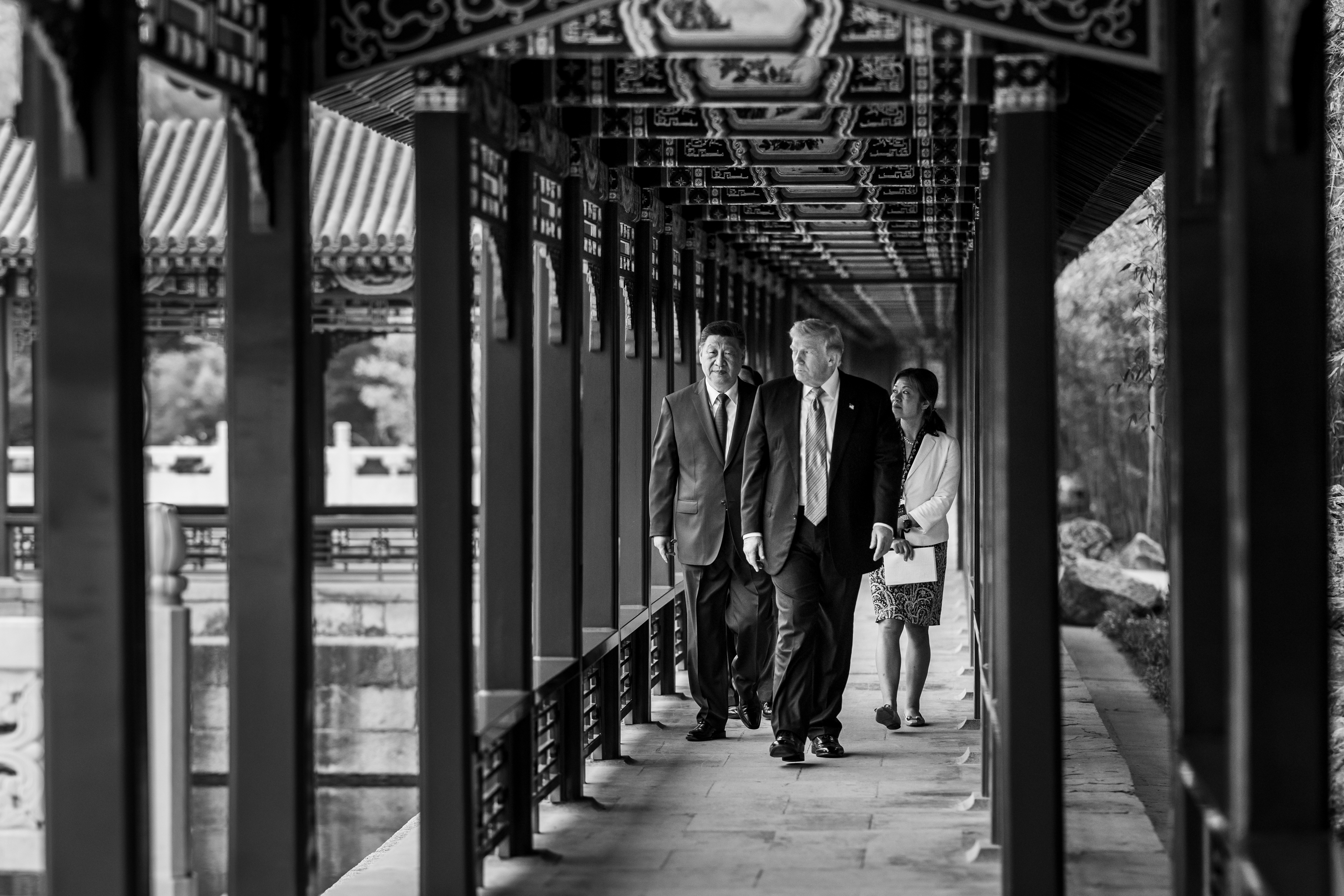
Xi Jinping lands at Joint Base Andrews tomorrow for a three-day summit that the White House is framing as a meeting of equals. It is not.
One leader arrives with the world's largest rare earth reserves, a trade engine that grew exports 13.4% in the first half of 2026, and energy stockpiles that cushion his economy from the oil shock ripping through everyone else's. The other arrives with record diesel prices, a Federal Reserve that just raised interest rates for the first time since 2023, a war in Iran entering its seventh month, and a trade truce that expires in five weeks.
The consensus in Washington is that this summit is a negotiation between rivals. The reality is simpler. One side needs a deal. And it is not China.
In this article, we argue that China will extract exactly what it wants from this summit — lower tariffs, continued rare earth leverage, delayed Taiwan arms sales, and breathing room on chip restrictions. And here is the uncomfortable part: that might be the best outcome for the American economy right now.
What Does Xi Bring to Washington?
Start with the leverage no one can replicate.
China controls 71% of America's rare earth imports — the dysprosium and neodymium that go into F-35 engines, Patriot missile guidance systems, and every electric vehicle motor on the road. When tariffs hit 145% in April 2025, Beijing did not blink. It imposed export restrictions on heavy rare earths and permanent magnets, threatening to halt American defence production. By October, it went further: a foreign direct product rule that required Chinese government approval for any product containing even trace amounts of Chinese-sourced rare earth materials.
It worked. Trump flew to Busan.
The Busan Truce of October 30, 2025 cut tariffs from a blended rate that had reached 57% down to 47%, suspended Section 301 maritime investigations, and — critically — suspended China's rare earth export restrictions for one year. That year expires on October 30, 2026. Five weeks from now.
Xi does not need to threaten. The clock does it for him.
Then there is energy. While the United States fights a war in the Middle East that has pushed Brent crude past $100 a barrel and American diesel to a record $6.50 per gallon, China has done the opposite. As the Council on Foreign Relations noted last week, Beijing "built the strongest buffers against the energy shock by stockpiling reserves and diversifying imports," positioning itself as the global clean energy leader in solar, wind, and batteries.
And then there is the trade engine itself. In the first half of 2026, China's high-tech manufacturing grew 13.3%. Semiconductor exports surged 88.7%. New-energy vehicle production grew 6.7%. Whatever the trade war was supposed to accomplish — decoupling, reshoring, containment — China's industrial machine is running faster than before it started.
Why Does America Need This Deal More?
Here is where it gets uncomfortable.
The Iran war is now on Day 206. The Houthis have captured the port of Mokha, threatening shipping through Bab el-Mandeb. Saudi pipeline infrastructure has been hit. Oil is above $100. American diesel is at record highs. And Fed Chair Kevin Warsh has responded by warning at Jackson Hole that "inflation is too high, and has been for too long" — then raising rates.
Higher fuel costs hit American farmers and truckers hardest. Diesel powers freight, agriculture, and industrial production. When diesel rises, everything rises with it.
Now add the trade clock. The Busan Truce expires October 30. Without an extension, tariffs on Chinese goods snap back to 57%. China's rare earth suspension expires simultaneously. American manufacturers who depend on Chinese neodymium — and that is nearly all of them — face a supply cliff.
And the agricultural deal that was supposed to ease the pressure? China committed to purchasing $17 billion in American agricultural products. Actual purchases are roughly half that. American soybean farmers, already paying six-dollar diesel, are watching their export market evaporate.
Consider the scoreboard.
| Pressure Point | United States | China |
|---|---|---|
| GDP growth (Q2 2026) | Slowing | 4.3% (weak, but positive) |
| Fuel costs | $6.50/gal diesel (record) | Stable (stockpiled reserves) |
| Central bank | Hiking rates | Cutting rates |
| Active war | Iran, Day 206 | No active conflict |
| Rare earth supply | 71% dependent on China | World's largest producer |
| If Busan expires | Tariffs rise to 57% | Rare earth ban resumes |
| High-tech exports (H1) | AI chips restricted | +88.7% semiconductor exports |
Read that table and ask yourself: who walks away from this summit if it fails?
The Kindleberger Trap: When No One Leads
Everyone knows the Thucydides Trap — the idea that war becomes likely when a rising power threatens an established one. Graham Allison made it famous. It gets cited at every US-China conference on earth.
But there is a second trap, less discussed, more dangerous. Joseph Nye, the Harvard political scientist who coined the term "soft power," warned about it years ago. He called it the Kindleberger Trap, after the economist Charles Kindleberger, whose 1973 study of the Great Depression argued that the catastrophe of the 1930s happened not because of a war between great powers, but because of a vacuum. Britain could no longer stabilise the global economy. America refused to.
No one led. Everyone suffered.
That is the trap opening now. The United States is overstretched — fighting a war in Iran, absorbing a fuel shock, tightening monetary policy into an inflation it partly caused. It cannot simultaneously police the Middle East, subsidise its own energy transition, contain China's technology sector, and maintain a trade war that raises consumer prices. Something gives.
China, for all its weaknesses, is offering to buy. Soybeans, Boeing jets, agricultural products. It is offering to extend the truce. It is offering to discuss AI safety, fentanyl cooperation, and even — through back channels — reduced purchases of Iranian oil.
The question is whether Washington can accept the deal without calling it a concession.
What Will China Actually Get?
If the reporting is accurate — and there is unusual consensus among Euronews, the Atlantic Council, and Seoul Economic Daily — Xi will walk away with most of his list.
- Busan Truce extension. At minimum six months. The Atlantic Council expects a "30 by 30" framework — each side removing tariffs on $30 billion in goods as a down payment on broader reduction.
- Taiwan arms delay. The $14 billion Taiwan arms package — pre-approved but with Congressional notification deliberately delayed — will be postponed until after the November APEC summit. Taipei knows it. The New York Times calls it Trump's "$14 billion bargaining chip." Every delayed arms sale signals that security commitments are negotiable.
- AI safety dialogue. Treasury Secretary Scott Bessent has accused Chinese firms of using "watermarks of our US large language models" on their own systems — a charge of industrial-scale distillation. But the proposed remedy is a notification mechanism, not enforcement. In practice, this buys China time.
- Rare earth suspension renewed. The one-year suspension from Busan will be quietly rolled over. Neither side wants to say it out loud.
- Chip restrictions paused. The US has already delayed planned excess-capacity tariffs until after the summit. The pattern is clear.
In exchange, China will offer the same currency it always does: purchases. Reports ahead of the summit indicate an order of five hundred Boeing 737 MAX jets — on top of the 200 agreed at the Beijing summit in May. More soybeans. A photo opportunity.
That is not a negotiation. That is a shopping list dressed as diplomacy.
Why This Reading Could Be Wrong
The contrarian case is never the whole picture. And China's hand is not as strong as the table suggests.
Start with the domestic economy. China's Q2 GDP growth of 4.3% was the weakest since Q4 2022. Retail sales grew just 1.3% in the first half. Domestic vehicle sales have weakened. Fixed-asset investment has slowed. The export machine is roaring, but the domestic consumer is not spending. Xi needs American market access — not as desperately as Trump needs cheap goods, but he needs it.
Chatham House warns against underestimating either side. America's structural advantages — its innovation lead, its alliance network in Asia, its capacity to absorb costs that would break smaller economies — are real. The US has "$40 trillion" in debt and a polarised electorate, but historically, "the US has paid high costs to prevent a country from dominating either Asia or Europe." That instinct does not disappear because diesel is expensive.
And there is a deeper risk. A deal that stabilises the global economy today could embolden Beijing on Taiwan tomorrow. Every delayed arms sale signals that security commitments are negotiable. Every extended truce tells Xi that the leverage works — and should be applied harder next time.
As the East Asia Forum put it: "G2-style cooperation between Washington and Beijing cannot be relied upon to shield the region from Trump's protectionist chaos or preserve the rules-based trading order." A bilateral deal fixes nothing structurally. It buys time. Whether that time is used wisely depends on what both sides do with it.
The Deal They Cannot Refuse
Here is the frame that matters.
The question is not who wins the summit. Summits do not produce winners. They produce communiqués, purchase agreements, and the postponement of harder choices.
The question is who cannot afford to walk away. And right now, with oil above $100, diesel at record highs, the Fed tightening, a war burning through military stockpiles in the Middle East, and a trade truce five weeks from expiration, the United States is the side that needs the handshake more.
China knows this. Xi's delegation knows this. The rare earth clock, the Busan expiry, the diesel price at every American gas station — these are not background noise. They are the negotiating environment.
Empires do not decline because they lose wars. They decline because they refuse to admit when they need the deal.
Tomorrow, we will find out whether Washington can admit it.
Sources: Indian News Network: Xi Jinping US visit · China Briefing: H1 2026 economic data · CNBC: Fed rate decision · CSIS: Rare earth export restrictions · Wikipedia: Busan Summit · MS Advisory: tariff rates · NPR: Houthi attacks on Saudi oil · Tradingpedia: US diesel · CFR: Trump-Xi summit · Al Jazeera: Iran war · Marketplace: US-China agricultural trade · Indexbox: China Q2 GDP · Project Syndicate: Kindleberger Trap · KFGO: summit factbox · Euronews: summit expectations · Atlantic Council: summit dispatch · Seoul Economic Daily: Trump softens · Semafor: Taiwan arms · Taipei Times: arms sale postponed · Tribune India / NYT: $14B bargaining chip · China Briefing: Beijing summit · Chatham House: summit analysis · East Asia Forum: protectionist woes · NPR: Jackson Hole.

Comments
No comments yet. Be the first.
Comments are closed on this article.