
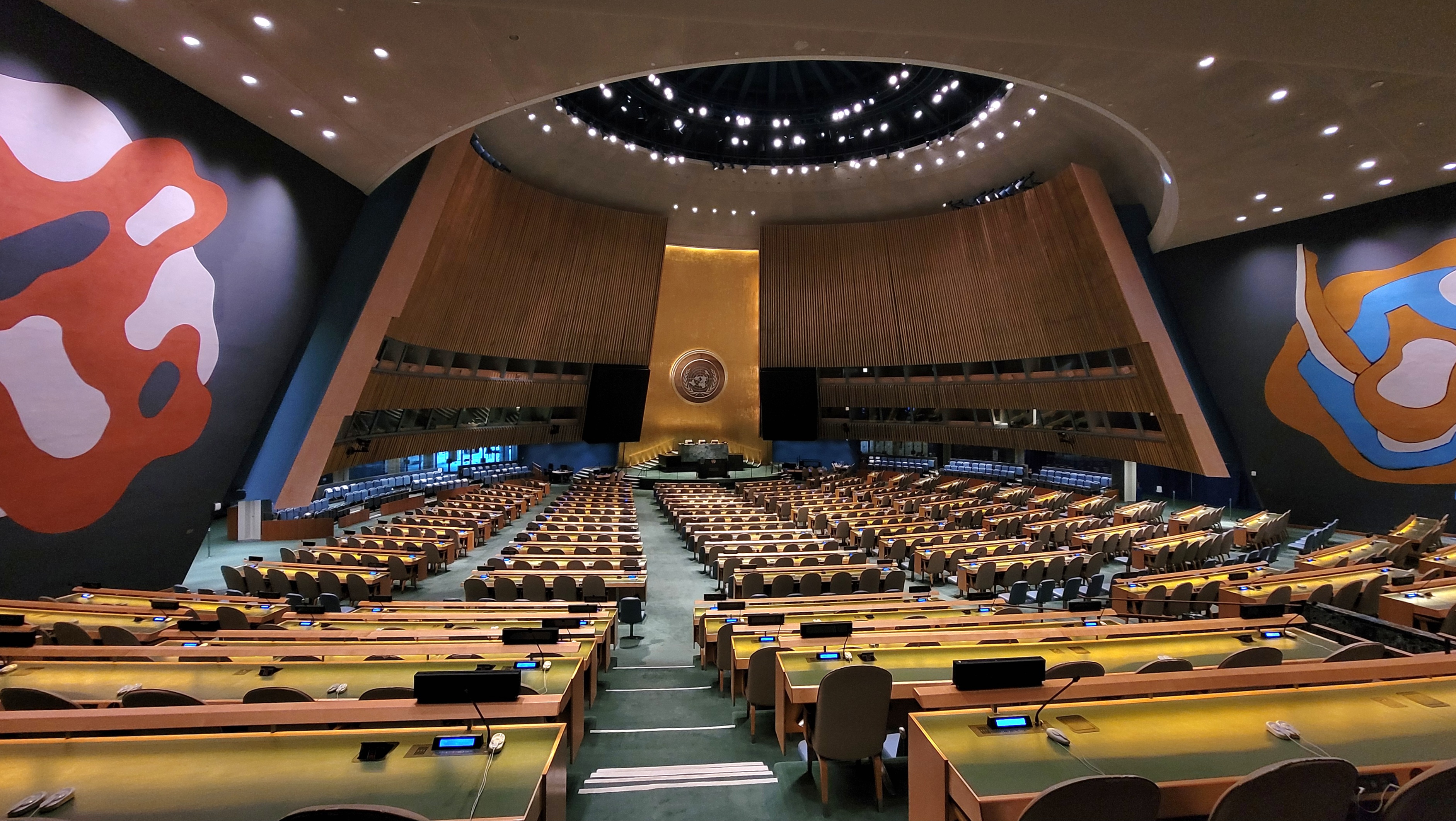
For those who care about the latest political ideology, President Donald Trump's speech to the United Nations General Assembly on Tuesday put the contours of "civilizationism" into greater relief.
In a nutshell, "civilizationism" is the idea that "the West is defined by a specific geographic territory, a shared ancestry, and Christianity" rather than "a shared set of principles that anyone, regardless of origin, can espouse, such as constitutional democracy, liberty, and equality," explains Leonard A. Schuette in a recent column in Foreign Affairs. The prior view broadly characterizes the neoconservative outlook, the latter that of the New Right.
For all the subtleties this new "-ism" entails, its raw version was on display in Trump's 37-minute speech on Tuesday. Trump gave political theorists and ideologues a privileged opportunity to distinguish "policy" from "solution" and discern whether a more stable world order might be more achievable by concentrating on the former rather than the latter.
But to comprehend what civilizationism is all about, it would be better to look at his remarks on Cuba rather than sift through the more complex case of Iran.
The Cuba test
Aside from any grand geopolitical vision, the President offered practical reasons to be concerned about Cuba. "The Cuban regime," he said, "has spent decades coordinating with the left-wing radicals and communist networks here in the United States. As our State Department has detailed, they've cultivated ties to subversive and radical groups such as the Communist Party USA, Antifa, and the Dumocrat (sic) Socialists of America. Communism will never be coming to America — but freedom will be coming to Cuba and safety and security will be coming to Mexico."
Those remarks square well with the civilizationist idea that the United States should restrict its foreign interests to the western hemisphere, or at least to the U.S.'s immediate circle of "civilizational" influence. Schuette explains that, according to civilizationism, the world should be governed by a few nations worthy of the name "civilization."
So, for example, leave the Asian sphere to China, not the United States.
By raising the issue of Cuba in a multilateral forum such as the United Nations, the President clarified the shifting priorities of the United States. He complains that his predecessors did nothing about Cuba for decades even though they knew something had to be done. He takes pride in being a man of action, not words:
… while others have talked, I have acted. While others have spoken of peace, I have made peace. While others have ignored threats, I have confronted them. While others have talked of courage, America has shown it. While others have promised strength, I have used it to make America the most powerful country in the world. Working with many nations in this room, we are solving decades of intractable challenges — and we are settling years of unfinished business.
His "getting-it-done" message packages current U.S. military engagements in a more palatable package given his former non-interventionism. Bolstered by civilizationism, it may be that the President does not consider military action toward Cuba "interventionist," since, in one way or another, Cuba is related to the United States "civilizationally."
But my main point is that a speech largely focusing on Iran not only included a significant excursus on a country closer to home, but a country the President alleges to have an ostensibly malevolent influence on domestic dynamics, namely, the rise of leftist politics. That may well amount to a deliberate attempt to place Cuba in the same civilizational sphere as the U.S. so that the latter may justify its resolve to bend the former towards conformity with an ill-defined but common civilizational heritage.
A civilizational sphere, not an empire
What are the elements of such a common heritage? They're buried underneath the stark differences that have taken center stage since the Cold War. Prior to that, however, arguments for national sovereignty and revolutionary liberty were remarkably similar. Cuban leaders drew inspiration from the American Revolution for the island's long battle for independence from Spain. How easy it is to forget Fidel Castro's frequent invocations of Abraham Lincoln, the Founding Fathers, and the U.S. Constitution before he avowed communism. That turn completely transformed any apparent parallels. Unlike the United States, Cuba has felt a perpetual need to fight for self-determination.
Even before the Cold War, Cuba's staunch resistance to U.S. interventionism fashioned its vision of the outside world. The Platt Amendment of 1901 led to a provision in the new Cuban constitution that allowed the U.S. to intervene militarily in Cuba to protect U.S. interests. Although President Trump did not explicitly invoke this amendment in his speech at the U.N., there is little doubt that more sophisticated civilizationists would not hesitate to appeal to it together with the Monroe Doctrine to justify force.
Earlier this year, Peter Kornbluh published a piece in The Nation entitled "Cuba Is Next: Havana is in Trump's imperial crosshairs, but dialogue is still an option."
"Empowered, emboldened, and clearly feeling entitled after the brazen success of 'Operation Absolute Resolve' in Caracas, Trump's focus on Cuba is completely predictable," writes Kornbluh. "All along, regime change in Venezuela has appeared to be a stepping stone toward regime change in Cuba. There is no doubt that the president, and his hardline Cuban American secretary of state, Marco Rubio, view Cuba as the ultimate post–Cold War trophy."
Even if Kornbluh is right in suggesting that Operation Absolute Resolve had Cuba in the bigger picture, his characterization of Cuba as a "post-Cold War trophy" misses the point. It's less a matter of imperialism than civilizationism. In other words, Trump's speech to the U.N. strongly suggests that the goal is to remove Cuba from the civilizational influence of actors who have no right to be meddling in the Western hemisphere: namely, Russia and China. A civilizationist like Trump could care less about the governmental system Cuba chooses and more about drawing clear boundaries of civilizational influence.
Rubio's golden opportunity
To understand the extent to which civilizationism is shifting U.S. attitudes toward Cuba, one only has to look at the increasingly intense interest Secretary of State Marco Rubio — himself the son of Cuban immigrants — has taken in the country.
The Trump administration could have reversed Obama-era policies and then stopped. After Trump imposed conditions for lifting U.S. sanctions against Cuba, he could have sat back and waited.
But his speech at the U.N. made it clear that he's done waiting. He delivered a clear message to pundits who think he is simply trying to solidify his long-term legacy before leaving office. But he made it clear on Tuesday that the status quo between the U.S. and Cuba has held for decades and nothing has happened. He thinks it won't happen until someone takes action and that no one is willing to take action but he. Until he does, the Caribbean will continue to host a foreign civilizational influence, and that simply won't do in the new multipolar world.
Accordingly, Secretary of State Rubio has gravitated toward a more active approach in leveraging the demise of Cuba's economy to negotiate change on the island. Earlier this year, his confidence was bolstered by a deal brokered by the Vatican to release 51 political prisoners. In Rubio's remarks at the General Assembly on Wednesday, he assured Cuba that the U.S. is ready to be "helpful" if Cuban leaders choose to pivot. He presented this as a "golden opportunity" for the nation as it totters on the brink of total failure. He seems confident that the approach will in no way undermine the corollary demand for political and economic freedom for all Cubans.
He seems equally confident that investors will stay away from an island whose regime can confiscate assets with no legal recourse for investors to recover them. This adds a particularly potent economic factor to civilizationism in that the lack of a shared capitalist vision bears real consequences on real investments. Rubio knows well that you cannot bracket business and economics from the western "civilization" common to the United States and Cuba.
The Ukraine question
As an ideology, civilizationism needs little reinforcement from political theory. It provides enough guidance of its own to shape the rhetoric employed by both President Trump and Secretary of State Rubio at the U.N. General Assembly.
The real question is the extent to which civilizationism allows nations that can boast of an authentic "civilization" to prescind from a worldview that acknowledges the central idea of national sovereignty. Ukraine may be the ultimate test case. Civilizationists are far from agreement on whether Ukraine falls under the civilizational "sphere" of Russia. Moreover, civilizationists have yet to offer a clear set of criteria that can be applied to both Cuba and Ukraine in a way that determines whether the former falls under the same civilizational domain as the United States and the latter under the same as Russia.
As an ideology, civilizationism is not a useful heuristic tool. It's not a political theory that can help us delineate the universal principles that govern the decisions and actions of nation states in an increasingly complex world. But it does help to explain the kind of arguments both President Trump and Secretary Rubio employ in justifying U.S. policy toward its allies and enemies.
My hunch is that it will take decades to determine whether civilizationism is an effective approach toward resolving international conflict and preserving peace. I haven't even touched on its grave dangers which are indeed more dangerous than neoconservatism's audacious assumptions and undertakings.
Then again, neither political theory nor ideology can do the hard work of pounding out diplomatic agreements that will secure world peace.
"Whenever peace," said Henry Kissinger, "conceived as the avoidance of war, has been the primary objective of a power or a group of powers, the international system has been at the mercy of the most ruthless member of the international community."
Any political ideology — let alone theory — needs a healthy dose of Realpolitik if it is to have any hope of distinguishing between policies and solutions — especially when "ruthless members" are involved.
Daniel B. Gallagher served at the Vatican Secretariat of State under Popes Benedict XVI and Francis. He is a lecturer in literature and philosophy at Ralston College in Savannah, Georgia.
Sources: The White House: President Trump at the United Nations (22 September 2026) · Leonard A. Schuette: The New Right's Grand Strategy After Trump (Foreign Affairs, 25 August 2026) · Peter Kornbluh and Katrina vanden Heuvel: Cuba Is Next (The Nation, 26 February 2026) · Operation Absolute Resolve (GlobalSecurity.org) · Cuba to release 51 prisoners in Vatican-brokered deal (BusinessWorld, 13 March 2026) · Al Jazeera: US says it is open to talks with Cuba (23 September 2026) · Platt Amendment (Encyclopaedia Britannica) · Henry Kissinger, A World Restored: Metternich, Castlereagh and the Problems of Peace, 1812–1822 (1957).
Comments
No comments yet. Be the first.
Comments are closed on this article.