
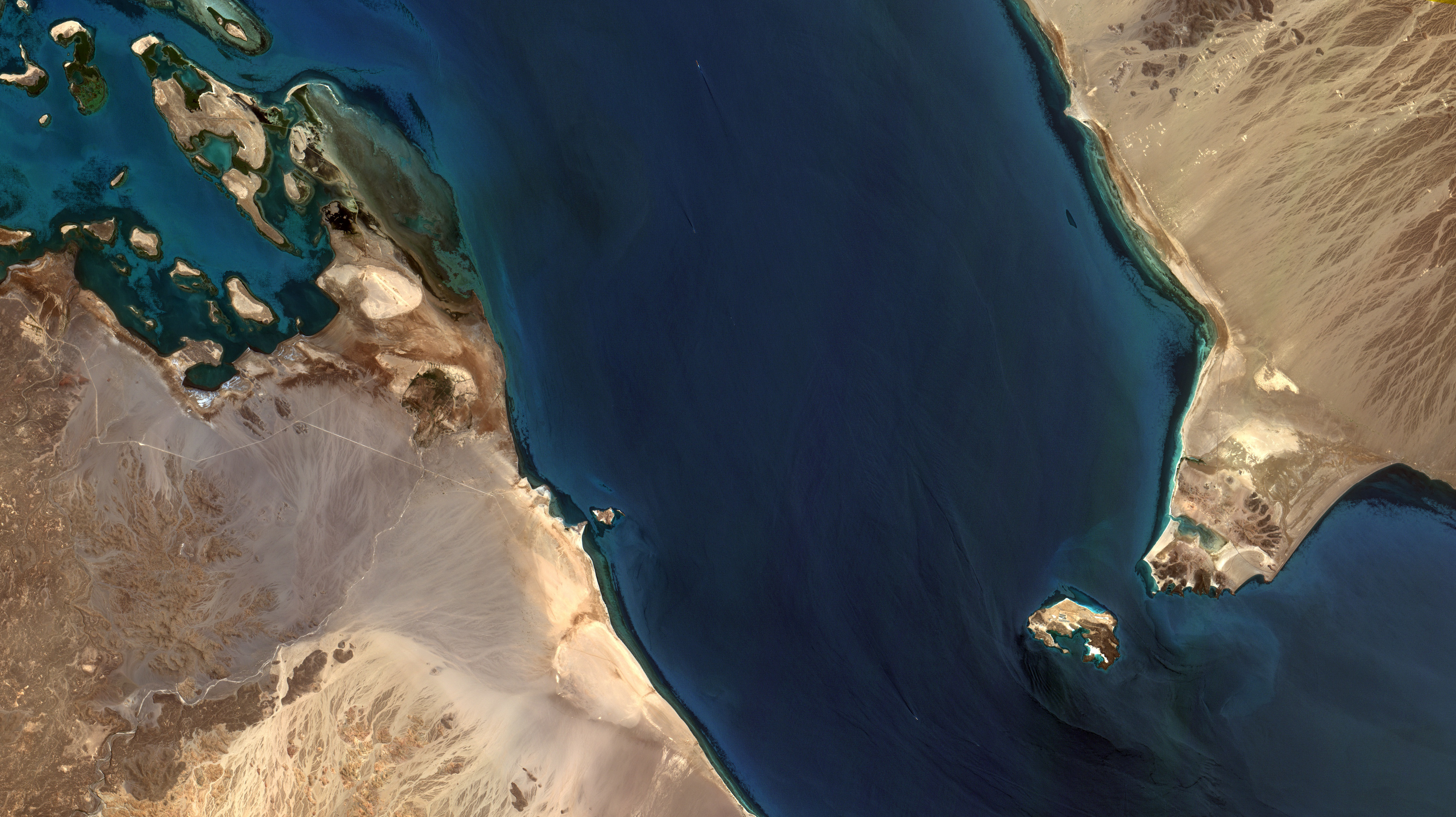
In the first half of September 2026, Yemen's Iran-aligned Houthis stopped being an insurgency and became a landlord. A short, fast offensive handed them the entire western Red Sea coastline, the port of Mokha, and the islands that sit inside the Bab el Mandeb: Perim, Zuqar, the Greater and Lesser Hanish. The defence that was supposed to hold did not break under fire. It broke under an audio file.
A synthetic voice resembling Lieutenant General Tariq Saleh ordered a withdrawal, and the withdrawal happened. The retreating columns left American armour behind them.
At the same moment, a documented working relationship between the Houthis and al Shabaab, covering weapons, drone instruction and maritime facilitation, matured across the Gulf of Aden.
Eritrea has publicly refused the idea of tolls while keeping its own posture deliberately unreadable. Sudan is too broken to commit and too exposed to abstain.
What follows is what actually changed, three scenarios for the next twelve to twenty-four months, the exposure carried by each category of stakeholder, and the responses still available to defence ministries, to shipping and insurance, and to the littoral states.
What changed in September
Territory and operational gains
The Houthis now hold the coast from Hodeidah to Dhubab, roughly 5,400 square kilometres taken in days, together with Mokha port and the high ground at Dhubab that looks straight down into the strait.
Perim sits in the middle of the channel. The Hanish and Zuqar group covers the northern approach. This is not territory in the ordinary sense. It is a tollbooth with a view. Bab el Mandeb carries some twelve per cent of trade by value, close to 4.8 million barrels of oil a day, and the Qatari LNG that Europe has quietly learned to depend on.
The collapse of government forces
Mokha was lost to a file, not to a firefight. Tariq Saleh's office called the audio a deepfake within hours. The units had already gone. Yemen's internationally backed coastguard did not regroup; it sailed to Djibouti, where it now performs rescue work for the refugees its own defeat created. More than two thousand Yemenis reached Djibouti's northern shores in the first days, and tens of thousands are displaced along a coastline they can no longer leave by land.
The best disinformation always wears a suit. This one wore a general's.
Captured equipment
The retreat was generous. Oshkosh M-ATV mine-resistant vehicles, armoured personnel carriers, artillery, NIMR patrol vehicles, technicals, ammunition and small arms, most of it Saudi and Emirati supplied, much of it American made.
The value is not symbolic. Protected mobility along a long and exposed coast changes what a coastal defence can absorb, what it can threaten, and how long it can hold when someone eventually comes to take the islands back.
The emerging axis
The al Shabaab partnership is no longer inference
More than a hundred Somali fighters have trained in Yemen on first-person-view drones, explosives, advanced weapons and anti-aircraft systems, and Houthi instructors have worked inside Somalia.
The traffic runs both ways: shoulder-fired air defence, Katyusha rockets, Dragunov rifles, attack drones, anti-tank missiles and night-vision equipment, moved through intermediaries who have been doing this work for a decade.
The maritime component is the one that matters. Piracy facilitation off the Somali coast is not banditry when it is coordinated from the far side of the water. It is a second hand on the same throat.
Sudan and Eritrea: the two wildcards
Asmara has rejected tolls out loud and insisted there is no military solution. Eritrea is also not a party to UNCLOS, holds the opposite shore, and has spent thirty years making ambiguity a national industry.
Khartoum has signed nothing, because Khartoum is in no condition to sign anything. That is precisely the risk. A faction holding Port Sudan and short of money does not need a treaty to become useful.
The Hormuz precedent
Tehran has spent forty years demonstrating that a strait is a lever you rent out rather than a door you close.
The Houthis now hold a narrower one. Whether toll revenue is ever formally shared with Somali partners remains unconfirmed in open sources, and is not necessary to the argument. The capability to tax exists. Doctrine always arrives afterwards, and it arrives quickly.
Escalation scenarios
Three futures are worth pricing over the next twelve to twenty-four months. None of them is a return to 2019.
The first is the one the Houthis would choose, the second is the one nobody chooses and several actors could stumble into, and the third is the one that requires the West to keep paying attention for longer than it usually does.
| Scenario | Trigger | Axis behaviour | Chokepoint impact | Economic and insurance impact | Probability |
|---|---|---|---|---|---|
| Coercive toll regime | Consolidation on Perim; al Shabaab maritime cells active | Selective harassment of non-compliant vessels; informal tolls by threat and interdiction | Bab el Mandeb throughput down 20 to 30 per cent; partial Suez diversion | War risk 0.7 to 1.5 per cent of hull; freight up 25 to 40 per cent; Cape routing for sensitive cargo | Medium |
| Dual chokepoint squeeze | A Sudanese faction aligns tacitly; Somali piracy surges | Coordinated pressure on Bab el Mandeb and the Gulf of Aden; southern Suez approaches threatened | 30 to 50 per cent reduction in Red Sea transits; Cape becomes the default | War risk above 1.5 per cent; Asia-to-Europe freight up 40 to 50 per cent; European LNG stress | Low to medium |
| Contained deterrence | Sustained multinational naval presence and Gulf state diplomacy | Symbolic attacks only; mass disruption avoided | Throughput near normal, punctuated by scares | War risk stabilises at 0.3 to 0.6 per cent; limited rerouting | Medium to high |
Who is exposed
Exposure is not evenly distributed, and it does not arrive on the same schedule. Shipping feels it in weeks, insurers in months, defence ministries over years.
| Stakeholder | Primary risk | Secondary risk | Horizon | Mitigation levers |
|---|---|---|---|---|
| Shipping lines | Hull war-risk premium spikes; voyage delays | Around 25 per cent more tonnage needed for the same service; charter disputes | 0 to 6 months | Cape routing protocols; war clauses; convoy participation |
| Insurers and reinsurers | Loss clustering from coordinated attacks | Model breakdown; capacity withdrawal from the Listed Area | 0 to 12 months | Dynamic pricing; exclusions for non-compliant transits; pooled reinsurance |
| Energy traders | Disruption premiums; delayed LNG deliveries into Europe | Price volatility; force majeure claims | 0 to 12 months | Route diversification; strategic reserves; hedging |
| Littoral governments | Spillover conflict, refugee flows, base security | Piracy surge; illicit arms trafficking | 6 to 24 months | Littoral coordination; intelligence sharing; port security |
| Defence ministries | Force protection, with Camp Lemonnier some 32 km from Dhubab | Escalation ladder; multi-front maritime conflict | 0 to 24 months | Naval task groups; layered air defence; diplomatic off-ramps |
Red Sea war-risk premiums have already touched 0.5 to 1.5 per cent of hull value during the 2026 escalations. On a container ship worth 150 million dollars, that is 750,000 to 2.25 million per transit. A Cape of Good Hope reroute adds some 3,500 nautical miles and ten to fourteen days, and roughly 30 per cent to bunker cost, or 400,000 to 800,000 dollars per round trip for a large box ship.
Policy responses
Defence ministries and naval commands
Forward presence is the cheapest instrument still available. A multinational task group in the Gulf of Aden and the southern Red Sea, with a standing convoy option, costs less than a single quarter of Cape routing for the European trades. Base defence around Camp Lemonnier and the Djibouti port complex needs layering against drones and missiles launched from 32 kilometres away, which is a distance measured in minutes rather than hours.
Intelligence fusion should be organised around the partnership itself, tracking transfers, training pipelines and intermediaries as one system rather than two files. And response protocols must be calibrated in advance, because improvised escalation in a strait is how a shipping problem becomes a war.
Shipping, insurance and energy
Treat the Cape as the structural default for sensitive cargo and Suez as the exception granted to vetted, escorted transits, rather than the reverse. Align war-risk endorsements with live threat levels instead of quarterly reviews, and consider pooled mechanisms for the cargoes that governments cannot allow to stop, principally grain and LNG.
Charterparties and bills of lading should now name toll coercion explicitly, because a demand for payment is neither a peril of the sea nor an act of war, and the gap between those two definitions is where the litigation will live. Importers should accelerate alternative supply routing now, while it is still a choice.
Regional governments
A Red Sea and Gulf of Aden security forum is worth building even if it must include actors who have never signed UNCLOS, because a forum that excludes the inconvenient coastline excludes the problem.
Port hardening at Djibouti, Assab, Massawa, Port Sudan and Jizan, coastal radar and counter-drone cover, is unglamorous and decisive. Diplomatic off-ramps through Oman, Kuwait and the United Nations remain worth keeping open, and worth keeping honest.
Negotiating with wolves never saves the flock. It merely schedules the next hunt.
Indicators to watch
- Watch Perim above all: radar installations, coastal defence missiles and drone launch sites on the island would convert a position into a system, and would be visible from orbit long before anyone announces it.
- Watch for al Shabaab attacks at sea rather than on land, and for drone strikes in the Gulf of Aden that nobody claims.
- Watch Sudanese factional language for the vocabulary of maritime resistance, which is always borrowed before it is acted upon.
- Watch the war-risk benchmark cross 1.5 per cent of hull, and transits fall more than 30 per cent for a sustained month.
- And watch Eritrean naval patrols near Hanish and Zuqar, which will tell you more about Asmara's intentions than any statement from its foreign ministry.
Bottom line
The Houthis have completed a transformation that most observers are still describing in the present tense as though it were pending. They are no longer a land insurgency with a missile inventory.
They are a maritime gatekeeper with terrain, captured armour, a trained partner on the opposite shore and a working precedent to copy.
Combined with the deepening axis into the Horn, the Red Sea now faces a plausible dual chokepoint squeeze capable of institutionalising higher costs, longer routes and periodic closure for years rather than seasons.
Deterrence, market alignment and littoral diplomacy can still hold this. What cannot hold it is the habit of treating each incident as an incident. A toll regime is not declared. It is established quietly, transit by transit, until the price is simply what the route costs.
The window to prevent that is measured in months, and it is already narrowing.
This analysis first appeared as No. 29 of the author's Geopolitics Sunday Brief and is published here with his permission.
Comments
No comments yet. Be the first.
Comments are closed on this article.