
Latin America is not short of regional cooperation initiatives. The region has MERCOSUR, the Pacific Alliance, the Andean Community, the Central American Integration System (SICA), and the Community of Latin American and Caribbean States (CELAC). Yet, after decades of building various organizations, the region's economic integration remains relatively limited. The challenge is no longer how to establish new organizations, but how to ensure that existing cooperation delivers stronger economic connectivity.
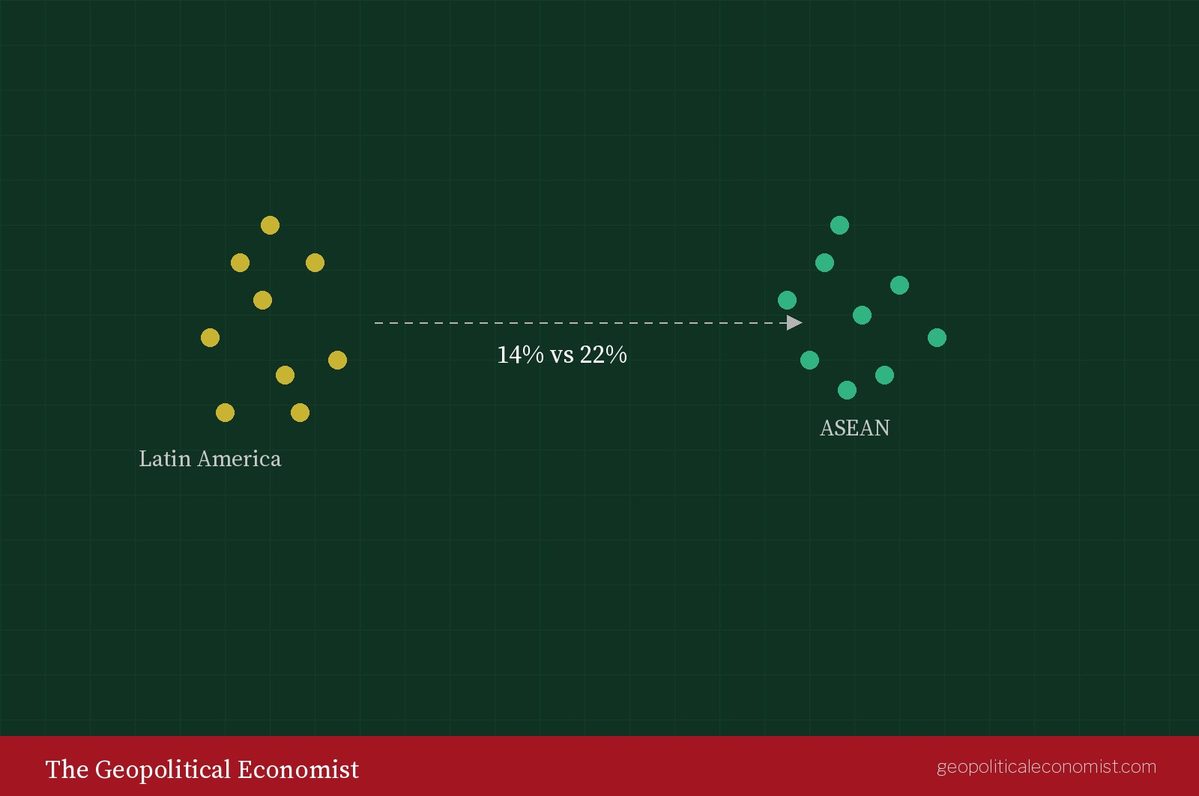
According to Americas Quarterly, intraregional trade accounted for only around 14% of Latin America's total trade in 2023, compared with approximately 22% in ASEAN and more than 60% in the European Union. This gap highlights the differences in regional economic connectivity, although trade volumes alone cannot capture every dimension of integration.
The Inter-American Development Bank's (IDB) Trade and Integration Monitor 2025 reveals uneven progress. In 2024, intra-MERCOSUR trade declined by 2.8%, while trade within the Andean Community also fell by 2.8%. In the first half of 2025, intra-Andean trade recovered by 5.1%, but MERCOSUR exports grew by only 0.1%. These figures suggest that progress toward integration has yet to become consistent.
When Cooperation Fails to Create Production Networks
The challenges facing Latin American integration can be understood through the region's economic structure. Countries can sign trade agreements and reduce tariffs without building complementary industries. When many economies depend on exports of agricultural commodities, minerals, and energy, they tend to compete for global markets rather than develop cross-border production chains.
The automotive industries of Brazil and Argentina provide a concrete example. Both countries have developed trade in vehicles and components through the MERCOSUR framework. Companies benefit from access to neighboring markets, production specialization, and economies of scale. However, these commercial relationships remain vulnerable to changes in domestic demand, exchange rates, import restrictions, and shifts in bilateral trade policies.
The IDB's 2025 trade report also documents how drought in Argentina in 2023 increased the need for soybean imports from MERCOSUR partners, while the subsequent normalization of agricultural supplies affected regional trade flows in 2024. This example illustrates how trade between countries can fluctuate in response to national economic conditions without necessarily evolving into more diversified and sustainable production networks.
A second example is the Itaipu hydroelectric power plant, jointly operated by Brazil and Paraguay. According to official data from Itaipu Binacional, the 14,000-megawatt facility supplied approximately 7% of Brazil's electricity needs and 78% of Paraguay's in 2024. Since beginning operations in 1984, the facility has generated more than 3.1 billion megawatt-hours of electricity. Itaipu demonstrates that regional cooperation can deliver tangible benefits when supported by long-term investment, shared infrastructure, and institutional coordination. However, the success of a bilateral project does not automatically translate into similar integration across the entire region. The challenge is to extend this approach to cross-border electricity networks, transportation, digital infrastructure, and industrial development.
Why Is ASEAN Relatively More Integrated?
ASEAN offers a relevant point of comparison because its member states have gradually connected their economies through regional manufacturing networks and supply chains.
According to ASEAN Key Figures 2025, intra-ASEAN trade accounted for 22.5% of the region's merchandise exports and 20.3% of its merchandise imports in 2024. ASEAN's total merchandise trade reached approximately US$3.5 trillion. ASEAN has not achieved perfect integration. Non-tariff barriers, development gaps, and divergent policies remain significant challenges. Nevertheless, the region has developed production networks across electronics, automotive manufacturing, machinery, and other industries. Components can be produced in one country, processed in another, and then assembled or marketed across multiple destinations.
These production linkages create shared economic interests. Companies have incentives to advocate for predictable trade rules, efficient logistics, and continuity in regional cooperation.
Latin America could pursue a similar approach without copying ASEAN's entire institutional framework. Brazil and Argentina, for example, could deepen their automotive supply chains. Meanwhile, mineral-producing countries such as Chile and Peru could expand cooperation with industrial centers in mineral processing, batteries, and clean energy technologies. In this way, natural resource advantages could be connected with manufacturing capabilities, technology, and regional markets.
Regional integration theories also help explain why Latin America's progress has remained limited.
First, liberal intergovernmentalism emphasizes that regional cooperation depends on the alignment of governments' economic interests and political preferences. Changes in government, differences in development strategies, and divergent approaches toward external partners can undermine the continuity of cooperation.
Second, neofunctionalism explains how cooperation in one sector can encourage integration in others. Cooperation in energy, for example, can create a need for common technical standards, cross-border electricity networks, and coordinated investment.
In Latin America, this expansion of cooperation is often constrained by political changes, infrastructure limitations, overlapping institutions, and production structures that are not sufficiently complementary. The barriers to integration are therefore not merely political; they also concern economic structures and the capacity to implement policies.
From Declarations to Practical Integration
Latin America needs to take several concrete steps.
First, governments should harmonize trade rules and simplify overlapping procedures.
Second, they should strengthen cross-border transportation, energy, and digital infrastructure.
Third, they should develop regional value chains in automotive manufacturing, agribusiness, mineral processing, pharmaceuticals, and renewable energy.
Fourth, the success of integration should be measured through transparent indicators, including intraregional trade growth, cross-border investment, logistics costs, and business participation in regional value chains. Fifth, governments should involve the private sector, universities, and financing institutions to ensure that cooperation projects continue despite changes in government.
The central lesson from ASEAN is not that integration requires a uniform political system or the transfer of all national sovereignty to supranational institutions. Rather, cooperation is more likely to endure when it generates tangible economic benefits and gives businesses incentives to invest across borders.
Latin America already possesses important assets: natural resources, industrial capabilities, regional markets, and long-established cooperation organizations. The next challenge is to connect these assets into broader production networks.
Ultimately, the success of Latin American integration should not be measured by the number of organizations and agreements established, but by their ability to raise productivity, strengthen economic connectivity, create jobs, and make member states more resilient to changes in the global economy.

Comments
No comments yet. Be the first.
Comments are closed on this article.