
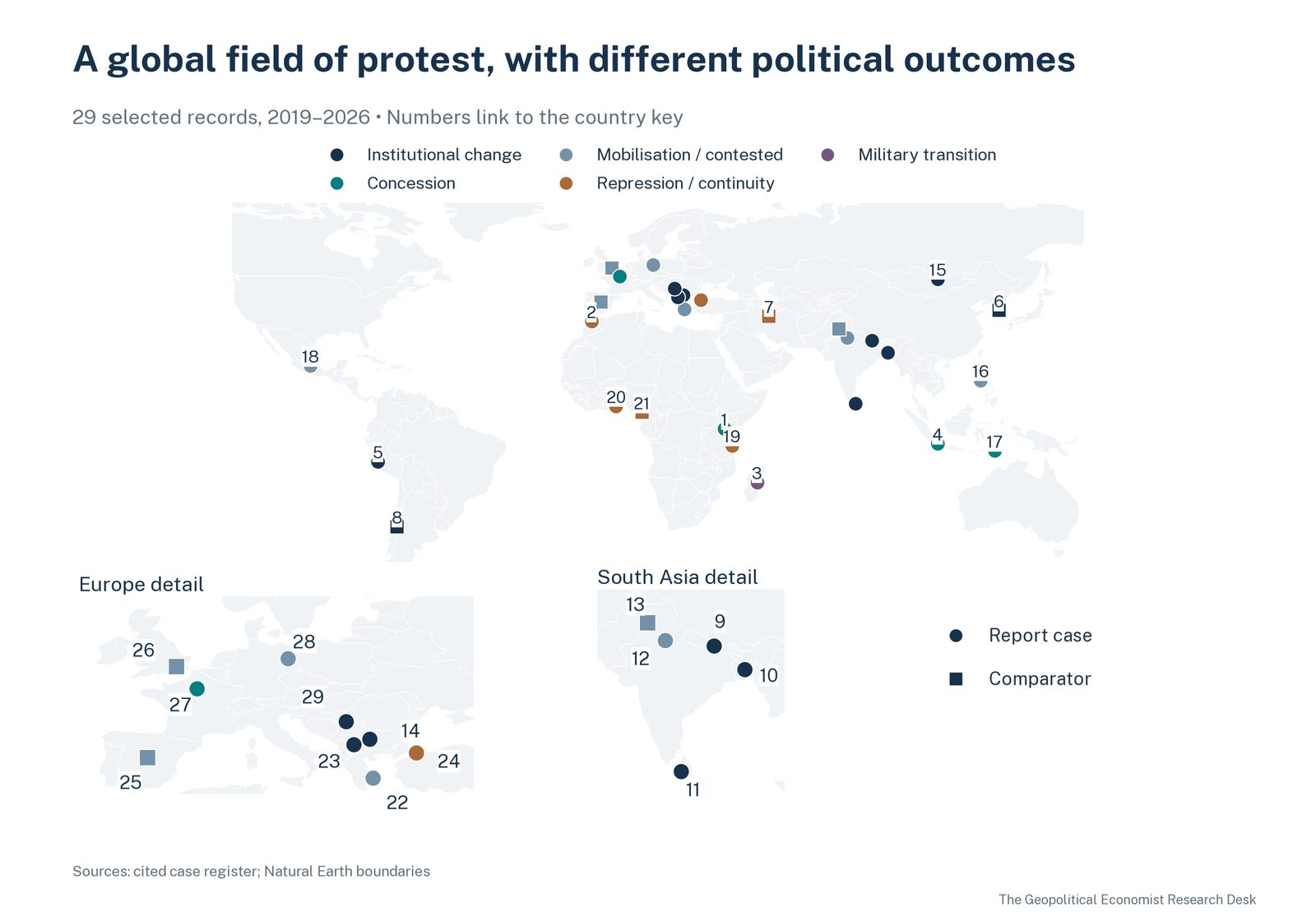
Country key for the overview map
| 1–10 | 11–20 | 21–29 |
|---|---|---|
| 1. Kenya | 11. Sri Lanka | 21. Cameroon |
| 2. Morocco | 12. India | 22. Greece |
| 3. Madagascar | 13. Pakistan | 23. North Macedonia |
| 4. Indonesia | 14. Bulgaria | 24. Türkiye |
| 5. Peru | 15. Mongolia | 25. Spain |
| 6. South Korea | 16. Philippines | 26. United Kingdom |
| 7. Iran | 17. Timor-Leste | 27. France |
| 8. Chile | 18. Mexico | 28. Germany |
| 9. Nepal | 19. Tanzania | 29. Serbia |
| 10. Bangladesh | 20. Togo |
Selected report cases and comparisons; detailed episode windows and sources are in the full report.
Young protesters have forced governments to withdraw policies, negotiate transitions and face new electoral challengers. They have also suffered lethal repression, watched established parties inherit their momentum and seen military actors take control. These outcomes belong in the same account of the global protest wave.
Nepal illustrates the distance between mobilisation and power. After police killed at least 19 people on 8 September 2025, a confrontation over social-platform restrictions, corruption and opportunity became a crisis of government. Prime Minister K. P. Sharma Oli resigned the next day. Discord discussions helped activists identify a preferred caretaker, but the presidential appointment followed offline negotiations. The subsequent election operated through national institutions, giving the pre-existing Rastriya Swatantra Party 182 of Parliament's 275 seats. Neither caretaker Sushila Karki nor incoming political figure Balen Shah belonged to Gen Z. 1 2 3 4 5 6
The new members' report follows that gap between public pressure and durable authority across South Asia, Africa, Europe and Latin America. Its central finding is that mobilisation has become more portable than representation. A symbol, short video or organising practice can cross borders rapidly. Building a party, obtaining a remedy, negotiating with security institutions and delivering services remain demanding national tasks.
Three findings that change the story
1. The common pressure is blocked adulthood
Global youth unemployment is not at an unprecedented peak. The ILO's revised series puts unemployment among 15-24-year-olds at 12.4% in 2025. Yet one in five young people was outside employment, education and training. That NEET rate reached 27.4% for young women, against 13.1% for young men. Employment figures alone cannot explain whether education produces opportunity, whether work pays for independent living or whether recruitment appears fair. 7
India shows why qualifications and connectivity need to be examined together. In 2023, unemployment among graduates aged 15-29 was 28.4%, compared with 10.0% among youth overall. A separate survey found that 94.3% of 15-29-year-olds had used the internet in the preceding three months in January-March 2025. These figures describe different surveys and periods; together they identify a large connected audience encountering uneven returns to education. October 2026 protests and detentions also mean India cannot be treated as permanently outside the wave. 8 9 10 11
Europe presents another route to insecurity. In 2025, 26.9% of EU 15-29-year-olds lived in overcrowded households, against 16.8% of the population overall. Housing, public services and conscription disputes coexist with divided left-wing, conservative and nationalist youth politics. The evidence points to several regional paths into mobilisation, not an automatic movement from poorer countries into richer ones. 12 13 14 15
Figure 1

Housing cost overburden means housing costs exceed 40% of disposable household income; EU coverage excludes the UK and Serbia. Source: 12.
2. Platforms shape protest through specific tasks
Social media can make a grievance visible; private messaging can turn attention into attendance; a livestream can document violence; a server can organise discussion. These functions involve different services, users and risks. Recommendation algorithms influence what audiences encounter, while organisers still decide what to demand and how to act.
Published experiments show that changing feeds can alter exposure and, in some settings, political attitudes. Their findings differ across X, Meta and YouTube, and across interventions. A measured effect among selected US users cannot simply be converted into an explanation of turnout in Kathmandu or Nairobi. The report explains each mechanism in plain language and separates experimental results from observational accounts. 16 17 18 19
It also asks who benefits from deceptive campaigns. Amnesty documented a paid counter-protest network in Kenya; fact-checkers traced misleading Nepal footage and a manipulated election video. These are concrete findings about particular operations. A fake account, paid promotion, donor relationship and foreign command are different claims requiring different evidence. AI adds tools for translation, explanation, impersonation and cheap content production. Its ability to generate a persuasive message does not establish who saw that message or whether it changed their behaviour. 20 21 22 23 24
3. The organisation that survives the protest often shapes the outcome
An incumbent's departure is a beginning, not a complete measure of success. Bangladesh's movement-created National Citizen Party won six of 300 directly elected seats after contesting 30. Sri Lanka's pre-existing National People's Power won 159 of 225 parliamentary seats. Nepal's RSP also existed before the uprising. These trajectories expose different relationships between movement legitimacy, an established political organisation and an election. 25 26 27 5
Other cases involve narrower concessions, coercion or military capture. The report therefore tracks policy reversal, implementation, institutional entry and control of government separately. It asks whether citizens can still organise safely and challenge the successors they helped bring to office.
What the full report adds
The members' edition develops these findings through five substantial chapters: the wave's historical development; the reasons longstanding grievances become action now; platforms, algorithms and AI; the transfer of political power; and risks and choices through 2030. Nepal receives the deepest transition analysis, alongside substantial treatment of India, Pakistan and Europe.
A dated country register distinguishes core cases, comparisons and announced future events. Fifteen charts and maps connect labour, housing, representation, elections and technology evidence. A graded influence framework separates spontaneous organisation, amplification, financing and direction. The final outlook gives qualitative judgments and observable indicators, with actual scheduled events kept distinct from the report's proposed monitoring checks.
The purpose is practical: to help readers identify which grievances are building, which institutions can respond and whether a political breakthrough is becoming accountable government.
For membership and report access, contact [email protected]. For research correspondence and corrections, contact [email protected].
References
[1] Human Rights Watch. 12 September 2025. Nepal: Protesters Demand Integrity, Rights, Rule of Law. Accessed 27 October 2026.
[2] Human Rights Watch. 20 November 2025. Nepal: Unlawful Use of Force During GenZ Protest. Accessed 27 October 2026.
[3] The Kathmandu Post / Aarati Ray. 29 September 2025. How Nepal’s enraged Gen Z turned Discord into a political arena. Accessed 27 October 2026.
[4] The Kathmandu Post. 13 September 2025. Nepal appoints Sushila Karki as first female executive head. Accessed 27 October 2026.
[5] Congressional Research Service. 31 March 2026. Nepal: 2026 election. Accessed 27 October 2026.
[6] Reuters. 27 March 2026. Ex-rapper Shah sworn in as Nepal prime minister after sweeping election win. Accessed 27 October 2026.
[7] International Labour Organization. 11 August 2026. Global Employment Trends for Youth 2026: executive summary. Accessed 26 October 2026.
[8] ILO / Institute for Human Development. 2024. India Employment Report 2024: Youth employment, education and skills. Accessed 27 October 2026.
[9] MoSPI / PIB. 29 May 2025. Results of Comprehensive Modular Survey: Telecom, 2025. Accessed 27 October 2026.
[10] Reuters via MarketScreener. 10 October 2026. India detains thousands, locks down Delhi to foil election chief protest. Accessed 27 October 2026.
[11] Associated Press. 8 October 2026. Thousands protest in India’s Bengaluru as Cockroach movement demands election chief resign. Accessed 27 October 2026.
[12] Eurostat. 30 September 2026. Young people: housing conditions. Accessed 27 October 2026.
[13] Federal Returning Officer Germany / Destatis. 23 June 2025. Bundestagswahl2025: Ergebnisse der repräsentativen Wahlstatistik. Accessed 27 October 2026.
[14] Federal Agency for Civic Education / Thorsten Faas. 29 August 2025. Wie wählen junge Menschen? Erkenntnisse aus den Bundestagswahlen1972bis2025. Accessed 27 October 2026.
[15] Deutsche Welle. 5 March 2026. German high school students protest against military service. Accessed 27 October 2026.
[16] Nature. 18 February 2026. The political effects of X’s feed algorithm. Accessed 26 October 2026.
[17] Science / Andrew Guess author record. July 2023. How do social media feed algorithms affect attitudes and behavior in an election campaign?. Accessed 26 October 2026.
[18] Science / Stanford author-hosted PDF. 27 November 2025. Reranking partisan animosity in algorithmic social media feeds alters affective polarization. Accessed 26 October 2026.
[19] PNAS. 18 February 2025. Short-term exposure to filter-bubble recommendation systems has limited polarization effects: Naturalistic experiments on YouTube. Accessed 26 October 2026.
[20] Amnesty International. 18 November 2025. Kenya: This fear, everyone is feeling it: Tech-facilitated violence against young activists. Accessed 27 October 2026.
[21] Nepal Newschecker / Sanjeeb Phuyal. 14 February 2026. Viral Video Of Gagan Thapa’s Appeal To Vote For Balen Is AI-Generated. Accessed 27 October 2026.
[22] AFP Fact Check. September 2025. Clips of Indonesia protests misrepresented as Nepal demonstrations. Accessed 27 October 2026.
[23] AFP Fact Check / Devesh Mishra. 15 September 2025. India hardliners give Nepal protests baseless religious twist. Accessed 27 October 2026.
[24] International Labour Organization. 20 May 2025. One in four jobs at risk of being transformed by GenAI, new ILO–NASK Global Index shows. Accessed 26 October 2026.
[25] IPU Parline. 2026. Bangladesh Parliament: February 2026 election. Accessed 26 October 2026.
[26] IPU Parline. 2024. Sri Lanka Parliament: November 2024 election. Accessed 26 October 2026.
[27] Reuters. 13 February 2026. After Gen Z uprising, Bangladesh vote shows limits of youth power. Accessed 26 October 2026.
Comments
No comments yet. Be the first.
Comments are closed on this article.