
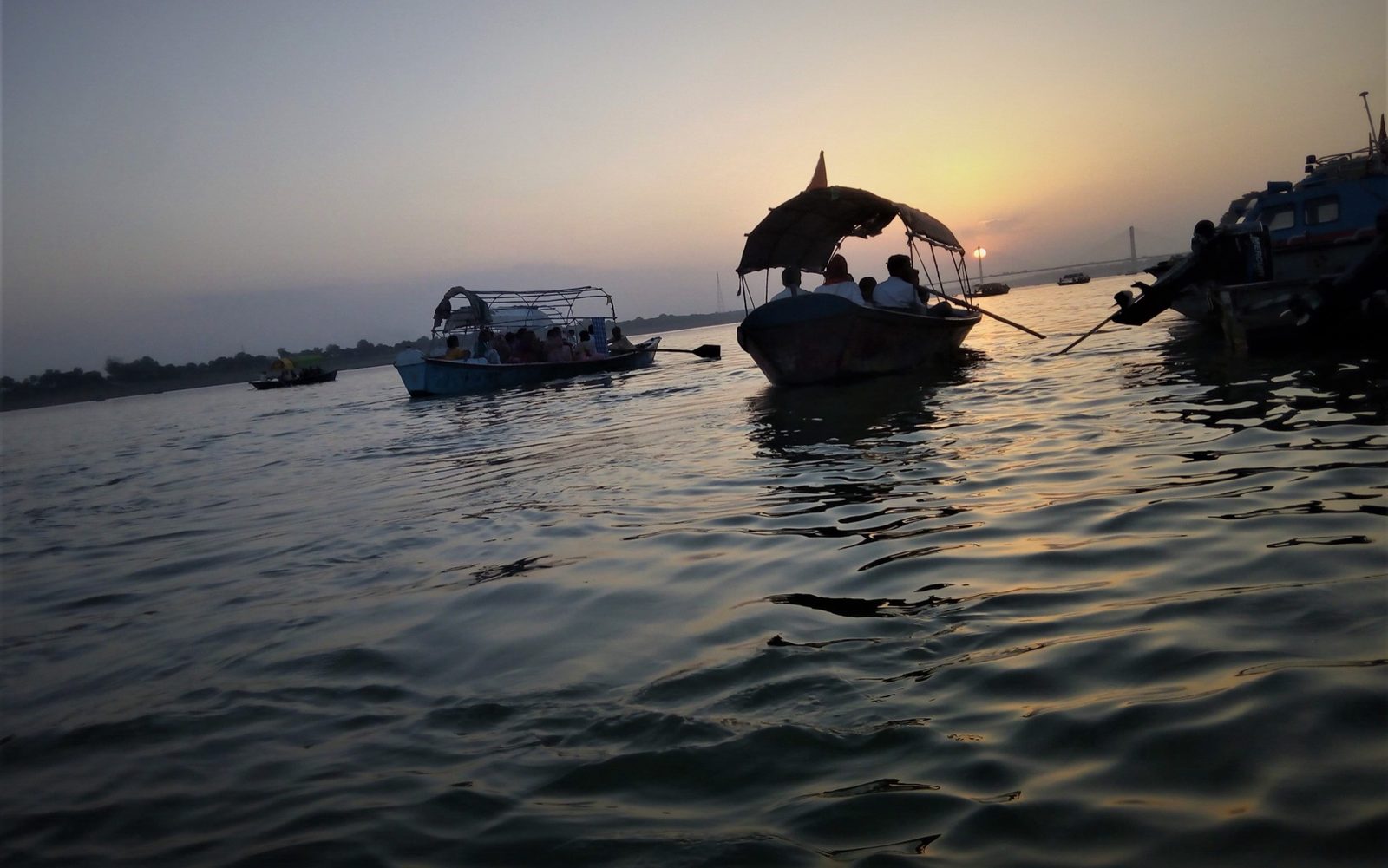
Every Hindu household rite begins with a small act of hydraulic engineering. The priest pours water into a vessel and invokes the Ganga, Yamuna, Godavari, Sarasvati, Narmada, Sindhu and Kaveri to be present in this water. Seven basins are summoned into one pot. Long before the National Water Development Agency, the Indian imagination treated the subcontinent's rivers as a single system that could be brought into relation, and the oldest national myth, Bhagiratha's penance to bring the Ganga down to earth, is an infrastructure story about water moved at great cost to regions that lacked it.
I argue that India cannot pursue AI sovereignty seriously while treating the interlinking of rivers as an embarrassing relic. The two projects are not rivals for the same rupee. They are the same wager made at two scales: that a civilisation-state must be able to sense, model and steer the large systems on which its life depends. Critics of interlinking are right about many details. They are wrong to think the detail settles the question.
Sovereignty is a capacity, not a slogan
Sovereign AI is usually defined by ownership: domestic chips, indigenous model weights, data held on Indian soil. But a sovereign mind needs something to think about. The most consequential problem for 1.4 billion people is water, which sets the limit on food, power, health and, as I show below, compute itself.
India is the world's largest groundwater user. Satellite gravimetry (Rodell, Velicogna and Famiglietti, Nature, 2009) detected a rapid loss of groundwater across the north-western plains, and the pattern has persisted in later studies. Pumping, powered by subsidised electricity, has outrun recharge. Here is a problem of continental scale, with no dominant owner, that unfolds over seasons, depends on monsoon variability, and is driven by millions of private decisions. It is exactly the kind of problem for which national-scale computational intelligence is meant.
A state that wants AI to matter would build the hydrological equivalent of what Paul Edwards, in A Vast Machine (2010), shows meteorology to be: a planetary infrastructure of observation, standardisation and modelling, built over decades, without which "the weather" would not be knowable at all. India's basin-scale knowledge is far thinner. We do not have dense, interoperable, publicly legible data on aquifer state, canal losses, evapotranspiration, sediment budgets and demand. A serious sovereign-AI programme would treat producing it as a founding task.
Interlinking is the forcing function. Whether or not a given link is ever built, the question it poses cannot be answered without this intelligence: how much water is where, when, and who depends on it? A project that requires basin-wide water balances, monsoon projections, and sediment and salinity models under climate change creates demand for precisely the sensors, datasets, digital twins and compute that make sovereign AI more than a procurement exercise.
The critics as co-designers
The critical literature on river-linking is formidable. Bandyopadhyay and Perveen (2004) showed that "surplus" is an accounting construct. Mehta, Mosse and Shah demonstrate that scarcity is partly manufactured by institutions, rights and incentives. Linton and Budds (2014) taught a generation to see water as hydrosocial, co-produced by flows and power. I accept these claims, and I think they strengthen my case.
A hydrosocial system cannot be understood from outside. The knowledge needed to manage it, such as where the aquifer actually recharges, which tank still fills, and how a canal reshapes cropping, is distributed among farmers, engineers, fishers and officials. Critics of interlinking have, in effect, produced the most rigorous requirements specification the programme could ask for. Environmental flows become constraints. Estuarine salinity and delta sediment become variables. Groundwater response and cropping change become part of the model rather than externalities to it. The same logic applies to AI: it needs ground truth, and the critics are the ones who hold it. Sovereignty here means building institutions that metabolise the objection rather than merely outvoting it.
There is also an empirical pattern that Indian planners know and the abstract debate often ignores. Water has repeatedly rejuvenated regions that history had written off. The Indira Gandhi Canal carried Himalayan water into the Thar and made agriculture possible where there had been dunes. It also produced waterlogging and salinity, and those failures are why we know how to design better drainage and conjunctive use today. Israel's National Water Carrier and its later wastewater reuse and desalination network turned a desert nation into a net water-technology exporter. China's South-North transfer has been costly and contested, but it is now an enormous experimental dataset on the ecology, politics and economics of inter-basin movement. Each of these infrastructures taught its operators more about their hydrosocial world than decades of passive study could. We learn what a system is by intervening in it carefully and measuring the response, which is exactly how machine learning works.
Water as the bridge between life and culture
Water here is not merely a resource. The Kumbh Mela, the Cauvery's place in Tamil literature, the Ganga's status as a living entity in cultural and, at one point, legal imagination: all show that Indian rivers are carriers of memory, ritual and belonging. Where water returns, so does the cultural life that depended on it, in festivals, tank-side markets, grazing calendars and songs. To restore a region's water is to restore a region's capacity to be a place. This is the "uncanny rejuvenation" that sceptics often undervalue when they speak only in cubic metres.
This is also why the larger vision of linking should be read as a programme of relation. The ritual vessel gathers seven rivers without erasing any. A modern interlinking logic worthy of the idea would do likewise, treating basins as distinct, with their own ecologies and communities, while building the capacity to move water, information and risk between them intelligently. That is a design principle for AI infrastructure as well: federated, plural, interoperable, and sensitive to local difference.
Compute is a river too
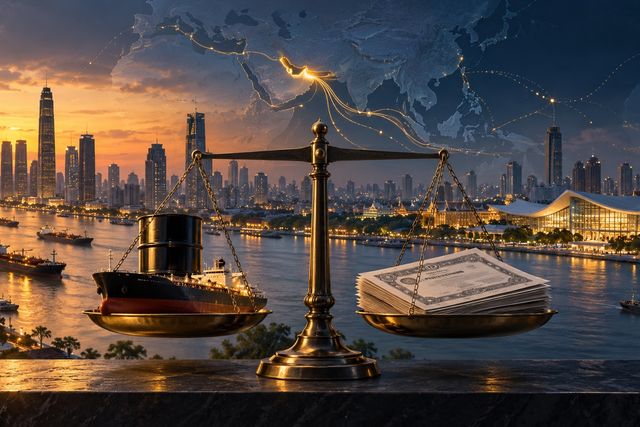
The two projects meet most concretely in the data centre. AI is thirsty. Direct cooling and the water embedded in thermoelectric power are substantial, and recent estimates (e.g. Pengfei Li and colleagues, Making AI Less 'Thirsty', 2025) suggest the demand will grow as models and usage scale. A sovereign AI programme that ignores this will rediscover the groundwater problem inside its own server halls.
The honest conclusion is that sovereign compute needs a sovereign water strategy. That means siting data centres where treated wastewater, coastal desalination or well-managed surface supply can serve them. It means basin-level accounting of water and power. It means using the same hydrological models, built for interlinking and watershed planning, to decide where compute can safely go. Treated urban wastewater alone, in a country producing vast volumes of sewage, is a large and underused cooling resource. Water infrastructure designed with compute in mind, and compute designed with water in mind, is a coupled system. A country that builds the models to manage one is best positioned to manage the other.
The strongest objection
The strongest objection is that large transfers lock in the wrong solution. Evidence from Ken-Betwa, whose foundation stone was laid in December 2024 amid disputes over forest submergence in the Panna landscape, shows that costs can be real, local and irreversible. Meanwhile watershed development, tank restoration, recharge, leakage reduction and crop-water alignment can deliver much with less disruption.
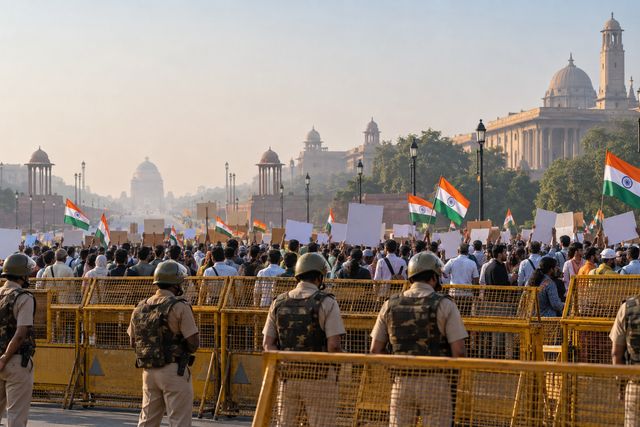
I agree with the premise and reject the conclusion. These are not alternatives to a national hydrological intelligence. They are among its first products. A system capable of comparing the marginal rupee spent on a link against the same rupee spent on recharge, scenario by scenario and basin by basin, is exactly what the interlinking debate demands and what AI can supply. Rejecting the idea of linking in advance gives up the one forcing problem large enough to justify building that system. Adopting it uncritically gives up the lessons the critics have already taught. The sovereign path is to take the idea seriously enough to subject it to the best model-building and the sharpest public scrutiny the country can muster, and to let some links die and others live on the evidence.
A parable of governed power
Bhagiratha did not bring the Ganga down by decree. The story is about austerity, persuasion, and the negotiation with Shiva needed to cushion the descent. Read properly, it is a parable of governed power: great flows can be redirected only by those who understand what they are moving, and why, and for whom.
India's AI ambition will be judged not by how many parameters its models carry but by whether it can learn to read and steer the systems that sustain its people. Water is first among them. The interlinking idea, stripped of both utopianism and dismissal, is the most demanding national test of that capacity. A country that can model its monsoon, ledger its aquifers, argue about its rivers in public, and cool its own computers sustainably will have a sovereign intelligence worth the name. The pot of seven rivers is waiting.
Comments
No comments yet. Be the first.
Comments are closed on this article.