
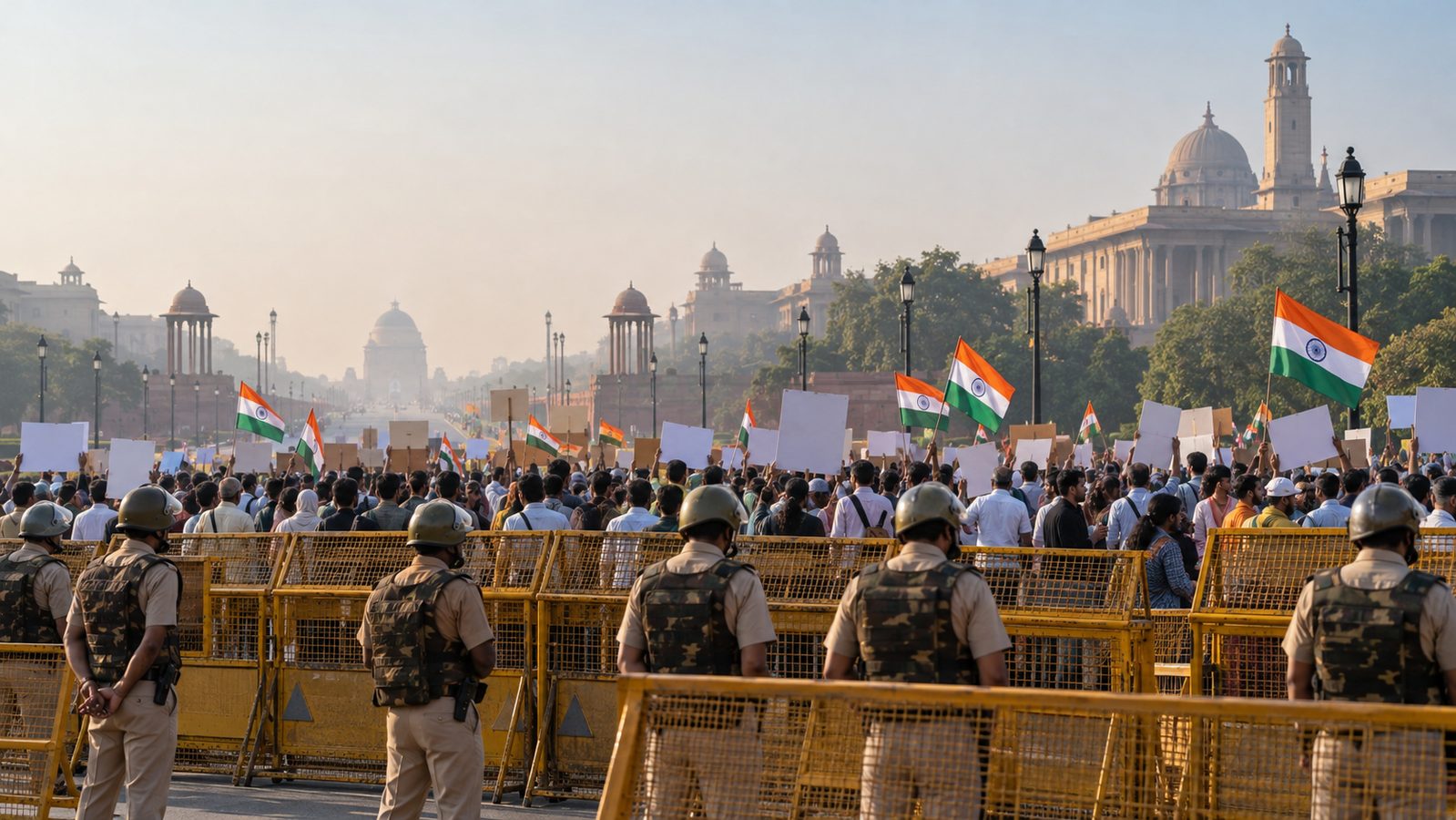
By mid-morning on 10 October, the protest that the Cockroach Janta Party (CJP), student organisations and opposition figures had called for at Jantar Mantar had largely been prevented from becoming the rally its organisers advertised. Associated Press reported that police intercepted people travelling to the site, detained many of them and took some to temporary detention centres. The movement’s leaders were detained after arriving at Delhi airport. The city had already been placed under an unusually broad security plan: road restrictions, rail cancellations, mobile-internet curbs and closures affecting dozens of Metro stations.
The immediate demand was for Chief Election Commissioner Gyanesh Kumar to resign and for the Election Commission’s Special Intensive Revision (SIR) of electoral rolls to be halted. The message was simpler, sharper and more portable: “vote theft.”
It is an effective political phrase because it collapses several fears into one accusation. A voter may be worried about a missing name, a confusing form, a software system no local officer can correct, or a decision made without a full Commission discussion. All are serious. None, by itself, proves that votes were stolen. The distinction matters: a democracy cannot protect the franchise by treating every administrative error as a conspiracy, nor by treating every allegation as propaganda and moving on.
This article separates the record into four parts: what happened in Delhi, what SIR is supposed to do, what the disputed numbers actually measure, and what the public evidence can—and cannot—establish.
What happened in Delhi
The scale of the operation is the first fact to keep separate from the argument over voter rolls. The day before the protest, AP reported that authorities had planned to close 57 Metro stations and had cancelled trains serving two New Delhi stations. The stated purpose was to limit access to central Delhi ahead of a demonstration expected to draw thousands. The Indian Express reported a 37-point police plan, detention facilities and the refusal of permission for the CJP and AISA gathering.
Police said the organisers had applied three days before the event, rather than giving the required ten days’ notice; Hindustan Times reported that this was part of their explanation. A late application can justify conditions, a change of venue or refusal of a permit. It does not settle the separate question of whether an operation that disrupts transport across the capital and detains people before a rally begins is necessary and proportionate.
That question became sharper when the Supreme Court, according to the same report, directed that there should be no outright prohibition on Metro movement and required the police, Metro and railway authorities to publicise any regulated plan. A constitutional right to peaceful assembly is not absolute; the state has a duty to protect others from violence and disruption. But restrictions have to be connected to an identifiable risk, not merely to an unpopular cause or a large expected crowd.
The immediate political result was predictable. The police action supplied the CJP with a powerful image of dissent being prevented rather than answered. It does not prove the CJP’s claims about the voter roll. It does explain why those claims travelled further.
What SIR is—and what it is not
SIR is an intensive revision of an electoral roll, not a new power to decide an election result. In its published schedules, the Election Commission sets out a sequence: house-to-house work by Booth Level Officers, publication of a draft roll, a period for claims and objections, notice and hearing, disposal of cases and then publication of a final roll. The Commission’s 2026 schedule listed Delhi among the jurisdictions where the final roll was to be published on 7 October.
That architecture matters. A person is not supposed to lose a vote simply because an official did not find them at home, because a database marked an entry as duplicated, or because a household form was incomplete. A roll revision may identify such cases for review; due process is what turns review into a lawful final decision. The safeguards are notice, a reason, an opportunity to respond, a visible correction route and a record that can be audited.
The Supreme Court upheld the Bihar SIR in its May judgment in Association for Democratic Reforms v. Election Commission of India. Its judgment summary frames the central issues as the Commission’s power to conduct SIR, the legitimacy and proportionality of the exercise, compliance with the Representation of the People Act and whether the Commission can scrutinise citizenship. The ruling did not turn every later procedure or software choice into an unquestionable fact. It upheld the exercise on the record before the Court; it did not remove the need to show that individual voters received fair treatment.
This is also where careless language does damage. Voter rolls may contain people who have died, moved, registered twice or are not citizens. Election authorities have a duty to remove ineligible entries. But SIR is not a deportation programme and a name flagged for review is not proof of illegal residence. Equally, an eligible citizen who cannot navigate an appeal process is not adequately protected merely because a procedure exists on paper.
The number that does not say what the slogan says
The most important factual correction is about 13.39 crore. The number has circulated in political argument as if it measured a mass purge or a quantity of votes “stolen.” It does neither.
The Election Commission said in an August PIB release that, after the SIR in Uttar Pradesh, more than 13.39 crore electors were included in the final electoral roll. That is a total electorate figure. It is not a national count of removed names; it is not a count of citizens wrongly denied a vote; and it is not evidence that any ballot was transferred from one party to another.
This is how propaganda works at its most efficient. It takes a large official number, strips away its definition, attaches an emotionally conclusive verb—stolen—and asks the audience to supply the missing causal chain. To establish vote theft, the evidence would need to identify specific eligible voters wrongly excluded, show that the exclusion survived the claims and appeals process, and demonstrate an electoral consequence. A number without those steps is not an answer. It is a prompt to be angry.
That does not mean every concern about SIR is invented. It means the burden of proof must remain where it belongs. A slogan can be politically useful before it is factually established; a newsroom should not let it become a finding by repetition.
Why the procedural concerns are real
The strongest case for scrutiny is not the largest number on social media. It is the evidence that parts of the process may have operated without sufficient transparency or institutional control.
The Indian Express reported that two of the three Election Commissioners had put objections on record at least 14 times in ten months. Their concerns, according to the report, included voter additions and deletions, access to the ERONet system, a changed statutory form, centralised control of software and decisions taken without their knowledge. The Election Commission acknowledged the notes but said they were part of its decision-making process; other reports cited officials saying SIR decisions were unanimous.
Both parts of that record matter. Internal dissent is not proof that a particular voter was unlawfully removed or that any party directed the process. But it is evidence that the Commission should release more, not less: the authorisation for form changes, complete instructions to officers, version histories for relevant software, anonymised counts of notices and appeals, and the disposition of each category of case.
There is a practical reason for this. The danger in a roll revision is rarely a single dramatic deletion. It is the small, repeated failure: the migrant who misses a notice, the elderly voter whose record is mismatched, the local officer who cannot correct a central database, the applicant who does not know which document a portal expects. A system can be lawful in design and still exclude people in practice. That is why audit trails and accessible appeals are not technical extras; they are the democratic substance of the exercise.
The CJP’s campaign—and the temptation to answer a slogan with another slogan
The CJP’s interest in turning SIR into a national democracy issue is obvious. It began as an online movement built around youth frustration, examination failures and political exclusion; a fight over the voter roll gives it a broader constitutional frame. Opposition parties also have an incentive to treat a disputed administrative process as evidence of a ruling-party strategy. These are normal political incentives, not proof of secret coordination or bad faith.
The government and its supporters have their own shortcut available: call a mass movement irresponsible, manipulated or foreign-backed and the underlying grievance becomes easier to avoid. This publication has previously examined claims of foreign amplification around the CJP and found that the publicly available record did not establish one. The standard should not change merely because the argument has moved from examinations to elections.
The useful rule is symmetrical. A public protest is not proof of electoral theft. A police intelligence claim or a funding inquiry is not proof that a protest is externally directed. Each allegation needs its own evidence, disclosed in a form others can test.
What would settle the argument
Neither side needs a louder slogan. They need records.
For the Election Commission, the minimum is a privacy-protective public account of the revision: how many entries were considered in each category, how many notices reached voters, how many objections and appeals were filed, how many decisions were reversed, how long the process took, and where local officers could not correct the system. Independent technical access to change logs would matter more than an assurance that the software is sound.
For parties and protest organisers, the test is equally clear. Publish documented cases of eligible citizens who were excluded; show the relevant roll, notice, hearing and appeal history; distinguish a pending case from a decided one; and do not convert a total electorate figure into a count of stolen votes. If systematic exclusion occurred, this evidence would identify it far more persuasively than a viral number.
For Delhi authorities, the relevant record is different: the legal basis for each restriction, the number of people detained, where they were held, how long, whether they were released, and the basis for any mobile-internet or transport restriction. A state that is confident its measures were necessary should be able to publish those facts.
The conclusion
The October 10 protest was not simply a dispute about paperwork. It was a collision between a public that has reasons to distrust opaque institutions and a state that treated a planned demonstration as a security problem before it became a political one.
The phrase “vote theft” captures the fear but outruns the evidence. 13.39 crore is a final-roll total in Uttar Pradesh, not a proof of votes stolen. The available record does not establish a national electoral theft, a completed purge of millions of citizens or an outcome changed by SIR. Repeating those claims as settled fact would be propaganda: a conclusion supplied before the evidence.
But the answer cannot be complacency. The objections recorded inside the Election Commission, the reported software and process questions, and the sheer reach of Delhi’s crackdown are reasons for transparency, independent scrutiny and specific remedies. Democracies lose trust both when people are wrongly excluded and when officials refuse to show the public how exclusions were reviewed. The durable answer to a slogan is not another slogan. It is an auditable record.
Sources and method
This analysis uses contemporaneous reporting by Associated Press, The Indian Express and Hindustan Times, plus the Election Commission’s published SIR schedule, its electoral-roll portal, the Supreme Court’s Bihar SIR judgment summary and the government’s UP final-roll release. Claims described as allegations or concerns are not presented as proven facts. This article will be updated if the Election Commission, courts or investigators release new material evidence.


Comments
No comments yet. Be the first.
Comments are closed on this article.