China has played a very clever move.
There is an announcement from Beijing that ships bound for the Taiwanese port of Kaohsiung must now file their cargo paperwork with Chinese authorities 48 hours in advance.
Vessels that refuse will be fined and lose access to Chinese ports.
By doing so, China has cleverly put the ship in quarantine, and by doing so, nobody can call it a blockade — only routine customs enforcement.
And this is why the US and the other countries cannot say it’s an act of war.
Last week, Taiwan’s Ministry of National Defence published its 2026 China Military Power Report, and the answer to why that question is suddenly urgent is sitting inside it.
The headline finding was blunt. Recent People’s Liberation Army exercises, the ministry said, are now built around “joint blockade and control” of Taiwan’s sea and air routes.
But read the ministry’s own wording again, because it contains a word most of the coverage skipped. The training, it said, emphasises “maritime and air blockades or quarantines.”
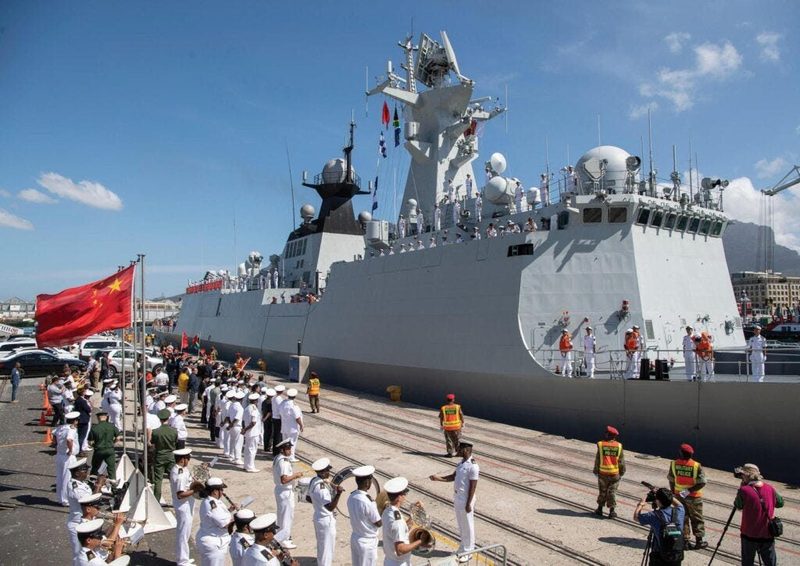
And look at who does the work: “PLA aircraft, naval vessels, China coast guard ships, and maritime militia”, operating together to cut Taiwan’s external transport routes and build an encirclement.
Coast Guard. Militia. Not just the navy.
In this article, I want to argue that almost everyone is preparing for the wrong scenario.
The world has spent a decade war-gaming an amphibious invasion, landing craft, missile salvos, and D-Day with drones.
The likelier crisis has no invasion, no declaration, and possibly no shooting at all.
It arrives as a regulation. And a regulation is very hard to shoot at.
Two Words, One Enormous Difference
Under international law, a blockade is an act of war. That is not rhetoric; it is the legal definition. To blockade a place is to announce that you are at war with it.
A quarantine is not. A quarantine is law enforcement.
That distinction is the entire strategy. As CSIS puts it in its modelling work, a quarantine is “a law enforcement–led operation to control maritime or air traffic”, while a blockade is “a military-led campaign to significantly curtail the flow of traffic into Taiwan.”
The aim of a quarantine is not to seal the island. It is to “assert China’s control over Taiwan by setting the terms for traffic in and out of the island.”
Setting the terms. That is what Beijing actually wants — not rubble, but the right to decide who docks in Kaohsiung.
Here is roughly how the limited version runs. China announces enhanced customs inspection rules for one Taiwanese port. Ships must declare in advance. There is a 48-hour warning, which conveniently lets Beijing move its ships into position. Enforcement is not gunfire — it is fines and loss of access to the Chinese market. The operation runs for about a week. The ships never entirely leave.
Notice that no shipping company has to be sunk. It only has to decide that Kaohsiung is not worth losing Shanghai over.
The choice of forces follows the same logic. The China Coast Guard was moved under the People’s Armed Police in 2018, and the 2021 China Coast Guard Law lets it operate throughout “maritime areas under Chinese jurisdiction” using “all means — including weapons.”
It is a military organisation in a civilian paint scheme. And because almost every other coast guard on earth genuinely is civilian, the disguise works.
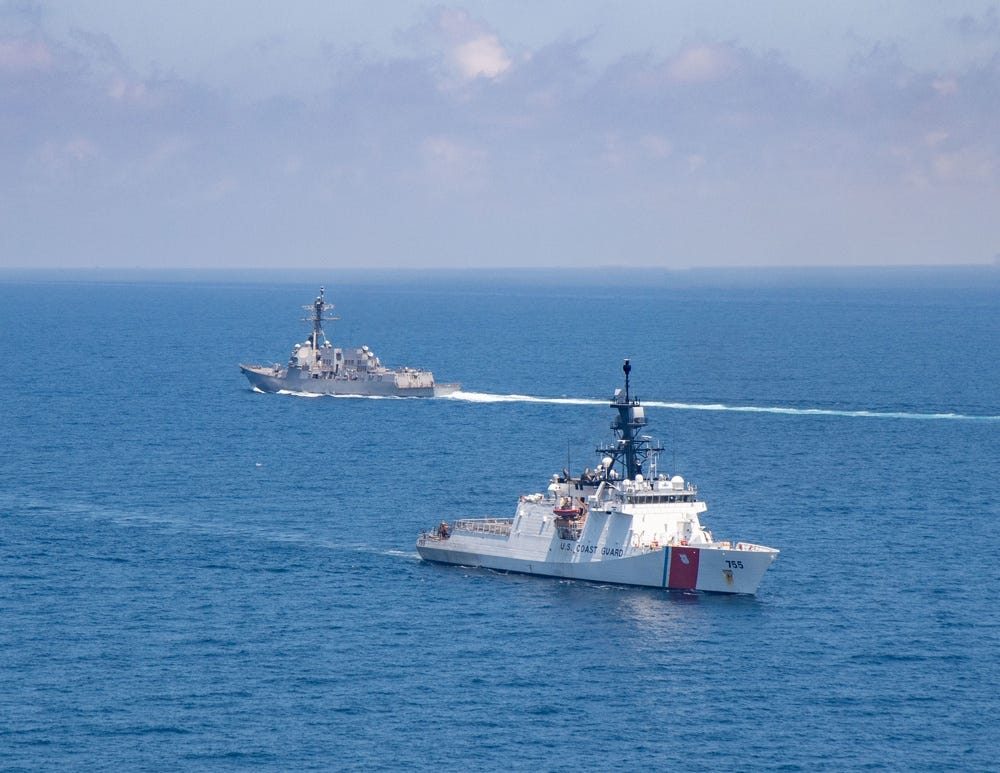
When CSIS surveyed experts on whether the United States would intervene militarily, only 13% of American and 9% of Taiwanese experts were completely confident it would — in a quarantine. For a blockade or an invasion, confidence was far higher.
Same island. Same ships. Different noun. Nine percent.
October 1962: The Word Was Invented for Exactly This
For those who don’t know the backstory, this trick has a famous author, and he was American.
When Kennedy decided to stop Soviet missile shipments to Cuba in October 1962, his lawyers had a problem. Ringing an island with warships and turning back cargo is a blockade — and a blockade would have been an act of war against the Soviet Union.
So they used a different word. Robert McNamara argued that “a quarantine would convey to Khrushchev the determination of the President to see those missiles were removed, without stimulating a military response.”
Kennedy drew two 500-mile circles around Cuba and banned one category of cargo, letting everything else through. When the first ship was finally boarded on 26 October, it was the Marucla — chosen deliberately because it was Panamanian-owned rather than Soviet, so Moscow would not be forced to respond.
It worked. Nobody went to war, because of a word.
Beijing has studied that episode more carefully than we have. Taiwan’s defence ministry notes the PLA is drawing lessons from Ukraine and the Middle East; it would be strange if the Cuban file were the one thing they skipped.
And Beijing has an advantage Kennedy never had. Kennedy had to invent a legal fiction from scratch. China already claims Taiwan is its own territory — which means inspecting ships bound for Taiwanese ports is not a blockade of a foreign country at all. In Beijing’s telling, it is domestic customs enforcement.
Schelling’s Salami, Sliced in Public
The theory here belongs to Thomas Schelling, the economist who taught Washington how to think about nuclear bargaining.
Schelling described what he called salami tactics: an aggressor should “begin his intrusion on a scale too small to provoke a reaction, and increase it by imperceptible degrees.”
The defender is then caught in a trap that is completely rational and completely fatal. Each slice is too small to be worth a war. The accumulated slices change everything. And once a slice is taken, as Snyder and Diesing put it, “the game is over, he has lost, and he had best accept it.”
Every serious defence planner knows this. Nobody has solved it, because the solution requires going to war over something trivial, in advance, on principle.
Count the Slices Already Taken
Here is what makes this more than theory. The salami is being sliced right now, and you can date every cut.
- February 2024, Kinmen. Chinese coast guard officers boarded a Taiwanese tourist boat. Beijing then suggested the “Kinmen model” of law-enforcement inspections could be applied to Matsu, Penghu, “and even the entire Taiwan Strait.” They announced the plan out loud.
- Pratas Island. China Coast Guard activity days rose from 25 in 2024 to 60 in 2025. On 27 June 2026, CCG vessel 3101 entered Taiwan’s restricted waters there broadcasting that “the Republic of China does not exist.”
- Taiping Island, 11 June 2026. First incursion into its restricted waters, by two Chinese government vessels.
- East of Taiwan, July 2026. China swapped one coast guard task group for another and kept patrolling. Taiwan Affairs Office spokesperson Zhu Fenglian called it “a lawful exercise of jurisdiction.” Chinese cutters had already started radioing foreign merchant ships to ask their departure points and destinations.
Read that last line again. That is a quarantine being rehearsed on live commercial traffic, one radio call at a time.
- The cables. On 30 March 2026 a Chinese-flagged work barge damaged the Taiwan–Matsu №3 subsea cable. Taiwan detained eleven crew and referred the case to prosecutors; repairs were not expected to finish before July. Every incident of this kind comes with an innocent explanation attached, which is precisely the point.
- And the muscle behind it. In December 2025 the PLA launched snap drills around Taiwan with at least 89 aircraft and 28-plus ships, practising “coverage, blockade, precision strike and decapitation strike” and simulating a total blockade of Taiwan’s major ports.
The pattern never changes: a legal claim, a white-hulled ship to enforce it, a propaganda line, then repetition until the new position looks normal. Jamestown calls that last step normalisation. It is the right word.
People discuss Taiwan as a moral question. It is also a plumbing question, and the plumbing is why a quarantine is so powerful.
More than a fifth of all global maritime commerce moves through the Taiwan Strait. That includes $1.3 trillion of China’s own trade, 30% of Japan’s imports and 25% of its exports, roughly $300 billion of South Korea’s trade, and 28% of Australia’s exports. The Democratic Republic of Congo ships about 60% of its total exports through it.
And Taiwan makes over 90 percent of the world’s most advanced chips.
Rhodium Group modelled a blockade and put “well over two trillion dollars in economic activity at risk” — while calling that figure a floor. Semiconductor-dependent industries alone could forfeit around $1.6 trillion in annual revenue.
You do not need to stop any of that to win. You need insurers and boardrooms in Copenhagen, Geneva and Singapore to believe it might stop. Freight reroutes on rumour.
That is why the paperwork is the weapon.
Deterrence Is Resting on a Noun
Strip everything away and here is what is left.
The security of the world’s most important shipping lane, and of the factories that make the chips inside almost every device you own, currently rests on a shared agreement about what to call things.
Call it a blockade, and treaties activate, alliances are triggered, and presidents have to decide in public.
Call it a customs inspection regime, and the same ships do the same thing to the same traffic — while lawyers argue, insurers reprice, and every capital waits to see whether somebody else will move first.
That is not a military balance. It is a shared belief, and shared beliefs are the softest thing in international politics. Kennedy proved in 1962 that the right word can prevent a war. Beijing appears to have concluded that the right word can also win one.
So watch the vocabulary, not the missiles. The day Chinese state media stops saying “exercise” and starts saying “inspection,” the crisis will already have begun — and half the world will still be arguing about whether anything happened.
Comments
No comments yet. Be the first.
Comments are closed on this article.