
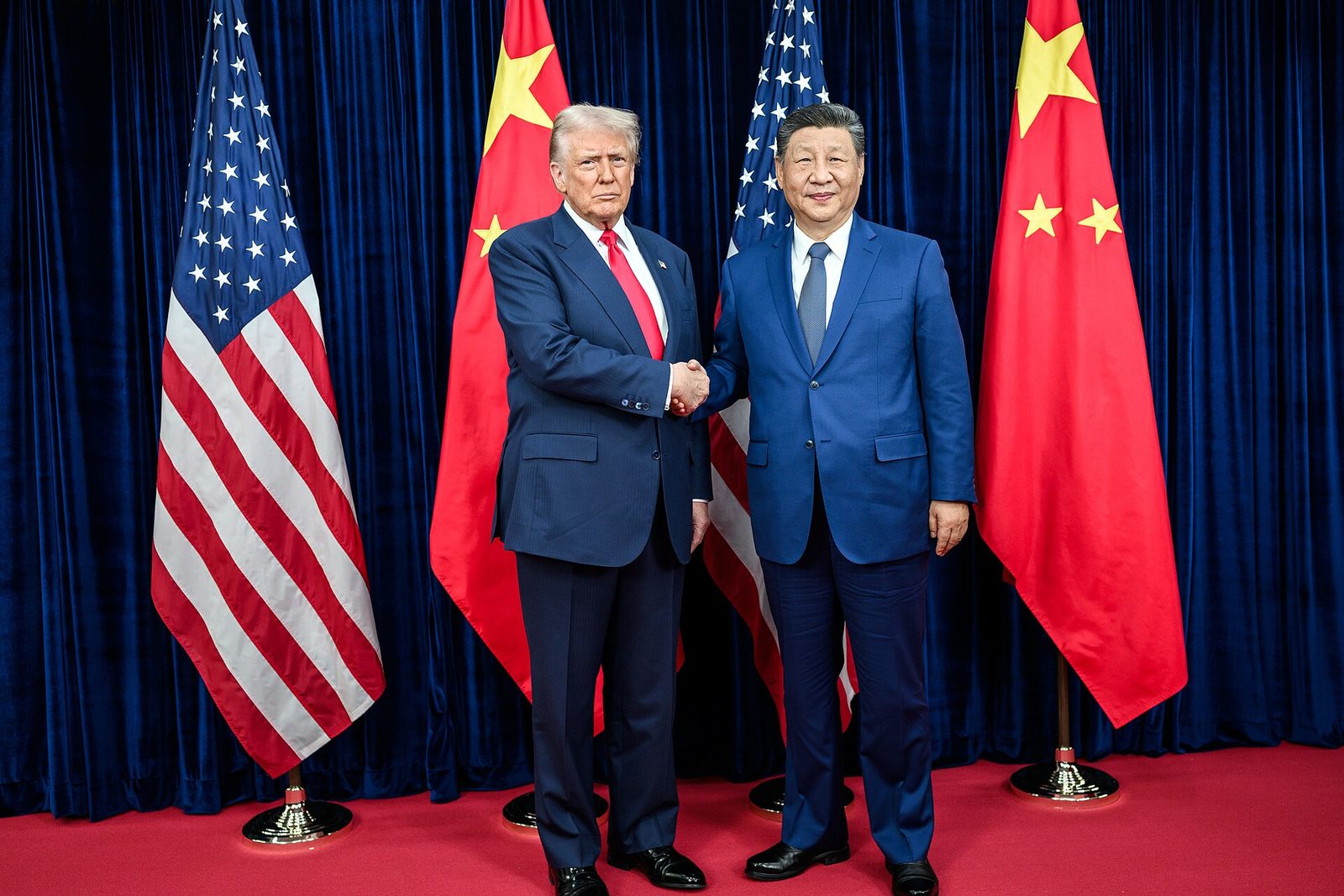
In three weeks Donald Trump and Xi Jinping meet again, this time in Shenzhen, at the APEC summit on 18 and 19 November. Their negotiators are racing to have something to sign. According to the South China Morning Post, the talks may not finish by Shenzhen and could run on to the G20 in December.
The headlines will be about soybeans, Boeing orders and investment boards.
That is the wrong place to look.
In this article, we argue that the US–China truce is not a step towards a settlement. It is a standoff between two hostages. China holds the rare earths that American factories and weapons need. America holds the jet engines and aircraft parts that China's own airliner cannot fly without. Neither side is using its weapon, and neither will put it down. That is what keeps the truce alive, and it is also why every extension is shorter than the last.
How did the truce get here?
The truce began on 30 October 2025, when Trump and Xi met at Gimhae airport in Busan. The terms, as China Briefing set them out from both governments' statements, were a set of suspensions, not settlements:
- The US cut its "fentanyl" tariff on Chinese goods from 20 to 10 per cent, and kept the extra 24 per cent "reciprocal" tariff suspended for a year.
- China suspended for a year the sweeping rare-earth export controls it had announced on 9 October 2025, and lifted its retaliatory tariffs on US farm goods.
- Both sides suspended the port fees they had imposed on each other's ships, and the US paused its rule extending chip controls to the affiliates of listed firms.
Almost everything ran to 10 November 2026. The older Chinese controls of April 2025, on seven rare earths, stayed in place.
Since then the two leaders have met twice more: in Beijing in May, and in Washington in September, the first state visit by a Chinese leader in eleven years. The Washington visit produced little except time. Treasury Secretary Scott Bessent announced that "we will extend what we call the Busan Agreement", from 10 November to 10 January.
Look at the length of each pause.
| Pause | Agreed | Length |
|---|---|---|
| Tariff cut after the spring 2025 escalation | May 2025 | 90 days |
| The Busan truce | 30 October 2025 | One year, to 10 November 2026 |
| Extension during Xi's Washington visit | 23 September 2026 | Two months, to 10 January 2027 |
Sources: Asia Times, China Briefing, Al Jazeera.
"The extensions are getting shorter and shorter," Philippe Le Corre of ESSEC Business School told Al Jazeera, "which means they haven't found a common ground on many issues."
A one-year truce is a bet that a deal is coming. A two-month truce is a promise not to shoot this week.
What is China's hostage?
Rare earths. China holds about 60 per cent of the world's known deposits and processes about 90 per cent of them, according to Al Jazeera's figures. Without them there are no electric motors, no wind turbines, no guided missiles.
China has not used the weapon openly since Busan. But it has kept its hand on it. Its licensing system lets it slow shipments without announcing anything, and the customs data show the hand moving:
- Rare-earth magnet exports to the US fell 21 per cent in August, to 512 tonnes, on Chinese customs data reported by Bloomberg, just before Xi flew to Washington.
- In September they rose 18 per cent, to 604 tonnes, the South China Morning Post reported. Analysts at the Shanghai Metals Market put the jump down mainly to orders that had been held at ports in July and August under tighter licensing being released.
- China recorded no US-bound shipments of yttrium at all in January, May and June this year, Asia Times noted.
This is the point. A ban would be an act of war on supply chains, and it would push every buyer to find another source. A licence that takes a little longer is deniable. China does not need to cut supply. It needs America to know that it can.
Sources told the SCMP that Beijing sees critical minerals as "China's most effective economic weapon", and that it was reluctant to increase supplies before Shenzhen.
What is America's hostage?
Aircraft. China's answer to Boeing and Airbus, the COMAC C919, flies on one engine: the LEAP-1C, made by a joint venture of GE and France's Safran. China's own replacement, the CJ-1000A, is not ready. Chinese commentators quoted by Asia Times do not expect a full switch on the C919 before 2030.
Washington has used this before. In May 2025, weeks after China restricted rare earths, the US suspended licences for COMAC's jet engines and parts. It lifted the engine suspension in July, after a rare-earth deal in London.
Now it is doing it again, more quietly. Reuters reported on 1 October, as Asia Times relayed, that the Commerce Department has capped the parts it licenses to COMAC, to stop the company from stockpiling, and has slowed licences for aircraft parts bound for China. Officials are weighing a rule that would make it easier to restrict landing gear and other components.
The damage is already visible. COMAC cut its 2025 delivery target from about 75 jets to about 25, and then delivered 15.
The mirror image is exact. China slows magnets through licences; America slows engine parts through licences. Neither is a ban. Both are reminders.
Why does neither side pull the trigger?
Because each hostage protects the other.
If China cut off rare earths, America would cut off engines, and the C919, the flagship of China's plan to build its own aircraft industry, would stop. If America cut off engines, China would cut off magnets, and American defence and car factories would stop. Each side's weapon is the other's insurance.
Political scientists call this mutually assured destruction when the weapons are nuclear. Here the weapons are economic, and the logic is the same: deterrence holds as long as both sides can still hurt each other, and as long as neither can escape its dependence quickly.
That second condition is the one to watch. America is spending to build rare-earth processing outside China; China is spending to certify its own engine. Each is trying to free its hostage before the other does. The truce lasts as long as both are still trapped.
Hence the shrinking extensions. Neither side wants a grand bargain that would lock in today's balance. Each wants to keep the other on a short lead until its own dependence has eased. "Washington is hostile, but it is hooked," as Einar Tangen of the Center for International Governance Innovation put it.
Is this too pessimistic?
There is a better case, and it deserves a hearing.
The two governments now have a standing trade board, led by Bessent, US Trade Representative Jamieson Greer and Vice Premier He Lifeng, and are trying to build a matching investment board, the SCMP reports. Beijing agreed in May to buy 200 Boeing aircraft. After the Washington visit the US said China would buy more American coal and that the two sides had made incremental progress towards future tariff cuts. Yun Sun of the Stimson Center read the short extension as a sign that a wider deal is near: the two sides "need more time to negotiate the technicalities."
Institutions matter. A board that meets every month is harder to walk away from than a handshake at an airport.
But look at what has not happened. The 200 Boeing jets have yet to materialise. The investment board stalled over American opposition to Chinese car plants. Bessent himself said in September that Beijing still needed to deliver more. Purchases are the easy part of a truce. As Sun Chenghao of Tsinghua University told Al Jazeera, "additional purchases cannot indefinitely compensate for uncertainty over tariffs, technology restrictions and market access."
What should we expect from Shenzhen?
Three things, if the hostage logic holds:
- Another extension, probably short. Three sources told the SCMP that both sides see "no alternative to extending the trade agreement". The question is whether it runs for months or for a year. A year would mean confidence; weeks would mean the standoff continues.
- Purchases announced as wins. Soybeans, coal, perhaps Boeing at last. They will be presented as a breakthrough. They are not, because none of them touches the two chokepoints.
- No movement on the hostages. Watch for any written commitment on rare-earth licence times or on COMAC's parts. If neither appears in the readouts, nothing fundamental has changed.
Why does this matter beyond Washington and Beijing?
Because the rest of the world lives inside this standoff.
China's rare-earth licensing does not only slow shipments to America. Every manufacturer that buys magnets, from Europe to India, works under the same system and the same uncertainty. And every country that hopes to win factories leaving China, the argument of our contributors on China+1 and ASEAN+1, is betting that the standoff lasts long enough for new supply chains to be built, but not so long that it breaks into open economic war.
The truce is often described as a thaw. It is better described as a balance of fear. Balances of fear can last a long time; the Cold War did. But they last only while both sides believe the other can still hurt them.
The moment one side frees its hostage, the truce loses its reason to exist. Shenzhen will not tell us whether that moment is near. The licences will.
Related: Signals of a Global Geo-economic and Geopolitical Shift · The Debt Behind American Power

Comments
No comments yet. Be the first.
Comments are closed on this article.