
Research brief, version 1.0, published 4 October 2026. Analysis for information, not legal or investment advice. Every later change is logged on the live tracker, which carries the current position.
This brief opens a research project on the new US tariff authority over buyers of Russian oil. It asks what duty Indian goods will face in the United States because India buys Russian crude, when, and which exporters carry the risk.
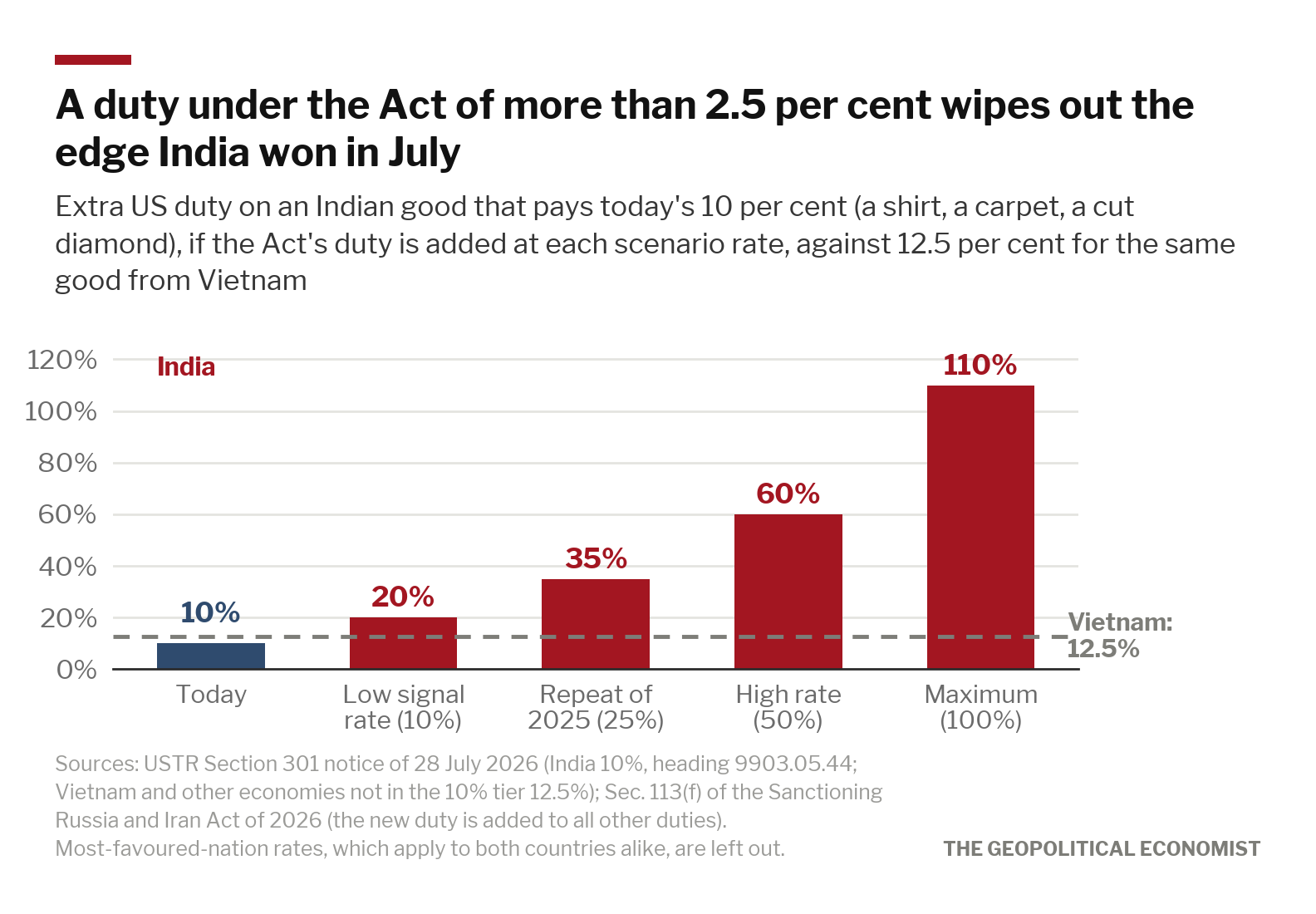
The law obliges the President to act against countries like India by 18 October 2026, and it lets him waive the duty with a written certification and a report to Congress. On the evidence to 4 October, no new duty on that date is the most likely single outcome, at roughly even odds. But a duty at any rate above 2.5 per cent would remove the edge Indian goods won in July over rivals in the 12.5 per cent tier, such as Vietnam and China, and it would reach goods that pay little or no extra US duty today, starting with nearly $25 billion a year of phones and network equipment.
Summary
| Scenario for 18 October | What happens | Likelihood |
|---|---|---|
| A. No new duty | India is named but the duty is waived or held back, or India is left off the list | Roughly even chance (about 50%) |
| B. A low signal rate | A duty above zero and up to 15 per cent | Unlikely (about 25%) |
| C. A repeat of 2025 | A duty above 15 and below 50 per cent, about 25 as in 2025 | Unlikely (about 20%, the low edge of the band) |
| D. A high rate | A duty of 50 to 100 per cent | Very unlikely (about 5%, the low edge of the band) |
Three dates to watch. 8 October is the last day for the written justification to Congress if a duty is to start on 18 October. 18 October is day 30 under the Act. 3 November is the US midterm election, the backdrop to the worries about prices that some House Republicans have raised.
What the law says
On 18 September 2026 the President signed the Lindsey O. Graham Sanctioning Russia and Iran Act of 2026. Its Section 113 gives Washington a tariff authority it has never had in statute: a duty on everything a country sells to the United States, triggered not by what that country does in trade but by what it buys from Russia. Six points in the text decide what it means for an Indian exporter. Every quotation in the six points below is from the enrolled text of the Act.
A duty of up to 100 per cent on all goods, due within 30 days. The President "shall, notwithstanding any other provision of law, increase the rate of duty for all goods imported into the United States from a country described in subsection (c) … to a rate of up to 100 percent ad valorem", and must do so "not later than 30 days after the date of the enactment" (Sec. 113(a)). Day 30 is 18 October 2026. The duty is country-wide: it falls on a shirt from Tiruppur or a diamond from Surat regardless of any link to Russian energy. There is no minimum rate. A duty of 1 per cent satisfies the text as well as a duty of 100.
Who is caught: a two-part test. A country is covered if it "knowingly made new purchases of crude oil or natural gas that originated in the Russian Federation on a date that is on or after 30 days after the date of enactment", and "was among the 5 largest importers, by total volume, of crude oil or natural gas that originated in the Russian Federation during the most recent 12-month period preceding the date of the enactment" (Sec. 113(c)(1)). A country is also covered if it "was among the top 5 countries facilitating Russian oil sanctions evasion" in the same period (Sec. 113(c)(2)). Crude means Harmonized System code 2709 and gas means code 2711 (Sec. 113(g)(2)); refined products do not count. The ranking is by volume, over the twelve months to enactment. The Act names no data source and no method for the first round; the written justification to Congress must give "the methodology used to determine that the country subject to the duty is a country described in subsection (c)" (Sec. 113(g)(1)(B)). The one exception in the text is for natural gas, for a country whose Russian gas was under 15 per cent of Russia's gas exports and which "has taken significant steps to reduce" it (Sec. 113(d)). There is no exception for crude.
It stacks on every other duty. A duty under the Act "shall be in addition to any other duty, fee, tax, exaction, or charge applicable with respect to the good", and the text names antidumping and countervailing duties, Sections 122, 201 and 301 of the Trade Act of 1974 and Section 232 of the Trade Expansion Act of 1962 (Sec. 113(f)). For Indian goods that means on top of the 10 per cent Section 301 duty in force since 24 July 2026, and on top of the Section 232 rates on steel, aluminium, autos and their parts.
The rate can move at any time, and the list is redrawn every 180 days. Once a duty exists, the US Trade Representative "shall modify or adjust any rate of duty … to a rate greater than zero and up to 100 percent" on a written determination to Congress that the country "has taken significant steps" to increase, or to "decrease or cease", its purchases of Russian crude or gas (Sec. 113(b)). "Significant steps" is not defined. A modification cannot take the rate to zero. Then, "not later than 180 days after the initial imposition of duties … and every 180 days thereafter", the Trade Representative re-determines the five largest importers of Russian crude and of Russian gas and imposes duties on them (Sec. 113(e)). A duty first imposed on 18 October 2026 would face its first review by 16 April 2027. The text does not say whether a country that drops out of the top five keeps its duty.
Two exits: waiver and termination. The President "may … waive … any duty under this title" after sending Congress "a certification in writing that the issuance of the waiver is in the national interests of the United States" and a report explaining it (Sec. 115). No ground narrower than the national interest is required, no duration is set, and Congress gets no vote. The President may also terminate a duty on a country by certifying that it "is not engaging in the activity that was the basis for the sanctions" and that he "has received reliable assurances" it will not do so again (Sec. 117(a)(1)(B)); a termination waits 30 days for a possible joint resolution of disapproval (Sec. 117(b)). A peace agreement in Ukraine does not switch the duty off by itself: the peace-agreement route in Sec. 117(a)(1)(A) is written for Russia only.
Ten days' written notice, and a five-year life. "Not later than 10 days before imposing a duty", the President or the Trade Representative "shall submit to the appropriate congressional committees a written justification" giving "a substantive rationale for the determination of the rate" and the method used to pick the country (Sec. 113(g)(1)). The committees are Finance, Foreign Relations and Banking in the Senate and Ways and Means, Foreign Affairs and Financial Services in the House. The Act does not require the justification to be published, but six committees receive it, and for a duty starting on 18 October it is due by 8 October. The division that holds the tariff authority "shall terminate on the date that is 5 years after the date of the enactment of this Act" (Sec. 203), on 18 September 2031; only its extension of the Iran Sanctions Act (Sec. 201) runs on.
What the text leaves open. The Congressional Research Service, reading the Senate text, found the deadline for imposing a duty and the window in which a country can become eligible "would overlap by at most a single day"; found no definition of "significant steps"; and asked whether "knowingly made new purchases" reaches a private refiner's purchases or only a government's, noting that the evasion prong "expressly authorizes tariffs based on the participation of nongovernmental persons" while the importer prong does not. The Act does not define a "new purchase", gives no origin rule for blended or re-exported crude, and says nothing about goods already at sea when a duty begins. One more question matters to exporters. Sec. 114 says "Sanctions and other measures under this title shall not apply to" the conduct of "a transaction for the provision of agricultural commodities, food, medicine, medical devices, humanitarian assistance, or for humanitarian purposes". The duty sits in the same title. Whether that clause keeps medicines and food out of a duty is not addressed by any source we have read.
The precedent. Washington has done this once before, by executive order rather than statute. On 6 August 2025 the President found that "the Government of India is currently directly or indirectly importing Russian Federation oil" and added a 25 per cent duty on Indian goods from 27 August 2025. It was lifted from 7 February 2026 on a finding that "India has committed to stop directly or indirectly importing Russian Federation oil", with the Commerce Department told to "monitor whether India resumes". The joint statement the two governments issued the day before the duty was lifted said nothing about Russia; it recorded India's intention to buy $500 billion of American energy, aircraft, precious metals, technology and coking coal over five years, and the Commerce Minister said two days later that "the trade deal does not decide who will buy what and from where". The 18 per cent rate announced with the agreement was never applied: the Supreme Court struck down tariffs under the International Emergency Economic Powers Act on 20 February, a temporary surcharge under Section 122 ran for 150 days, from 24 February to 24 July, and the 10 per cent Section 301 duty has applied since. We found no published Commerce finding on whether India resumed. The Act replaces that discretionary loop with a statutory one, and moves the monitoring to the Trade Representative.
Where India stands on Russian oil
The Act asks two questions about India: was it among the five largest importers of Russian crude by volume in the twelve months to enactment, and will it make new purchases on or after 18 October? The first has an answer. The second is being decided now.
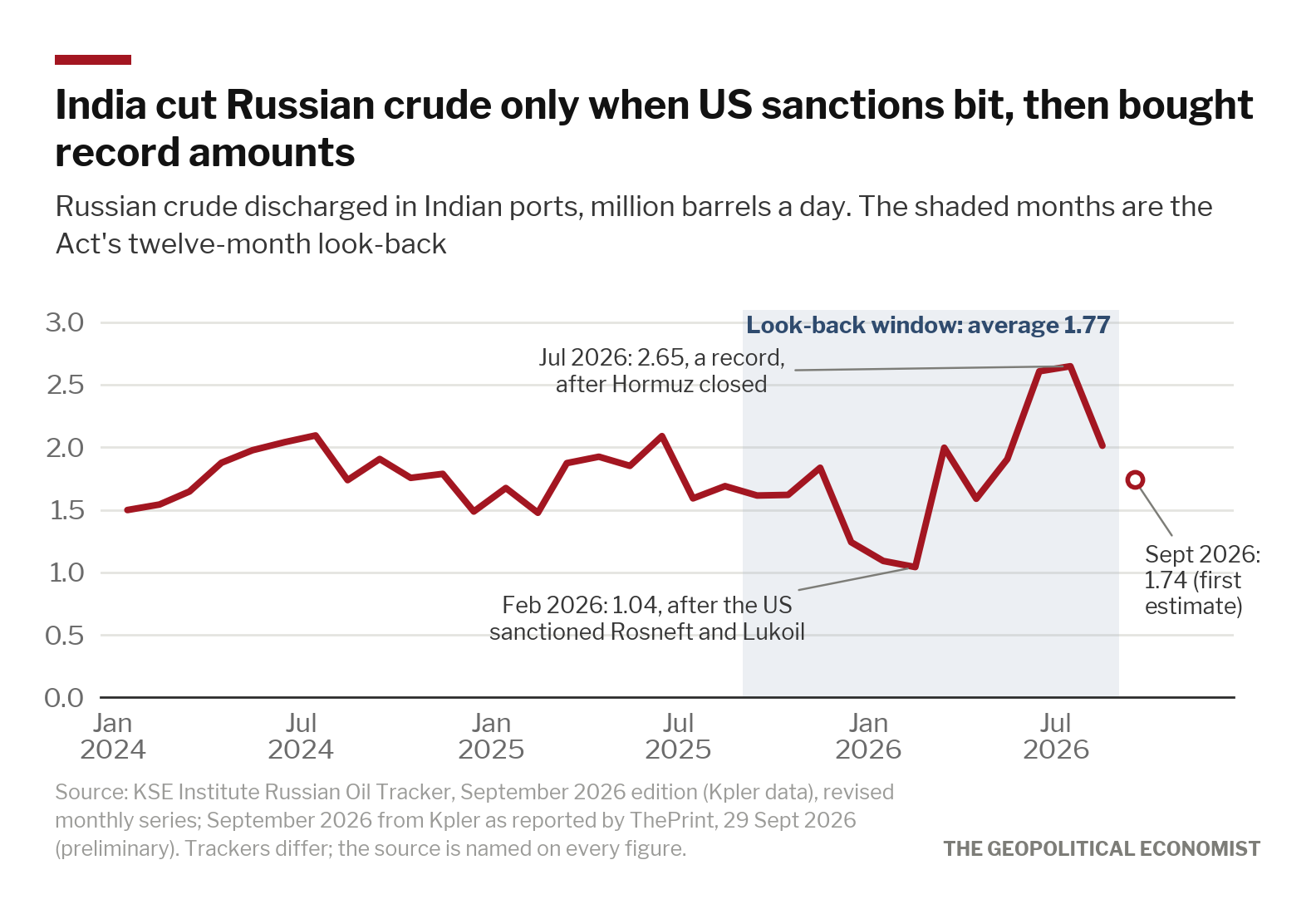
The twelve months the Act looks at. On the KSE Institute's monthly series of Russian crude discharged in Indian ports, built on Kpler data, India took 1.61 million barrels a day in September 2025, fell to 1.04 million in February 2026 after the United States sanctioned Rosneft and Lukoil, and then climbed to records of 2.61 million in June and 2.65 million in July 2026, more than half of everything India imported, before easing to 2.01 million, 43 per cent of imports, in August. The twelve-month average is 1.77 million barrels a day. On the same tracker's destination basis, Russian seaborne crude bound for India averaged 1.75 million barrels a day over the window against 1.39 million for China and 0.21 million for Türkiye. Those are seaborne figures. Adding the roughly 600,000 barrels a day China takes by pipeline puts China first by total volume and India second, which is also the order of CREA's cumulative value shares since December 2022: China 50 per cent, India 37. In no monthly edition of the KSE tracker does India fall below second among seaborne buyers, and third place is about eight times smaller. India is a top-five importer of Russian crude by volume under any defensible method. India buys no Russian gas of consequence and does not appear in CREA's lists of buyers of Russian LNG or pipeline gas, so it is covered through crude, for which the Act allows no exception.
Why refiners went back. The February trough was not a policy; it was a sanctions shock. After the United States designated Rosneft and Lukoil on 22 October 2025, many Indian refiners paused new orders, and the KSE Institute recorded supply that "stabilized at ~1.2 mb/d, 32% below the 2024-2025 average", with Saudi Arabia briefly India's largest supplier. Then war with Iran closed the Strait of Hormuz in March. A 30-day US Treasury waiver let Indian refiners buy Russian cargoes stranded at sea, Kpler expected inflows to lift "around 1.8 to 2 Mbd in the near term", and the months that followed set records. The refiners' own account is about availability, not price. By September Urals delivered to India was selling at a premium to Brent: about $133 a barrel on Argus's assessment in the week to 18 September, with Oman and Murban dearer still, Bloomberg reported, and Business Standard's refining sources expected premiums of $8 to $9 a barrel for November arrivals. Indian Oil's finance director put the company's position in October 2025, as Reuters reported: "Russian crude is not sanctioned. It is the entities and the shipping lines which have got sanctions".
What September and October show. September was the lowest month since April: 1.74 million barrels a day out of 5.3 million on Kpler's count as reported by ThePrint, with an earlier estimate of 1.9 million revised down as the month closed. Refining sources told Reuters, as IndraStra reported, that Indian refiners had secured September and October supplies that include Russian oil and wanted New Delhi to seek time to wind down contracts and a quota for Russian purchases. By 29 September the same agency reported that Russian supply to India would tighten in October and November because Russian exports had fallen and Chinese buyers were booking earlier and paying more; refiners turned to Murban, Basrah and Angolan grades. That is a supply story, not a compliance story. Talks for November-delivery Russian cargoes normally open in the last week of September, and purchases concluded then would load around the second half of October, on either side of the 18th. No report to 4 October says Indian refiners have stopped buying. They are buying less because less is on offer at a price they will pay, and the refiners' request, as reported, is for a quota, not a stop.
What switching would cost. Estimates run from $1.8 to $3.7 billion a year for each million barrels a day replaced at $5 to $10 a barrel dearer, which the analyst Natalia Katona described as a sensitivity calculation rather than a forecast, through $9 to $11 billion a year if India moved away from Russian crude altogether (analysts quoted by PTI, August 2025), to SBI Research's $9 billion for 2025-26 and $11.7 billion for 2026-27 if imports stopped. Most were built as discount-loss sums, and the discount was gone by the time the Act was signed. The loss now would come from paying up for scarce medium sour barrels while the Gulf's own exports remain constrained. As Kpler's Nikhil Dubey put it, "The real question is not replacement, but the cost of replacement." The comparison analysts offer is Iran in 2019, when India gave up about 313,000 barrels a day, 6 per cent of its imports. Russia in August 2026 supplied about 2 million.
What this means for the test. India meets the importer prong on volume. Whether it meets the purchase prong depends on what loads after 18 October, on whether a cargo contracted in September and loaded in late October counts as a "new purchase", which the Act does not define, and on whether a private refiner's purchase is attributed to the country, which the Congressional Research Service says the text leaves open. The sign to watch is the November-delivery programme: cargoes fixed, loading dates, and whether state refiners are told to stop, slow or carry on.
Four scenarios
Nobody outside the White House knows what the President will decide. What can be mapped is the set of possible decisions, the public signs that would come before each, and what each would mean for exporters. The four scenarios below cover every outcome of the first decision and do not overlap. Likelihoods use the scale of the US intelligence community's analytic standard, ICD 203: very unlikely is 5 to 20 per cent, unlikely 20 to 45, roughly even chance 45 to 55, likely 55 to 80 and very likely 80 to 95. They are judgements on the evidence to 4 October, not predictions, and after the decision we will publish which scenario happened and what we got wrong.
| Scenario | What happens | Signs it is coming | For exporters | Likelihood |
|---|---|---|---|---|
| A. No new duty | India is named as a top buyer but the President waives the duty under Sec. 115 or holds it back, tied to the trade deal or to cuts in Russian purchases; or India is left off the list, including because it makes no new purchases | A waiver certification sent to Congress; an interim trade agreement; refiners booking fewer Russian cargoes | No new duty now. A waiver can be withdrawn, and the list is redrawn every 180 days once any country pays the duty | Roughly even chance (about 50%) |
| B. A low signal rate | A duty above zero and up to 15 per cent, to keep pressure on | A justification to Congress with a modest rate; officials stressing the steps India has taken | The July edge over Vietnam is gone; margins are squeezed; few orders move | Unlikely (about 25%) |
| C. A repeat of 2025 | A duty above 15 and below 50 per cent, about 25 as in 2025 | Trade talks stall; officials cite the February pledge; Russian imports stay near 2 million barrels a day | A repeat of 2025-26: orders move in price-sensitive sectors, and this time smartphones pay too | Unlikely (about 20%, the low edge of the band) |
| D. A high rate | A duty of 50 to 100 per cent | An open break in talks; pressure from Congress to enforce; no fall in Russian imports | Most price-sensitive exports to the US stop being viable | Very unlikely (about 5%, the low edge of the band) |
Why no duty is the most likely single outcome. Four things point that way.
- The waiver is cheap. Sec. 115 needs only a written certification that a waiver is "in the national interests of the United States" and a report explaining it. It sets no duration and gives Congress no vote.
- Officials describe the authority as a tool held in reserve. A senior State Department official said on 25 September that "Congress gave the President another tool in his toolkit. That doesn't mean necessarily that he's going to implement that tomorrow", and that Congress "gave him a huge national security waiver". The Trade Representative, Jamieson Greer, said on 1 October: "we do have to do a report within 30 days — we have to name names — so we'll be doing that. What kind of action we'll take is for the president to decide."
- A trade deal is near, and a duty would cut across it. Greer said the talks were "in the short strokes", though "I don't think there's something imminent", and that the President and the Prime Minister "may have another call very soon"; the Commerce Minister, Piyush Goyal, called the deal "almost done and dusted". Narendra Modi and Donald Trump spoke on 30 September.
- Prices matter before the midterms. Ronak Desai of the Hoover Institution told CNBC that nearly "a dozen House Republicans privately urged [the] leadership to strip the tariff provisions for fear of rising prices on the eve of the midterms", and 37 US trade associations led by the American Apparel and Footwear Association wrote to the House against the authority on 11 September. India's September imports of Russian crude, the lowest since April, also give Washington a fall it can point to, even though supply drove it.
Why a duty remains a real possibility. Scenarios B, C and D together are about as likely as A. The Act says "shall", and it passed the Senate 86 to 11 and the House 262 to 159 (Sullivan & Cromwell); a waiver for India has to be certified and explained to Congress in writing, where Senator Richard Blumenthal's view during passage was that "Appeasement is not a strategy". The administration singled out India a year ago, with a duty that spared China, the larger buyer. The February order said India "has committed to stop" importing Russian oil, and its imports then rose to records, though we have found no US official saying in public that India broke that commitment. Greer has called India's purchases "really kind of a wartime-discount situation", and the President told the UN General Assembly that the Act gives him "enormous new tariff authorities" and that "if necessary" he "will have to use them" (Sullivan & Cromwell).
Why B ranks above C, and C above D. A low rate satisfies the "shall" in Sec. 113(a) at the smallest cost to the talks and to American buyers, and Sec. 113(b) lets the Trade Representative move it later. A 25 per cent rate repeats a step Washington has taken before, but this time it would also fall on $25 billion a year of phones and network equipment a fortnight before the midterms. A rate of 50 per cent or more would end most trade in the exposed sectors, and the talks with it.
China. China is the largest buyer of Russian crude and would in law face the same test. The Conference Board judged it "unlikely this authority would be used against China, given the Administration's desire to preserve the current 'trade truce' with China". India, Bloomberg reported, will be watching "whether Washington applies the measures to all major Russian energy buyers, including China". A duty on India alone would repeat the pattern of 2025.
One path to A needs its own judgement. If India makes no new purchases of Russian crude or gas on or after 18 October, it falls outside the importer test (Sec. 113(c)(1)), though the separate test for countries that help evade sanctions (Sec. 113(c)(2)) remains. We judge this path very unlikely before the decision. September arrivals were still 1.74 million barrels a day, talks for November-delivery cargoes normally open in the last week of September, and refiners have asked for a quota, not a stop.
What would change this judgement. Toward a duty: reports that a written justification has gone to the six committees, due by 8 October for a duty from the 18th; a breakdown in the trade talks; high Russian loadings for India in the second half of October; the President naming India in public. Toward no duty: a waiver certification, a signed interim agreement, or refiners told to stop or cap their purchases. If no justification is reported by 8 October, a duty starting on 18 October becomes less likely; whether a later duty would be lawful is untested. The Act does not require the justification to be published, so silence is weak evidence either way.
Who is exposed
A duty under the Act would fall on "all goods" from a covered country (Sec. 113(a)) and would be added to every duty they already pay (Sec. 113(f)). So the question for each export sector is not whether it would be hit but how hard. Three things decide that: how much of the sector's exports go to the United States, how its US sales held up under the 25 per cent duty of 2025-26, and whether it is exempt from US duties today, because the Act names no product exemptions of its own.
| Sector (HS code) | US imports, 2025, $bn | US share of exports | Change under the 2025 duty | Extra US duty today | Rivals' extra duty | Exposure |
|---|---|---|---|---|---|---|
| Phones and network equipment (8517) | 24.8 | 59% | +129% | None: smartphones, nearly all of it, are exempt | Vietnam, China: none | High |
| Medicines (3004) | 14.6 | 37% | −8% | None: exempt | None: exempt for all | Medium* |
| Machinery (84) | 7.3 | 19.6% | +2% | 10% on most lines; computers exempt | China, Vietnam 12.5% | Low |
| Other electrical equipment (85, without phones) | 5.3 | 28% | −9% | 10% on most lines | China, Vietnam 12.5% | Medium |
| Organic chemicals (29) | 4.1 | 13% | +7% | None on pharmaceutical inputs; 10% on the rest | China 12.5% outside pharmaceutical inputs | Low |
| Diamonds (7102) | 3.4 | 15% (36% in 2024-25) | −77% | 10% | Israel 12.5%; EU none on natural diamonds | High |
| Petroleum products (2710) | 3.2 | 7% | +25% | None: exempt | None: exempt for all | Low |
| Made-up textiles (63) | 2.9 | 44% | −13% | 10% plus MFN | China, Türkiye, Vietnam 12.5%; Pakistan 10% | High |
| of which bed, table and kitchen linen (6302) | 2.0 | 57% | −17% | 10% plus MFN | China, Türkiye, Vietnam 12.5%; Pakistan 10% | High |
| Iron and steel articles (73) | 2.7 | 29% | −15% | 50% Section 232 on listed steel derivatives; 10% on the rest | The same Section 232 rate for most | Medium |
| Woven apparel (62) | 2.6 | 30% | −11% | 10% plus MFN | Vietnam, China 12.5%; Bangladesh, Cambodia, Indonesia 10%, with duty-free quotas promised | High |
| Knitted apparel (61) | 2.4 | 31% | −19% | 10% plus MFN | Vietnam, China 12.5%; Bangladesh, Cambodia, Indonesia 10%, with duty-free quotas promised | High |
| Jewellery (7113) | 2.2 | 21% | −79% | 10% plus 5.5 to 6% MFN | Thailand, Türkiye, UAE, Vietnam 12.5% | High |
| Shrimp and other crustaceans (0306) | 1.9 | 32% | −27% | 10% plus anti-dumping and countervailing duties | Ecuador, Indonesia 10%; Vietnam, Thailand 12.5% | High* |
| Auto parts (8708) | 1.8 | 27% | −13% | 25% Section 232 on about half; 10% on the rest | The same Section 232 rate for most | Medium |
| Carpets (57) | 1.2 | 56% | −16% | 10% | China, Türkiye 12.5%; Pakistan 10% | High |
| Bags and cases (4202) | 0.4 | 29% | −7% | 10% plus MFN | China, Vietnam 12.5%; Cambodia 10% | Medium |
| Leather footwear (6403) | 0.4 | 21% | −4% | 10% plus MFN | Vietnam, China 12.5%; Indonesia, Cambodia 10% | Medium |
The Act's humanitarian clause (Sec. 114) names "medicine" and "food". If it reaches a duty, these rows would be spared. US imports from India and the change under the 2025 duty are US-reported figures from UN Comtrade; the change compares August 2025 to February 2026 with the same months a year earlier. The US share is the share of the sector's exports that went to the US in India's fiscal year 2025-26, April to March, on India's own figures. MFN is the most-favoured-nation duty that every supplier pays. Duties are from the USTR notice of 28 July 2026, CBP's list of exempt tariff lines, the Commerce Ministry's release of 25 July 2026, GJEPC for jewellery and diamonds and CITI for the textile quotas. The rows cover $81 billion of the $104 billion the US imported from India in 2025.
How we rate exposure. High means at least 30 per cent of the sector's exports go to the US and its US sales fell by more than 10 per cent under the 2025 duty, or they fell by more than half, or the sector is exempt today and sends more than half its exports to the US. Medium means at least 20 per cent go to the US or sales fell by more than 10 per cent. Low is the rest. Ratings use unrounded figures. The rule is mechanical so that anyone can check it against the dataset. On it, the high-exposure sectors sold $41 billion to the US in 2025, $25 billion of it phones and network equipment.
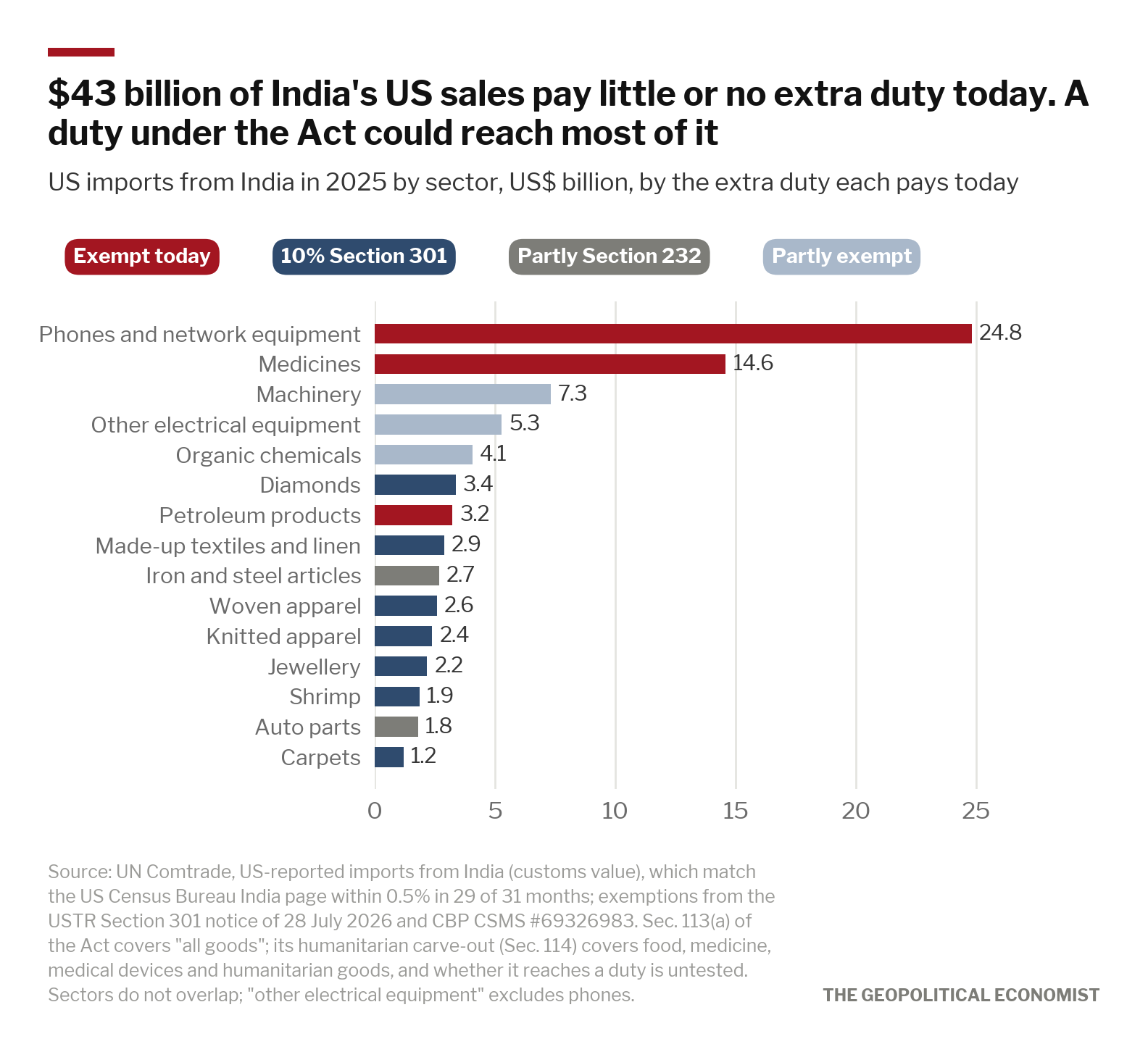
Smartphones are the new exposure. Smartphones make up nearly all of India's largest export line to the US. They were exempt from the 2025 duty and pay no extra duty today, and US imports of the line more than doubled while the 2025 duty ran (+129 per cent on the year). The US took 59 per cent of India's exports of the line in 2025-26, up from 42 per cent the year before. Smartphones from Vietnam and China also pay nothing. The Act names no product exemptions, so a duty under it would reach them and put Indian-made phones behind both rivals. This is the largest difference between the coming decision and the one in 2025.
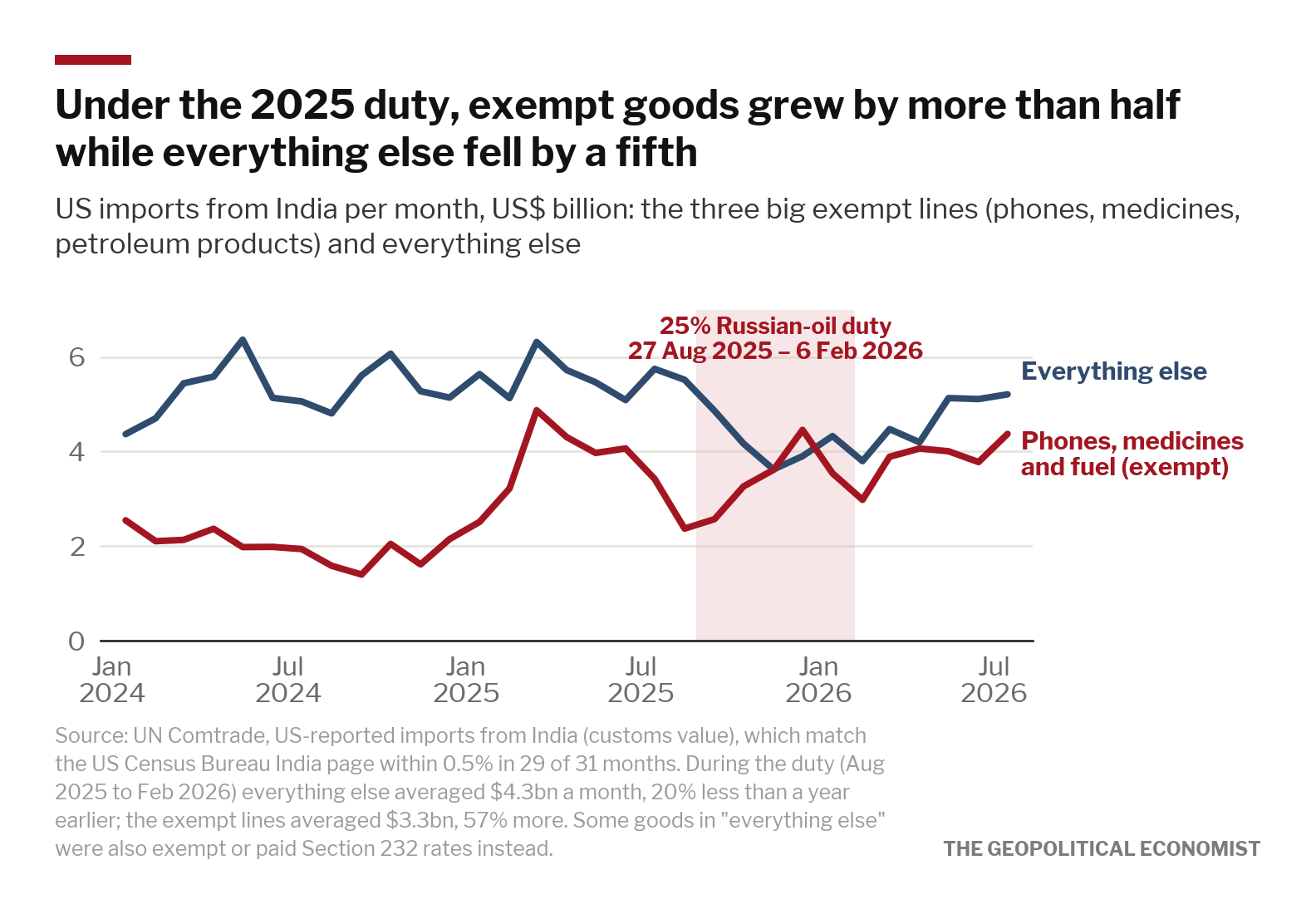
The 2025 precedent shows who absorbs a duty. From August 2025 to February 2026, while Indian goods paid an extra 25 per cent on top of a 25 per cent reciprocal tariff, US imports of the three big exempt lines rose 57 per cent on a year earlier, to $3.3 billion a month, and everything else fell 20 per cent, to $4.3 billion a month. Total imports from India were roughly flat on the year, up 1.5 per cent, because phones made up the loss.
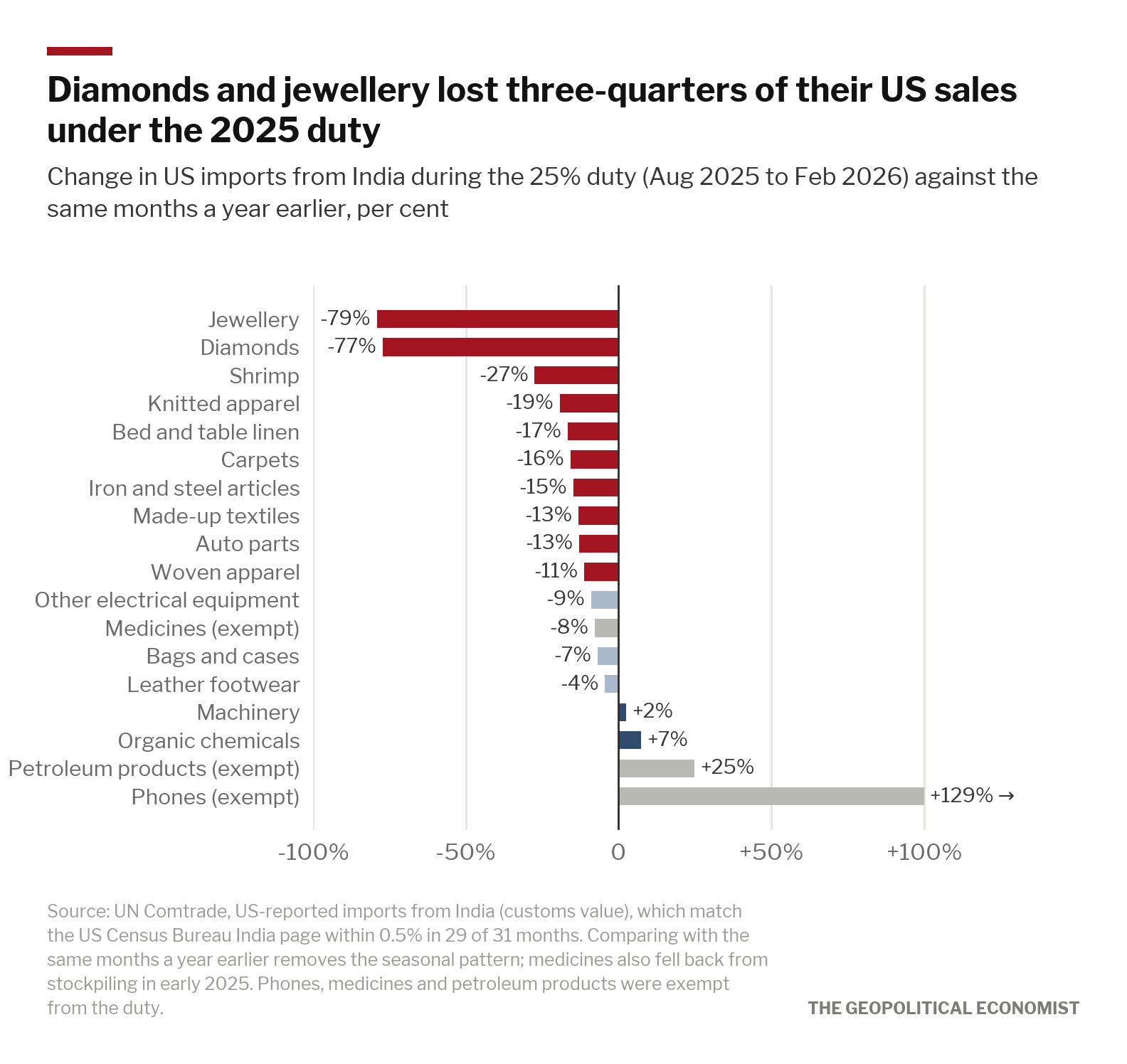
Diamonds, jewellery, textiles and shrimp took the hit. US imports of Indian jewellery fell 79 per cent on the year and diamonds 77 per cent. The US share of India's diamond exports fell from 36 per cent in 2024-25 to 15 per cent in 2025-26, while exports to the UAE and Hong Kong rose (ICRIER). Shrimp fell 27 per cent, knitted apparel 19, bed linen 17 and carpets 16. Shrimp, apparel, home textiles and carpets send between 30 and 57 per cent of their exports to the US and compete on price with suppliers in Vietnam, Bangladesh, Ecuador and Türkiye. Jewellery units in Mumbai's SEEPZ export zone are working to complete and ship orders by 16 October, the chairman of their manufacturers' association told the Economic Times (as reported by SEE News). The textile industry's confederation, CITI, said on 19 September that "any additional tariffs under this Act will be very difficult to absorb for the MSME-dominated Indian textile and apparel sector".
Medicines and shrimp hang on an untested clause. Sec. 114 keeps "sanctions and other measures under this title" off transactions for "food, medicine, medical devices". Read literally, that could keep India's $14.6 billion of medicine sales to the US, and its shrimp, out of a duty. No source we have read says whether the clause reaches a Sec. 113 duty, and the implementing proclamation may settle it. Until then we rate medicines medium and shrimp high on the other evidence, and flag both.
Metals and auto parts already pay more. Listed steel derivatives pay 50 per cent and about half of auto parts 25 per cent under Section 232, the same as most rivals. A duty under the Act would come on top (Sec. 113(f)), so these sectors would lose ground to rivals by the full amount of any new rate.
What to watch
| Date | What | Why it matters |
|---|---|---|
| 6 October | US Census Bureau trade data for August | The first full month of US imports from India under the 10 per cent Section 301 duty |
| By 8 October | Written justification to Congress (Sec. 113(g)) | Required at least 10 days before any duty; the Act does not require it to be published |
| 10 to 14 October | CREA's monthly analysis for September | India's rank among buyers of Russian fossil fuels |
| 15 October | India's trade figures for September | Exports to the US in the last month before the decision |
| 18 October | Day 30 (Sec. 113(a)) | Duty, waiver or delay; also the first day on which new purchases count |
| Second half of October | Loadings of November-delivery Russian cargoes for India | Whether India makes new purchases under the Act |
| October | Secretary of State Marco Rubio's planned visit to India | A possible setting for a waiver or a trade announcement |
| 3 November | US midterm elections | The backdrop to the worries about prices in Congress |
| 4 November | US Census Bureau trade data for September | US imports from India in the last full month before the decision |
| 16 April 2027 | First 180-day review, if a duty is first imposed on 18 October (Sec. 113(e)) | The Trade Representative redraws the list of the five largest importers |
| 18 September 2031 | The division of the Act that holds the tariff authority expires (Sec. 203) | The end of the authority |
| Signpost | Points to | Where to check |
|---|---|---|
| A written justification sent to Congress | B, C or D | Statements by the six committees; press reports |
| A waiver certification | A | The committees; the White House |
| A Federal Register notice or a new tariff heading for India | B, C or D | The Federal Register; the US tariff schedule |
| An interim trade agreement signed | A | The Commerce Ministry (PIB); USTR |
| High Russian loadings for India for November delivery | B, C or D | Ship-tracking figures as reported; the KSE and CREA monthly editions |
| Officials citing India's February pledge | C | USTR, the White House, Treasury |
| An open break in the trade talks | C or D | The Commerce Ministry; USTR |
The tracker logs each of these as it happens. A senior State Department official said Rubio plans to visit in October, as IndraStra reported; no date has been given.
Method and sources
The law. Every statement about the Act quotes the enrolled text of H.R. 5334, not a memo or a news report. Dates derived from it, such as day 30, the notice date, the first 180-day review and the end of the Act, are counted from enactment on 18 September 2026.
Trade data. US imports from India are US-reported figures from UN Comtrade at customs value. They match the US Census Bureau's India page within 0.5 per cent in 29 of the 31 months from January 2024 to July 2026. Export shares are India's own figures from the Commerce Ministry's TradeStat. The two sources do not match, because they value goods differently, record the partner country differently and are separated by shipping time, so we use US data for what the US bought and Indian data for how much each sector depends on the US. Changes under the 2025 duty compare August 2025 to February 2026 with the same months a year earlier, which removes the seasonal pattern. Duty-paid figures by sector are not yet in the dataset: the Census Bureau's trade API now requires a key, and those columns will be filled once it is in place.
Oil. Every figure for India's Russian crude names its tracker: the KSE Institute's monthly Russian Oil Tracker, built on Kpler data; CREA's monthly analyses; and Kpler figures as reported in the press. Trackers differ, so where two give different figures for the same month both are kept and neither is averaged.
Scenarios. Built by listing who decides and what each wants, the uncertainties that matter most, and the public signs that would come before each outcome. The likelihoods are our judgement on the evidence to 4 October 2026.
Data, scripts and charts. The tables, the scripts that build them and the charts are published in the dataset, with a method note for each file. The charts are our own, drawn from those tables.
How this was made. Researched and written by Vikas, with AI assistance in collecting sources, building the tables and drafting. Every figure was checked against the source it links to.
Version and corrections. Version 1.0, published 4 October 2026. Corrections are welcome at [email protected], with the line and your source. Each change will be noted here with its date and logged on the tracker.
How to cite. Vikas, "Will the US Put a Tariff on Indian Goods Over Russian Oil, and Who Would Pay?", research brief, version 1.0, The Geopolitical Economist, 4 October 2026, https://geopoliticaleconomist.com/articles/india-russian-oil-tariff-scenarios.
India and the Russian-oil tariff, a research project:
- Will the US Put a Tariff on Indian Goods Over Russian Oil, and Who Would Pay? (this brief)
- The full report: law, oil, scenarios and sector exposure (forthcoming)
The live position is on the Russian-Oil Tariff Tracker. Related reading on this site: The Price Cap Didn't Stop Russian Oil. It Created a Toll Booth, Washington Is Now Defending Russia's Oil Refineries and Why China Will Get What It Wants From Trump.
Comments
No comments yet. Be the first.
Comments are closed on this article.