
Key judgements
- The European Union concluded or signed trade agreements with Mercosur, India and Australia between January and March 2026, and began implementing the US framework that entered into force on 1 July 2026. The pace is historically unusual. The substance is less impressive than the pace.
- The United States still takes a 15 per cent tariff floor on most EU goods and 50 per cent on steel and aluminium. The EU implementing regulation contains a safeguard: if Washington does not bring steel and aluminium derivative tariffs to or below 15 per cent by 31 December 2026, the Commission can suspend EU concessions. We assess it as more likely than not (60%) that Washington does not comply in full by that date.
- The four deals together cover markets worth roughly half of EU goods exports. But the structural problem — that the EU eliminated most of its tariffs while its partners kept theirs — runs through all four, and no amount of deal-making diversifies an economy away from dependence it has accepted rather than resisted.
What the deals contain
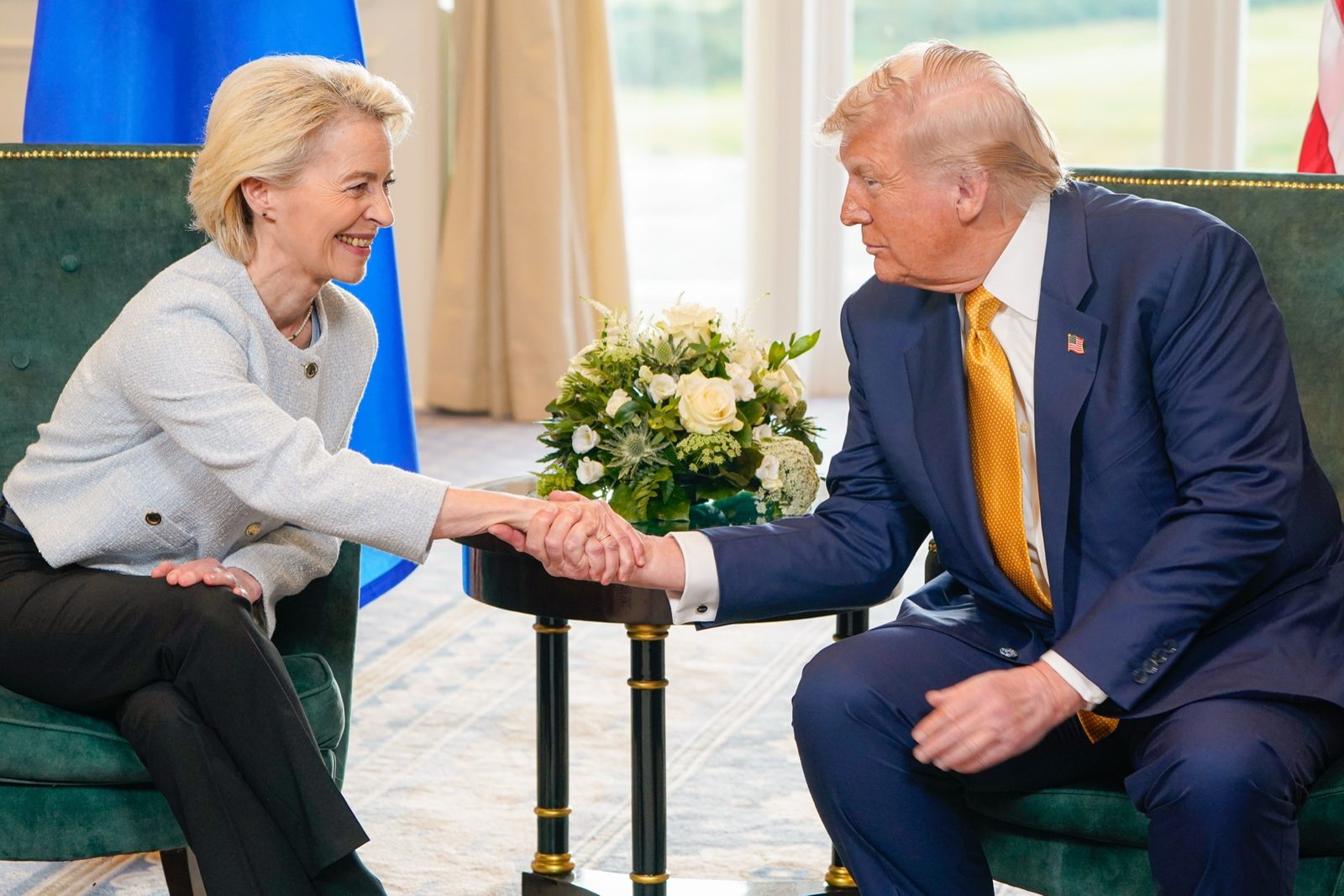
The Turnberry framework of July 2025, implemented by EU regulation from 1 July 2026, set the terms: the EU removes tariffs on most US industrial goods and opens agricultural quotas; the US caps its tariffs at 15 per cent, with steel and aluminium excluded at 50 per cent. The EU also made non-binding commitments to purchase $750 billion in US energy and make $600 billion in US investments by 2029. The European Parliament approved the regulations on 16 June by 440 votes to 151, with the rapporteur calling the deal "unbalanced and unfair" and voting for it anyway.
The Mercosur agreement, signed in January after twenty-five years of negotiation, creates the largest free-trade area in the world by population. Its ratification is uncertain: the European Parliament has asked the Court of Justice for an opinion on compatibility with EU law, which could delay entry by eighteen months. France voted against CETA ratification in 2024 and has not committed on Mercosur.
The India deal, concluded on 27 January after talks that began in 2007, is expected to be formally signed on 16 December 2026. India will progressively reduce tariffs on 96.6 per cent of EU exports. Agriculture — beef, sugar, rice — stays protected on both sides.
The Australia deal, concluded in March, provides near-complete tariff liberalisation. It is the simplest of the four and the least consequential in volume.
The numbers
| US | Mercosur | India | Australia | |
|---|---|---|---|---|
| EU goods exports, 2025 (€ bn, approx.) | 502 | 56 | 42 | 37 |
| Share of total EU goods exports | 20.4% | 2.3% | 1.7% | 1.5% |
| Tariff the EU faces | 15% floor (50% on steel) | Variable, phasing in | Variable, phasing in | Near zero |
| EU tariff on partner's goods | Near zero (industrial) | Quotas on beef, poultry | Standard MFN on farm goods | Near zero |
| Status | In force 1 Jul 2026 | Signed; ratification uncertain | Expected signing Dec 2026 | Concluded |
Sources: Eurostat trade data; European Commission; Sullivan & Cromwell; author estimates. Figures rounded.
The United States alone is four times the size of the other three partners combined. A doubling of trade with India, Mercosur and Australia — which would take a decade — would add roughly €135 billion. A one-percentage-point increase in the effective US tariff rate subtracts more than that in market access. Diversification through trade deals is arithmetically real and strategically marginal.
The steel deadline
The operative provision is in the EU implementing regulation. If the United States continues to apply tariffs above 15 per cent on steel and aluminium derivative products imported from the EU by 31 December 2026, the Commission is empowered to suspend EU concessions.
The US has shown no public intention to lower the steel rate. The White House fact sheet from July 2025 stated that 50 per cent tariffs on EU steel, aluminium and copper "will remain in place". In August 2025 the US added 407 product categories to the derivative steel and aluminium tariff list, widening the scope of the carve-out rather than narrowing it.
This creates a confrontation the deal was supposed to prevent. Three scenarios:
Scenario A. Quiet extension (45%). Washington signals privately that it will lower derivative tariffs "early in 2027", and the Commission declines to trigger the suspension clause, invoking the broader relationship. This is the path of least resistance, but it hollows out the safeguard and exposes the Commission to a parliamentary challenge.
Scenario B. Partial compliance (30%). The US lowers some derivative tariffs below 15 per cent, leaving the core 50 per cent rate on primary steel and aluminium intact. The Commission declares partial compliance and defers suspension, buying time. This is legally defensible but politically awkward: European steelmakers will not distinguish between derivatives and primary products.
Scenario C. Suspension (25%). Washington does nothing, and the Commission triggers the clause. The suspension would reintroduce EU tariffs on some US industrial goods, provoking a response from Washington and raising the prospect of the cycle the Turnberry framework was built to end.
The structural problem
The deals do not share an adversary or a purpose. The US framework is a managed retreat: the EU lowered its barriers further and faster than Washington did, in exchange for a cap on how much worse things could get. CSIS described it as a "geopolitical victory" for Washington. The Council on Foreign Relations called it "one-sided" and asked whether it would lead to an awakening. The LSE judged its political costs higher than its economic ones.
The Mercosur, India and Australia agreements are hedges, each signed with one eye on Washington. The Bundesbank argued that they "help diversify the EU's trade relations". That is true in direction and trivial in scale. The three markets together take 5.5 per cent of EU goods exports. The United States takes 20 per cent. China takes another 9 per cent and is subject to its own set of trade restrictions. The EU is not diversifying; it is adding lines to a ledger whose largest entry it cannot change.
The deeper issue is defence. European NATO members will spend roughly $639 billion on defence in 2026, up from $560 billion in 2024. Germany alone crossed $107 billion. But the spending is driven by the same power that imposes the tariffs. The EU is simultaneously paying more for its own security, accepting worse terms of trade with its security guarantor, and signing deals with third countries that cannot substitute for either. A strategy would connect these three facts. A shopping list treats them as separate purchases.
What to watch
- 31 December 2026. Whether the US brings derivative steel and aluminium tariffs to 15 per cent. If it does not, whether the Commission triggers the suspension clause or finds a reason not to.
- 16 December 2026. The expected formal signing of the EU-India FTA. A delay signals ratification trouble on one side or the other.
- The Court of Justice opinion on Mercosur. An adverse finding would delay the agreement's entry into force by at least a year, removing the largest of the three hedging deals from the near-term ledger.
- 1 January 2027. The threatened US tariff on Canadian vehicles. If it is imposed, the signal to Europe is that Washington's tariff threats are not negotiating positions but policy. If it is deferred, the Turnberry framework looks more durable.
- The 2029 sunset. The entire US framework expires at the end of 2029 unless renewed. Every compliance dispute between now and then is also a data point about renewal.
Assessment
The European Union has had the most productive nine months in trade-agreement history, and it has less to show for it than the announcements suggest. The US deal locked in an asymmetric tariff structure that Coface estimates will cost EU competitiveness in precisely the sectors — automotive, chemicals, machinery — where Europe's export strength lies. The Mercosur, India and Australia deals open markets that are growing but small in European trade terms, and each faces its own ratification calendar. The steel deadline at year's end is the first real test of whether the Turnberry framework is a settlement or a ceasefire. The terms of the answer will tell Europe more about its position than all four agreements combined.

Comments
No comments yet. Be the first.
Comments are closed on this article.