
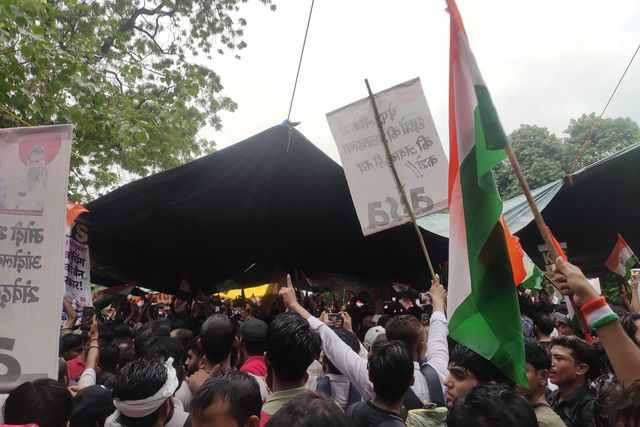
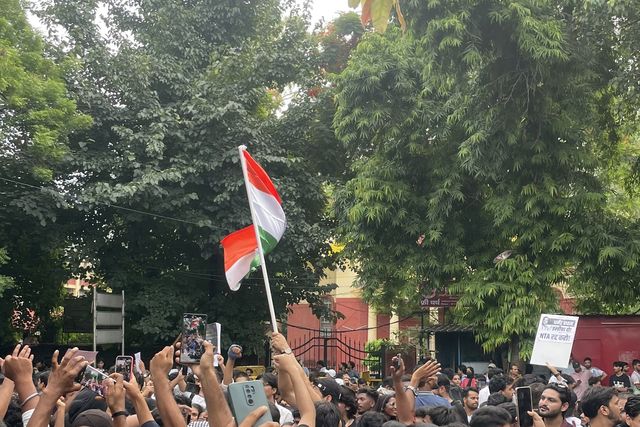
On 25 July 2026, with the Education Minister's resignation hours old and the Jantar Mantar protests in their eighth week, the Ministry of External Affairs was asked whether foreign money was behind them. The spokesman's answer was one sentence: "I do not have any information on this matter to share with you at this time." When posts then claimed the ministry had confirmed there was no foreign funding, its fact-check unit called those misleading too. No conclusion either way.
That is a fair summary of the state of the evidence, and this part sets out why. Part 1 established that Indians are protesting more. Part 2 established what about. The question that follows, who pays, has a documentary trail in India that most countries lack: a register of every organisation allowed to receive foreign money, the ministry's own orders cancelling them, the agency cases that follow, and the courts that test those cases. This part reads that trail end to end. The rule throughout is the one this series has kept since the start: an organisation or person is named only as a document names them, with the ministry's stated ground and the court's answer, where there is one.
The lever
India regulates foreign money to civil society through the Foreign Contribution (Regulation) Act of 2010. The 2020 amendment, passed in two days that September, tightened it in ways the Home Ministry itself summarised this July: every foreign rupee must first land in one designated account at a single State Bank of India branch in New Delhi; a registered body may no longer pass foreign money on to another; the share spendable on administration fell from 50 to 20 per cent; office-bearers must identify themselves with Aadhaar or passport. The Supreme Court upheld the amendments in April 2022, holding that there is no absolute right to receive foreign contribution and that the strict regime had become essential "because of the past experience of abuse and misutilisation."
The tightening has not stopped. A November 2024 ministry note listed the grounds on which registration is refused, among them "attempts to incite protests with malicious intent" and "activities seen as anti-development". Rules in June 2025 require applicants to declare they are not involved in publishing news or current affairs. Rules in June 2026 require the certificate to name the purposes and the states an organisation works in, a minimum of Rs 10 lakh of foreign money spent over two years to qualify for renewal, and disclosure of the "ultimate foreign donor" and of social-media handles.
And a Bill is before Parliament. Introduced on 25 March 2026 and sent to a Joint Parliamentary Committee on 12 August after the opposition called it draconian, the Foreign Contribution (Regulation) Amendment Bill would make registration cease automatically when it lapses, vest the foreign funds and assets of lapsed or cancelled bodies in a central Designated Authority, allow those assets to be transferred to government departments or sold with the proceeds to the Consolidated Fund, make trustees and office-bearers presumptively liable, and require central approval before any state agency opens an FCRA investigation. The ministry's stated reason is practical: nearly 22,000 cancellations and 15,000 lapses have left "assets worth thousands of crores" that it is "neither feasible nor desirable" to leave unmanaged. The committee, 31 members chaired by a ruling-party MP, met for the second time on 29 September and is due to report in the Winter Session.
The numbers
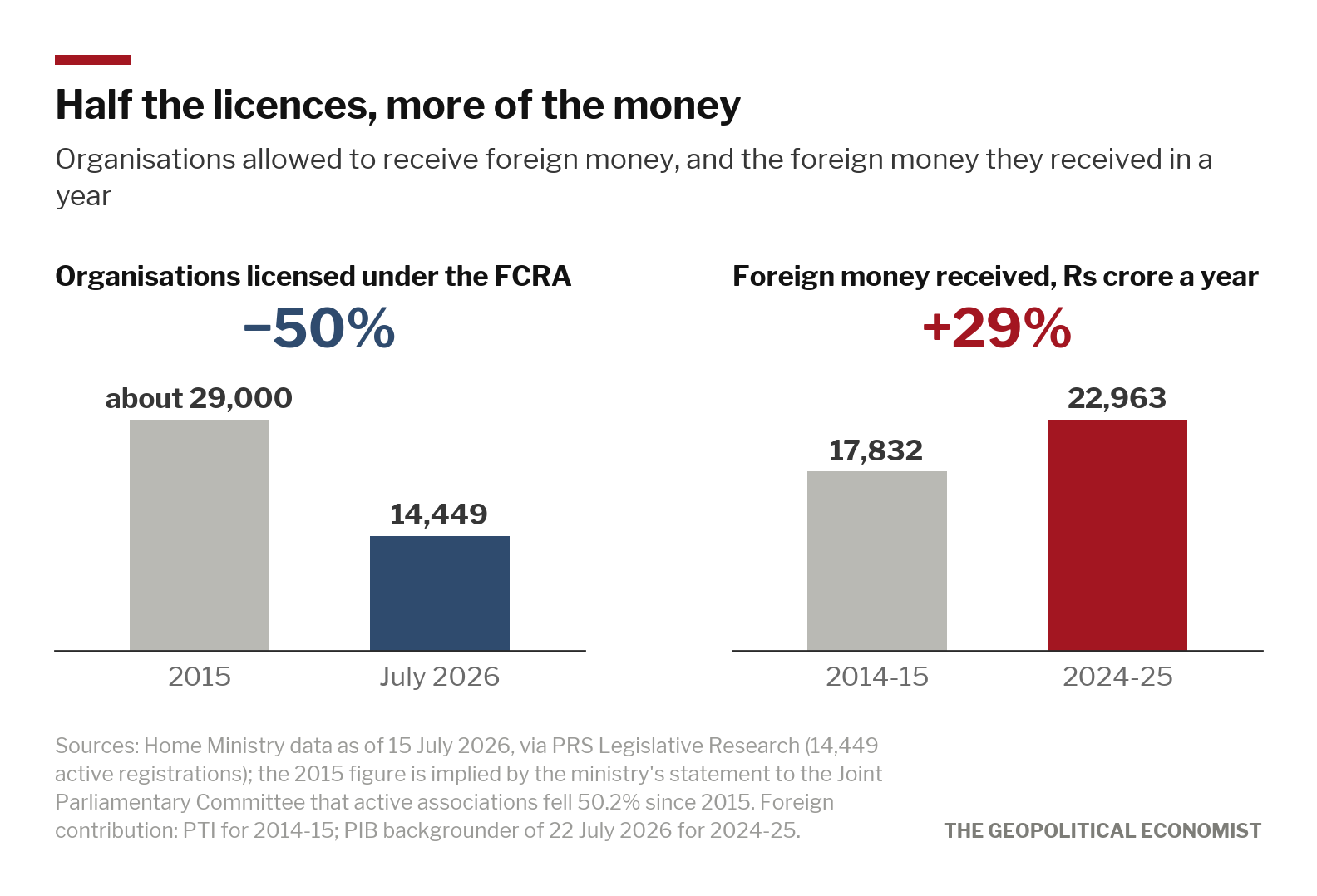
Two series run in opposite directions. The register has halved. As of 15 July 2026, 14,449 associations held active registration against 22,498 cancelled and 15,212 expired, by the ministry's own data; the figures given to the committee put the decline in active bodies at 50.2 per cent since 2015. Most cancellations are for not filing returns; the ministry says expiry "should not automatically be equated with fraud or criminal wrongdoing", and its only official count of cancellations for violations is 1,828 between 2020 and March 2023, led by Tamil Nadu, Maharashtra and West Bengal. There is no official year-by-year table.
The money, meanwhile, has grown. Summing the ministry's state-wise annexure, foreign contribution received was Rs 16,359 crore in 2019-20, Rs 17,166 crore in 2020-21 and Rs 22,122 crore in 2021-22; the 2024-25 figure is about Rs 22,963 crore to around 16,200 bodies. Fewer organisations, more money each. The ministry adds a proportion worth holding on to: the entire FCRA register is under 1 per cent of the NGOs operating in India.
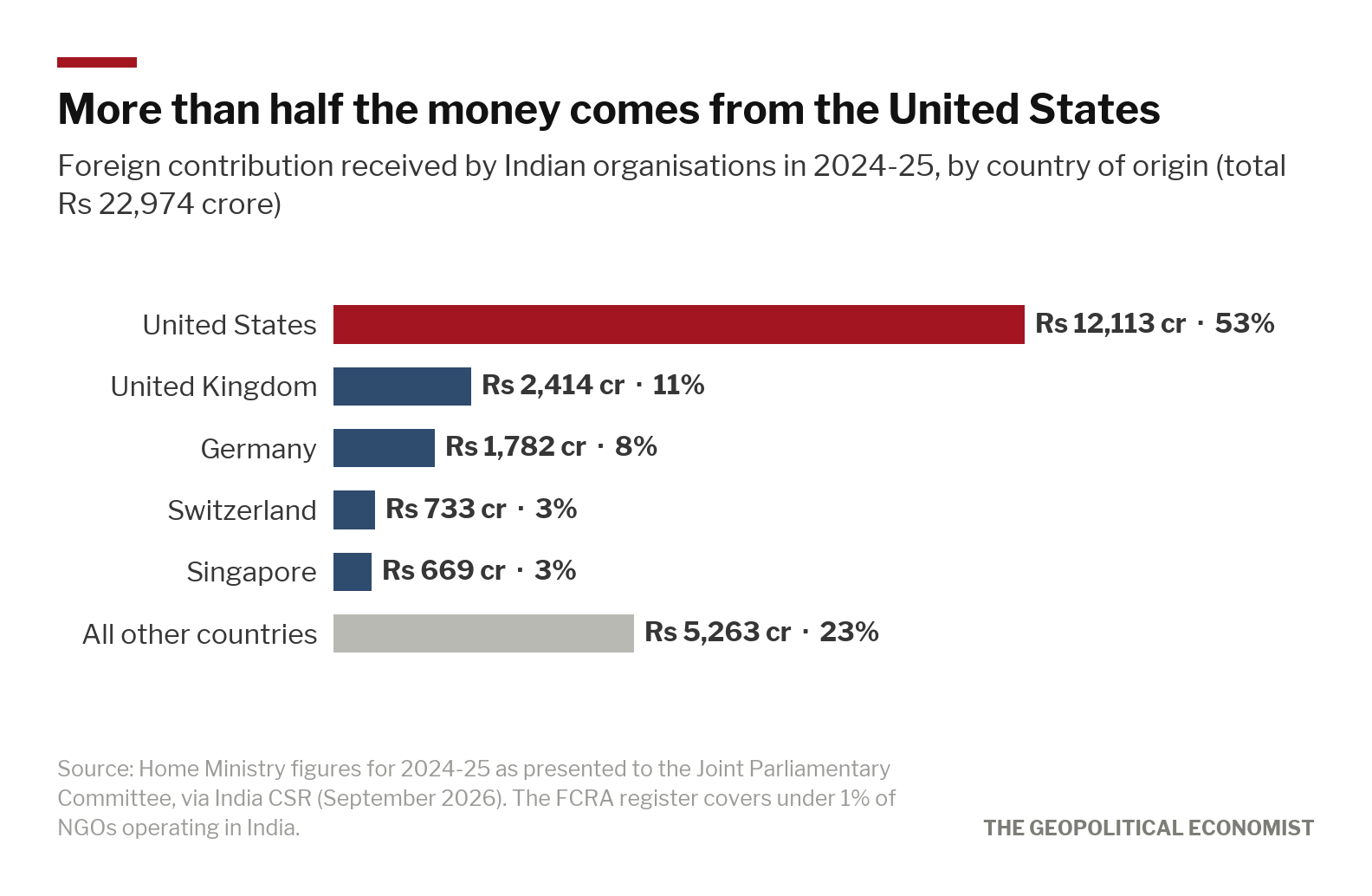
Where it comes from is not mysterious. In 2024-25, 52.7 per cent came from the United States, 10.5 from the United Kingdom, 7.8 from Germany; Delhi, Karnataka, Maharashtra and Tamil Nadu received the most; 57 per cent was declared for social purposes, 30 for education, 8 for religion. The donors the political argument revolves around are a sliver of this. The Ford Foundation has made about 3,640 grants worth some $502 million since 1952, an average of about Rs 60 crore a year at today's rates against a Rs 23,000 crore annual flow. The Open Society Foundations have been under prior-reference restriction since May 2016 and say their Indian grant-making has been constrained ever since. US government assistance to India was $165.6 million in fiscal 2024 and USAID ceased operations in July 2025. The $21 million "voter turnout" grant that a US government post attributed to India in February 2025 was, the US Embassy later told the Ministry of External Affairs, never received or provided for India in any year from 2014 to 2024.
The cases
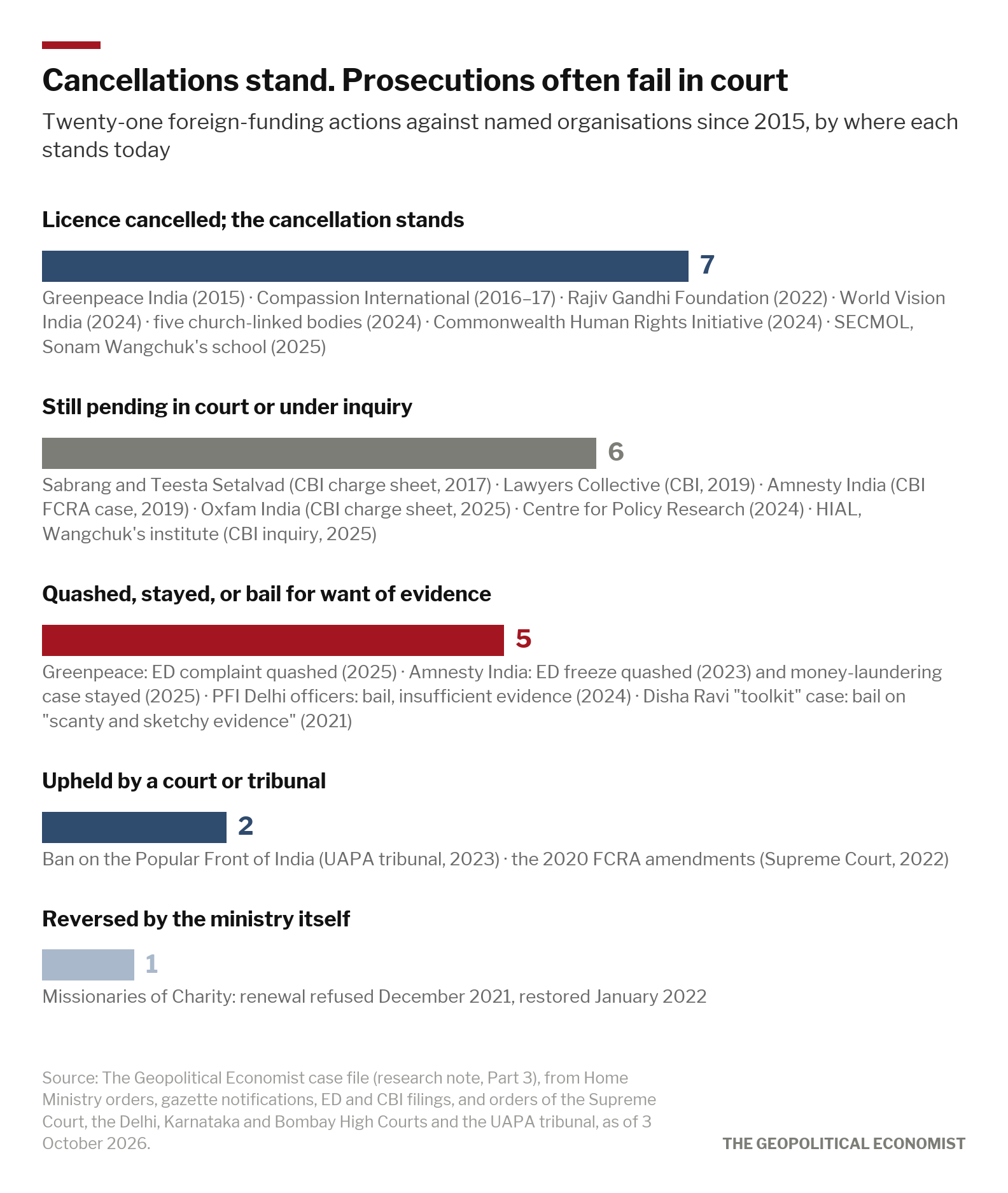
The register is the lever; the cases are where it has been pulled. We compiled every FCRA or foreign-funding action against a named organisation since 2015 for which an order, charge sheet or court record exists, 21 in all, and traced each to its current status. The full table, with the ministry's stated ground in each case and the source, is in the research note. Three patterns stand out.
Cancellations stand; the follow-on cases often do not. No cancellation order in the file has been quashed. But where the ministry's action led to an Enforcement Directorate or CBI case that reached a court, the record turns. The Karnataka High Court quashed the ED's 2019 complaint against Greenpeace in June 2025 because the provision relied on had been repealed before the complaint was filed. It quashed the ED's 2018 freeze of Amnesty India's accounts in 2023 and stayed the money-laundering case in April 2025. The Delhi High Court granted bail to the Popular Front's Delhi officers in the ED case in December 2024 for prima facie insufficient evidence. And on 17 September 2026, dismissing the Centre's appeal in the Commonwealth Human Rights Initiative case, the Delhi High Court said in a sentence what the Act does: "Cancellation of FCRA registration merely means that the organisation cannot receive foreign funds."
The stated grounds are accounting and "national interest", not protest. The orders cite mixed accounts, sub-grants after cessation, undeclared bank accounts, use of funds for purposes other than those registered. Where the ministry has gone further, it has done so in affidavits rather than in orders: its Delhi High Court filing on Oxfam India describes a "negative and malicious campaign" against Assam tea and calls the organisation a "probable instrument of foreign policy"; the CBI's January 2025 charge sheet alleges Oxfam sought foreign governments' intervention to get its licence back. Oxfam says it was fully compliant. The case is pending. The one order that mentions a protest is the one Part 5 examines: the cancellation of Sonam Wangchuk's school's licence the day after the Leh firing, over five entries totalling about Rs 9.81 lakh, one of them a Swedish grant for a study whose description used the word "sovereignty", which the ministry said "cannot be accepted" as being "against the national interest" and the school says meant food sovereignty.
No 2026 protest body has been touched. We searched for any FCRA, ED or CBI action in 2026 against the Cockroach Janta Party, its founder, the student federations or any youth organisation linked to the Jantar Mantar protests. There is none. The Supreme Court refused an urgent hearing of pleas for a CBI probe into the party in May: "There is no such grave urgency." A High Court petition on its "anti-national activities" was withdrawn for want of jurisdiction. Ministers spoke of followers from "Pakistan & George Soros gang" and an MP questioned how the founder's studies in Boston were paid for. No document followed any of it.
Where foreign money for protest has been proven
It has been, and the series would be dishonest to leave that out. In the Kashmir terror-funding cases the National Investigation Agency alleged that money from Pakistan reached separatist leaders through hawala "to foment trouble in Kashmir through stone-pelting, burning down of schools, and organising strikes and protests"; the Supreme Court, reversing bail for one accused in 2019, found the offences prima facie established, and in May 2022 a special court sentenced Yasin Malik to life on his plea to raising funds for terrorism. The Popular Front of India was banned for five years in September 2022 on a notification citing terror cases, links to foreign groups and funds collected abroad and remitted through hawala; a tribunal confirmed the ban in March 2023, and the Delhi High Court has now agreed to hear the challenge. And this August, Punjab Police said two modules trained online by handlers in Pakistan had travelled to Delhi with petrol bombs during the protest and abandoned the plan; nine were held, four of them juveniles. That case is unadjudicated, and it is about an attack on the protest, not the running of it.
So the documented record of foreign money and Indian protest is this: Pakistani state-linked funding of unrest in Kashmir, established in court; an Islamist organisation banned on terror-funding grounds, upheld by a tribunal, now under challenge; and nothing in any charge sheet or judgment connecting foreign money to the anti-CAA protests, the farmers, Ladakh or 2026.
The claims that did not survive
Set beside the proven cases, the record of protest-funding claims is instructive. The Rs 120 crore the Popular Front was said to have "pumped" into anti-CAA protests entered the record through an unnamed source in a wire report in January 2020, inside the Delhi election campaign; the ED's own later complaint describes credits to PFI-related accounts and a "direct correlation" in dates, and the Delhi officers it arrested were bailed for want of evidence. The NIA's case on the farmers' protest, registered on a Home Ministry complaint to investigate funding by Khalistani groups "organising on-ground campaigns and demonstrations" and "the role of some NGOs", summoned more than forty people and then called them witnesses; no protest body was charged. The "toolkit" prosecution ended with a sessions judge's finding of "scanty and sketchy evidence" and a line worth keeping: citizens "cannot be put behind bars simply because they choose to disagree with State policies." Two years later the Delhi High Court was still asking the Centre for the status of the investigation. In Ladakh, the police chief said there was "a probe of foreign funding" and that what had been found "cannot be disclosed at this moment"; six months later the ministry withdrew the detention without charge, and the CBI enquiry into his institute has produced no public FIR. For 2026, the only official action on money is the Delhi Police digital probe of three marketing firms and 180 influencer accounts, about which the police themselves say the findings have not been tested before a court and no arrest or charge has been announced.
What outsiders say about the lever
The regime has been assessed by bodies that are not Indian civil society and not its critics by trade. The Financial Action Task Force, the inter-governmental standard-setter on terror finance, rated India only partially compliant on its non-profit recommendation in its September 2024 evaluation, found that the FCRA amendments "were implemented without adequate consultation" with non-profits, and said that India had identified 7,500 high-risk organisations but "has not demonstrated that this is based on risk of terror-financing abuse". The UN's special rapporteurs have said since 2016 that the Act is not in conformity with international law and, in the Amnesty case, that its application to rights organisations "creates a stigmatizing and chilling effect". The government's reply, in its July backgrounder, is that the FCRA is "a registration and disclosure regime for foreign-directed activity, not a permission-to-exist regime", comparable to the United States' Foreign Agents Registration Act, Australia's transparency scheme and the UK's new Foreign Influence Registration Scheme. The comparison is fair as far as it goes. None of those regimes vests a lapsed charity's assets in the state.
What the money settles
The documents support a narrow set of conclusions. The state has built, and is extending, a powerful instrument over foreign money to civil society, and has used it against named organisations on stated accounting and national-interest grounds, with courts upholding the instrument and increasingly unpicking the prosecutions built on it. Foreign money for protest has been established in court in Kashmir and administratively in the Popular Front's ban. For the movements that fill this series, the anti-CAA sit-ins, the farmers, Ladakh and the Cockroach summer, the same instrument, backed by the ED, the CBI, the NIA and the Home Ministry's register, has produced assertions, summonses, one sub-Rs-10-lakh cancellation and no finding.
Two readings of that are possible, and Part 6 weighs them. Part 4 turns from the money to the networks. One is that the money is well hidden: through crypto, hawala or cut-outs the FCRA register cannot see, which is what the Delhi Police's digital probe implies and has not shown. The other is that the register is doing its job and finding nothing because there is nothing of the kind to find, which is what the Ministry of External Affairs' "no information" and the courts' bail orders imply. What the record does not permit is the sentence that opened most official statements this summer: that the protests were paid for from abroad. On the evidence the state itself has produced, that remains a claim, six years and four movements old, awaiting its first document.
Method and sources
This part is built from primary documents: the Act and its amendments, the PIB backgrounder of 22 July 2026, the Home Ministry's Rajya Sabha answer of 29 March 2023 and its annexures, the PRS and ICNL summaries of the 2026 Bill, gazette notifications, ED and CBI filings as reported, and the orders of the Supreme Court, the Delhi, Karnataka and Bombay High Courts and the UAPA tribunal. Foreign-contribution totals for 2019-20 to 2021-22 are our sums of the state-wise annexure and differ from the Lok Sabha three-year total by under 0.2 per cent, which later-filed returns explain; no national total for 2022-23 or 2023-24 was published in any source we found, and the chart leaves those years blank. The 21-case table, the 16-claim register and the state-wise cancellations and receipts are in the research note, each row with its document and status; items we could not confirm against a primary document, including the exact date of the Delhi Police's 480-handles statement and a reported May 2025 ministry advisory, are marked unverified there and not used here. Organisations are named only as the documents name them, with their rebuttals where they made one.
The Protest Question, a research series in six parts:
- Are Indians protesting more? Yes. Here is the evidence
- What Indians are protesting about. It isn't prices
- Follow the money: what the FCRA record shows (this part)
- The foreign hand, measured
- Five movements, one template
- The verdict: is India's protest wave engineered?
Comments
No comments yet. Be the first.
Comments are closed on this article.