
Four parts of this series have worked on aggregates: counts, grievances, money and the information layer. This part does the opposite. It takes the five movements that defined the period, the anti-CAA sit-ins of 2019 to 2020, the farmers' camps of 2020 to 2021 and their 2024 sequel, Manipur since 2023, Ladakh since 2023 and the Cockroach Janta Party of 2026, and runs each through the same template: trigger, who protested, who organised, scale, violence, money, amplification, state response, outcome. Then it puts them next to the three uprisings Indian officials keep citing as warnings, Bangladesh, Nepal and Indonesia.
The template is the test. If protest in India were being engineered, the engineering should show up in at least one of these cases as a funder, a handler, a network or a court finding. If it is organic, each case should have a trigger you can date and a grievance a ministry later conceded. What follows is what the record holds, with the sources on every claim. The full twelve-field template for each case, with the gaps still open, is in the research note.
Anti-CAA and Shaheen Bagh, December 2019 to March 2020
Trigger. The Citizenship (Amendment) Bill passed the Rajya Sabha on 11 December 2019. On 15 December the Delhi Police entered the Jamia Millia Islamia campus and its library. The Shaheen Bagh sit-in began that night.
Who and how many. Two movements under one name: in Assam, a regional protest against demographic change led by the students' union; elsewhere, Muslim citizens, students and civil-liberties groups reading the Act together with a citizenship register. Shaheen Bagh was a women-led sit-in on one road, explicitly leaderless. No police crowd figure was ever published; press and organiser counts ran from a thousand by day to more than fifty thousand on peak Sundays.
Violence. Twenty-five named protest deaths across Uttar Pradesh, Karnataka and Assam by January 2020, per The Wire's count; the UP government told its High Court that 22 had died in UP and 322 were in jail. None at Shaheen Bagh. The Delhi riots of 23 to 26 February killed 53 and produced 758 FIRs; the catalogue codes them as communal violence, not protest.
Money. Three claims. The Enforcement Directorate's unsigned notes of 27 January and 6 February 2020, both inside the Delhi election campaign, said the Popular Front of India had received Rs 120.5 crore across 73 accounts; that was a total of credits to the organisation's accounts, not a traced payment to any protest, and no court has found otherwise. The ED separately chargesheeted a suspended municipal councillor, Tahir Hussain, for laundering about Rs 1.1 crore through shell companies before the riots; a court took cognisance. That is the one established money case in the whole series, and it is domestic. A police status report claimed another accused raised funds abroad; charges in that conspiracy case, FIR 59 of 2020, had still not been framed six years on when the Delhi High Court refused bail again on 30 September 2026.
Amplification. The claim that the women were paid Rs 500 a day, pushed by the BJP's IT cell head, was shown by Alt News to rest on a morphed poster and a sting that did not say what it was said to say; the women served a defamation notice. No platform takedown and no agency finding of a foreign network exists.
State response and outcome. Police firing in three states, a UAPA conspiracy case against eighteen, property-seizure notices in UP later quashed by the Supreme Court. The Act stands; the register was not rolled out. Of 126 riot cases decided by late 2024, twenty ended in conviction, with courts in more than fifty faulting the investigation.
Reading. An organic reaction to a law and a police raid. The documented money is Indian. The clearest documented engineering was of the counter-narrative: the Rs 500 video, and two ED notes released on the eve of a vote.
The farmers, 2020 to 2021, and Shambhu, 2024 to 2025
Trigger. Three farm ordinances in June 2020, Acts in September. The 2024 sequel: no legal minimum-support-price guarantee three years after the 2021 assurances.
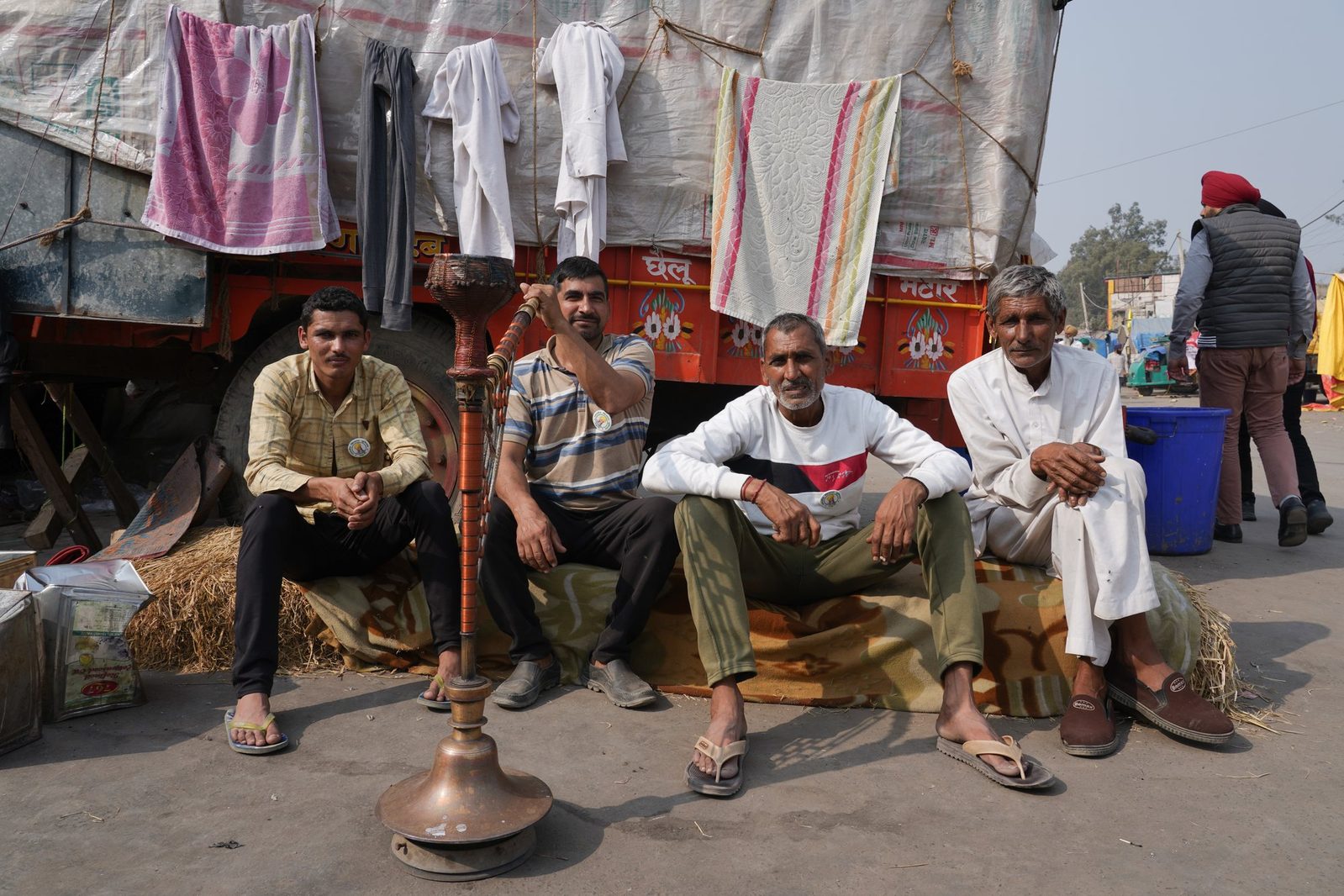
Who and how many. Punjab and Haryana's forty-year-old unions, forty of them under the Samyukt Kisan Morcha, later western UP. Police published no crowd totals for the border camps; the langars at Singhu served 50,000 to 60,000 meals a day. The Centre told the Lok Sabha it had "no record" of deaths at the camps. The Punjab government, meanwhile, paid Rs 5 lakh each to the families of 789 Punjab farmers who died of cold, accident and illness during the agitation. That is a state-verified floor for one state.
Violence. The Red Fort breach of 26 January 2021: 394 police injured, sedition and UAPA invoked. Lakhimpur Kheri, October 2021: eight dead. At Khanauri in February 2024, Shubhkaran Singh died of metal pellets in both hemispheres of the brain, per the autopsy. Haryana cut mobile internet in seven districts and extended the order seven times.
Money. Gurdwaras, deras, Khalsa Aid and diaspora gifts in kind; one Canadian donor's C$50,000 was the largest single sum reported. Against that, three state theories. The Attorney General told the Supreme Court in January 2021 that Khalistanis had "infiltrated" the protest, on Intelligence Bureau inputs; no affidavit outcome has surfaced. The NIA registered a Sikhs for Justice case and summoned more than forty people, then clarified they were witnesses; no union was charged. The "toolkit" case against a 22-year-old climate activist ended in bail on "scanty and sketchy evidence" and no charge sheet by 2022.
Amplification. This is the case where the information war is best documented, and the documentation points the other way. After Rihanna and Greta Thunberg posted on 2 February 2021, Indian celebrities tweeted near-identical #IndiaTogether messages; Maharashtra's home minister said a preliminary probe pointed to the BJP IT cell chief and twelve others. A Newslaundry investigation traced one widely broadcast "Khalistani hand" story to Pakistan's military media wing; Indian channels ran it as fact. The government ordered Twitter to block 1,178 accounts it called Pakistani or Khalistani without publishing a list. Pakistani opportunism was real. Direction was never shown.
Outcome. All three laws repealed in November 2021, the only full policy reversal in the catalogue. No legal MSP to date. The camps at Shambhu were cleared in March 2025 after a 131-day fast.
Reading. Organic, with a mass base its own state government compensated, and a foreign-hand case that ran through the Attorney General, the NIA and the Delhi Police without producing a charge.
Manipur, May 2023 onward
This case is in the series because officials treat it as protest. It is an armed ethnic conflict that began with one.
Trigger. A High Court direction on Scheduled Tribe status for Meiteis, a tribal solidarity march on 3 May 2023, clashes at Churachandpur. Behind it: eviction drives, a "war on drugs" and a house-to-house immigrant survey in the preceding months.
Scale and violence. The government's figure, 258 killed and about 60,000 displaced by November 2024, more than 260 by this April. Manipur accounted for 97 per cent of South Asia's conflict displacement in 2023. The internet was off for 212 days under 44 consecutive orders, the longest shutdown anywhere that year.
Money and the foreign hand. The only agency case is the NIA's July 2023 "transnational conspiracy", alleging Myanmar- and Bangladesh-based insurgent leaderships funded arms to exploit the unrest. It produced two arrests, one from each side, and concerns militias, not protest organisers; no charge sheet has been reported. The former Army chief's remark that Chinese aid to north-eastern insurgents was "definitely there" was a statement about the region in general, not evidence about 2023. The chief minister's standing explanation, drug mafias and illegal immigrants, is a political claim with no independent audit behind it.
The claim that failed the test. The most consequential amplification allegation here ran against the state. Kuki groups put leaked audio before the Supreme Court as proof that the chief minister directed the violence. The court-ordered forensic report found the clips "modified, edited and tampered", and the court declined to act on them. The record cuts both ways, and this series records it both ways.
Outcome. President's Rule from February 2025 to February 2026, then a new government with a Kuki-Zo and a Naga deputy chief minister. Buffer zones and displacement persist. On 1 September 2026 the Centre deferred the Census in Manipur under a "No NRC, No Census" agitation.
Reading. Domestic ethnic conflict with cross-border aggravation. Foreign direction unproven; the state's own framing untested.
Ladakh, 2023 to 2026
Trigger. Union Territory status without a legislature in August 2019; a deadlock in Home Ministry talks in March 2024; then, on 24 September 2025, the hospitalisation of two hunger strikers on day fourteen of a fast.
Who. Buddhist Leh and Shia Kargil, united for the first time, under the Leh Apex Body and the Kargil Democratic Alliance, with Sonam Wangchuk as the public face. Six years of fasts and marches with one day of lethal violence: four killed by police firing on 24 September 2025, among them a Kargil War veteran.
The 48 hours after. The Home Ministry's statement that evening blamed Wangchuk's "provocative mention of Arab Spring-style protest and references to Gen Z protests in Nepal". The next day his school's foreign-contribution licence was cancelled; the day after, he was detained under the National Security Act and flown to Jodhpur.
Money. The FCRA cancellation cited five transactions: an old bus sold for Rs 3.5 lakh and deposited in the wrong account, Rs 54,600 of local funds in the same account, and a Rs 4.93 lakh Swedish grant for a programme whose description used the word "sovereignty", which the school says meant food sovereignty. The sums total under Rs 10 lakh. A separate CBI enquiry into about Rs 1.5 crore received by his institute, which it says was payment for research sold to foreign universities, has produced no public FIR. Part 3 treats this case in full; the point here is proportion. The state's entire foreign-money case against a six-year movement is a sub-Rs-10-lakh licence action and an enquiry without a charge.
Amplification. The "Pakistan link" circulated by the BJP's IT cell was his attendance at a climate conference in Islamabad, where Boom found he spoke on glacial melt on a UN-facilitated panel, travelled with Indian clearance and praised the Prime Minister's climate record.
Outcome. Released after about 170 days when the ministry revoked the detention in March 2026. The judicial inquiry had examined 93 witnesses by early 2026; its report was not public at the first anniversary. In September 2026 the Centre put on the table safeguards modelled on Articles 371A, 371F and 371G and a Union Territory-level elected body, explicitly short of statehood.
Reading. Organic. The Nepal reference is the one documented instance in the series of a foreign protest being used as a template, by the activist as a warning and by the ministry as a cause.
The Cockroach Janta Party, May to July 2026
Trigger. Two events three days apart. The NEET-UG medical entrance exam for 2.27 million candidates was cancelled on 12 May after a WhatsApp "guess paper" matched 120 to 140 of its 180 questions. On 15 May the Chief Justice, in open court, spoke of youngsters "like cockroaches" who find no employment. A political-communications student abroad registered the name the next day.
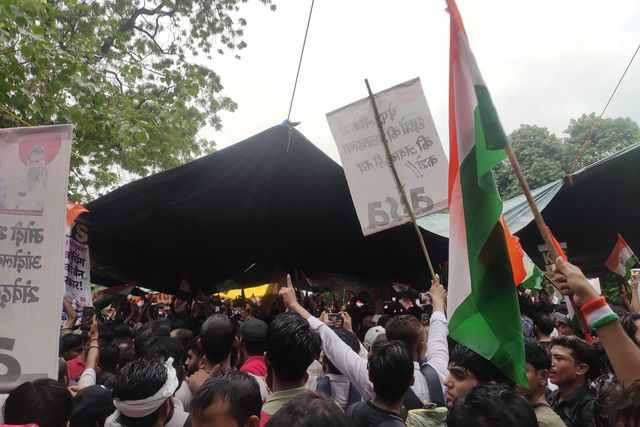
Who and how many. Aspirants and parents, the student federations, and a Gen-Z public that had never attended a protest. Police put the Jantar Mantar crowds at "more than 10,000"; TIME called the Monday gatherings of about 20,000 one of the largest anti-government assemblies in years.
Violence. No protest deaths. On 20 July, RML Hospital logged 65 medico-legal cases; RTI replies show at least ten pellet injuries, and an internal inquiry found that a dozen Rapid Action Force personnel had been issued pellet guns that morning. Twenty FIRs, three for attempted murder, against protesters; one FIR, a month later, over the pellets.
Money. No ED, NIA or FCRA action against the movement, its founder or any union. The costs visible on the ground, masks, sound, transport, were crowd-funded and in kind. The police "digital conspiracy" probe examined three marketing firms and 180 influencer accounts and has, as of this writing, published no finding on who paid whom.
Amplification. Part 4 took this apart. The "49 per cent Pakistani followers" graphic had no source and was contradicted by the only data that exists. The 480 "Pakistan-based handles" came with no platform, method or list. Both were plausible as descriptions of opportunistic Pakistani activity, and neither was ever connected to organisation or funding.
Outcome. The Education Minister resigned on 25 July, the first ministerial resignation attributable to a street movement in the catalogue since 2014. Within a fortnight Parliament passed an amendment raising exam-leak sentences to five to ten years, with fines up to Rs 5 crore for service providers and mandatory fast-track courts. On 2 October the movement pivoted to demanding the Chief Election Commissioner's resignation.
Reading. The most organic case in the file, with the thinnest foreign thread, a founder studying in Boston, and the most elaborate foreign-hand response.
Twenty claims on one chart
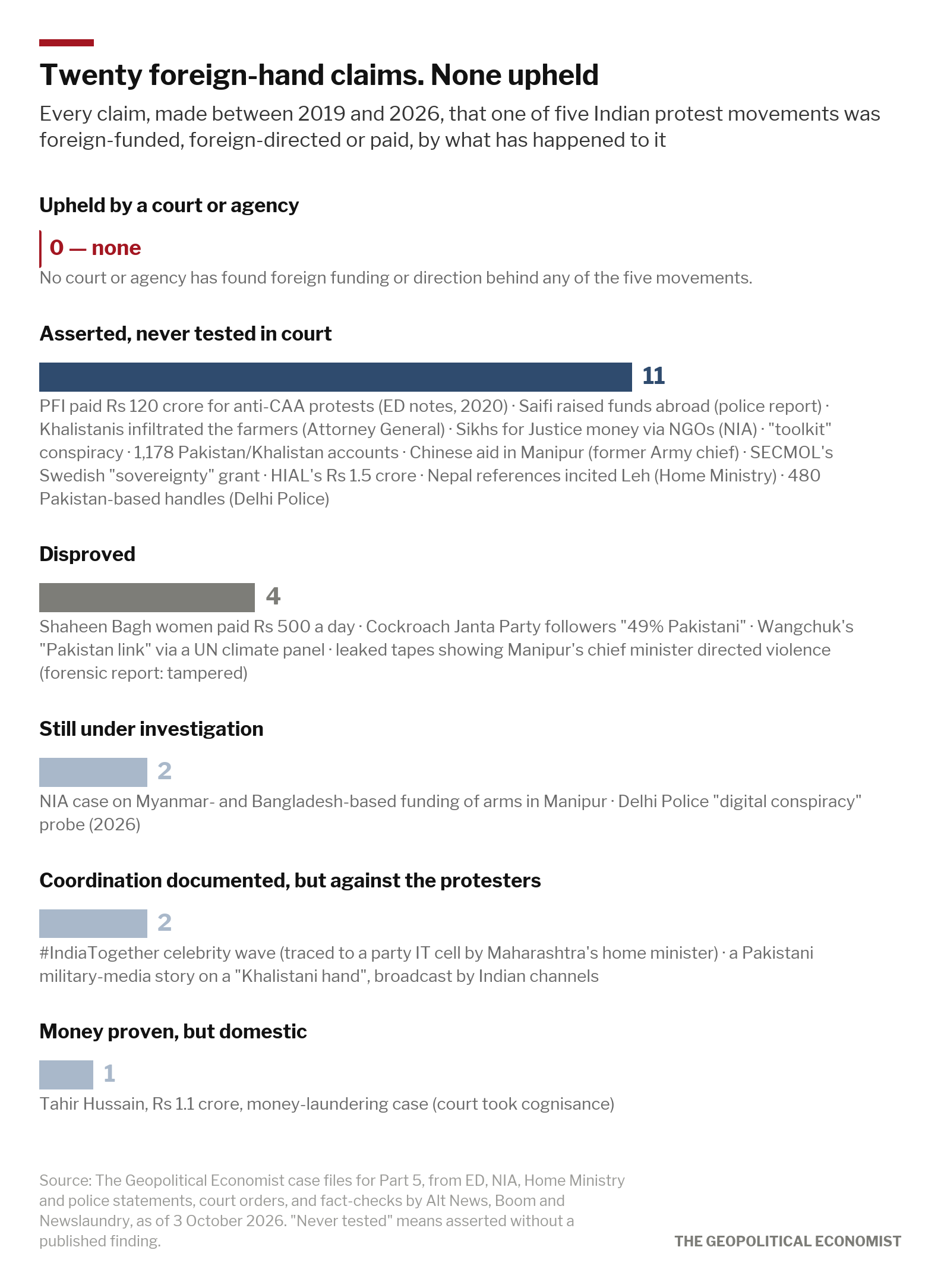
Across the five cases we logged every claim that a protest was foreign-funded, foreign-directed or paid: twenty of them, from ministers, agencies, party functionaries and, in one case, protesters against a chief minister. The chart shows where each stands. The tally:
| Status | Claims | Which |
|---|---|---|
| Found by a court or agency to involve foreign money or direction | 0 | None in any case |
| Asserted by an official or party, never tested in court | 11 | ED's PFI notes; Saifi's funds; the Attorney General's Khalistan claim; NIA's Sikhs for Justice case; the toolkit; 1,178 accounts; Naravane on China; SECMOL; HIAL; the Home Ministry on Nepal; 480 handles |
| Disproved by a fact-check, a forensic report or the only available data | 4 | Rs 500 a day; "49% Pakistani"; the Pakistan link via a climate panel; the Biren tapes |
| Still under investigation | 2 | NIA's Manipur arms case; the Delhi Police "digital conspiracy" |
| Coordination documented, but against the protesters | 2 | The #IndiaTogether wave; a Pakistani military-media story recycled by Indian TV |
| Money proven, but domestic | 1 | Tahir Hussain, Rs 1.1 crore, money-laundering case at cognisance |
Three of the four disproved claims were aimed at protesters. One was aimed at a chief minister, and this series applies the same standard to it. The two documented instances of coordination are a government-side celebrity wave that a state home minister traced to a party IT cell, and a Pakistani information operation that worked because Indian channels broadcast it. Pakistani opportunism, in other words, is on the record. So is the fact that its most successful product was a story against the protesters.
Dhaka, Kathmandu, Jakarta: the comparison officials make
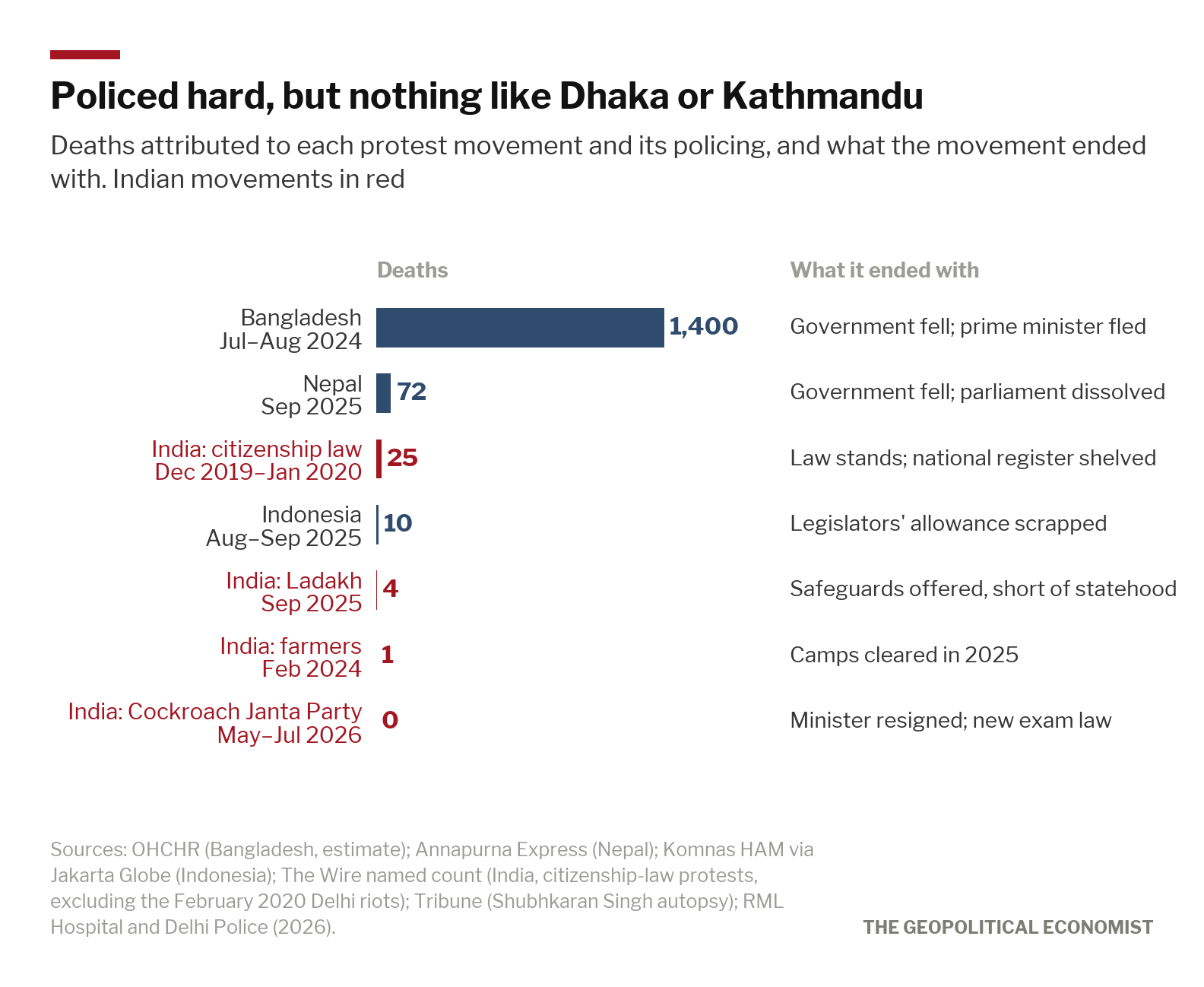
Indian officials reach for three foreign uprisings. Bangladesh, where a quota ruling in June 2024 ended with about 1,400 dead by the UN's estimate and a prime minister on a flight to Delhi. Nepal, where a social-media ban in September 2025 ended with Parliament burned, 72 dead and an interim prime minister chosen by a Discord poll of 145,000 members. Indonesia, where a housing allowance for legislators and a driver crushed by a police vehicle produced ten deaths in a week and a reversal.
How they were used in India matters. Prime-time channels gave Nepal a monarchist, religious frame its own protesters did not share. When the Leader of the Opposition posted that Gen Z would "save the Constitution", MPs of the ruling party accused him of wanting a "Nepal model". The Home Ministry made Nepal the stated cause of the Leh violence. Foreign Policy reported that Indian policymakers feared contagion and had responded with campus surveillance and online restrictions.
What actually crossed the border was a word and a flag. "Gen Z" travelled as a label. The One Piece pirate flag went from Jakarta to Kathmandu to Manila, Antananarivo and Lima; we found no verified sighting at an Indian protest. Discord as a decision tool is documented for Nepal alone; the Cockroach party ran on Instagram, X, a Google Form and a website. No transfer of organisers, money or training between the four movements has been documented by anyone. The "common sponsor" theories, USAID grants and a financier's foundation, are assertions by partisan outlets that no Indian agency has adopted.
The structural differences are larger than the resemblances. Nepal and Bangladesh are unitary states with one capital that fell; Indian protest plays out in Patna, Ranchi, Leh and Imphal under elected state governments that absorb, compete with or repress it. Hasina had just won a boycotted election; Oli's coalition had no mandate for its ban; India held a competitive general election in 2024 and every case in this catalogue had a state election within six months. The Bangladesh army chief announced the transition and the Nepal army brokered one; no Indian case involved the army in the outcome. And Delhi concedes in a way Dhaka and Kathmandu did not: three laws repealed, a minister gone in ten weeks, a new statute in a fortnight. The deaths chart carries the last difference. Indian policing of these movements is heavy on detention, preventive law and shutdowns, and lighter on lethal force than any of the three comparators.
What the template shows
Five movements. Each with a trigger you can date: a Bill, three ordinances, a court direction, a hospitalisation, a cancelled exam. Each with a grievance the state later acted on: a stayed register, a repeal, a power-sharing cabinet, a constitutional offer, a resignation and a law. Each met within days by a foreign-hand claim. Twenty claims. None upheld.
What this part cannot do is prove a negative. An operation that left no trace in any platform report, charge sheet, forensic test or court file over seven years is not impossible. But the state has had, in every case, the powers to find it: the ED, the NIA, the CBI, the FCRA register, blocking orders, notices to platforms, and in two cases the National Security Act. The output of those powers is the chart above. Part 6 weighs it, puts the strongest version of the engineered-protest thesis against the strongest version of the ordinary-democracy one, and says what each would mean for the country, for its investors and for the people who keep turning up at Jantar Mantar.
Method and sources
Each case was built on the series catalogue of 217 protest events (rows cited in the research note) and extended with money, amplification and court records on a fixed twelve-field template. Crowd figures are given as police, organiser or press, never averaged. Every foreign-funding or amplification claim is recorded as who made it, what evidence was cited, and what the rebuttal or court outcome was; "unproven" means no published finding, "disproved" means contradicted by a fact-check, forensic report or the only available data. Items that could not be verified in this round, including the trial record of FIR 59, the NIA's Manipur and SFJ charge sheets, the SECMOL appeal and the Chauhan inquiry report, are listed as open in the note and were not used. Comparator death tolls are from the OHCHR, Komnas HAM and the Annapurna Express; the anti-CAA figure is The Wire's named count and excludes the Delhi riots.
The Protest Question, a research series in six parts:
Comments
No comments yet. Be the first.
Comments are closed on this article.