
This series began with a question that is asked in Indian drawing rooms, ministries and newsrooms more often than it is answered: why is everyone suddenly protesting, and is somebody making them?
Five parts of data later, the question can be answered, within limits, and the limits are part of the answer. Part 1 counted: demonstrations roughly doubled over a decade while violence fell. Part 2 found the grievance: the examination and hiring machine, not prices. Part 3 followed the money through the Foreign Contribution register and found no document connecting it to a protest. Part 4 tested the information war and found the foreign-hand claims unmet by the standard past cases met. Part 5 ran five movements through one template and found twenty foreign-hand claims and no court finding.
This part does what the series promised at the start: it argues the case it was built to test as strongly as the evidence allows, then argues the other side, and then says which the record supports. It ends with what follows, because the answer has consequences for the state's conduct, for anyone with capital in India, and for how the country is read abroad.
The strongest case that it is engineered
Begin where the hypothesis is strongest, because it is not nothing.
Foreign information operations against India are real and documented. Facebook removed a network run by employees of Pakistan's military media wing in 2019. Graphika traced a second in 2021. Meta described a third, built on artificial intelligence, this March. China ran a fake Sikh-activist network until Meta took it down in 2024. India's own doctrine, from the Land Warfare Doctrine of 2018 to the National Security Adviser's 2021 speech on civil society as "the new frontier of war", is not paranoia invented for the occasion; it describes a contest every serious state now believes it is in. Anyone who says foreign manipulation of Indian opinion is a fantasy is wrong, and Part 4 said so.
Foreign money for unrest has been proven in court, once. The Kashmir terror-funding cases established, to the satisfaction of the Supreme Court at the bail stage and a special court at sentencing, that money from Pakistan reached separatist leaders to organise stone-pelting, strikes and protests. The Popular Front of India was banned on a notification that cited funds collected abroad and remitted through hawala, and a tribunal upheld it. The mechanism exists. It has been used on Indian soil.
The pattern is suggestive. Protest in India has risen in step with a decade of rising global grey-zone competition. The 2026 movement grew faster than any account in Indian history, in a form, satire and memes around a mascot, that looks engineered to travel. It arrived within a year of youth uprisings that toppled governments in Dhaka and Kathmandu, under a shared label, with a shared flag flying elsewhere. Pakistani accounts were active around it; the police say 480 of them. A state facing all this would be negligent not to ask the question.
Absence of proof is not proof of absence. The FCRA register sees only the 1 per cent of organisations registered under it. A payment in cryptocurrency, through a diaspora cut-out or in kind, would not appear in it. Platform data on who follows whom is visible only to Meta and the account owner. A police investigation that has served notices on three platforms may yet produce a charge sheet. Courts move slowly; the conspiracy case from 2020 has not reached the framing of charges. The record of "unproven" in Part 5 is, on this reading, a record of cases not yet decided.
That is the case. It is coherent. It is held by people who are not fools. And it has one feature that must be stated before the counter-case begins: it is unfalsifiable as usually put. Every finding of nothing is explained as concealment. A hypothesis that cannot lose is not a finding; it is a prior. The way to test it anyway is to ask what the world would look like if it were true, and compare.
The strongest case that it is not
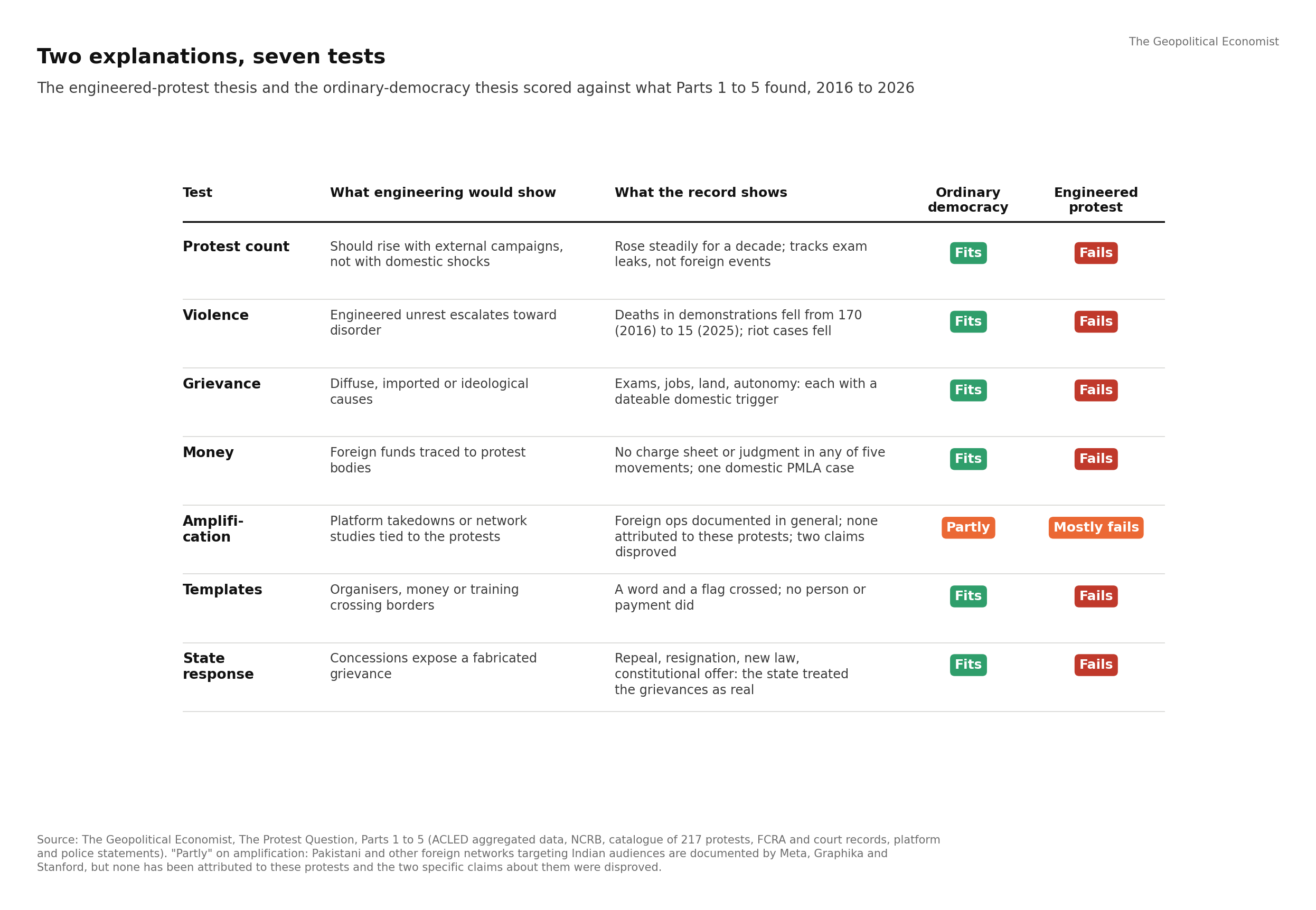
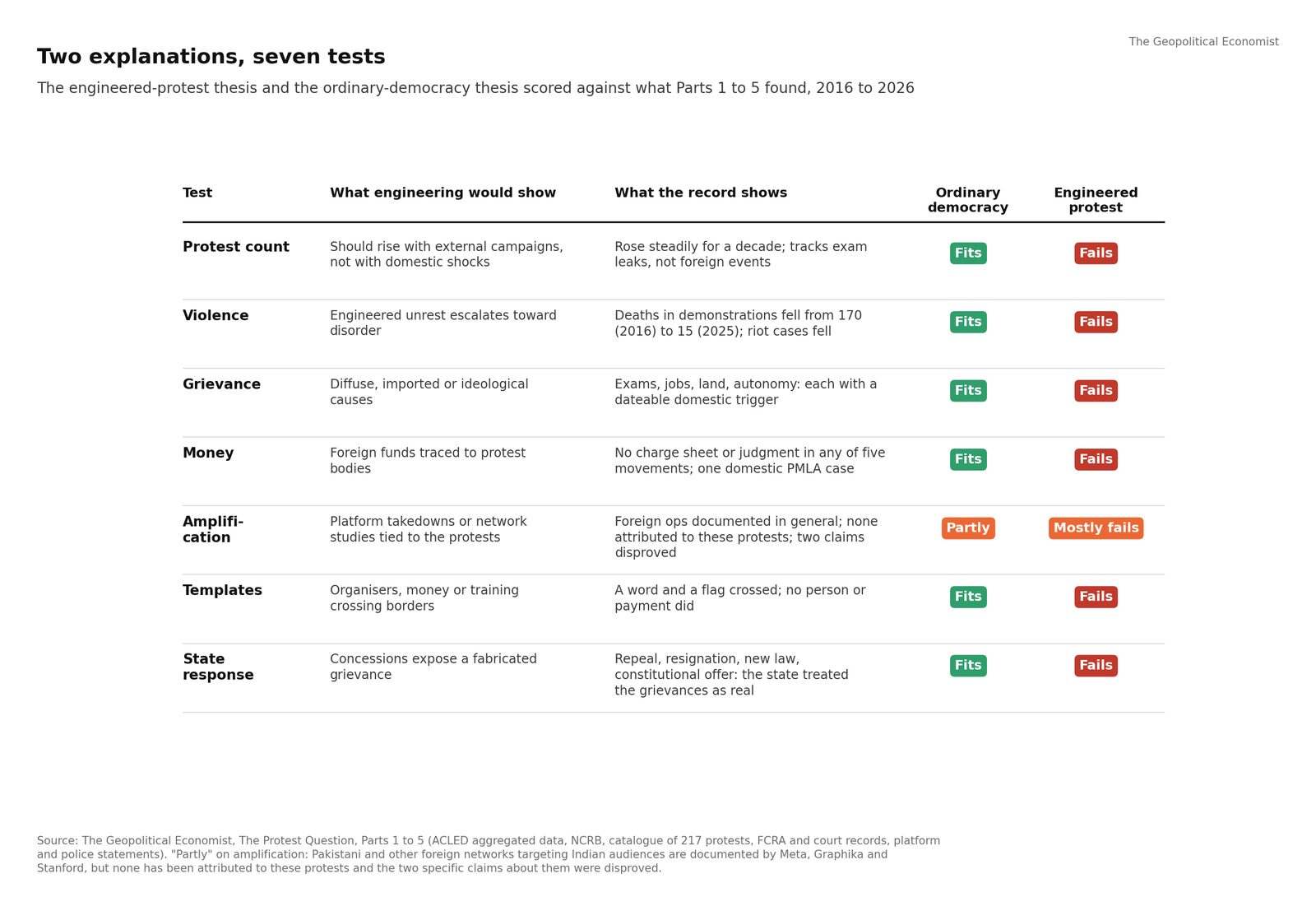
If India's protest wave were engineered from abroad, seven things should be visible. The series looked for each.
The count should track external campaigns, not domestic shocks. It does the opposite. The rise is a decade long and steady, not a series of spikes around foreign events. Month by month, the count moves with examination leaks and recruitment failures: five major exam protests in 2024 when NEET and UGC-NET fell within a fortnight, five in 2026 after NEET fell again. It did not move in March 2026 when the Iran war shut Hormuz and fuel prices rose for the first time in four years, the month a foreign adversary would most want Indian streets to fill. The correlation between the monthly protest count and inflation over ten years is zero.
Engineered unrest should escalate. The purpose of destabilisation is disorder. India's protest wave has produced the reverse: deaths in demonstrations fell from 170 in 2016 to 15 in 2025 and four in the first nine months of 2026; registered riot cases fell by a third from 2019; the share of riots the police attribute to collective causes fell by three-quarters. The Cockroach movement, the one most often called a foreign operation, produced no deaths across ten weeks and called off its marches the day after the police used pellet guns. An operation designed to break India is producing more marches and fewer bodies.
The grievances should be diffuse, imported or ideological. They are specific, local and dateable. A Bill passed on 11 December. Three ordinances in June. A High Court direction on tribal status. A hospitalisation on day fourteen of a fast. An examination for 2.27 million people cancelled on 12 May and a judge's remark three days later. Each is an Indian institution failing an Indian constituency, and each can be found in the gazette or the court record. Nobody abroad needed to invent them.
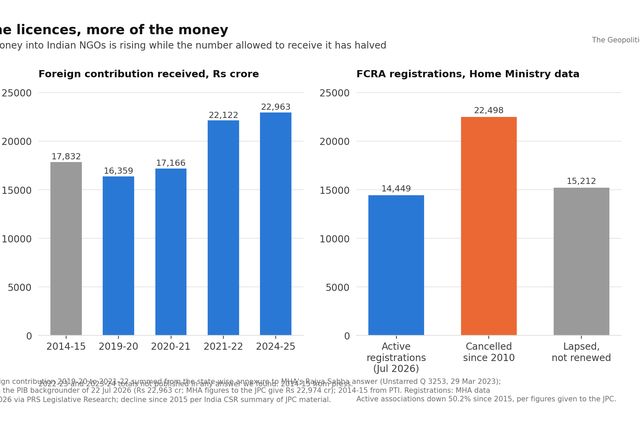
Money should be traceable to protest bodies. The state has the most intrusive instrument over foreign money in any large democracy, has cancelled 22,000 licences, has the ED, the CBI and the NIA, and has used all of them on these movements. The output is one domestic money-laundering case at cognisance stage, one licence cancelled over Rs 9.81 lakh of accounting entries, summonses later downgraded to witnesses, a bail order on "scanty and sketchy evidence", and a foreign ministry with "no information". The funder is the one thing a seven-year investigation should have found and has not.
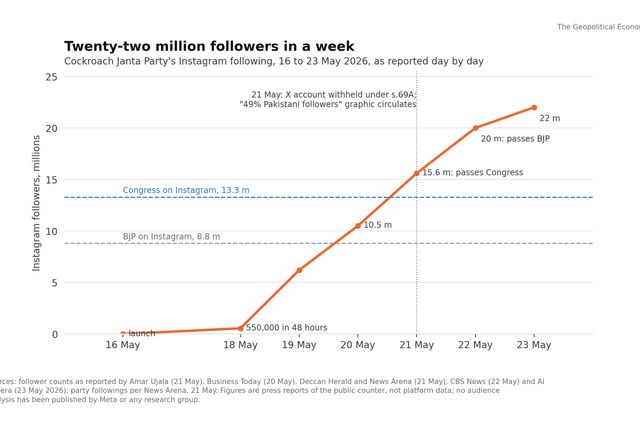
Amplification should leave network traces. Past foreign operations against Indian audiences were caught by platforms and researchers with account lists, creation dates and numbers. For these protests there is no takedown, no dataset, no network study. The two specific claims that were made, the follower graphic and the 480 handles, had no source and no method, and the first was contradicted by the only data that exists.
Templates should travel as organisations. What crossed from Jakarta and Kathmandu was a label and a pirate flag, neither of which has been verified at an Indian protest. No organiser, payment or training crossed with them. The Indian movement used Instagram, a Google Form and a website; Nepal's used Discord. The structural conditions that let a capital fall in Dhaka and Kathmandu, a unitary state, a boycotted or mandate-less government, an army willing to arbitrate, do not exist in India, and the series' comparison showed Delhi conceding in ways those governments never did.
The state's own response should reveal a fabricated grievance. Instead it validated each one. Three farm laws repealed. A citizenship register shelved. A Union minister resigned and a statute passed within a fortnight. A power-sharing cabinet in Manipur. Constitutional safeguards on the table for Ladakh. Governments do not repeal laws and sack ministers to appease a foreign bot network. They do it when the grievance is real and the voters know it.
On every test the ordinary-democracy thesis fits and the engineered thesis fails or, on amplification, mostly fails. The engineered thesis survives only in the space the record cannot see, and that space narrows with every investigation that returns empty.
What is settled
Four things, on the evidence of six parts.
Indians are protesting more, and more peacefully. This is measured three ways, by ACLED, by the police's own agitation counts before they stopped publishing them, and by the series' catalogue of major protests, and the three agree.
The grievance is the state's competence, concentrated in one place. The examination and recruitment system, which the young have been told is the route out and which keeps breaking. A 21 per cent vacancy rate in Union posts, a thousand applicants per railway job, and more than ninety leaks in two decades are not a foreign plot. They are a domestic policy failure with a constituency of tens of millions, and it is the constituency that protests.
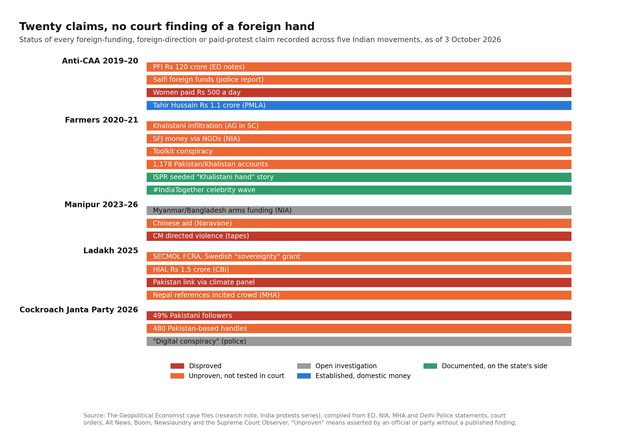
No foreign funding or direction of any protest since 2019 has been established by any court or agency. Twenty claims, five disproved, twelve asserted and never tested, two open. The one proven case of foreign money for unrest is Kashmir, and it is a terror-finance case, not a protest.
The foreign-hand claim is itself a documented pattern. It arrived within days in every case, from the same offices, in the same vocabulary, before the evidence and, so far, without it. The best-documented coordination in the series is on the state's side of the argument: a celebrity hashtag wave traced to a party IT cell, a Pakistani story broadcast by Indian television as fact, two investigative notes released on the eve of a vote.
What is not settled
The series cannot prove a negative, and does not claim to. The open items are real and the reader should hold them. The Delhi Police's digital probe has served notices on three platforms and named three firms; if it produces a charge sheet with payment records and server logs, Part 4 and Part 5 will need an update, and the series will publish one. The conspiracy case from 2020 will eventually be tried. The judicial inquiry into the Leh firing has examined 93 witnesses and its report is not public. The NIA's Manipur case concerns insurgent arms and may yet say more about who paid for them. Pakistani opportunism around Indian protest is real and nobody has quantified it; a network study of the 2026 hashtags, which would cost a lab five figures in platform fees, would settle how large it was.
Nor can the series settle motive. Officials who reach for the foreign hand may believe it, may be applying a doctrine that tells them to expect it, or may find it useful against an opposition and a press. The record shows what they said and what they produced. It does not show why.
What follows
For the state. A doctrine that locates the front line in civil society is right about the world and wrong about the exam hall. The practical cost of the foreign-hand reflex is not only to the people detained under the National Security Act and released without charge. It is that the state spends its investigative capital proving a Pakistani account followed a meme page while the Public Examinations Act, the one thing the 2026 protests actually produced, waits for the fast-track courts it mandates. The honest reading of this series is that the state has a competence problem that it keeps describing as a security problem. Fixing recruitment would do more for internal security than any blocking order.
For investors and companies. Part 2 said it and the rest of the series confirms it: India's protest risk is a stress on governance, not on property. The protesters are young, urban, educated and non-violent, and their target is the examination board, the minister and now the Election Commission, not the factory gate or the foreign firm. The risks that do bear on business are the ones the state creates in response: internet shutdowns, which cost the economy by the day; preventive detention of people with whom the company may have dealings; and an FCRA regime whose 2026 Bill would let the state take the assets of a charity whose licence lapsed. A multinational's community-development partner is more exposed to the lever than its plant is to the crowd. The foreign-hand narrative itself is a reputational variable: a government that calls a student movement a Pakistani operation is one whose statements about other things, including the economy, a prudent investor will discount.
For India's standing. Here the engineered-protest thesis does the most damage to the people who hold it. The Bangladesh and Nepal comparisons were meant as warnings. The data turns them into a compliment. India absorbed a youth movement larger than either without a single protest death, through a resignation and a statute, because it has elections every six months, state governments that compete for the young, and courts that still grant bail on scanty evidence and quash FIRs. That is what a resilient democracy looks like under exactly the stress the region is now famous for. A state confident of this would publish the Leh inquiry, let the digital probe produce a charge sheet or close it, and stop saying "no information" about claims its own ministers make. The alternative, in which every protest is a foreign plot until proven otherwise, converts India's greatest comparative advantage, that its people argue with their government in public and the government sometimes gives way, into evidence of weakness. The protests are not the threat to India's standing. The explanation is.
The verdict
Is India's protest wave engineered? On the evidence the Indian state itself has produced, no. It is the ordinary and in some ways admirable behaviour of a young, unequal, loud democracy whose government has been failing at one specific thing for a decade and whose citizens have noticed. Foreign actors watch it, post about it and would like to use it; nothing shows they made it. The burden of proof for the other view sat with the people who asserted it, in every case, within days, and in seven years they have not met it. If they do, this series will say so. Until then, the cockroaches are India's own, and so is the kitchen.
Method and sources
This part draws only on findings established in Parts 1 to 5 and their research notes, each of which carries its sources: the ACLED aggregated export and NCRB series behind Part 1; the catalogue of 217 protests, PLFS, price and examination data behind Part 2; the FCRA register, the 21-case enforcement table and the court record behind Part 3; the takedown table, platform reports and the documented-versus-claimed register behind Part 4; the twelve-field case template and 20-claim table behind Part 5. The scorecard above is the authors' judgment of fit on each test and is reproducible from those notes. The full dataset, scripts and charts are published with the series. Items any part marked unverified were not used. The series will be updated if any of the open investigations named above produces a finding.
Comments
No comments yet. Be the first.
Comments are closed on this article.