
Abstract
Against the high-decibel media glare and the relentless advocacy of the gargantuan state machinery, India’s multiple strides are, by and large, self-congratulatory in nature. A multitude of roadblocks, hardly showing any sign of abatement, continue to obstruct our growth, leading the nation towards unfortunate circumstances. Fundamentally, this reflects the mindless acts of much of our political class, which has become addicted to exploiting the state exchequer for selfish ends.
Even more disturbing is the fact that this political darkness continues to spread and is being proactively fostered. It casts a shadow over the noble cause of nation-building and actively weakens it. The rot has already become deeply rooted and is clearly visible. But what can be done when self-serving entities and opportunists pretend to be in a deep slumber?
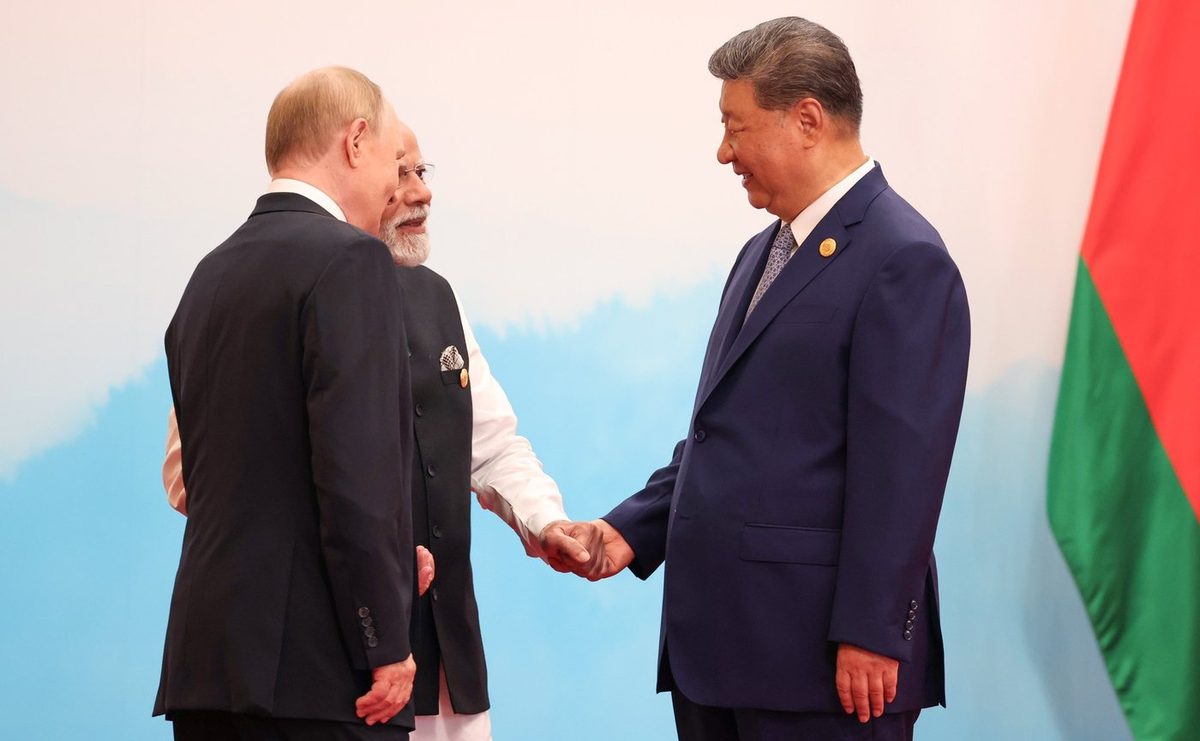
It is at this defining moment in the nation’s history that Modi has emerged, in my view, as a ray of hope. His honesty, integrity, charisma and leadership qualities embody the traits of an exceptional human being and, to many, nothing less than an incarnation. Since Modi commenced his mission by promising deliverance, the most reassuring aspect, in my assessment, has been his commitment to strengthening the grassroots of democracy.
Meanwhile, the political bloc on the opposite side of the spectrum appears to have started disintegrating. Its increasingly panicked actions bring to mind the proverb that a drowning man catches at a straw. Modi’s emergence in the political arena has infused the nation with a magnetic spirit, steadily exercising its influence across the country.
Modi has made every moment of his movement count, standing against forceful currents and overcoming formidable challenges. Despite the presence of negative forces, Moditva continues to spread, marching ahead against hostile factors. Let us hope that it gathers strength, that the light at the end of the tunnel becomes a reality, and that a golden era of national development follows.
Keywords: Growth perspective; know-how; know-why; know-what; visionary decade; successive triggering; phenomenal growth; liberalisation; realism; excellence; mandatory measures.
Introduction: comparing economic performance
The objective of beginning with a comparative chart is to obtain a picture of where India stands alongside major economies. China and Singapore are particularly relevant to us. We have to analyse how these two nations performed to attain high economic standards, starting from much lower levels of development. Their models should be considered only after detailed scrutiny, addressing know-how, know-why and know-what in India’s pursuit of global power status. Australia is also considered because it works under the Westminster model of multiparty democracy at a high level of economic performance.
| Country | Nominal GDP per person, 2026 projection (current US$) |
|---|---|
| United States | 95,212 |
| Russia | 19,953 |
| China | 15,371 |
| Singapore | 109,117 |
| Australia | 75,172 |
| India | 2,750 |
Source: IMF DataMapper, World Economic Outlook, GDP per capita in current US dollars, retrieved 3 November 2026. Figures are rounded projections, not average salaries. They are affected by exchange rates and do not adjust for purchasing power or describe income distribution. The submitted table’s unsourced population, defence and “freebies” comparisons have been excluded.
Singapore: leadership and institutions
Looking at Singapore, a small former British colony, Lee Kuan Yew, a barrister and statesman, led the People’s Action Party to power and became its first prime minister in 1959. He was then 35. A brilliant scholar, Lee completed his legal education in Britain and was called to the Bar in 1950, before practising law in Singapore.
Lee, the founder of modern Singapore, ran the country for 31 years, until 1990. Goh Chok Tong and, subsequently, Lee Hsien Loong became prime minister. Lee Kuan Yew continued as Senior Minister from 1990 to 2004 and Minister Mentor from 2004 to 2011, advising successive governments. He died on 23 March 2015, aged 91, triggering condolences across the world.
Inheriting a poor nation, Lee took visionary, bold and enabling measures that propelled Singapore towards prosperity. The country’s present high GDP per person reflects that development over successive administrations. This outcome can be termed the “possibility of impossibility”. The measures and institutional priorities worth considering include the following.
- Corruption control: The Corrupt Practices Investigation Bureau, established in 1952, became central to Singapore’s approach to investigating corruption. It predates Lee’s premiership.
- Civil-service performance: High salaries for civil servants, accompanied by accountability.
- Meritocracy: The recruitment of bright and capable people to run the government.
- Export-oriented industrialisation: The use of production and overseas markets to support economic development.
- Ease of doing business: Efficient bureaucracy and the cultivation of Singapore’s reputation to attract investment.
- Mass public housing: Public provision that made widespread home ownership possible. Singapore’s 2024 Public Sector Outcomes Review reported that around 80 per cent of resident households lived in HDB flats in 2023, with more than 90 per cent of those households owning their homes.
- Education: Bilingual education, with English as the medium of instruction and the learning of a mother-tongue language, rather than Mandarin alone for every pupil. This remains a cornerstone of Singapore’s education system.
China: reform and the scale of transformation
Let us now dwell upon China’s economic growth. The Communist Party of China, founded in 1921, has governed since 1949 within an authoritarian political system. China commenced its reform and opening-up programme in 1978, when economic poverty was widespread.
From those conditions, China went on to become the second-largest economy in nominal GDP terms, next to the United States. Initiated under Deng Xiaoping, reform moved the country from rigid ideological planning towards a greater role for markets and international investment. It did not amount to deregulation in every sphere of the economy. The development experience of Singapore was one of the examples studied during China’s transformation.
Lee delivered major economic progress for a small nation. Singapore attained self-government in 1959 and independence in 1965; China began reform in 1978. We in India may question the direct applicability of Singapore’s model because of its small size, but China’s development, with a population comparable in scale to India’s, demands attention. India must contemplate self-inspection and introspection in its approach to national growth.
Population policy
Recognising population as an important factor in economic development, China adopted its one-child policy around the beginning of the reform era. It reduced births but eventually contributed to concerns over the age structure of the workforce. China moved to a universal two-child policy in 2016 and announced a three-child policy in 2021. These changes illustrate the difficulties of providing for a vast population while managing demographic change.
Tiananmen and political control
The Tiananmen crackdown of June 1989 remains a defining episode. Students and other civilians assembled in Beijing from April, protesting corruption and calling for political change. Chinese authorities sent troops and tanks into central Beijing on the night of 3–4 June. The exact death toll remains unresolved; the US Office of the Historian records estimates of hundreds or thousands. The crackdown attracted international condemnation and sanctions and profoundly affected the trajectory of pro-democracy activism and perceptions of China abroad.
Household responsibility
In the late 1970s and early 1980s, China moved from collective agricultural production towards the household responsibility system. While rural land remained collectively owned, farming households took responsibility for production and could benefit from their output. This gave individual farmers greater incentives and scope for decisions. The World Bank’s account of the reform period places rural reforms among the early steps in the wider transformation.
Education and basic needs
Education is an essential vehicle of growth. China’s Compulsory Education Law provides for nine years of compulsory schooling without tuition or miscellaneous fees. Its later 2021 restrictions on academic private tutoring concerned tutoring institutions and student workloads; they were not a ban on all private English-medium schools.
The broader question is how a country caters to the basic needs of a huge population. Access to food, healthcare, education and housing is central to the meaning of development. China’s experience calls for examination of the relationship between economic growth, state capacity and the provision of those needs.
India’s economic ambition and democratic constraints
India functions under the Westminster model of multiparty democracy, as do countries including the United Kingdom, Canada, Australia and New Zealand. These countries demonstrate that parliamentary government can coexist with high income levels. The cases are illustrative, not exhaustive: the constitutional model alone does not determine economic performance.
The contention is that India, with nominal GDP per person projected at around $2,750 in 2026, must improve its economy to a level commensurate with its ambitions. India is performing with admirable economic strides, but it must look towards the standards of developed economies. Its large workforce gives particular urgency to that ambition.
Despite encouraging capabilities, the distance still to travel is excruciating. If the Indian economy fails to perform at the desired level, it is a clarion call to professionals in politics, bureaucracy, economics, engineering and other sectors. Their positive performance must contribute to national growth.
There is no space merely to applaud ourselves as the fifth or any other numbered economy. Human development and output per person should guide our ambitions. Many tasks remain ahead.
On deeper analysis, we can identify conditions that hinder growth and seek redress. Our much-admired multiparty democracy frequently throws up challenges, requiring political leaders to resort to firefighting. In that process, the economic trajectory can be badly affected. I recall a newspaper announcement for an essay competition whose theme questioned whether what we practise on the political front is politics at all, or instead “polytricks”.
Politics, in its legitimate sense, concerns gaining and exercising power to make decisions, manage the state, campaign, negotiate and govern. “Polytricks” is a colloquial description of deceptive or unethical political behaviour. Politics can be a legitimate exercise of power; the slang term points to its manipulative misuse.
The familiar suggestion that everything is fair in love, war and politics describes a situation in which rules are ignored to achieve victory. While Singapore and China direct sustained attention towards economic growth, India has to address roadblocks that arrest its endeavours in national development.
Institutional integrity, criticism and political means
The efficiency of Indian democracy depends upon institutional integrity, public reason and a constitutional commitment to morality. The rule of law must carry more weight than a simple assertion of numerical strength. Parliament and legislative assemblies must be capable of carrying out their responsibilities.
Ambedkar’s warning about the relationship between democratic institutions and society remains pertinent. In the Constituent Assembly debates of November 1948, he described democracy in India as “only a top-dressing on Indian soil, which is essentially undemocratic”. His concern invites reflection on the social foundations needed to sustain constitutional government.
Economic growth, public welfare and access to education should be determinants of the efficiency of governance. China’s progress in reducing extreme poverty deserves study, but it should not be described as the disappearance of poverty at every income threshold. The World Bank distinguishes extreme poverty from higher living-standard benchmarks.
Gandhi strongly argued that the means used to pursue a goal shape the result. His writings on means and ends reject the treatment of the two as separable. The suggestion that a worthy goal justifies any method, commonly associated with Machiavellian politics, presents a different approach. The exact phrase “the ends justify the means” should not be treated as an authenticated quotation from Machiavelli.
Indian democracy embodies criticism and dissent in order to sustain its pluralism. Political parties, national figures and constitutional ideas all remain open to examination. Arun Shourie, a journalist, author and former BJP minister, provides examples through Worshipping False Gods, his critique concerning Ambedkar, and The New Icon: Savarkar and the Facts, his examination of Savarkar. Admiration of a political figure does not remove that figure from critical scrutiny.
Personal popularity and electoral outcomes can also diverge. The defeat of the BJP-led government in 2004 raised questions about the distance between the “India Shining” campaign and conditions experienced by voters. Public affection for an individual leader does not automatically secure an electoral victory.
The familiar political terms associated with Kautilya offer another way of thinking about the exercise of power:
- Sama: Reconciliation, discussion and dialogue.
- Dana: Gifts, inducements or concessions.
- Bheda: Creating divisions among opponents to weaken their position.
- Danda: Punishment or coercion when other measures fail.
Such concepts continue to feature in discussions of politics, governance and international relations. They remind us that the means used in political life deserve examination alongside the goals professed.
Fiscal promises and national development
Politicians across the party divide compete to announce benefits without always considering whether the economy can absorb the costs. The question of expenditure undertaken for electoral advantage requires serious introspection.
The term “freebies” needs care: it does not define a consistent budget category for comparison between countries. Spending on social welfare, industrial support and defence cannot be placed together without specifying the programme, year and level of government. Public-welfare expenditure and payments intended primarily to gain political support should be assessed on their purposes, financing and results.
My concern is that political promises can become counterproductive when they ignore the economy’s capacity to sustain them. All concerned must examine this issue seriously. Economic development needs resources, and policy choices affecting production and trade must be evaluated in the national interest.
A nation cannot be built through zeal alone, nor through pragmatism detached from national purpose. The performance of all groups must align with the country’s needs, and the measures they pursue must address contemporary conditions.
The British author and lexicographer Samuel Johnson observed on 7 April 1775 that “Patriotism is the last refuge of a scoundrel”. Boswell’s account makes clear that the target was pretended patriotism used to conceal self-interest, rather than sincere love of country. More than 250 years later, the cynical use of patriotic rhetoric remains relevant to political life. In my view, self-serving conduct continues to affect Indian politics and other sectors at many levels.
From global balancing power to global economic power
Modi became prime minister in 2014, shortly before Lee Kuan Yew’s death in 2015. Modi attended Lee’s funeral in Singapore and described him as a “lion among leaders”. The experience of Singapore provides a reason to reflect on leadership, institutional performance and the practical work of development.
Indian governments have faced serious roadblocks in the functioning of democracy. Coalition management has been one of them. The distinction between global balancing power and global power is therefore worth stating.
Global power, as used in this paper, is measured through internal growth, higher output per person, improvements in human development and the capacity to exert international influence.
Global balancing power describes India’s ability to maintain independence of judgment among competing blocs, act on regional responsibilities and draw upon diplomacy, culture and other forms of soft power in a multipolar world. India’s relations with competing major powers are an important part of that position.
Having discussed these issues, we are left with the task of accomplishing the economic growth required to support global power status. The political calculus of Indian multiparty democracy is complex. A leader needs political ability, charisma and decisiveness, together with personal integrity and the capacity to confront dishonest conduct.
In my assessment, Modi possesses these qualities. After two general elections that gave the BJP single-party majorities, the 2024 election returned it with 240 of 543 Lok Sabha seats, requiring coalition partners for a majority at that election. Coalition strength must not be confused with a single-party majority.
The question is who can carry out the difficult work before the country. Modi, or a leader of comparable ability across the political divide, must bring political authority to bear on the economic tasks that will determine India’s future. National development requires leadership capable of converting the country’s international standing into higher productivity, stronger institutions and greater prosperity for its people. Who will bell the cat?
Sources: IMF: GDP per capita projections · Singapore PMO: Lee Kuan Yew biography · Singapore CPIB: Roles and Functions · Singapore Public Sector Outcomes Review: Housing · Singapore Ministry of Education: Education system · World Bank: China overview · China State Council: Population policy changes · US Office of the Historian: Tiananmen · World Bank: Forty years of China’s reforms · China Ministry of Education: Compulsory Education Law · China State Council: 2021 tutoring guidelines · Constituent Assembly Debates, November 1948 · M. K. Gandhi: Means and Ends · Penguin: The New Icon · James Boswell: Life of Johnson · Prime Minister of India: Tribute to Lee Kuan Yew · PRS: 2024 Lok Sabha results.
Comments
No comments yet. Be the first.
Comments are closed on this article.