
A familiar argument
Russia's war in Ukraine brings back memories of Germany before the Second World War. Before the war began, Adolf Hitler repeatedly used the existence of ethnic Germans living outside Germany's borders as his principal reason to invade another country with the goal of territorial expansion. The clearest example was Czechoslovakia.
In 1938, approximately three million ethnic Germans were living in the Sudetenland of Czechoslovakia, which bordered Germany. In what became known as the Sudeten crisis, Hitler claimed the Sudeten Germans were being mistreated and their right to self-determination was being denied.
Truth be told, Hitler had already been preparing for expansion and, according to the historical record, his concern for the Sudeten Germans was more than a humanitarian concern that unexpectedly arose. The German Federal Archives note that Hitler had decided on the destruction of Czechoslovakia through military action. The ruse of presenting himself as the protector of a disadvantaged German minority allowed him to frame the invasion in a way that was more palatable to other European nations.

The crisis culminated in the Munich Agreement, signed on September 30, 1938. Czechoslovakia was forced to surrender the Sudeten territories to Germany from October 1 of that year. The agreement that was supposed to preserve peace did the exact opposite. Within months, Germany had occupied the rest of Czechoslovakia, and less than a year later Hitler invaded Poland. What followed was the Second World War.
The point isn't that Russia is Nazi Germany, or that every modern dispute involving an ethnic minority will lead to another world war. History doesn't repeat itself so neatly. The point is that ethnic populations living outside the borders of a powerful country can become politically useful when that country wants to justify intervention or territorial expansion.
Russia's "compatriots" abroad
That brings us back to Russia, whose war in Ukraine may be creating an unusual problem for its neighbours. The problem isn't simply that Russians have been leaving Russia in droves since the invasion of Ukraine began four years ago, as there's no rewinding that clock. Nor is it simply that Russia has a history of claiming an interest in Russian citizens, ethnic Russians, and Russian-speaking populations living outside its borders. The more interesting question is what happens when those two things collide.
Russia justified its actions in Ukraine, in part, by claiming Russian speakers and ethnic Russians were being mistreated or threatened. The RAND Corporation estimates upwards of 300,000 Russians then left Russia, largely to avoid being drawn into the war themselves, to escape political repression, or to avoid the economic consequences that were to follow. Many settled in neighbouring countries such as Georgia and Armenia. Over time, some of them established businesses, bought property, obtained residence permits, and became part of the local population in their new land. Meanwhile, Russia has repeatedly asserted a special interest in Russians and so-called compatriots living beyond its borders.
Could Russia's current war be creating, or at least enlarging, the populations that a future Russian government could someday claim it has an obligation to protect?
That's not a prediction that Russia will invade Georgia, Armenia, Kazakhstan, or any other country simply because Russian citizens have moved there. Nor is it an accusation that the Russians who fled their country are somehow agents of the Kremlin. Many left precisely because they opposed the Ukraine war or didn't want to be forced to fight in it.
Perhaps this is the more uncomfortable question: can a country create a diaspora through war and then later use the existence of that diaspora as political leverage? History suggests the basic idea isn't as far-fetched as it may initially sound. Indeed, Russia has demonstrated its own version of the idea: Russia's "compatriots abroad".
The breakup of the Soviet Union left millions of ethnic Russians and Russian speakers living outside the borders of the Russian Federation. For Russia, this created both a demographic reality and a political opportunity, leading Moscow to develop the concept of protecting Russian compatriots abroad.
The term can be broader than simple citizenship and can include people connected to Russia through language, culture, history, or identity. That concept hasn't always translated into military action. Millions of Russian-speaking people live outside Russia without Moscow invading the countries where they reside. But Russia has used the protection of compatriots as part of its political justification in major conflicts.
In Georgia, Russia said it was acting to protect people in South Ossetia, including Russian citizens. In Ukraine, Moscow repeatedly invoked the interests and alleged mistreatment of Russian speakers and Russian compatriots, particularly in Crimea and the Donbas. Academic research has specifically described Russian references to "compatriots" in Georgia in 2008 and Ukraine in 2014 as a form of political framing used to justify Russia's actions. This matters because Russia has already established the basic argument: Russian people beyond Russia's borders can be presented as a Russian concern. The question now is whether Russia's own war in Ukraine is helping to create more of those populations.
The exodus
When Russia launched its full-scale invasion of Ukraine in February 2022, many Russians took flight. A second and particularly visible wave followed in September 2022, when Vladimir Putin announced what he called a "partial mobilization." The effect at Russia's borders was immediate.


Georgia's Ministry of Internal Affairs reported that daily crossings from Russia increased sharply after September 21, 2022. On September 25, more than 11,000 people entered Georgia from Russia while fewer than 5,600 crossed in the other direction.
Georgia wasn't the only destination for Russians on the run. They also went to Armenia, Kazakhstan, Turkey, Serbia, and other countries. Some stayed, while others continued further into Eastern Europe and the Balkans, putting multiple borders between themselves and their home country.
The exact number of Russians who permanently left is difficult to establish. Migration statistics are complicated by people crossing borders multiple times, those moving temporarily, and those eventually returning to Russia. One thing is certain: the scale was large enough to have a measurable impact on several neighbouring countries.
Perhaps the clearest example is Georgia. According to Georgian statistics cited by Transparency International Georgia, 62,300 Russian citizens registered as immigrants in Georgia in 2022. In the same period, Russian migration produced a visible increase in businesses and economic activity. TI reported that the number of Russian companies registered in Georgia tripled after the full-scale invasion of Ukraine compared with the whole period from 1995 to 2021.
The mass migration didn't stop there. European migration data shows that Russian citizens remained one of the largest groups receiving first residence permits in Georgia in the years following the invasion.
Armenia didn't fare much differently. A United Nations-supported assessment estimated that roughly 53,000 to 58,000 citizens of Russia, Ukraine, and Belarus were temporarily residing in Armenia in 2023, the overwhelming majority believed to be Russian citizens.
Those aren't insignificant numbers when you consider the small populations of Georgia and Armenia. Georgia has a population of a few million. Armenia's tops out around three million. So even a relatively small number of newcomers can have a significant impact on housing, prices, businesses, local politics, language, and public opinion. That's where the geographical question begins.
The Georgia problem
Georgia is particularly interesting because it has already fought a war with Russia. In 2008, Russian forces entered Georgia during the conflict involving South Ossetia and Abkhazia. Russia recognised both territories as independent after the war, although most of the international community continues to regard them as part of Georgia.
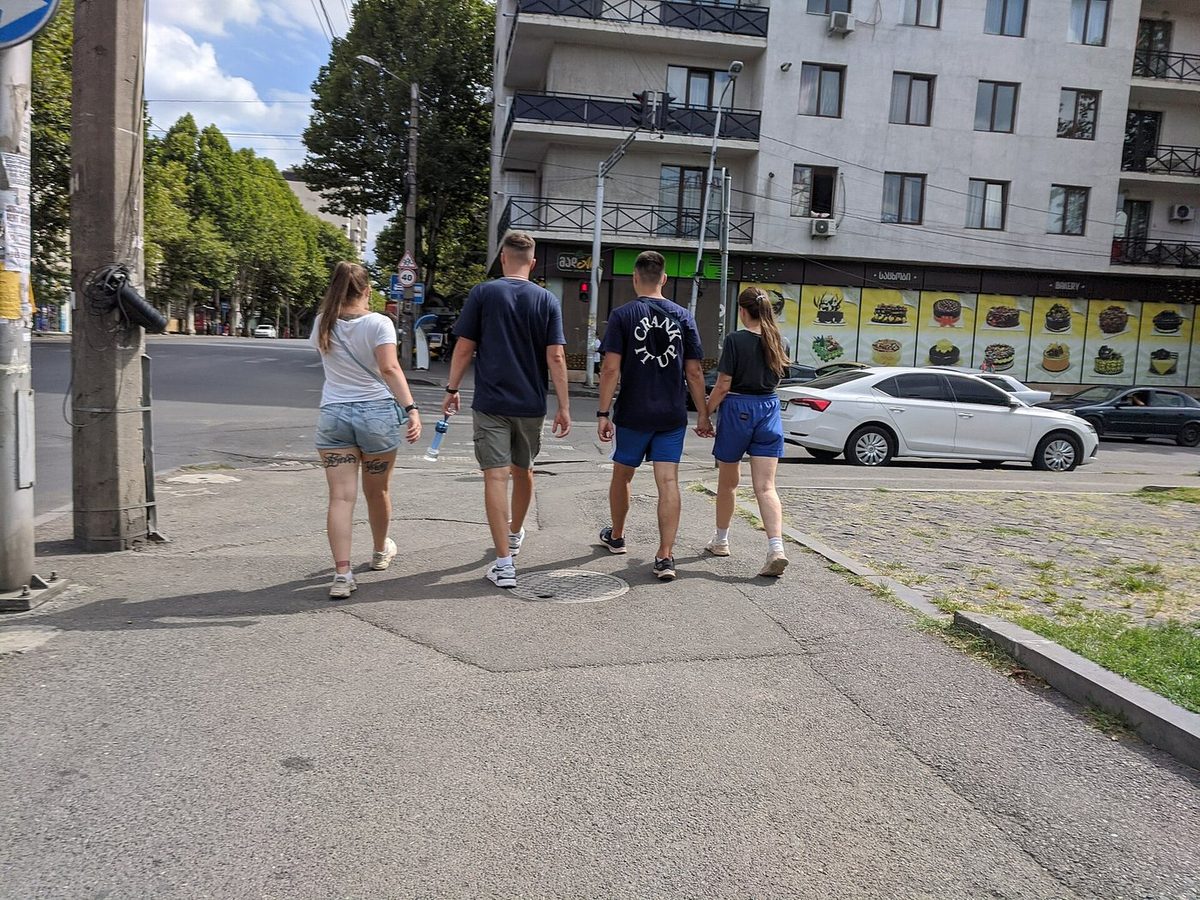
The arrival of large numbers of Russians since 2022 therefore produced a strange and uncomfortable situation. Many Georgians were sympathetic to Russians fleeing Putin's war; others were not. For Georgians, Russia isn't some distant geopolitical problem. Georgia experienced Russian military intervention in 2008, and Russian forces are still stationed in the breakaway territories.
The concern isn't necessarily that Russian migrants themselves are dangerous, as many are openly opposed to Putin and left Russia because they don't want to fight in Ukraine. The concern is what happens when a large Russian population develops inside a country that already has a history of conflict with Russia.
Fast-forward a few years. Russian communities would likely have grown, Russian businesses would be established, more Russians would own property, and the Russian language would undoubtedly be common in some areas. This could cause tensions between established residents and newcomers, as often happens when large populations move quickly into another country.
Then a Russian politician begins talking about discrimination. Perhaps a Russian-owned business is vandalised. Perhaps a Russian speaker is assaulted. Perhaps the host government passes restrictions involving property, residency, language, or political activity. None of those events alone would justify a Russian military response, but justification and propaganda aren't the same thing.
Russia wouldn't necessarily need to prove that Russians were being systematically persecuted. It would only need an event, or a series of events, that it could present to its own populace and to the outside world as evidence that Russians were being threatened in Georgia. That's where the irony becomes difficult to ignore.
Some of those Russians are likely living in Georgia because they fled Russia to avoid being forced to fight in Ukraine. Russians who leave to escape one Russian war could theoretically become part of the political narrative surrounding another.
Creating the future pressure point
There's no evidence Russia launched its war against Ukraine for the purpose of deliberately sending Russians fleeing into neighbouring countries, thereby creating future pretexts for invasion. That would be a conspiracy theory. The more plausible argument is that Russia has created this situation as an unintended consequence of its own policies.
The sequence is straightforward. Russia needs soldiers, and the possibility of mobilization creates fear among people who don't want to be sent to war. Some leave the country and settle in neighbouring countries. Their numbers change the demographics of the countries where they now live, creating political, economic, or cultural tensions. Russia now has a larger population outside its borders that it can describe as Russian citizens, Russian speakers, or Russian compatriots.
A future Russian government may never attempt to use that population for political purposes, but it most certainly could. Russia has already demonstrated that the existence of Russian populations outside its borders can become part of its justification for intervention. This possibility becomes more relevant if Russia conducts another large-scale mobilization.
As of August 2026, there's no official announcement of a new mass mobilization, but recent reporting indicates that Russian authorities have been conducting readiness planning for that possibility, while Ukrainian President Volodymyr Zelenskiy has said Ukraine believes Russia may draft an additional 300,000 troops after Russia's September 18–20 parliamentary elections. That remains an assessment from Kyiv, not a confirmed Russian mobilization plan. Still, just the possibility already has Russians lacing up their sneakers to do as many have done before: leave Russia before they can be drafted.
Russia has also learned from the 2022 exodus and has developed more sophisticated systems for identifying and contacting military-age males eligible for service. A future mobilization could therefore be conducted more gradually and in a way intended to reduce the mass panic that accompanied the announcement in September 2022.
If large numbers of Russians leave again, though, the broader pattern could continue. Russia's war could send yet more Russians into countries where complicated relationships with Moscow already exist.
Not every Russian abroad is a threat
Russian migrants aren't automatically supporters of Putin looking to infiltrate Russia's neighbours. They're not automatically agents of the Russian government. They're not responsible for the Kremlin's foreign policy simply because they speak Russian or hold Russian citizenship. Many of those who fled Russia did so because they opposed the war, feared political repression, or simply didn't wish to die in Ukraine.
The danger discussed here doesn't come from the migrants themselves, but from the possibility that a government can weaponise the existence of a population regardless of what that population desires. The Sudeten Germans didn't create Hitler's expansionist ambitions. The existence of Russian speakers in Crimea didn't create Putin's desire to take that region. The population may be real, but the grievances may be exaggerated, manipulated, or entirely made up.
The important question is who controls the narrative. Once a powerful state claims a special right to intervene on behalf of people living inside another sovereign country, the existence of those people can become strategically useful, and Russia's war is increasing the number of people who fit within its broad definition of "compatriots abroad."
The question Russia may eventually have to answer
Russia's war in Ukraine was supposed to strengthen Russia's security and expand its territory. Instead, it has expanded NATO, imposed enormous economic costs, produced massive military casualties, helped drive large numbers of Russians out of their own country, and has yet to prove it can permanently hold the land it has so far taken.
Some Russians will eventually return to their own country. Some will become permanent residents of other countries. Those who remain abroad will marry, start businesses, buy homes, raise children, and become part of the societies where they settled. That's normal. It's expected. But Russia isn't a normal case when it comes to the political significance of Russians living beyond Russia's borders.
Russia has repeatedly asserted an interest in the treatment of Russians and Russian compatriots outside the Russian Federation. It has also demonstrated that those claims can become part of a broader argument for political or military intervention. That creates an unusual geopolitical feedback loop.
Russia starts a war. The war causes Russians to leave. Their departure increases Russian communities outside Russia. Those communities could someday become the subject of Russian political pressure or propaganda.
The people fleeing one Russian war could, through no fault of their own, become pawns of the political landscape surrounding the next one. That doesn't mean another invasion is inevitable, nor does it mean every Russian community outside Russia is a future security threat to the country they're in, and it certainly doesn't mean Russia is deliberately exporting future excuses for war. But history suggests that powerful states have a long record of finding political uses for people who happen to share their ethnicity, language, or nationality beyond the state's borders.
Russia already has a doctrine in place and a history of claiming an interest in such populations. The uncomfortable question is whether anyone will notice the connection before Russia decides it's useful.
Comments
No comments yet. Be the first.
Comments are closed on this article.