Abstract
The liberal international order is widely held to be breaking apart, yet scholars disagree about what is breaking, when the breakdown began, and what will take its place. This article examines the principal answers to these three questions, drawn from Mearsheimer, Acharya, Druzin, Kissinger, and Altay, and argues that the order is in terminal decline but that its decline has neither a single cause nor a single date. The economic shifts of the 1970s opened the cracks, the financial crisis of 2008 widened them, and the political backlash of 2016 made the decline irreversible by turning the order's own architects against it. The transition will take decades, because no state holds both the power and the legitimacy needed to impose new rules. The present, in which great-power rivalry and regional pluralism coexist, offers evidence for the realist and the 'multiplex' forecasts at once. The world is living in an interregnum, and what comes next cannot yet be known.
Keywords: liberal international order; interregnum; multiplex world; multipolarity; legitimacy; great-power politics
Introduction
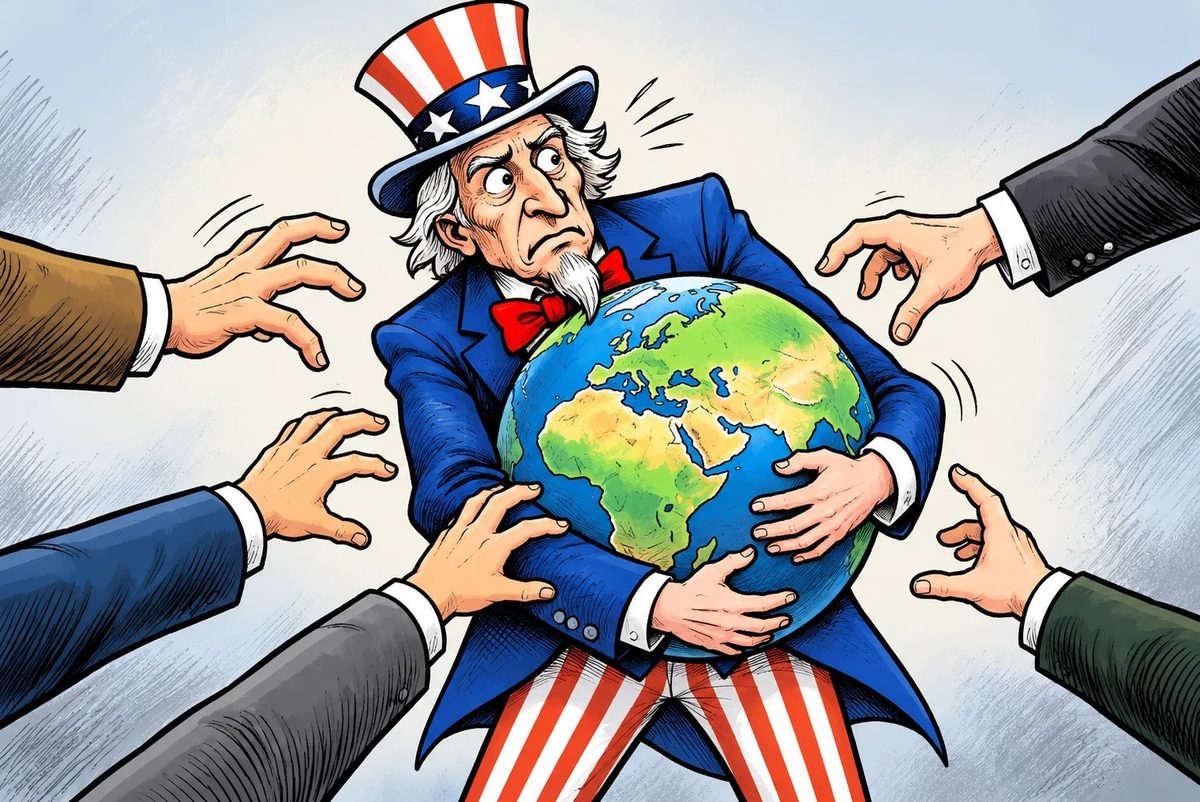
For more than seven decades the world has lived under a liberal international order: an open world economy, a system of multilateral institutions, a network of American alliances, and a set of rules presented as universal (Ikenberry, 2018). That order was built after the Second World War, and it has been breaking apart slowly ever since the certainties of the post-war settlement began to fade. Today the breaking is visible to everyone. What is not visible is what will replace it. The world is caught between two historical phases, one collapsing in front of our eyes and the other not yet formed, and nobody truly knows what the new order will be.
This article asks three questions. What does it mean to say that the liberal international order is breaking apart? When did the breakdown begin, and how long will the transition take? And, most importantly, what is emerging in its place? The questions matter for two reasons. Practically speaking, governments must decide now whether to prepare for a world of great-power rivalry or for a plural world of regions and shared rules, and the two preparations are different. Theoretically speaking, the answers test the competing schools of international relations, since realists, pluralists, and institutionalists each predicted a different ending and each now claims to see it.
I argue that the order is in terminal decline, but that its decline has neither a single cause nor a single date. The economic shifts of the 1970s opened the cracks, the financial crisis of 2008 widened them, and the political backlash of 2016 made the decline irreversible by turning the order's own architects against it. The transition will take decades, because no state holds both the power and the legitimacy needed to impose new rules. And the present offers evidence for both of the leading forecasts at once, the realist return of great-power politics and the pluralist 'multiplex world', which is why what comes next cannot yet be known. We are living in an interregnum.
In what follows I first examine what the principal scholars say is breaking, then compare their dating of the breakdown, then consider how long the transition is likely to last, and finally set the two leading forecasts of the future against the evidence of the present.
What Does It Mean to Say the Order Is Breaking Apart?
Scholars fundamentally disagree about what is breaking: American military dominance, the global institutions, or the Western ideas behind them. For realists such as Mearsheimer (2001, 2019) the order was never really about liberal values or cooperation. International politics is a ruthless, tragic competition for survival, and the 'order' was a mask for American military and economic power. Its breaking apart therefore means one thing: the United States is losing its unipolar dominance. As rising powers such as China gain wealth they do what great powers have always done, seeking to maximise their share of world power and to push the United States out of their region. In Mearsheimer's view the mask of peaceful cooperation is falling off, and what it reveals is raw power politics.
Acharya (2014, 2018) contradicts this purely military reading. The order that is ending, in his account, is not primarily a structure of American power but a Western monopoly on ideas and rule-making. For decades the West dictated the rules of sovereignty, security, and trade. The breakdown means that the 'Rest', and above all the post-colonial states of the Global South such as India and China, no longer accept those rules passively. They assert their own agency, bring their own historical concepts to the making of order, and demand a decentralised world (Acharya & Buzan, 2019).
Druzin (2023) locates the break in the institutions themselves. The IMF, the WTO, and the dollar system looked strong, he argues, because they were the 'only game in town'. States were locked in to the dollar and to Western institutions because no alternative existed, not because they believed in them. For Druzin the breaking apart of the order means that the monopoly now faces competition: states have discovered that they can escape the lock-in and bypass Western rules entirely.
A fourth reading treats the breakdown as a crisis of legitimacy. Kissinger (2014) holds that any stable order requires a balance of power paired with a shared moral consensus, and Altay reads the present crisis in the same terms. Power without consensus produces not order but contestation. On this view the liberal order is breaking because its claim to legitimacy is no longer shared by many of the states, and now by many of the publics, that live under it.
These four answers are not simply rivals. Each author watches a different force, military, ideational, institutional, or moral, and each sees that force failing. Read together they describe an order that is losing its power, its monopoly on ideas, its institutional lock-in, and its legitimacy at the same time. That is what it means to say the order is breaking apart.
When Did the Breakdown Begin?
The dating of the breakdown reveals how differently these authors weigh historical forces. Economic and critical accounts trace the beginning of the end to the crises of the 1970s, which ended the post-war 'embedded liberalism' that had reconciled open markets with domestic social protection (Ruggie, 1982). But the fatal blow, Altay argues, fell in 2008. The global financial crisis destroyed the credibility of the Western neoliberal model, and the Global South and the rising powers, China and Russia above all, turned toward state capitalism and economic nationalism, fracturing the global trading system from within.
Acharya pushes the timeline much further back. The breakdown, in his account, began immediately after the Second World War with decolonisation. When the states of Africa and Asia gained independence they tripled the membership of the international system and at once began to resist Western dominance. While the West believed it was building a universal order, the newly independent states were already building regional alternatives and rejecting superpower alliances, planting the seeds of the post-Western world we see today (Acharya & Buzan, 2019).
Mearsheimer disagrees with both the economic and the post-colonial timelines. Because he focuses on great-power dynamics alone, the breakdown for him begins much more recently, at the end of the unipolar moment. The collapse of the Soviet Union in 1991 gave the United States a brief window of absolute dominance. But the moment China's economy began to grow at a spectacular rate, in the late 1990s and the 2000s, transforming it into a potential peer competitor, the unipolar order was destined to end and great-power politics returned (Mearsheimer, 2001, 2019).
What we have seen most recently, however, is the trigger. The year 2016 marked the moment at which the core architects of the liberal order began to dismantle it themselves. The Brexit vote in the United Kingdom and the election of Donald Trump in the United States signalled a massive domestic backlash against globalisation. When the creator of the international institutions began withdrawing from treaties, launching trade wars, and pursuing an 'America First' nationalism that leaned toward isolation, the decline of the order became irreversible. Whether 2016 was a cause of the decline or, as Acharya (2017) argues, a consequence of deeper structural change, it removed the one power that might have defended the order.
How Long Will the Transition Take?
We are living in an interregnum, in Gramsci's (1971) sense: the old world is dying and the new one cannot yet be born. How long it will last nobody knows, but there are strong reasons to expect it to be long. The two great transitions of the twentieth century had dates. The post-war order was founded in 1945, and the Soviet order collapsed suddenly in 1991. The decline of American hegemony and the rise of a post-Western world is, by contrast, a gradual and grinding process. The United States remains the largest military and economic power in the world, and it will not collapse overnight like the Roman Empire. At the same time, the rising powers that might replace it are not ready. China and India face their own massive domestic challenges, and neither is in a position to take over global leadership.
The point is decisive. No single country has the overwhelming power, or the global legitimacy, needed to force a new set of rules on everyone else. Until one does, or until the major powers agree on rules among themselves, the world will remain in this chaotic and uncertain phase. That is likely to be the condition of international politics for the foreseeable future, and it may well last for decades.
What Comes Next?
The greatest fear is that the end of the liberal order will bring global chaos or a catastrophic third world war. The scholarship points to a more complex future, and it offers two very different pictures of it.
The first is Acharya's (2014) 'multiplex world', and it is hopeful. The future, in his account, is not a return to dark and violent power struggles. He compares it to a multiplex cinema: instead of one dominant American film on a single screen, many films, meaning many cultures, regions, and systems, play at the same time. Three features follow. No single power dominates, and the United States, China, India, the European Union, and others share the stage. Non-state actors hold real power, since multinational corporations, technology giants, non-governmental organisations, and even transnational networks such as hacker groups and terrorist organisations will shape the rules alongside governments (Nye, 2011). And regionalism replaces globalism: rather than relying on the United Nations or the WTO for every problem, African states turn to the African Union, and Asian states to ASEAN or the Shanghai Cooperation Organisation, to manage their own security and trade.
Realists see something darker. Without a hegemon, Mearsheimer (2001) argues, the world returns to 'unbalanced multipolarity', which history shows to be the most war-prone and deadly of all systems. As China rises it will seek aggressively to dominate Asia, and the United States will try aggressively to stop it; in a world of several great powers miscalculation is common, and the chance of a catastrophic great-power war rises sharply. The danger has a name, the 'Thucydides Trap' (Allison, 2017), and it was invoked by Xi Jinping himself during Donald Trump's visit to China in May 2026. Xi's message, as reported, was that China will rise, that conflict with the United States is possible, and that a peaceful transition of power is available only if the United States accepts China's rise (Davis, 2026; Farrow & Fishel, 2026; Stringer, 2026).
The Uncertainty of the Present
So when we say that the liberal international order is breaking apart, we mean that the era of Western-dictated universal rules and American monopoly is over. The system was weakened by the economic shifts of the 1970s, severely damaged by the financial crisis of 2008, and pushed into terminal decline by the political backlash of 2016. We cannot predict what will replace it. But we can face the reality of the present, and the present is the most uncertain period in modern history.
That uncertainty is unfolding in real time across the globe. Gaines (2022) finds, in a formal model of an attenuated liberal order, that when the order weakens and institutions lose their authority the costs of breaking the rules fall and the incidence of conflict rises. The evidence fits. The war between Russia and Ukraine is not a local border conflict but a proxy rivalry between the United States and Russia played out on the world stage. The trade and technological conflict between the United States and China shows, as Mearsheimer would predict, the tragic return of great-power politics in which states act out of fear and the desire for survival; and yet, as Acharya would predict, both countries continue to seek cooperation even as they compete. Both forecasts are visible in the same relationship.
The Middle East shows the collapse of legitimacy that Kissinger (2014) describes, where the United States, Iran, and Israel contest authority amid sectarian wars, proxy battles, and a dangerous vacuum of state power. From that instability comes the constant threat of a crisis in the Gulf and of an oil shock that could hold the global economy hostage. And the financial foundation of the order is, as Druzin (2023) warns, brittle. The United States carries a national debt in excess of US$36 trillion (U.S. Department of the Treasury, 2025), while rising powers build alternative payment systems through BRICS to bypass the dollar. These alternatives face difficulties of their own. But if the dollar were to lose its dominance, the global financial system could fracture entirely, and nations would scramble to survive the fallout.
Conclusion
What we are witnessing is a deeply uncertain period. The old rules of diplomacy, trade, and security no longer function, but the great powers have not agreed on a new and legitimate set of rules to replace them. The liberal international order is undeniably breaking apart; a new and stable system has not emerged; and the transition between them will take decades rather than years. Until the major powers find a way to forge a shared consensus, the world is condemned to an interregnum defined not by peace or cooperation but by the dangerous, unpredictable uncertainty of a world struggling to be reborn.
References
- Acharya, A. (2014). The end of American world order. Polity Press.
- Acharya, A. (2017). After liberal hegemony: The advent of a multiplex world order. Ethics & International Affairs, 31(3), 271–285. https://doi.org/10.1017/S089267941700020X
- Acharya, A. (2018). Constructing global order: Agency and change in world politics. Cambridge University Press.
- Acharya, A., & Buzan, B. (2019). The making of global international relations: Origins and evolution of IR at its centenary. Cambridge University Press.
- Allison, G. (2017). Destined for war: Can America and China escape Thucydides's Trap? Houghton Mifflin Harcourt.
- Altay, S. (n.d.).
- Davis, E. (2026, May 14). Trump blames Biden for US 'declining' after Xi comments on 'Thucydides Trap'. The Hill.
- Druzin, B. H. (2023). How to destroy the liberal international order. Duke Journal of Comparative & International Law, 34(1), 1–43.
- Farrow, F., & Fishel, J. (2026, May 15). Trump responds to Xi's 'Thucydides Trap' comment about America's decline. ABC News.
- Gaines, M. J. (2022). Whither the liberal international order? Does an attenuated liberal international order affect the propensity, incidence, and intensity of conflict? [Doctoral dissertation, Pardee RAND Graduate School]. RAND Corporation.
- Gramsci, A. (1971). Selections from the prison notebooks (Q. Hoare & G. Nowell Smith, Eds. & Trans.). International Publishers.
- Ikenberry, G. J. (2018). The end of liberal international order? International Affairs, 94(1), 7–23. https://doi.org/10.1093/ia/iix241
- Kissinger, H. (2014). World order. Penguin Press.
- Mearsheimer, J. J. (2001). The tragedy of great power politics. W. W. Norton.
- Mearsheimer, J. J. (2019). Bound to fail: The rise and fall of the liberal international order. International Security, 43(4), 7–50. https://doi.org/10.1162/isec_a_00342
- Nye, J. S., Jr. (2011). The future of power. PublicAffairs.
- Ruggie, J. G. (1982). International regimes, transactions, and change: Embedded liberalism in the postwar economic order. International Organization, 36(2), 379–415. https://doi.org/10.1017/S0020818300018993
- Stringer, C. (2026, May 15). How Trump lost control of the 'best summit ever'. The Telegraph.
- U.S. Department of the Treasury, Bureau of the Fiscal Service. (2025). Debt to the penny [Data set]. https://fiscaldata.treasury.gov/datasets/debt-to-the-penny/

Comments
No comments yet. Be the first.
Comments are closed on this article.