
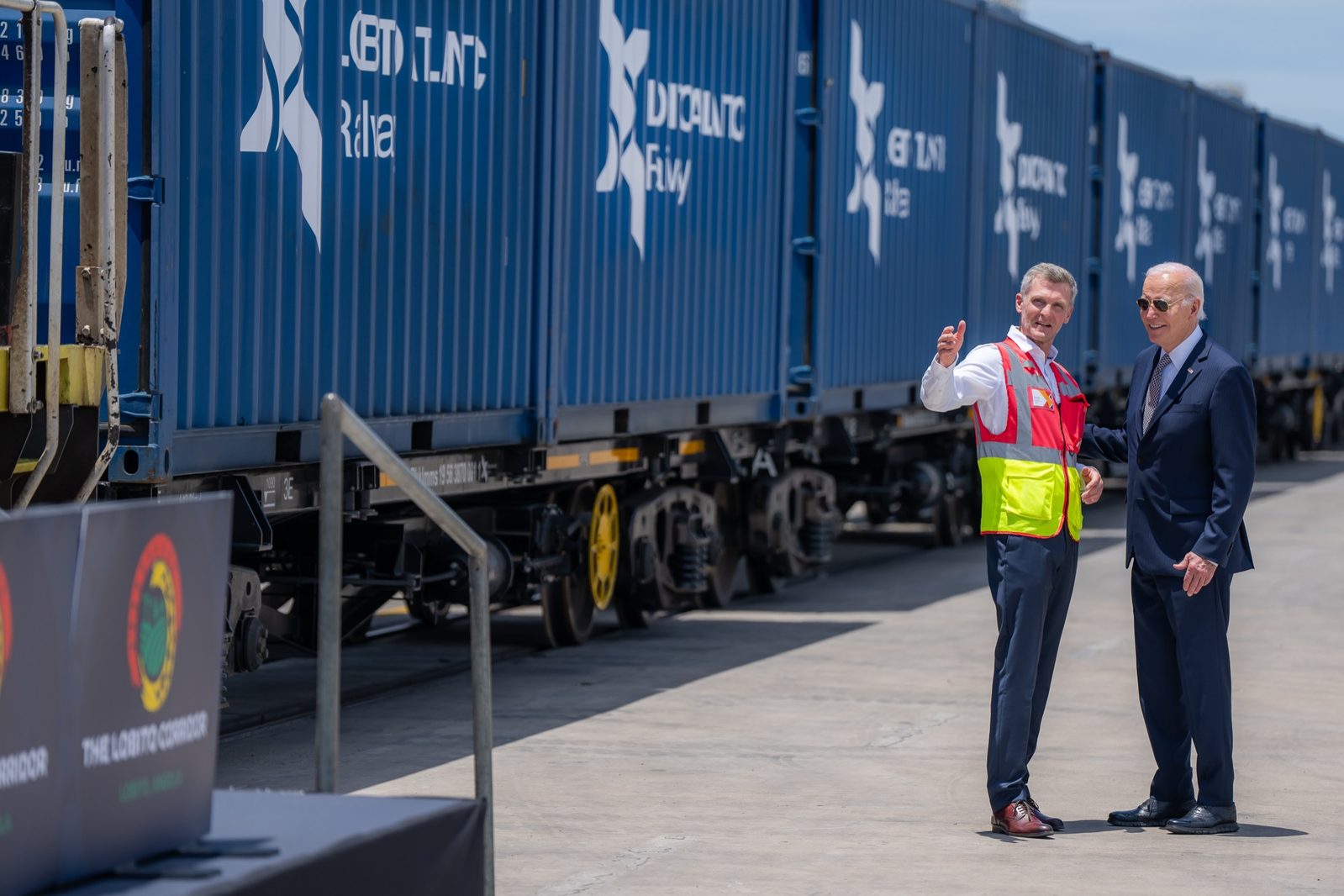
The Lobito Corridor is routinely described as Washington and Brussels' answer to China's Belt and Road Initiative in Africa, a Western funded alternative route for critical minerals that bypasses Chinese controlled infrastructure. Here, "Western-backed" refers to financing and strategic support from U.S., EU and allied institutions, while the corridor itself is implemented through African governments, regional development institutions such as the Africa Finance Corporation and the African Development Bank, and private operators. The physical core of that corridor tells a more specific story, one this analysis treats as an analytical distinction rather than a literal claim about current ownership. The 1,300 kilometer railway linking the port of Lobito on Angola's Atlantic coast to Luau on the border with the Democratic Republic of the Congo was reconstructed by China Railway Construction Corporation between 2006 and 2015, with financing that included at least a 300 million dollar China International Fund facility and a separate 362 million dollar China Eximbank loan, within a reported total project cost of approximately 1.83 billion dollars. What the United States, the European Union and regional development finance institutions have done since 2022 is take over the operating concession for that existing line through a consortium led by the commodity trader Trafigura, and finance its modernization, upgrading track, signaling and rolling stock rather than laying new rail. The genuinely new piece of infrastructure in this story, an 830 kilometer rail extension connecting Zambia's Copperbelt directly into the corridor, remains in pre-construction financing stages as of 2026, with financial close most recently targeted for the fourth quarter of 2027, later than the early 2026 construction start originally announced in December 2024. China, meanwhile, signed its own concession in September 2025, a 30 year, 1.4 billion dollar agreement to modernize the rival TAZARA mineral export corridor linking Zambia to the Tanzanian port of Dar es Salaam, with a Chinese state contractor already designated as operator. The more defensible version of this analysis, and the one this article argues, is narrower than the headline suggests: the early Western backed phase of the Lobito Corridor has relied less on constructing an alternative railway than on acquiring an operational role in, and financing the modernization of, a Chinese built railway, integrating it into a new Western backed critical minerals strategy.
Construction, Concession and Financing Are Not the Same Thing
Any assessment of who is winning an infrastructure competition needs to distinguish between several different things that get collapsed together in public commentary: who originally built an asset, who currently holds the legal concession to operate it, who is financing its modernization, and whether new physical construction is taking place at all. China Railway Construction Corporation rebuilt the Lobito-Luau line. The Angolan government awarded the operating concession in November 2022, for a term of 30 years, to the Lobito Atlantic Railway consortium of Trafigura, the Portuguese firm Mota-Engil and the Belgian operator Vecturis, a concession the consortium states on its own public materials was funded entirely by its shareholders rather than through government equity. The U.S. International Development Finance Corporation and South Africa's Development Bank of Southern Africa are financing a modernization of that same concession's infrastructure, not building a new line. Only the Zambia-Angola extension, still in pre-construction financing as of 2026, would constitute new rail construction under Western backed financing. Treating a concession award or a modernization loan as equivalent to building new infrastructure is the specific confusion this analysis aims to clear up.
The Financing Sequence
Western financial engagement accelerated from 2023. In October of that year, the United States and the European Union signed a memorandum of understanding with Angola, the Democratic Republic of the Congo and Zambia establishing the corridor as a joint strategic priority under the U.S. led Partnership for Global Infrastructure and Investment and the EU's Global Gateway initiative. A U.S. government fact sheet issued on December 3, 2024, alongside a presidential visit to Angola, announced over 560 million dollars in new U.S. funding and put cumulative U.S. investment in the corridor at more than 4 billion dollars, with total international investment, including G7 partners and regional development banks, exceeding 6 billion dollars. That figure spans transportation, agriculture, clean energy, critical minerals supply chains, health infrastructure and digital access projects across the broader corridor region, not a dedicated sum for building new rail. The railway specific financing arrived at a smaller scale relative to that headline figure: on December 17, 2025, the U.S. International Development Finance Corporation and the Development Bank of Southern Africa finalized 753 million dollars in financing, 553 million from DFC and 200 million from DBSA, explicitly designated for upgrading the existing Lobito Atlantic Railway's track infrastructure, workshops, signaling systems and rolling stock.
The mechanism connecting these figures to the thesis is straightforward. The more than 6 billion dollar headline commitment is a regional figure spanning multiple projects and years. The portion specifically tied to the railway, the 753 million dollar DFC and DBSA financing, is for rehabilitation and modernization of a line China's financing had already rebuilt. The first tangible operational result frequently cited as evidence the corridor is working, a shipment of Congolese copper that left Lobito for the United States in August 2024, moved over Chinese built infrastructure under newly Western financed management, not over any newly constructed Western alternative.
The Zambia-Angola Extension, and Its Timeline
The one element of the current Lobito Corridor plan that would constitute genuinely new rail construction is the roughly 830 kilometer extension connecting Lucano, Angola to Chingola in Zambia's Copperbelt. At the December 2024 summit, U.S. officials targeted a construction start in early 2026. By April 2026, reporting on the project's financing, including a 500 million dollar commitment from the Africa Finance Corporation, 500 million dollars from the African Development Bank and roughly 320 million dollars from Italy, described financial close as expected in the fourth quarter of 2027 and groundbreaking as planned for late 2026 or early 2027, with bidding for engineering and construction contracts still underway and construction not yet begun. Project estimates have placed the total cost at up to 5 billion dollars. This is the component of the Western initiative that cannot be described as modernizing existing Chinese infrastructure, since no comparable line exists on this specific route today. It is also the component that has slipped furthest from its own original public timeline, moving from an early 2026 construction start announced in December 2024 to a financial close not expected until late 2027.
China's parallel response to the competition over Copperbelt mineral-export routes has moved on a comparable or faster timeline for a project of similar ambition. In September 2025, China signed a 30 year, 1.4 billion dollar concession with Zambia and Tanzania for its state contractor, China Civil Engineering Construction Corporation, to finance, rehabilitate and operate the TAZARA railway, a 1,860 kilometer line connecting the same Zambian Copperbelt region to the Tanzanian port of Dar es Salaam on the Indian Ocean. TAZARA was itself originally built by China in the 1970s as a Cold War era development project, which means the 2025 agreement is also, in its own way, a modernization of a decades old Chinese built asset rather than wholly new construction. That parallel does not undermine the broader point. It sharpens it: both governments are substantially competing over control and modernization of rail infrastructure each originally built in an earlier era, and the specific new construction on the Western backed side, the Zambia-Angola extension, remains at an earlier stage of implementation than China's already contracted and operator assigned modernization of TAZARA.
Why the Distinction Matters
Taking over an operating concession on an existing line can be accomplished relatively quickly, as the 2022 to 2025 timeline for the Lobito Atlantic Railway concession and its financing demonstrates, and it produces an immediately visible result, a cargo shipment moving over an active railway, that can be presented as evidence of success regardless of how much new capacity it represents. Building genuinely new rail requires years of engineering, land acquisition and financing structuring regardless of which government or company attempts it, which is a plausible explanation for why the Zambia-Angola extension has fallen behind its own original timeline while the operational narrative built around the corridor's early shipments has continued to circulate. This means the early visible results of the Western backed corridor have come significantly from the operationalization of a modernization and concession deal layered onto infrastructure that already existed, while the structurally harder task of adding genuinely new capacity has, on the evidence available, proceeded no faster than China's own concurrent investment in modernizing its own older regional infrastructure.
What Evidence Would Change This Assessment
This analysis would be substantially weakened under several observable conditions. First, if the Zambia-Angola extension reaches financial close and enters construction substantially earlier than the currently projected 2027 timeline, that would indicate the Western side is accelerating past its own recent trajectory on genuinely new infrastructure. Second, if additional new rail or port capacity beyond this single extension is announced and funded specifically under the Lobito framework, rather than further financing layered onto the existing Lobito Atlantic Railway concession, that would show the pattern identified here is shifting toward new construction at greater scale. Third, if the share of Western financing specifically tied to new construction comes to exceed the share tied to operating concessions and modernization of pre-existing lines, that would reverse the pattern this analysis identifies. As of the most recent data available in 2026, none of these three conditions had clearly materialized, which is why describing the current phase of the Lobito Corridor as a contest over control and modernization of existing infrastructure, more than a race to build new infrastructure, best fits the available evidence.
Conclusion
The Lobito Corridor's core railway was rebuilt by Chinese financing and a Chinese state contractor between 2006 and 2015, nearly a decade before it became the centerpiece of a Western strategy to counter Chinese influence over African critical minerals. What the United States, the European Union and regional development banks have financed since 2022 is the operating concession and modernization of that existing line, a 753 million dollar upgrade layered onto Chinese built track, not a newly constructed alternative route. The one piece of the plan that would represent genuinely new rail capacity, the Zambia-Angola extension, has slipped from an early 2026 construction start to a financial close not expected before 2027, while China has already signed its own 30-year concession and named its designated operator to modernize the competing TAZARA corridor. The evidence points less to the construction of a new Western railway than to the reconfiguration of an existing Chinese built asset within a broader contest over control of Africa's mineral export corridors, rather than primarily a contest to build new physical infrastructure.
Comments
No comments yet. Be the first.
Comments are closed on this article.