
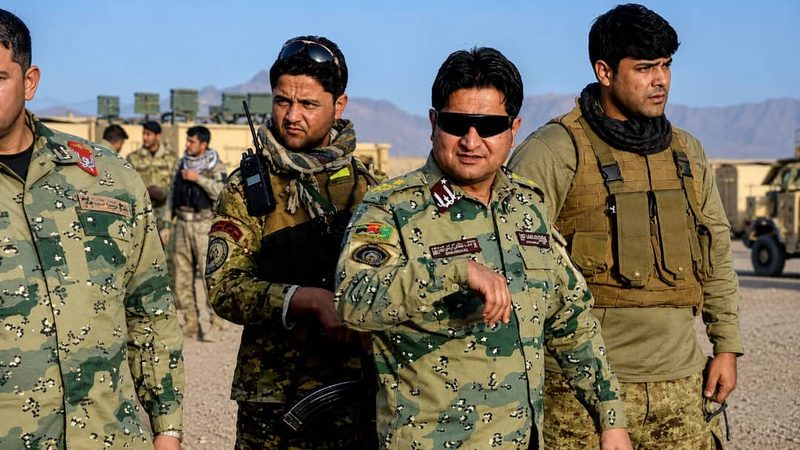
This analysis is drawn from the author's direct field experience as a police commander on Highway 517 in Farah, western Afghanistan, and was written originally in Dari. His own analytical terms are kept here in the original alongside the English, retained with their field meaning rather than translated away.
Part One
The highway as more than a security route
In late 2017, while serving in a command position within the Afghan National Public Order Police (ANP), I was responsible for security-related duties along Highway 517 in Farah Province and its surrounding areas. My experience on this route gradually led me to understand that highway security could not be assessed simply by counting patrols, checkpoints, or armed engagements.
A highway is not merely a line on a map. It is an economic and social connection between communities, markets, administrative centres, and essential services. When movement along such a route becomes unsafe, the consequences extend beyond the immediate security environment. Trade is disrupted, transport costs rise, access to services becomes more difficult, and ordinary people begin to organize their daily lives around fear and uncertainty.
During that period, insecurity along parts of the route had developed an economic dimension. Armed opposition groups were not relying exclusively on direct confrontation with government forces. They were also extracting money from commercial movement, transport activity, and traders. Illegal payments and extortion became part of the cost of moving goods. In practical terms, insecurity was being converted into an economic activity.
This distinction is important. Controlling a highway and securing an economic corridor are not necessarily the same thing. A force may maintain a physical presence along a road while traders remain exposed to illegal demands, movement remains uncertain, and the local economy continues to suffer.
The strategic question, therefore, is not simply whether a road is under government control. It is whether people can use it lawfully, safely, and with reasonable confidence.
The political economy of insecurity
The economic dimension of insecurity was visible in the pressure placed on traders and transporters. Illegal collections increased the cost of moving goods and created an additional burden for people whose livelihoods depended on regular movement along the route.
Based on my operational assessment at the time, I estimated that armed opposition groups were collecting approximately US$150,000 through illegal payments along the route. This figure was an operational calculation based on the information available to me during that period. It was not the result of a statistical study, an independently verified financial investigation, or a confirmed daily-income record. It should therefore be understood as an estimate from my field experience, not as an established financial statistic.
A considerable part of this activity took place at night. I believed that daytime collections could have increased the overall amount, but I did not have verified figures to establish that. The distinction between what I observed, what I estimated, and what I could not independently confirm is essential.
The broader point is that insecurity can create an informal system of economic extraction. When armed actors can influence movement, they can also influence the cost of trade, the choices available to transporters, and the economic life of communities. In such circumstances, the road becomes more than a physical route. It becomes a space in which different actors compete to exercise authority and extract resources.
This is where the political economy of insecurity meets the geopolitics of the field. Geography shapes movement; movement creates access; access influences economic activity; and the ability to regulate that activity becomes a form of power.
Situational judgement: understanding reality on the ground
One of the important lessons I drew from this experience was the need to make decisions according to the actual conditions on the ground rather than relying only on formal plans or assumptions.
I use the term situational judgement — in the original Dari, muḥākama-ye wazʿiyat (محاکمهٔ وضعیت) — to describe the continuous process of assessing the realities of an operational environment, understanding how conditions are changing, and correcting decisions when the evidence on the ground requires it.
A decision that appears reasonable on paper may not produce the intended result when applied to a different geographical, social, or security environment. Conditions change. Routes, local relationships, patterns of movement, and the behaviour of armed actors can all affect the outcome of an operation.
For this reason, situational judgement cannot be a one-time assessment. It requires continuous observation, comparison, and adjustment. The purpose is not simply to respond to an incident after it occurs, but to understand the conditions that make the incident possible and to assess how those conditions may change.
In my experience, effective security decisions require an understanding of the environment in which they will be implemented. A commander must consider not only the location of a threat but also the surrounding communities, the economic importance of the route, the patterns of civilian movement, and the likely consequences of a particular decision.
The area passport: knowing the environment before acting
This understanding led me to develop the concept of the area passport — in the original Dari, pāsport-e sāḥa (پاسپورت ساحه).
By area passport, I mean a living and continuously updated understanding of the operational environment. It is not simply a map, a collection of coordinates, or a security report. It is a practical body of knowledge about the area in which decisions are made.
It includes geography, roads, terrain, settlements, social relations, local culture, economic activity, patterns of movement, community needs, available capabilities, and the relationships that influence how the area functions.
A map may show the road, the distance between two locations, and the surrounding terrain. But it may not explain why people use one route rather than another, where commercial activity is concentrated, which communities depend on a particular crossing, or how local relationships affect movement and cooperation.
The area passport seeks to connect these dimensions. It helps decision-makers understand not only where they are operating, but also how the environment works and why certain conditions matter.
Without this understanding, an operational plan may address the visible security problem while overlooking the economic, social, or geographical conditions that sustain it.
The concept is therefore closely connected to situational judgement. The area passport provides the knowledge required to understand the environment; situational judgement applies that knowledge to decisions and adjusts those decisions as the environment changes.
Institutional challenges and accountability
The security environment was not shaped only by armed opposition activity. Weaknesses within parts of the government security structure also affected public confidence and the ability of institutions to perform their responsibilities.
Corruption and the misuse of official authority could undermine the very purpose of a security presence. When personnel entrusted with protecting movement become involved in unlawful practices, the distinction between public authority and private extraction becomes blurred.
Within the limits of my authority, I took measures against individuals and groups suspected of involvement in such practices and referred relevant matters to the central authorities. These actions were part of an effort to address misconduct within the security structure. They should not be understood as evidence that corruption was eliminated or that the wider institutional problem was resolved.
A security institution cannot build public confidence through its physical presence alone. Its personnel must act lawfully, its authority must be accountable, and its conduct must support the public purpose for which the institution exists.
The experience along Highway 517 reinforced a central lesson for me: security is not simply the ability to deploy personnel or exercise force. It is also the ability to establish lawful conditions in which people can move, work, trade, and live without being subjected to arbitrary pressure.
Part Two
From security presence to public outcomes
The purpose of improving security along Highway 517 was not simply to increase the presence of security forces. The broader objective was to reduce illegal collections and corruption, facilitate lawful movement, and strengthen public confidence in the institutions responsible for protecting the route.
These objectives were connected, but they were not identical. Reducing illegal payments did not automatically resolve every security problem. Improving movement did not mean that insecurity had permanently disappeared. I do not claim that the entire route was made permanently secure. Such a conclusion would go beyond what my experience and available information can establish.
What mattered was the relationship between security measures and their practical consequences for people. A road becomes more useful when traders can move goods with fewer unlawful demands, transporters can plan their journeys with greater confidence, and communities can maintain access to markets and essential services.
This is the point at which security must be assessed through public outcomes rather than institutional activity alone. The number of patrols or checkpoints may describe what a security force has done, but it does not necessarily explain whether ordinary people have experienced a meaningful improvement in their daily lives.
The more important questions concern lawful movement, transport costs, access to services, economic opportunity, and public confidence.
Humanitarian assistance and the social dimension of security
The security environment along the route was also connected to humanitarian and development activities.
The World Food Programme (WFP) provided humanitarian assistance in the area several times a year. The role of the police in this process was primarily related to security coordination and the facilitation of safe distribution. Local residents also participated in the distribution process and received wages for their work.
This distinction is important. The police were not the institution responsible for financing or delivering the humanitarian programme. Their responsibility was to help create the security conditions under which the relevant organizations and local participants could carry out their work.
The experience demonstrated that security institutions operate within a wider social environment. Their responsibilities may intersect with humanitarian activities, local economic needs, and the practical requirements of communities.
The National Solidarity Programme (NSP) was also active in the area. Infrastructure and local development activities, including bridge-related projects, formed part of wider efforts to improve connectivity and community conditions. Specialized institutions were responsible for implementing and financing these programmes. The security role was to facilitate their activities and help maintain the conditions necessary for implementation.
These examples illustrate an important distinction: security can create conditions for humanitarian assistance and development, but it does not replace the institutions responsible for delivering them.
A secure route may enable a development project to proceed. A functioning bridge may improve access between communities. Humanitarian assistance may reduce immediate hardship. Yet the long-term value of these activities depends on coordination, institutional responsibility, local participation, and continuity.
Security should therefore be understood as an enabling condition within a broader system of public life, not as a substitute for that system.
Dominant resources and subordinate points
My field experience also encouraged me to examine the geographical and functional relationships that influence the movement and organization of an area.
In developing this analysis, I use two working concepts: dominant resources (manābeʿ-e ḥākem, منابع حاکم) and subordinate points (noqāṭ-e maḥkūm, نقاط محکوم). These are analytical terms I have been developing through field-informed observation. I do not present them as established concepts belonging to a recognized academic school or as a universally validated model.
By dominant resources, I mean locations, capacities, or resources that significantly influence movement, access, connectivity, and the functioning of an area. Their importance does not necessarily depend on their physical size. A road junction, bridge, market, administrative centre, or strategically located settlement may have an influence that extends beyond its immediate geographical boundaries.
By subordinate points, I mean locations or communities whose functioning depends more heavily on access to particular routes, resources, or dominant locations. They may be more exposed to pressure because they have fewer alternatives and less ability to determine the conditions affecting their movement and daily activities.
The relationship between these two categories is not necessarily permanent. Changes in infrastructure, security conditions, economic activity, or patterns of movement may alter the importance of a location. A point that once depended heavily on a particular route may gain alternative access. A location that appears geographically secondary may become more important when surrounding conditions change.
The purpose of these concepts is to examine how geography, resources, movement, and dependency interact. They can help explain why the strategic importance of a location cannot always be understood through distance or physical size alone.
In the context of Highway 517, the relevant question was not simply where the road passed. It was how different locations and communities depended on the route, what resources and connections influenced movement, and which points had the greatest capacity to affect the functioning of the wider area.
This perspective expands the analysis from the physical control of territory to the practical organization of access and dependence.
From field observation to strategic understanding
The experience of Highway 517 contributed to a wider analytical approach that I continue to develop. It begins with the field, but it does not end there.
The sequence can be expressed as: field → observation → experience → analysis → principle → doctrine → strategy → practice → outcome → feedback.
Each stage has a distinct purpose. The field provides the environment in which events and decisions take place. Observation identifies what is happening and how conditions are changing. Experience helps interpret those observations through practical involvement. Analysis examines relationships, causes, consequences, and uncertainties.
From that analysis, principles may be identified. Principles can contribute to the development of doctrine, while doctrine can inform strategic choices. Strategy must then be translated into practice. The results of that practice must be assessed through outcomes, and those outcomes must generate feedback for further adjustment.
This sequence is not intended to suggest that every experience automatically produces a valid doctrine or that every operational lesson can be applied in another environment without modification. Conditions differ, and a principle that proves useful in one geographical or institutional setting may require adjustment elsewhere.
The value of the process lies in maintaining a continuous relationship between experience, analysis, decision-making, and the consequences of action.
Highway 517 was not only a security responsibility. It was also an environment in which the relationship between geography, economic activity, institutional authority, and public confidence could be observed in practical terms. The experience reinforced my view that strategic understanding must remain connected to the realities it seeks to explain.
Restoring the state’s economic and social authority
The experience of Highway 517 in Farah taught me that the security of an economic corridor cannot be measured only by the presence of armed personnel or the absence of visible confrontation.
A road may appear controlled while illegal economic practices continue. Security forces may operate along a route while communities remain uncertain about their ability to move freely. Development projects may exist on paper but face practical obstacles when access, coordination, and institutional responsibility are weak.
The real measure of public authority is found in the conditions people experience in their daily lives. Can traders move goods without unlawful payments? Can transporters use the road with reasonable confidence? Can communities reach markets, health facilities, and administrative services? Can humanitarian organizations operate safely? Can public institutions exercise authority lawfully and remain accountable for their conduct?
These questions connect security to the wider responsibilities of the state. The state does not establish meaningful authority simply by occupying territory or maintaining a physical presence. Its authority becomes more credible when people can experience its practical value through lawful movement, functioning services, economic opportunity, institutional accountability, and public trust.
For me, the central lesson is that securing a highway is not the same as securing the life that depends on it. The strategic purpose must extend beyond the road itself to the people, communities, and economic relationships connected through it.
This is why the analysis of Highway 517 moves from the political economy of insecurity toward the geopolitics of the field. It examines how geography shapes movement, how movement influences economic activity, how economic relationships affect power, and how public institutions can restore their authority through lawful and meaningful performance.
The field provides the starting point. Analysis helps explain what the field reveals. Strategy must then respond to those realities, and its results must remain open to assessment and correction. Ultimately, the success of security should not be judged only by what institutions control, but by what people are able to do safely, lawfully, and with dignity.

Comments
No comments yet. Be the first.
Comments are closed on this article.