
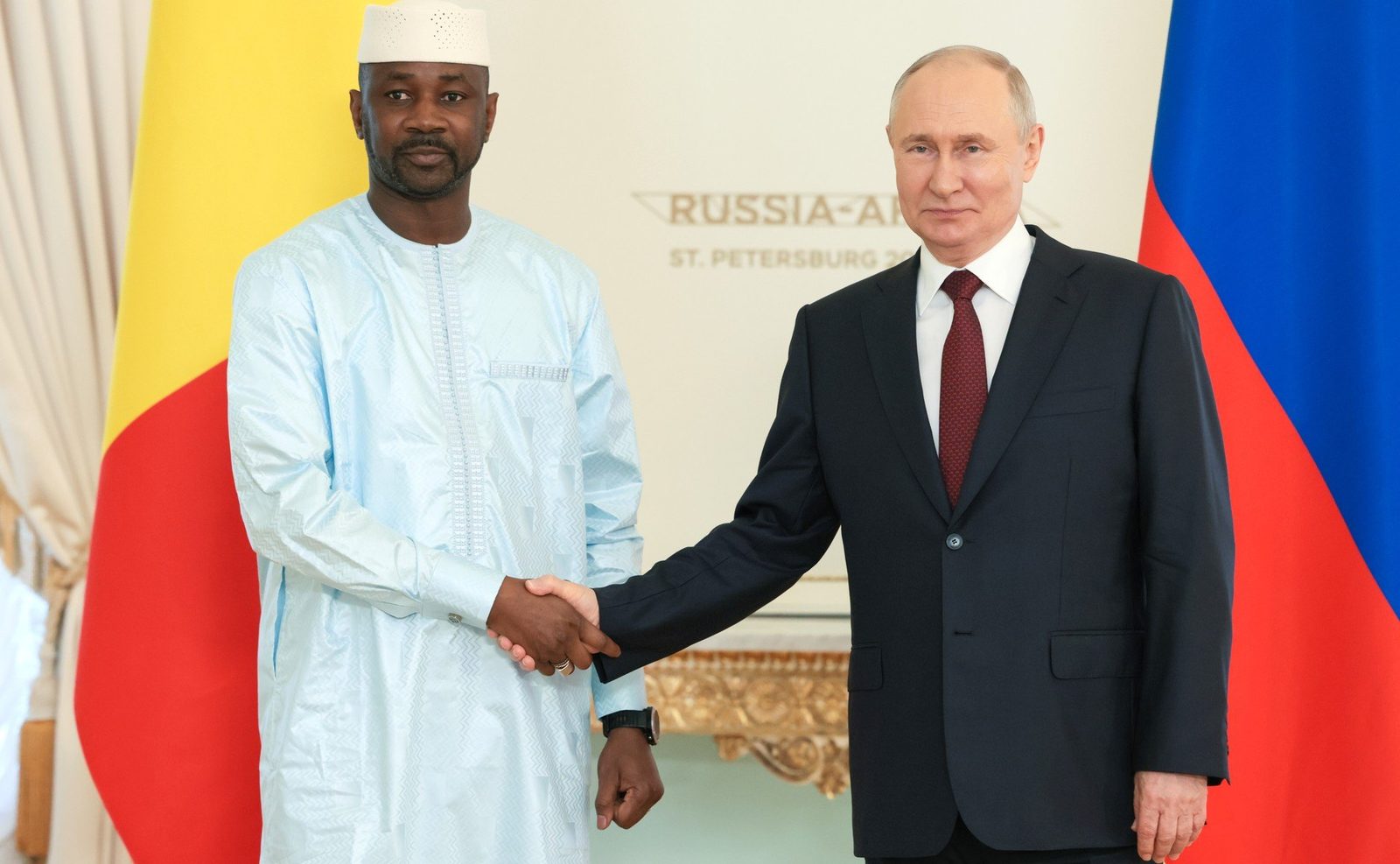
Between March 2022 and December 2023, military governments in Mali, Burkina Faso and Niger forced the complete withdrawal of French troops, ending more than a decade of direct French security involvement in the central Sahel. Mali's junta demanded French withdrawal on February 18, 2022, the day after Paris announced it would leave, and the last French troops left Mali on August 15 of that year, ending a deployment that had numbered roughly 5,000 across the Sahel at its peak. Burkina Faso's government terminated its military accord with France in January 2023, with French forces completing their departure the following month. Niger's case was the most abrupt: after the July 2023 coup, the junta gave France's ambassador 48 hours to leave on August 25, and the final French troops departed on December 22, 2023. The governments that forced this sequence framed it as a recovery of sovereignty. This analysis argues a narrower and more analytical claim about Mali, Burkina Faso and Niger specifically, not a literal description of how any formal agreement was structured: that France's regional presence functioned as a multi-layered system in which security cooperation coexisted with development finance, monetary integration and access to Western diplomatic and financial networks, and that when the security layer was severed, the other layers were not replaced symmetrically by the same new partners. Security capability was substituted far more readily than development finance, monetary architecture or institutional access, and that uneven substitution, not a simple story of France being swapped for Russia, is what the available data show.
What France's Presence Actually Involved
France's military role in the Sahel, formalized through Operation Serval in 2013 and its successor Operation Barkhane from 2014, coexisted with separate but institutionally linked channels of French engagement. The Agence Française de Développement extended concessional financing and grants to Mali, Burkina Faso and Niger across the Barkhane period, and AFD's own country pages describe its Sahel engagement as one that explicitly linked security and development objectives. AFD suspended new financing commitments to Mali in November 2022, to Niger in July 2023 and to Burkina Faso in August 2023, in each case following the respective political rupture with Paris, according to AFD's own public reporting. The West African CFA franc, used by all three countries, is pegged to the euro under a French convertibility guarantee operated through the regional BCEAO and WAEMU institutional architecture (the requirement to hold reserves at the French Treasury was abolished in the 2019 to 2021 reform), not through a bilateral French mechanism specific to any one country. This arrangement gives these economies a degree of monetary predictability that insulates against certain currency risks: the IMF's 2025 Article IV consultation on Mali noted that around 30 percent of the country's external debt, denominated in euros, carries no corresponding foreign exchange risk precisely because of the CFA franc's euro peg. These are three distinct institutional channels, security cooperation, development finance and monetary architecture, that operated alongside each other rather than through a single French contract, and understanding what was and was not replaced after 2022 requires tracking each one separately.
The Timeline of Withdrawal and the Security Replacement
Russia's Wagner Group arrived in Mali on December 19, 2021, before the French withdrawal had even begun, landing via a Tupolev TU-154 transport aircraft that flew from Moscow through Syria and Libya, according to tracking by the Center for Strategic and International Studies. Initial deployments were small, visible mainly through a new camp constructed near Bamako's airport, but subsequent reporting cited by CSIS and other trackers put deployments at roughly 200 mercenaries in Ségou within weeks, growing toward broader estimates in the 1,000 to 2,000 range by 2023 and 2024. Following the August 2023 death of Wagner's founder in a plane crash, Russia's Ministry of Defence moved to formalize direct state control over the group's African operations, creating "Africa Corps" as an explicitly state run successor. By June 2025, Wagner's remaining personnel in Mali had been folded into this structure, with roughly 2,000 Russian personnel estimated to remain in the country, alongside smaller Africa Corps deployments estimated at 100 to 300 in Niger and around 300 in Burkina Faso.
In February 2024, Wagner and Malian forces briefly seized the Intahaka artisanal gold mining area in northern Mali, levying fees before withdrawing days later, an episode documented by multiple independent trackers. A World Gold Council report published in November 2024 cited an estimate that Wagner had earned more than 2.5 billion dollars since the start of Russia's war in Ukraine through illegal gold mining, a figure first compiled by the Blood Gold Report covering Sudan, Mali and the Central African Republic, without isolating a Mali specific amount within that total, and without documenting the precise financial terms between Wagner and Malian authorities at Intahaka specifically. The episode is best read cautiously, as illustrating a different economic model of security provision, in which access to extractive assets can form part of the broader economic relationship between a foreign security actor and local authorities, rather than as proof of a specific, documented payment contract substituting resource access for cash.
Turkey supplied the second major piece of replacement security capability. Mali received its first Bayraktar TB2 armed drones in December 2022, fitted with Turkish sensors rather than the Canadian built optics that Ottawa had barred from export to Turkey in 2020, according to specialist defense reporting. Burkina Faso commissioned its own Bayraktar TB2 fleet into service during 2023. Unlike the Wagner arrangement, these were discrete commercial transactions rather than embedded troop deployments, giving the purchasing government direct operational control over a narrowly defined capability, aerial surveillance and strike capacity, without the political entanglement of hosting foreign ground forces. The distinction matters for the thesis: these governments were not purchasing a new France. They were purchasing separable components, combat personnel from one supplier, strike technology from another, each a discrete transaction rather than a renewed version of the old bundle.
What Was Not Replaced, and What the Numbers Show
AFD's suspension of new financing in Mali, Niger and Burkina Faso removed a channel whose scale, while not fully quantifiable here in a single before and after figure, is evidenced by the suspension's character: each was announced by the French foreign ministry as a political decision, within days of Niger's coup, three months after the last troops left Mali, and in Burkina Faso's case after Ouagadougou backed the Niger junta, rather than as a gradual drawdown. This analysis finds no evidence of Russia establishing a development finance mechanism in these three countries through a clearly documented replacement channel of comparable institutional scope, nor of China scaling its continental development financing into the security dominated central Sahel at a comparable institutional scope, the pattern seen elsewhere in Africa. Mali's own economic indicators since the rupture show real GDP growth of 4.5 percent in 2023 and 4.7 percent in 2024 according to the World Bank's April 2026 Macro Poverty Outlook, which also estimates that growth slowed to 4.1 percent in 2025 as a jihadist fuel blockade choked supply corridors, with net foreign direct investment inflows equivalent to roughly 2.1 to 2.2 percent of GDP in 2023 and 2024. These figures show an economy that continued to function despite the rupture, but they do not identify a replacement investment channel equivalent to the French development finance relationship.
The CFA franc arrangement has remained in place despite the political rupture with Paris, even as the Alliance of Sahel States, the alliance Mali, Burkina Faso and Niger formed in September 2023 and converted into a confederation in July 2024, has increasingly questioned other dimensions of their inherited regional arrangements, including discussion of a common currency outside the CFA zone that has not yet materialized into a concrete alternative. On the institutional access dimension, the picture is more mixed than a simple isolation narrative would suggest: the three governments faced ECOWAS sanctions and African Union suspension after their coups, quit ECOWAS outright on January 29, 2025, and in December 2025 chartered their own confederal investment bank, yet the World Bank launched a new Country Partnership Framework for Burkina Faso, Chad, Mali and Niger covering 2026 to 2031, indicating that multilateral engagement, while altered, has not been severed entirely. Neither Russia nor Turkey, however, has sought or gained the institutional standing within the IMF, the World Bank or the G7 dominated donor community that would let either substitute for the specific kind of access and leverage France's advocacy had provided within those institutions.
The Mechanism Connecting Uneven Substitution to Outcomes
If substituting the security layer alone were sufficient to restore stability, the expectation would be an improving security trajectory following the consolidation of Wagner, then Africa Corps, and Turkish drone capability across 2023 and 2024. The Global Terrorism Index's 2025 edition found instead that the Sahel accounted for 51 percent of global terrorism related deaths in 2024, up from 48 percent in 2023, the same two years in which these security substitutes were consolidating their roles. This does not establish that uneven substitution caused the deterioration, since the insurgencies were already escalating before the French withdrawal and France's own decade of military engagement had not reversed that trend either, and the Global Terrorism Index itself attributes the region's violence to a broader set of factors including state fragility and local political dynamics. What the rising share does provide is a consistency test rather than proof: it does not offer evidence that a narrower, security only substitution had solved the underlying problem, which is the more defensible and more precisely scoped claim available from this data.
What Would Prove This Wrong
This analysis would be substantially weakened under several observable conditions. First, if Russia or another new security partner begins providing development financing or budgetary support to Mali, Burkina Faso or Niger at a scale approaching what AFD previously extended, that would indicate the layered relationship is being reconstituted rather than unevenly replaced. Second, if the Sahel's share of global terrorism deaths falls decisively below half, which the 2026 edition, covering 2025, did not yet show even as absolute deaths in the region declined, that would suggest the narrower security substitution is succeeding on its own terms. Third, if the Alliance of Sahel States successfully launches a concrete alternative monetary or financial mechanism that measurably reduces reliance on the CFA franc and WAEMU architecture, that would show the monetary layer is being actively replaced rather than remaining in place by continuity. As of the most recent data available, the World Bank's renewed engagement through its 2026-2031 Country Partnership Framework suggests multilateral access has not been severed outright, which is itself a reason for caution before describing any of these three governments as fully isolated from the system France's presence once helped connect them to.
Conclusion
Mali, Burkina Faso and Niger did not replace France with a single new partner offering an equivalent combination of security cooperation, development finance and institutional access. They substituted the most visible and immediately substitutable layer, military capability, with combat personnel from Russia's Wagner Group, absorbed in 2025 into the state controlled Africa Corps, and with Turkish drone technology, while France's development finance channel was suspended by Paris after each political rupture and has not been replaced through a clearly documented channel of comparable institutional scope. The CFA franc arrangement has remained in place through continuity rather than active replacement, even as the Alliance of Sahel States debates alternatives that have not yet materialized, and multilateral institutional access, while diminished, persists through mechanisms such as the World Bank's renewed 2026-2031 framework. The Sahel's share of global terrorism deaths rose from 48 to 51 percent between 2023 and 2024, a pattern consistent with, though not proof of, the expectation that substituting one layer of a multi-layered relationship would not by itself resolve a conflict whose drivers extend well beyond security alone.
Editor's note, 3 October 2026: the security substitution this article describes has itself been tested since it was written. In April 2026 a joint offensive by JNIM and Azawad separatists killed Mali's defence minister, Sadio Camara, and forced Africa Corps and Malian units out of Kidal and other northern bases, while a jihadist fuel blockade from late 2025 cut Mali's growth. Russia's 2025 agreements with Bamako on nuclear power, a gold refinery and lithium are commercial and extractive rather than concessional finance. Neither development alters the article's argument; both bear on its first and second tests.
Comments
No comments yet. Be the first.
Comments are closed on this article.