
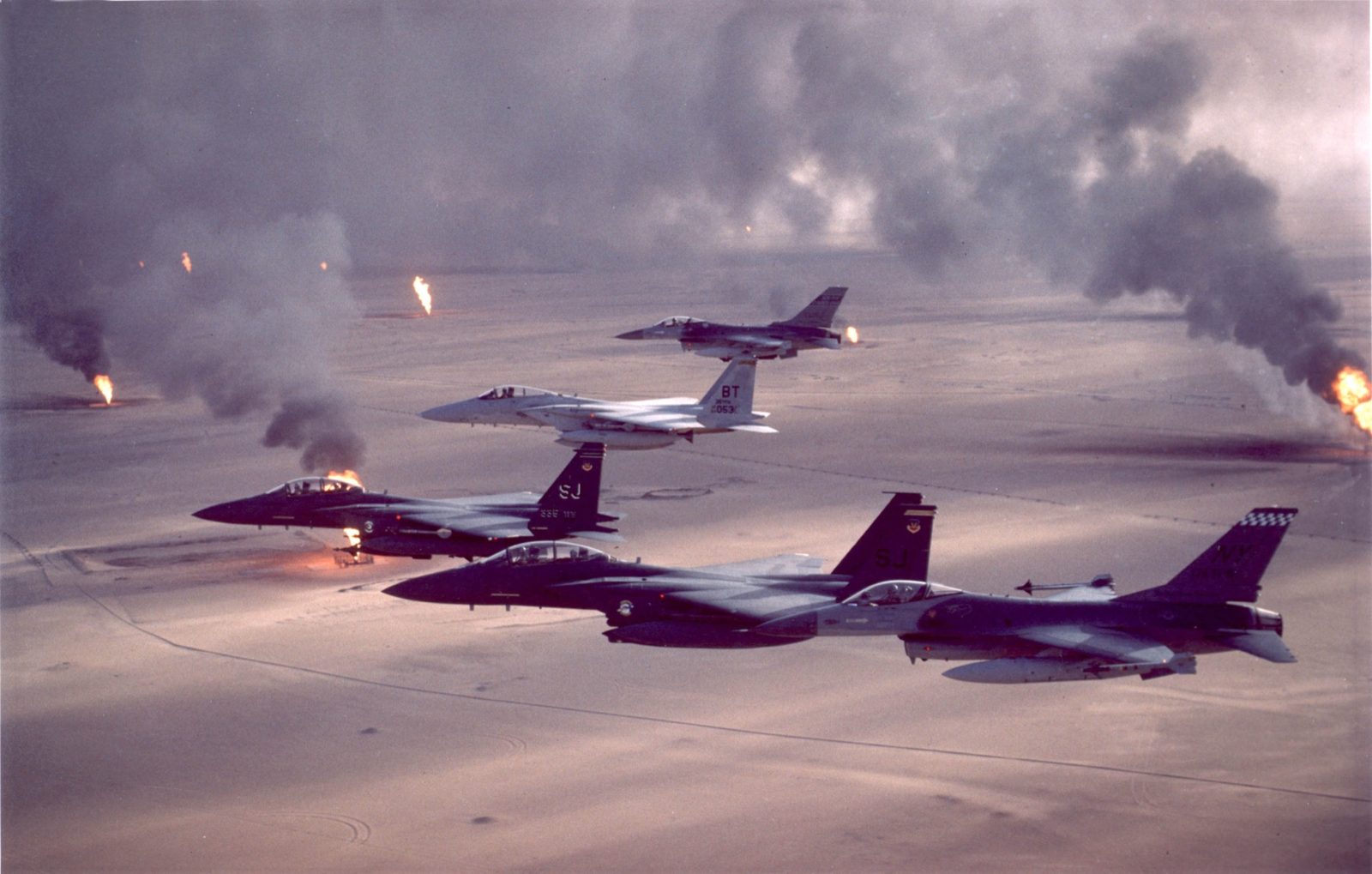
The United States won two wars in the Gulf with striking military ease — the first in 1991, the second in 2003 — and lost the peace after both. The story usually told in America runs from a tyrant's aggression to a liberation and, later, to a hunt for weapons of mass destruction. The more useful story is the one about consequences: how each battlefield victory set loose political forces that the people who ordered the fighting did not foresee, and how a straight line can be drawn from the deployment of American troops to Saudi Arabia in 1990 to the attacks of 11 September 2001 and the invasion of Iraq that followed.
Saddam's calculus: the road to Kuwait
Iraq emerged from its eight-year war with Iran — fought from September 1980 to a ceasefire in August 1988 — victorious in name and ruined in fact. Baghdad owed tens of billions of dollars, much of it to the Gulf monarchies that had bankrolled its war, including large loans from Kuwait that Kuwait declined to forgive. When oil prices then fell, Saddam Hussein blamed Kuwait and the United Arab Emirates for producing beyond their OPEC quotas and driving the price down, costing Iraq revenue it could not spare. He accused Kuwait of drawing oil from the shared Rumaila field and revived an old claim that Kuwait was rightfully a province of Iraq.
These grievances were real, and they were also a pretext. Convinced that Kuwait's policies threatened Iraq's survival and that a weakened Iraq would be left exposed after the Cold War, Saddam ordered the invasion on 2 August 1990. His army overran Kuwait in a day. In the United States, almost none of this context reached the public. Once Kuwait fell, American coverage reduced a tangle of debt, oil politics and regional fear to a single figure of a uniquely evil villain, and leaders in both Bush administrations reinforced the image by likening Saddam to Hitler. That framing made Iraq's stated motives easy to dismiss as nothing more than excuses for aggression.
Manufacturing consent
The campaign to move American opinion toward war was, in part, paid for. The exiled Kuwaiti government and wealthy Kuwaitis financed a lobbying and public-relations effort through a front group called Citizens for a Free Kuwait, which retained the public-relations firm Hill & Knowlton in one of the largest foreign-influence operations ever run in the United States. Its most notorious product was the testimony of a 15-year-old girl identified only as "Nayirah", who told a congressional caucus in October 1990 that she had watched Iraqi soldiers pull babies from hospital incubators and leave them to die. The story was false and the witness coached; she was, in fact, the daughter of Kuwait's ambassador to Washington, a connection not disclosed at the time.
Historians still debate how much the campaign mattered. Most conclude that it shaped the climate for war rather than causing it — the United States had strategic and economic reasons of its own to reverse the seizure of Kuwait. But as a documented exercise in manufacturing a mood, it has few rivals, and it is a reminder of how little of the decision to go to war was settled by the public that was asked to support it.
Sayyid Qutb and the intellectual roots of the backlash
Decades earlier, an Egyptian writer named Sayyid Qutb spent two years in the United States. He came away repelled — by what he saw as a materialist, spiritually hollow culture, by racial segregation, and by American support for the new state of Israel. In the books he wrote afterward, above all Milestones, he argued that modern society, America's included, had fallen back into jahiliyya, the state of ignorance Islam was meant to have ended, and he called for a vanguard to confront it. Qutb was executed by the Egyptian government in 1966, but his writing outlived him to become a foundational text of militant Islamism, shaping a generation of jihadist thinkers. His brother Muhammad Qutb carried the ideas to Saudi Arabia, where a young Osama bin Laden is said to have attended his lectures. The point is not that one book produced al-Qaeda, but that a coherent ideology was already in circulation, waiting for a grievance it could attach itself to.
The grievance that fuelled al-Qaeda
That grievance arrived with the American army. To Muslims, Saudi Arabia is uniquely sacred: it holds Mecca, the birthplace of the Prophet Muhammad and the site of the Kaaba toward which Muslims pray, and Medina, where he is buried. When Saddam's forces massed on the Saudi border in 1990, the kingdom chose to invite in a US-led force that eventually numbered around half a million troops. Bin Laden, newly returned from the war against the Soviets in Afghanistan, had offered to defend the kingdom with his own Arab veterans; the royal family heard him out and refused, turning instead to the Americans. He took the presence of non-Muslim soldiers in the Land of the Two Holy Mosques as a desecration and a humiliation, and it became the central grievance around which he built al-Qaeda.
It is worth being precise about how such movements recruit. The common American assumption is that religion is the driver. The better evidence is that violent extremism — always a crime, and responsible for immense suffering — feeds on political humiliation, alienation and the wreckage of war and occupation; the ideology supplies belonging and a story that turns private resentment into a cause. Bin Laden's rage at the deployment, not a verse of scripture, is what set him on the path to the bombing of the USS Cole in 2000 and the attacks of September 2001.
The Soviet lesson America failed to learn
Through the 1990s al-Qaeda took shelter in Afghanistan under the Taliban, each sustaining the other: the Taliban gave sanctuary, al-Qaeda gave money and fighters. After September 2001 the United States went in to destroy both, confident that its campaign would look nothing like the Soviet disaster of the 1980s — that superior technology, a lighter footprint and Afghan goodwill would spare it the quagmire that had helped break the USSR. Instead it inherited the same geography, the same insurgency with sanctuary across the Pakistani border, and the same slow realisation that a stable Afghan state could not be built by force. Twenty years on, the United States withdrew and the Taliban returned to power, an ending that echoed the Soviet exit more closely than Washington had ever meant it to.
The case for war that wasn't there
After September 2001 the Bush administration spoke of Iraq and al-Qaeda in the same breath so often that many Americans came to assume a connection the intelligence agencies never found. Polling in 2003 captured the result: a majority believed Iraq had given substantial support to al-Qaeda, and in some surveys close to seven in ten thought Saddam had probably been personally involved in 9/11 — this despite the later finding of the 9/11 Commission that there was "no credible evidence" of operational cooperation between Baghdad and al-Qaeda. Saddam, a secular dictator, regarded jihadist movements as a threat to his own rule.
The weapons case was no sturdier. Iraq had indeed built and used chemical weapons in the 1980s, but UN inspectors had dismantled its programmes after 1991. When inspectors returned before the 2003 invasion, Hans Blix and Mohamed ElBaradei told the Security Council they had found no active weapons programmes and asked for more time to finish the job. Washington chose war instead. Much of the "intelligence" pointing the other way came from Iraqi exiles with an interest in the outcome: Ahmed Chalabi's Iraqi National Congress fed Western agencies dramatic and unreliable claims, and a defector codenamed "Curveball," Rafid Ahmed Alwan al-Janabi, invented the story of mobile biological-weapons laboratories that became a centrepiece of the American case. He admitted in 2011 that he had lied in the hope of toppling Saddam. Neither man ever faced consequences; Chalabi returned to Iraqi politics and died in 2015.
There was a jihadist presence in Iraq before the war, but not one Saddam controlled: Abu Musab al-Zarqawi operated with the group Ansar al-Islam in the Kurdish north, beyond Baghdad's writ. And the much-cited "terrorist training camp" at Salman Pak, with its airliner fuselage, turned out on post-war investigation to have no connection to al-Qaeda. The building blocks of the case for war, examined one by one, were hollow.
Why Iraq? Powell, Cheney and an unanswered question
The public face of that case was Secretary of State Colin Powell, who laid it out before the UN Security Council in February 2003. Much of what he presented had been questioned in advance by his own department's intelligence bureau, and much of it proved, in his own later words, "inaccurate and wrong and in some cases deliberately misleading." Powell called the speech a lasting blot on his record.
Behind the push stood Vice-President Dick Cheney, who more than anyone framed Iraq as the next front in the war on terror, pressed the agencies for worst-case readings, and championed the WMD claims that did not survive contact with the evidence. Once a congressional deficit hawk, he became the most forceful advocate for a war financed largely by borrowing. Why he pushed so hard has never been fully explained. Oil is the usual answer, yet the United States spent far more fighting in Iraq than Iraqi oil was ever worth. Halliburton is another: Cheney had run the company, and its subsidiary later won billions in no-bid reconstruction contracts — though official inquiries found no proof that he shaped policy to benefit it. He maintained to the end that he had believed Iraq held the weapons. Perhaps that was the whole of it. With the principals now gone, any fuller account of the motive may never be settled.
The cost of strategic miscalculation
The lesson of these three wars lies in the gap between winning on the battlefield and achieving anything durable afterward. The 1991 campaign showed what overwhelming force and clear objectives could do; it also left the regional tensions that produced the next decade untouched. By 2003 the regime in Baghdad fell in weeks, and then the trouble began. The Iraq Survey Group confirmed in 2004 that there were no stockpiles and no active programmes — the stated reason for the war had not existed. What followed was years of insurgency and sectarian war, at least 200,000 Iraqi civilians dead and roughly 4,600 American troops, a bill well above two trillion dollars, and, out of the chaos, the movement that became ISIS.
The honest question is not only "what were we told?" but "which assumptions guided the war, and what did they fail to foresee?" In a democracy the public is asked to consent to the use of force, and it can only consent well if it is told the truth. On the road from Kuwait to Baghdad, it mostly was not — and the consequences are still being paid.
Sources
- Britannica, Persian Gulf War — the invasion of Kuwait, its causes and the 1991 coalition campaign.
- Wikipedia, Citizens for a Free Kuwait and the Nayirah testimony — the Hill & Knowlton campaign and the incubator story.
- National Commission on Terrorist Attacks, The 9/11 Commission Report — Qutb's influence, bin Laden's opposition to the US deployment, and the origins of al-Qaeda.
- CBS News, 9/11 panel: No al-Qaeda–Iraq link — "no credible evidence" of operational cooperation.
- The Christian Science Monitor, The impact of Bush linking 9/11 and Iraq — public misperceptions about Iraq's role in 9/11.
- NPR, Curveball admits he lied about Iraq's WMD — the fabricated mobile-weapons-lab claim.
- Al Jazeera, "Blot" on Powell's record — the UN speech and the State Department's prior doubts.
- Arms Control Association, Duelfer disproves US WMD claims — the Iraq Survey Group's finding of no stockpiles.
- Costs of War, Brown University, Human cost of the post-9/11 wars — casualty and cost estimates.


Comments
No comments yet. Be the first.
Comments are closed on this article.