
Wars are often launched in the language of national security but eventually become crises of economic sustainability, political legitimacy, and human survival. The ongoing US-Israeli war against Iran is another example of how military superiority can coexist with economic vulnerability. What began as a confrontation over strategic and security objectives has evolved into a global economic shock, threatening energy markets, international trade, and the livelihoods of millions.
The fundamental question is no longer simply who will win the war. It is who will pay for it, who will suffer from it, and who will benefit from the destruction.
America’s Expensive Strategic Gamble
The financial burden on the United States is growing. A Pentagon estimate reported by the Associated Press on October 28 placed the cost of the Iran war at approximately $47.1 billion as of October 16, 2026. The estimate included around $29 billion for replacing munitions, $11.9 billion for military operations, and $6 billion for equipment losses. It excluded damage to American military bases.
The administration is also seeking a further $95 billion funding package for the Iran war and other priorities, adding to concerns about the opportunity cost of prolonged military expenditure.
Every dollar spent on warfare represents a dollar unavailable for alternative priorities, including healthcare, education, infrastructure, scientific research, and debt reduction. The economic consequences become more serious when military operations continue without a clearly defined political settlement.
The historical experience of Vietnam, Iraq, and Afghanistan demonstrates that military victories do not automatically produce political stability. Iran presents an even more complicated challenge because of its geography, regional influence, population, and ability to disrupt global energy transportation.
The United States may possess overwhelming military capabilities, but it cannot escape the economic consequences of a prolonged confrontation.
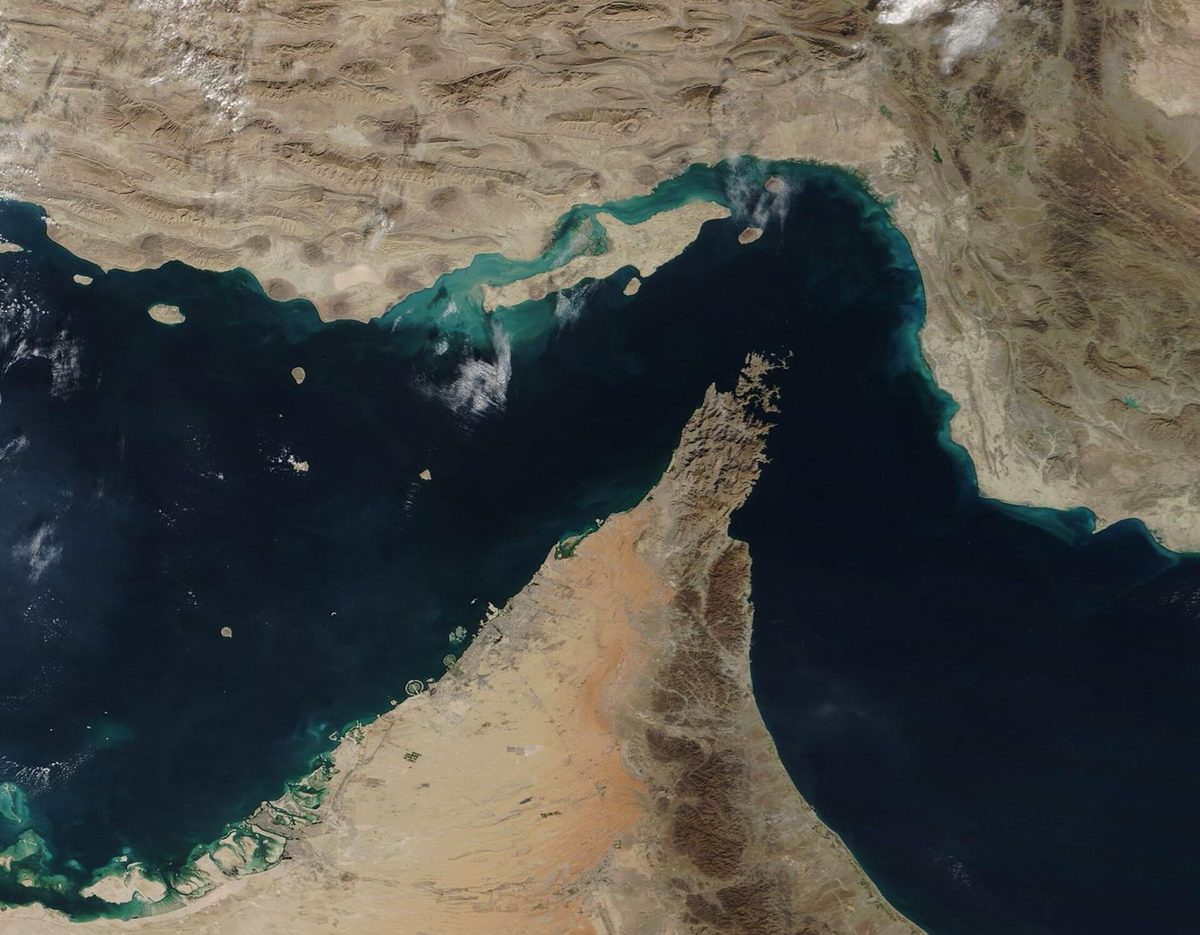
The Strait of Hormuz: A Global Economic Chokepoint
The most significant economic consequence of the Iran war is its disruption of the global energy system.
The Strait of Hormuz is among the world's most important maritime chokepoints. Before the conflict, approximately 20 million barrels of oil and petroleum products passed through it daily, representing roughly one-fifth of global consumption.
Its disruption has produced an extraordinary shock to international energy markets.
The International Monetary Fund describes the conflict as a global but asymmetric economic shock: energy-importing countries, poorer economies, and countries with limited financial reserves are particularly vulnerable.
Higher energy prices increase transportation costs, manufacturing expenses, electricity tariffs, and food prices. Shipping insurance becomes more expensive, supply chains are disrupted, and investors become more cautious.
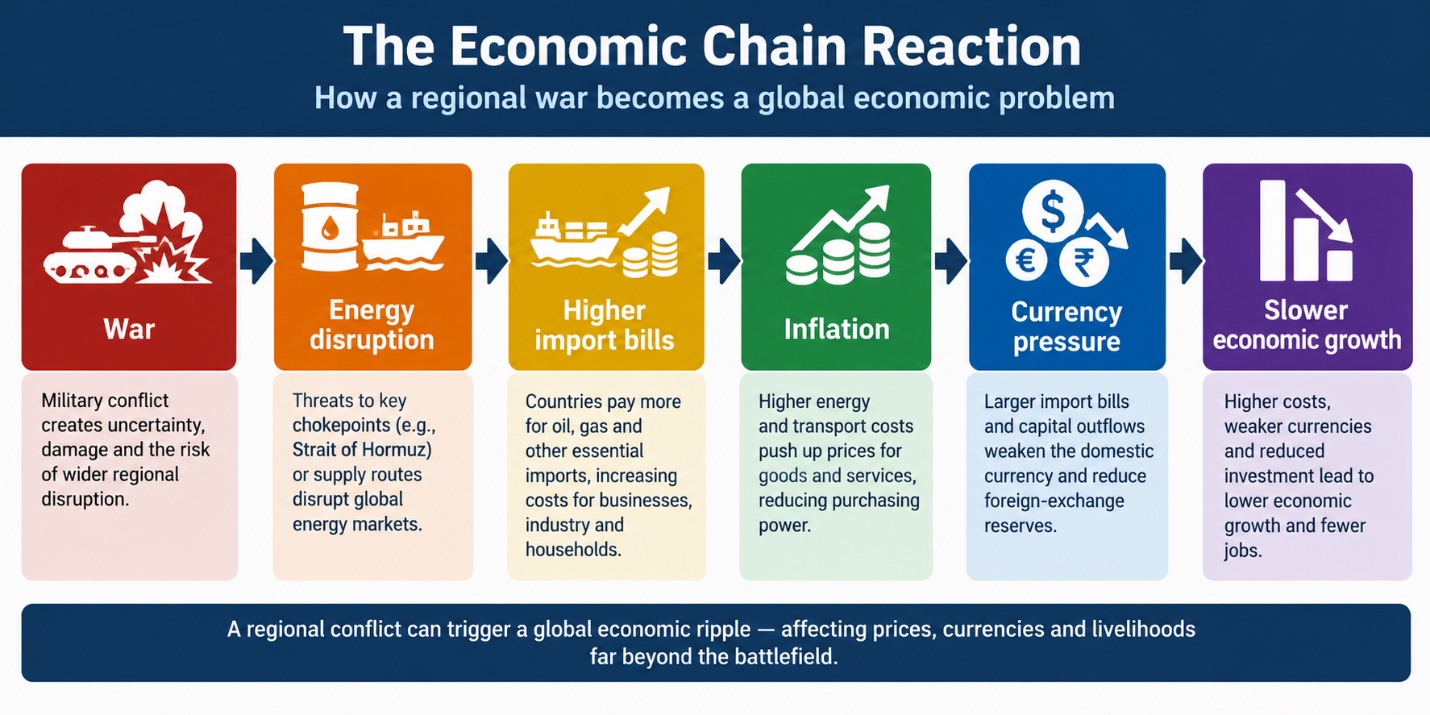
The economic chain reaction is straightforward:
War → Energy disruption → Higher import bills → Inflation → Currency pressure → Slower economic growth.
The consequences extend far beyond the Middle East.
Who Pays the Economic Price?
Europe, China, India, and developing economies face substantial exposure to higher energy prices.
Europe confronts renewed energy vulnerability, with higher oil and gas prices threatening industrial competitiveness and household purchasing power.
China faces higher production and transportation costs, although its energy reserves, diversified supply arrangements, and expanding renewable-energy capacity provide important buffers.
India faces a particularly difficult challenge because of its dependence on imported petroleum. Higher oil prices increase its import bill, weaken external balances, and potentially put pressure on the rupee.
The developing world faces the most severe relative consequences.
Countries with limited foreign-exchange reserves, high public debt, and weak currencies have fewer resources to absorb an external shock. Governments must choose between increasing fuel prices, subsidizing consumers, reducing development expenditure, or borrowing more.
The IMF has warned that poorer countries are particularly exposed because food and energy represent a larger share of household expenditure.
Pakistan is especially vulnerable. Higher petroleum prices increase its import bill, put pressure on foreign-exchange reserves, and potentially worsen inflation. Transportation, agriculture, electricity generation, and industrial production all depend on affordable energy.
Pakistan does not need to participate militarily in the conflict to suffer its consequences. For an economy already facing structural challenges, regional stability is an economic necessity.
Who Benefits From the War?
War does not distribute economic gains and losses equally.
Some energy exporters may benefit from higher prices, provided they retain the capacity to transport and sell their oil and gas.
Saudi Arabia, Oman, and the United Arab Emirates possess alternative export routes that may provide some protection against disruptions in the Strait of Hormuz. However, the benefits vary considerably according to export capacity and infrastructure.
The United States energy industry may also benefit from higher global prices, particularly producers with sufficient production and export capacity. Yet higher energy prices simultaneously impose costs on American consumers.
Defense contractors represent another potential beneficiary. Prolonged warfare increases demand for ammunition, missile interceptors, aircraft maintenance, surveillance systems, and military equipment.
This creates a troubling economic contradiction: taxpayers finance military expenditure, while certain companies benefit from procurement contracts.
Russia may also gain from higher energy prices and the diversion of American strategic attention. China, meanwhile, faces energy-related economic costs but may gain diplomatic opportunities if Washington becomes increasingly committed to another Middle Eastern conflict.
These benefits are neither universal nor guaranteed. The destruction of regional stability can impose economic costs even on countries that initially benefit from higher commodity prices.
The Social and Political Cost
The economic statistics conceal a deeper human tragedy.
Iranian civilians face destruction, displacement, economic hardship, and uncertainty. American military personnel face casualties and psychological trauma. Families across the Gulf confront the threat of attacks, disrupted services, and rising living costs.
The social consequences include damaged hospitals, interrupted education, reduced employment opportunities, and deteriorating household welfare.
In Iran, the economic crisis is already affecting ordinary citizens. Reuters reported on October 28 that Iranians were cutting essential spending and postponing major life decisions as the war-hit economy deteriorated.
For the United States, the political consequences may become increasingly significant. Rising energy prices, military casualties, and growing public expenditure can intensify domestic political polarization.
The war also creates strategic overextension. American military resources, intelligence capabilities, and diplomatic attention must be divided across multiple geopolitical commitments.
A prolonged conflict may therefore weaken the very strategic position it was intended to strengthen.
The Real Question: What Constitutes Victory?
Military success, strategic success, and political success are not identical.
A military campaign may destroy infrastructure and degrade an adversary's capabilities. However, if the outcome is a destabilized Gulf, higher global energy prices, increased American debt, and unresolved political tensions, the long-term strategic benefits may be limited.
The central challenge is to establish a sustainable political settlement addressing nuclear concerns, regional security, freedom of navigation, sanctions, and the legitimate interests of all parties.
Without such a framework, temporary ceasefires may simply postpone another confrontation.
The Iran war demonstrates that military power cannot eliminate economic interdependence. The United States may possess the world's most powerful military, but its taxpayers, consumers, and allies remain exposed to the consequences of prolonged warfare.
The greatest victims are often those with the least influence over the decisions that produce war: ordinary citizens, low-income households, small businesses, and developing economies.
Ultimately, the question is not merely who wins the war. It is whether the world emerges more secure, more prosperous, and more politically stable—or whether another generation inherits the consequences of a conflict whose costs were underestimated and whose political objectives remained unresolved.
The greatest victory would not be the destruction of an adversary. It would be the prevention of another war.
Sources: Associated Press: Iran war’s cost to American taxpayers grows to an estimated $47.1 billion (28 October 2026) · IMF: How the War in the Middle East Is Affecting Energy, Trade, and Finance (30 March 2026) · IMF: The Oil Market Absorbed the War Shock, but Buffers Are Running Low (15 July 2026) · Reuters: Iranians Cut Essentials and Put Dreams on Hold as War-Hit Economy Bites (28 October 2026).

Comments
No comments yet. Be the first.
Comments are closed on this article.