
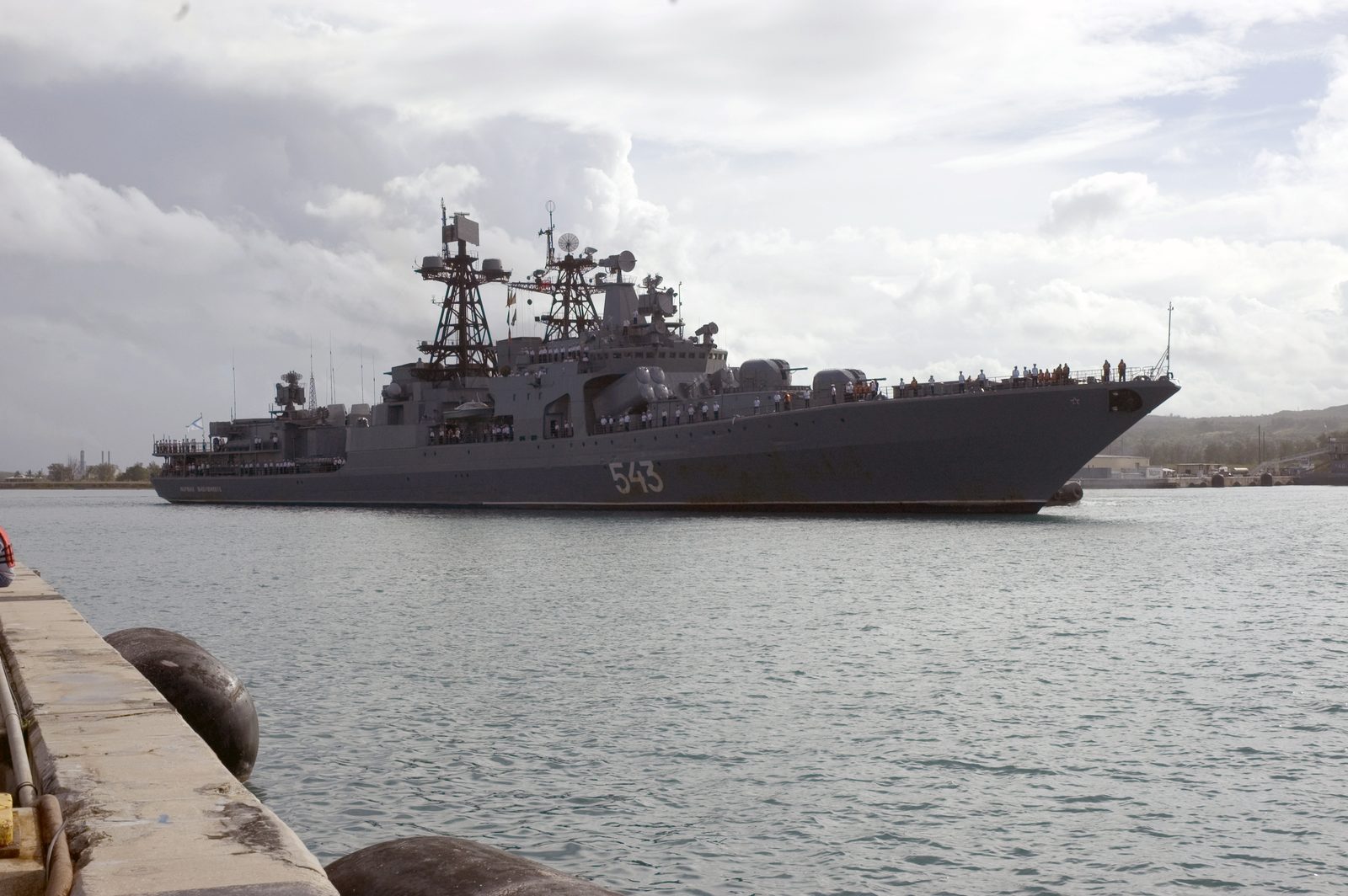
Between September 30 and October 4, 2026, three Russian Pacific Fleet vessels—the frigate Marshal Shaposhnikov, the destroyer Admiral Tributs, and the tanker Pechenga—docked at Tanjung Priok, Jakarta. The visit’s agenda included professional exchanges between the two navies, cultural activities, introductions to naval traditions, and an Open Ship Day for the public on October 2. Russia described the visit as an effort to strengthen friendship with Indonesia. However, in international relations, defense diplomacy can also open up opportunities for broader economic dialogue.
Following the Jakarta visit and joint maritime exercises with the Indonesian Navy, the Russian group of vessels was scheduled to depart for Malaysia. However, the sources I found have not confirmed the date of arrival or the port they would visit in Malaysia. Meanwhile, on September 12, 2026, the Russian training ship Perekop departed Cambodia’s Sihanoukville Port after a two-day visit. However, this vessel was different from the three ships that visited Jakarta.
Considering the route of the visits, destination countries, and joint military exercise agendas, the Russian warships’ visits to Southeast Asia were not merely defense-related activities. Amid changes in the global economic order, maritime diplomacy can serve as a gateway to expanding trade, energy, investment, and industrial cooperation.
Uneven Economic Cooperation
Economic relations between ASEAN and Russia are not new. Russia has been an ASEAN dialogue partner since 1996. According to ASEAN statistics, bilateral trade reached US$18.13 billion in 2024, an increase of 13.2 percent from US$16.01 billion in 2023. However, Russian foreign direct investment (FDI) flows into ASEAN amounted to only around US$65.17 million in 2024, a decline of 66.9 percent from the previous year. In 2025, bilateral trade in goods was recorded at approximately US$17.8 billion, according to preliminary ASEAN statistics.
The composition of trade reveals both opportunities and limitations. Russia supplies mineral fuels, fertilizers, iron and steel, as well as various metal products. ASEAN countries export palm oil and other vegetable oils, electronic products, machinery, rubber, and food commodities. The ASEAN Statistical Yearbook 2023, for example, recorded ASEAN imports from Russia in 2022 that included US$5.2 billion in mineral fuels and US$1.52 billion in fertilizers. In the same year, ASEAN exports of animal and vegetable oils and fats to Russia reached approximately US$994.5 million. This means the relationship has an economic foundation, particularly in energy, food security, and industrial needs. However, substantial trade does not automatically translate into productive investment, technology transfer, or extensive job creation in Southeast Asia.
Why Is Russia Moving Closer to ASEAN?
For Russia, strengthening ties with ASEAN opens up market opportunities beyond its traditional partners, particularly as sanctions and geopolitical tensions affect some of its economic relations with Western countries. Southeast Asia offers a large consumer market, demand for energy and fertilizers, and production networks connected to global trade.
For ASEAN, cooperation with Russia could broaden its choice of suppliers of energy, fertilizers, raw materials, and certain technologies. Indonesia, for example, could explore opportunities to export palm oil and its derivatives while ensuring the availability of industrial and agricultural inputs.
However, these opportunities come with risks. Cross-border payment costs, shipping insurance, sanctions compliance, and logistical uncertainty can reduce the profitability of trade. Therefore, warship diplomacy needs to be followed by business discussions, trade agreements, and payment mechanisms that comply with international law.
Is ASEAN Becoming a Battleground for Three Powers?
Economic competition among China, the United States, and Russia provides a broader context for this visit. However, the three countries do not carry equal economic weight in ASEAN.
In 2024, ASEAN–China merchandise trade reached US$772.4 billion, equivalent to 20.1 percent of ASEAN’s total trade. China’s direct investment in ASEAN reached US$19.3 billion. In the same year, two-way ASEAN-United States trade reached US$453.19 billion, while US direct investment in ASEAN amounted to US$42.13 billion, or 18.64 percent of total ASEAN FDI inflows. By contrast, ASEAN-Russia trade amounted to only around US$18.1 billion.
This comparison shows that China and the United States have much larger trade and investment ties with ASEAN. Russia remains a relatively small economic partner. Therefore, the warship visit cannot automatically be interpreted as a shift in ASEAN’s economic orientation away from Washington and Beijing toward Moscow.
Will Russian diplomacy end ASEAN’s economic relations with China and the United States? The available data do not support such a possibility. Supply chains, investment, export markets, and technological ties with these two powers are already deeply embedded in the region’s economy. Replacing one partner with another could also entail substantial adjustment costs.
ASEAN’s real challenge is how to avoid excessive dependence on any single country without closing off opportunities from others. Maritime diplomacy can support communication and trust, but its economic benefits must be measured through tangible outcomes: trade growth, realized investment, industrial contracts, technology transfer, and more efficient logistics costs.
Going forward, ASEAN needs to translate diplomatic relations with Russia into a measurable economic agenda while maintaining the cooperation it has developed with China and the United States. Every project should be assessed in terms of commercial viability, domestic benefits, geopolitical risks, and legal compliance.
Ultimately, warships may open the door to diplomacy. However, their economic value is determined not by the size of the ships or the strength of their weapons, but by diplomacy’s ability to transform political relations into productive trade, quality investment, and economic resilience for the people of ASEAN.
Sources: RRI Voice of Indonesia: Russian naval visit to Jakarta (3 October 2026) · Agence Kampuchea Presse: Perekop visit to Sihanoukville (10 September 2026) · ASEAN: overview of ASEAN–Russia dialogue relations (November 2025) · ASEAN: fifteenth AEM–Russia consultation (22 September 2026) · ASEAN Statistical Yearbook 2023, Table 5.47 · ASEAN: twenty-fourth AEM–MOFCOM consultation (24 September 2025) · ASEAN: overview of ASEAN–U.S. dialogue relations (June 2025).

Comments
No comments yet. Be the first.
Comments are closed on this article.