
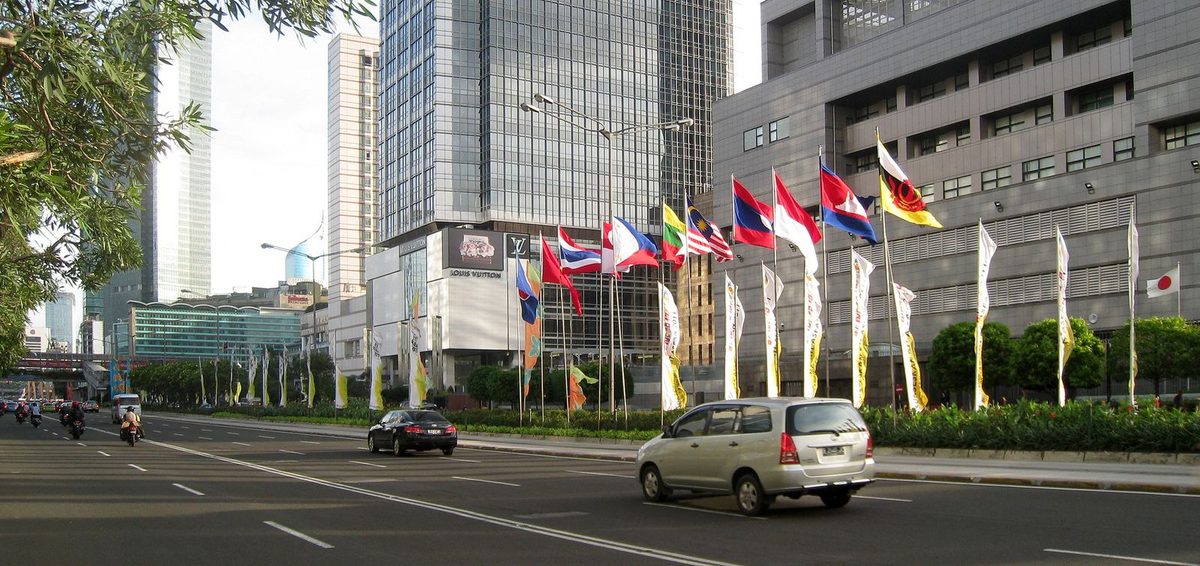
The ASEAN Economic Ministers recently held a meeting entitled the 58th ASEAN Economic Ministers (AEM), on 19 September 2026 in Metro Manila, Philippines. The 58th AEM adopted the theme “Navigating Our Future, Together”, with a focus on accelerating ASEAN economic integration in the face of geopolitical uncertainty, protectionism, energy volatility, and supply chain disruptions.
The 58th AEM also stated that the ASEAN economy grew 4.9% in 2025 and is projected to grow 4.5% in 2026, higher than the projected global economic growth of 3.0%. ASEAN also recorded a record high in foreign direct investment (FDI), amounting to US$243.9 billion in 2025. Therefore, to pursue the 2026 economic growth projection, the 58th AEM encouraged ASEAN not only to pursue investment volume, but also to place greater focus on the quality of foreign investment so that it can generate added value, namely innovation, quality jobs, strengthened industrial capacity, technology transfer, and sustainable development.
Currently, ASEAN and its member states are facing an increasingly complex economic environment, ranging from protectionism, energy volatility, and geopolitical conflicts to supply chain disruptions. ASEAN's high economic growth, of course, leaves a major question, does high economic growth automatically generate economic security for all ASEAN member states?
As a comparison, we can look at the McKinsey & Company report on 4 September 2026 concerning the economic development of ASEAN countries in the second quarter of 2026. McKinsey & Company stated that Vietnam's economy grew 8.39%, Malaysia 6%, Singapore 5.9%, Indonesia 5.29%, Thailand 1.9% and the Philippines 2.3%. Technology, investment and trade have become leverage factors accelerating the engines of economic growth. Conversely, weak domestic activity has caused some countries to experience slower economic growth.
Vietnam is a clear example of a country capable of demonstrating how a combination of trade, technology exports, manufacturing and investment can create a much stronger growth momentum. Its economy grew 8.39% in the second quarter of 2026. Exports also continued to increase by 22.7%, for electronic products, machinery and mobile phones. Its productivity and industrial capacity also experienced strong increases, with industrial growth at 11.2% and manufacturing at 11.4% during the same period.
The same is happening in Malaysia. Investment support for technology and AI has become a lever for the performance of the growth engines. Meanwhile, Singapore continues to play a role as a regional center for trade, services, finance and technology. Conversely, Thailand and the Philippines are experiencing slower growth, mainly due to weakening domestic activity. Meanwhile, Indonesia's economy continues to grow. However, its economic challenges are different.
The Indonesian case study can serve as a shared reflection to examine and analyze the quality of growth. Because economic growth in Indonesia tends to experience a paradox of growth and distribution, characterized by two indicators;
First, inequality. BPS stated that the Gini ratio in March 2026 was 0.368 or an increase of 0.005 points compared with September 2025. Meanwhile, BPS also stated that the poverty rate fell to 8.07% or 22.93 million people. This condition illustrates a distribution paradox, poverty declined, but expenditure inequality actually increased during the same period.
Second, the structure of the middle class. The 2026 Mandiri Institute report states that around 86 million people are in the transitional middle-class group, while the Lower Middle Class group declined by more than 11 million during 2019–2025.
The widening economic growth rates among ASEAN countries due to differences in growth rates confirms that technology is not only becoming a new economic sector, but has become a driver for other economic sectors. This proves that ASEAN is not stopping growth, but is entering an era of increasingly uneven growth. The challenge is no longer merely to pursue growth figures, but to ensure that technology and trade generate inclusive growth, and are distributed evenly among all countries.
From a geoeconomic perspective, this is certainly a serious issue. Not all countries have equal access to and investment support for technology and AI. If the economic growth gap widens further, ASEAN faces a new challenge in maintaining regional economic cohesion, namely economic security. This could create tensions in economic interests and complicate efforts to maintain regional cohesion.
Considering the potential for economic security, ASEAN should not continue to pursue economic growth, but formulate a regional concept and mandate, namely what kind of growth ASEAN actually wants to achieve. This is important because; (1) Not all ASEAN member states have equal access to and support for investment in technology and AI. (2) Economic growth also requires a larger scale of economy. Many resources are needed as support. The problem is that resources on earth are limited, and not all ASEAN member states have the same resources, whether natural resources, human resources and infrastructure resources. (3) Global uncertainty, geopolitical conflicts and changes in supply chains can increase market volatility and create room for excessive speculation. In the economic context, this has the potential to cause a bubble economy, whether in the form of prices soaring far beyond their actual value, rampant speculation, FOMO, excessive short-term demand due to going viral on social media, and markets moving with extreme volatility and increasing greater risks.
Therefore, a proposed regional concept and mandate is growth that can expand productivity, create quality jobs, strengthen the middle class, and reduce disparities between countries. For this reason, ASEAN needs to reformulate an economic system that positions growth not only as an engine of economic expansion, but also as an instrument of equitable distribution. Growth needs to be accompanied by policies that expand employment opportunities, strengthen income guarantees for vulnerable groups, build a more progressive tax system, and ensure more equitable access to education and health services.
Therefore, measures of economic success should not stop at GDP alone, but continue to other indicators, namely welfare indicators, such as life satisfaction, quality of life, and public perceptions of their well-being, which can be used as complements to understand the benefits of growth more fully. At the same time, strengthening productive sectors needs to be balanced with financial sector management so that speculative activities do not increasingly dominate the real economy in ASEAN member states.
Thus, McKinsey's report on the ASEAN economy in the second quarter of 2026 provides an important alarm for ASEAN. Technology and trade can become new engines of growth, but their benefits are not automatically distributed evenly. Countries capable of mastering technology, attracting investment and taking advantage of changes in global supply chains gain greater momentum. Countries that lag behind face different challenges. Therefore, ASEAN's future will not only be determined by how high its economic growth is, but also by how widely the benefits of that growth can be felt.
Sources: 58th ASEAN Economic Ministers’ Meeting; Invest ASEAN: 2025 FDI; McKinsey: Southeast Asia quarterly economic review; BPS: March 2026 Gini ratio; BPS: March 2026 poverty statistics; Mandiri Institute: middle-class resilience.


Comments
No comments yet. Be the first.
Comments are closed on this article.