
Research report, version 1.0, 21 October 2026. Part 2 of the research project India and the Russian-oil tariff; part 1 is the brief of 4 October, Will the US Put a Tariff on Indian Goods Over Russian Oil, and Who Would Pay? Analysis for information, not legal or investment advice. The live tracker carries every later change.
On 16 October the President signed an executive order that did two things at once. It set a duty of 100 per cent on goods from the five largest importers of Russian crude oil and gas that keep buying from 18 October, and it waived that duty, for every country, with no end date. No new duty applies to Indian goods today.
This report asks what is left of the risk. The answer is: more than the word "waived" suggests. The duty is written at the full 100 per cent, not "up to" it, so the waiver works like a switch with two positions. Two officials can move it, the President and the Secretary of State. India still meets both parts of the law's test, because it was a top-five buyer of Russian crude over the twelve months the law looks at, and nothing in the reporting suggests it has stopped buying. And Marco Rubio, the Secretary of State, has said the President will take "the 60-day period of time" to weigh what the sanctions and tariffs would mean. That review runs to about 15 December.
The report sets out what the law and the order say, where India's Russian oil purchases stand after the deadline, who decides now and what each wants, four scenarios to the end of the review with our judgement of each, and the exposure of every major Indian export sector if the switch is thrown.
Summary
| Scenario to about 15 December 2026 | What happens | Likelihood |
|---|---|---|
| A. The waiver stays | The order stays as it is for every country | Likely (about 65%) |
| B. The waiver narrows, India is spared | The waiver is withdrawn or narrowed for other buyers, such as China, but kept for India | Very unlikely (about 15%) |
| C. A duty on India at a reduced rate | The order is amended, or the rate adjusted, and a duty below 100 per cent applies to Indian goods | Very unlikely (about 12%) |
| D. The full 100 per cent on India | The waiver is withdrawn and the duty applies as written | Very unlikely (about 8%) |
Three dates to watch. 3 November, the US midterm elections, with fuel prices high on voters' minds. 4 November, when US trade data for September show the last full month before the deadline. About 15 December, the end of the 60-day review Rubio described.
Why does a waived tariff still matter?
Because the duty exists. The order did not decline to impose it; it imposed it and then suspended its application. Section 4(d) keeps the waivers in force "until such time as the President or the Secretary of State, in consultation with the Secretary of the Treasury and the Trade Representative, as appropriate, determine that further action is appropriate". Nothing in the order requires notice before that happens, and the order gives no date by which anyone must look again. The US Trade Representative is told to monitor purchases of Russian crude and gas and to "promptly inform the President of any circumstance that, in his opinion, might indicate the need for further action by the President, including with respect to the waivers" (Sec. 3).
Four facts make that switch matter to Indian business.
- The rate is 100 per cent. At 100 per cent on top of today's duties the question for most exporters is not margin but whether any trade continues at all.
- The trade is large. The United States bought $103.8 billion of goods from India in 2025, making it India's largest single export market. On India's own count, exports to the US rose 11.1 per cent to $50.81 billion in April to September 2026.
- India meets the test. As the section on India's oil shows, it was a top-five importer of Russian crude by volume over the twelve months the law looks at, and nothing suggests it has stopped buying.
- The authority is long-lived. The division of the Act that holds the tariff power runs until 18 September 2031 (Sec. 203). A waiver granted in October 2026 can be withdrawn in any of the next 59 months.
Who pays? In law, the American importer of record. In practice, as 2025 showed, the cost falls on the Indian exporter when the US buyer moves the order to Vietnam, Bangladesh or Ecuador. The section on 2025-26 below sets out what that cost was.
What does the law allow?
The brief quotes the enrolled text of the Lindsey O. Graham Sanctioning Russia and Iran Act of 2026 point by point. Six provisions matter now.
| Provision | What it says | Why it matters after the order |
|---|---|---|
| Sec. 113(a) | The President "shall" raise the duty on "all goods" from a covered country "to a rate of up to 100 percent ad valorem", within 30 days of enactment | The order used the maximum. The Act sets no minimum |
| Sec. 113(c) | A country is covered if it "knowingly made new purchases" of Russian crude or gas from day 30 (18 October 2026) and was among the five largest importers by volume in the twelve months before enactment; or if it was among the top five facilitators of sanctions evasion | India meets the volume test; the purchase test turns on what it buys from 18 October |
| Sec. 113(f) | The duty is "in addition to any other duty", naming Sections 122, 201, 232 and 301 and anti-dumping duties | 100 per cent comes on top of India's 10 per cent Section 301 duty and the Section 232 rates |
| Sec. 113(b) and (e) | The Trade Representative can move a rate to anything "greater than zero and up to 100 percent" on a written finding of "significant steps"; and must redetermine the five largest importers every 180 days after the "initial imposition of duties" | The route to a lower rate, and an open question on when the 180-day clock starts |
| Sec. 115 | The President "may" waive "any duty under this title" after certifying to Congress that it is "in the national interests of the United States" | The power the order used. No duration, no renewal, no congressional vote |
| Sec. 114(a)(1) | "Sanctions and other measures under this title shall not apply to" transactions "for the provision of agricultural commodities, food, medicine, medical devices, humanitarian assistance, or for humanitarian purposes" | The order applies this exception to the duty |
Two more points from the text. Before imposing a duty, the President or the Trade Representative must send six congressional committees a written justification, "not later than 10 days before" (Sec. 113(g)(1)); the Act does not require it to be published. And Congress has a way to block a termination of a duty, a 30-day review and a joint resolution of disapproval (Sec. 117(b)), but none to block a waiver.
What did the order of 16 October do?
The order, "Implementing the Lindsey O. Graham Sanctioning Russia and Iran Act of 2026", is seven sections long. Five things in it matter to India.
It set the duty at the full rate. Section 2(b): "The rate of duty on goods from the largest 5 importers of crude oil and natural gas that originated in the Russian Federation shall be increased by 100 percent ad valorem if the country knowingly makes new purchases of crude oil or natural gas that originated in the Russian Federation on or after October 18, 2026, subject to the exceptions set forth in section 114 of the Graham Act and the waivers issued in section 4 of this order." The Act said "up to 100 percent". The order chose 100. If the waiver ends with the order unchanged, that is the rate. A lower one would need either a new order or the Trade Representative's written finding under Sec. 113(b) that India "has taken significant steps" to cut its purchases. The order also set 500 per cent on goods from Russia (Sec. 2(a)) and 100 per cent on the top five facilitators of sanctions evasion (Sec. 2(c)), both waived. The rates stack on every other duty (Sec. 2(d)).
It names no country. The order does not list the five largest importers, does not say whose data counts and does not say whether India is one of them. It hands the question to the Trade Representative, who "shall monitor the circumstances related to the importation and purchases by countries" of Russian crude and gas and "provide recommendations for further action" (Sec. 2(b) and 3). The US ambassador to India, Sergio Gor, had said on 15 October that the measures target no single country but that India falls in one of the Act's categories. On any method we know of, India is a top-five importer, as the next section shows.
It applies the humanitarian exception to the duty. Our brief noted that no source had said whether Sec. 114 reaches a duty. The order answers in part: every duty it sets is "subject to the exceptions set forth in section 114". That clause covers transactions "for the provision of agricultural commodities, food, medicine, medical devices". Read with the order, India's generic medicines, shrimp, rice and spices would be outside a duty. Two cautions. The duty is waived, so no list of tariff lines has been published and US Customs has not said how it would apply the exception. And the line between "medicine" and the chemicals that go into it, such as the active ingredients India exports under chapter 29, is not drawn.
It waived nearly everything else. Section 4(a) waives "any duties provided for in sections 112 and 113". Sections 4(b) and (c) waive the Act's sanctions and restrictions in sections 102(a), (d) and (e), 103 to 111 and 117. The order leaves untouched the sanctions already in force under earlier executive orders on Russia (Sec. 4(b)), including the designations of Rosneft and Lukoil that cut India's purchases in late 2025.
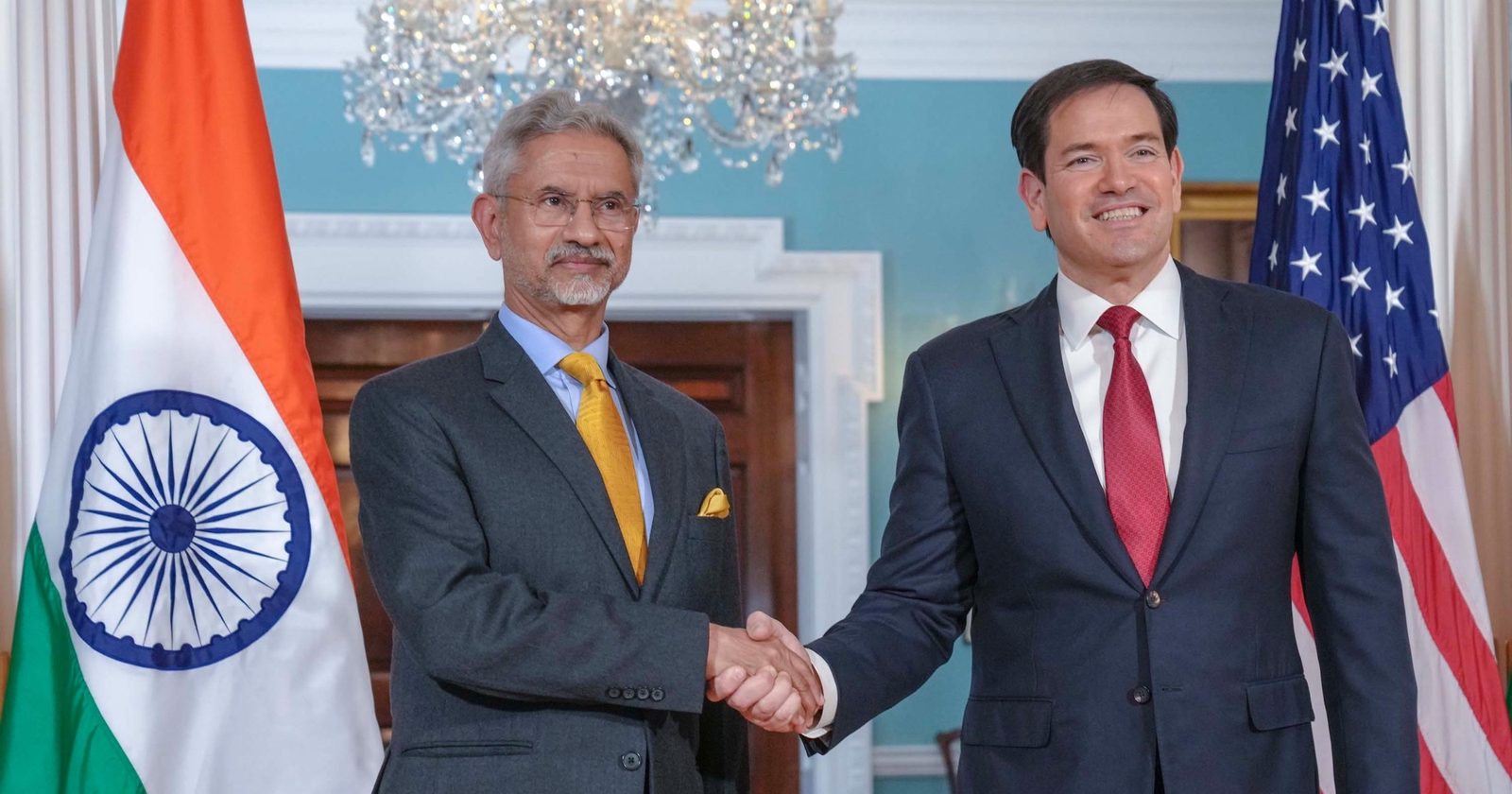
It put the switch in two hands. The waivers end when "the President or the Secretary of State" decides (Sec. 4(d)). The order delegates the President's waiver power under Sec. 115 to the Secretary of State, in consultation with the Treasury and the Trade Representative (Sec. 5(a)(ii)); the power to impose duties under Sec. 113(a) to the Trade Representative (Sec. 5(a)(vi)); and the power to terminate a duty to the Trade Representative as well (Sec. 5(a)(viii)). In practice that makes Marco Rubio, who is in India this week, the official with the clearest legal route to ending the waiver short of the President himself.
What the order leaves open. Four questions now matter more than the ones our brief listed.
- Has a duty been "imposed"? Sec. 113(e) starts the 180-day cycle of redeterminations "after the initial imposition of duties". The order "increased" the rate and waived its application in the same breath. If that counts as imposition, the Trade Representative must redraw the list of the five largest importers by about 14 April 2027. If it does not, the clock has not started. The order does not say.
- Would ending the waiver require ten days' notice? Sec. 113(g)(1) requires a written justification to six committees "not later than 10 days before imposing a duty". The order mentions only the waiver certifications. If that requirement applies when a waived duty is switched on, the committees would get at least ten days' warning, though the Act does not require the justification to be published.
- Can the waiver be ended for one country? Nothing in the Act or the order prevents it. Sec. 4(d) speaks of "further action", not of all-or-nothing.
- What is a "new purchase", and whose knowledge counts? The Act defines neither. A cargo contracted in September and loaded in late October may or may not be "new". Whether a private refiner's purchase makes a country one that "knowingly makes new purchases" is, as the Congressional Research Service noted of the Senate text, unresolved.
What officials said next. On 17 October Rubio told reporters, as Reuters reported, that "the president wants to take the 60-day period of time to sort of analyze what imposing both sanctions and tariffs will mean to the global economy and even to the US economy". The order itself sets no such period. The President said the same day: "A lot of you don't know what my decision is yet, but we'll figure it out, and you'll figure it out." In a post the next day he said his decision-making was aimed at avoiding anything "that will drive, foolishly, Russia away from the bargaining table". Sixty days from 16 October is 15 December.
The diesel deal behind it. The waiver came a week after the President announced a deal with Vladimir Putin for Russian diesel. On 9 October the Treasury issued General License 135, which authorises transactions in Russian-origin diesel "including importation into the United States" until 7 April 2027. The Treasury Secretary, Scott Bessent, said on 11 October: "Anyone in Congress who says that either it's an old bill or the Lindsey Graham bill that prohibits us from doing it, they're wrong". Rubio's defence: "That diesel is going to be sold one way or the other. The only difference is how much of it the United States was going to get." The Energy Secretary, Chris Wright, called the deal "a carrot to try to end the war, not an economic lifeline" for Russia (Reuters). A government licensing Russian diesel for its own market is in a weak position to tax India for buying Russian crude, at least while the licence runs.
The reaction. A bipartisan group of senators had written that the Act's authorities "require you to apply economic pressure on Russia and the chief enablers of its war, in particular China" (CBS News). After the order, the Republican senator Thom Tillis called it "Beyond irresponsible" and Ted Cruz "a mistake" (France 24). In Moscow, Putin's envoy Kirill Dmitriev called the suspension "an important and truly historic moment"; in Kyiv, Volodymyr Zelensky called it "unfortunate" and said the Act "could have helped enormously" (CBS News). Congress has no vote on a waiver. To force a duty it would need a new law, which the President could veto. The Act passed the Senate 86 to 11, more than two-thirds, and the House 262 to 159, less than two-thirds (Sullivan & Cromwell).
Is India still covered, and is it still buying?
The Act's test has two parts: was India among the five largest importers of Russian crude or gas by volume in the twelve months before enactment, and does it make new purchases from 18 October? The first was settled before the deadline. The second is being answered now, cargo by cargo.
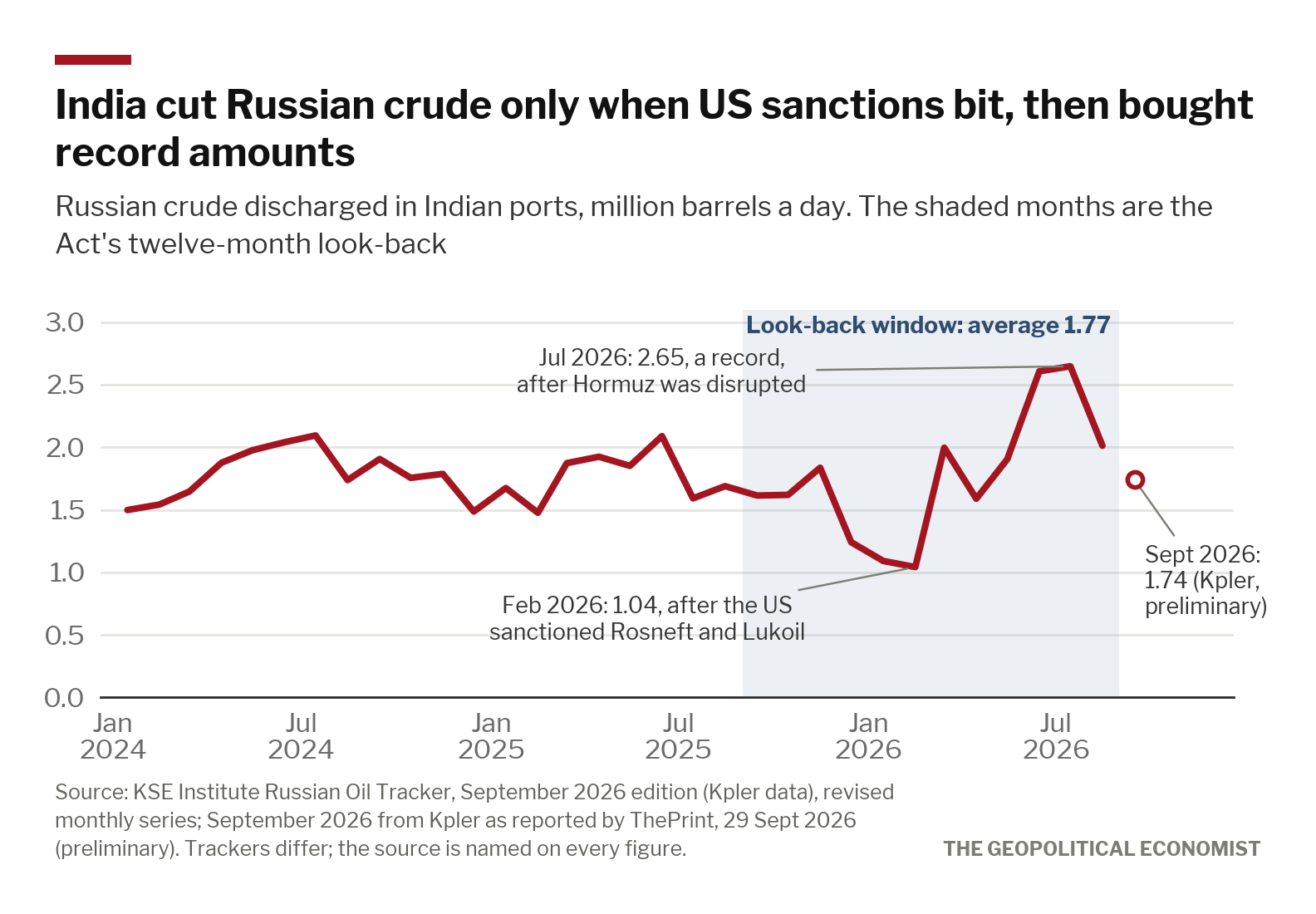
The volume test: India is in. On the KSE Institute's series of Russian crude discharged in Indian ports, built on Kpler data, India averaged 1.77 million barrels a day over September 2025 to August 2026 and was the first or second largest buyer of Russian seaborne crude in every month. China, which also takes Russian crude by pipeline, is first by total volume; India is second. CREA's count by value since December 2022 gives the same order: China 50 per cent of Russia's crude exports, India 37, Türkiye 5 and the EU 5. India buys almost no Russian gas, so it is covered through crude, for which the Act allows no exception.
After the deadline: less, but not none. India imported about 1.82 million barrels a day of Russian crude in September on Kpler's figures, 29 per cent below July's 2.57 million, against about 1.49 million for China's seaborne imports; Kpler expected October to hold at 1.8 to 1.9 million. CREA's September analysis found India's Russian crude imports down 13 per cent on the month, a second monthly fall, to the lowest since April. Intake fell at all three of the largest importing refineries, Vadinar (down 8 per cent), Jamnagar (down 27) and Paradip (down 21), and Vadinar overtook Jamnagar as India's largest importer of Russian crude. India was still the second-largest buyer of Russian fossil fuels in September, at EUR 4.1 billion, of which crude EUR 3.6 billion.
November cargoes were cut for price, not by order. Indian refiners cut their purchases of Russian crude for November delivery, Bloomberg reported on 8 October, because Russian crude was being offered at "premiums of more than $10 a barrel to Dated Brent" and was "priced almost at par with Middle Eastern grades", while Gulf flows through Hormuz had recovered to about 80 per cent of pre-war levels. Russia's share of India's crude imports fell to about 35 per cent in September from as much as 56 per cent in July, on Kpler's data. Sumit Ritolia of Kpler pointed to China: its imports of Russian crude "have been increasing over the past few months, adding competition for those barrels that would otherwise be available to Indian refiners". Bloomberg's sources said New Delhi had not asked refiners to cut Russian imports in response to the US tariff risk. After the waiver, analysts told PTI they expected India to keep importing Russian crude at close to current levels.
One number in that reporting needs care. Bloomberg's tanker data showed shipments to India averaging 310,000 barrels a day in the four weeks to 4 October, the lowest since March 2022. That counts cargoes loading for India over four weeks, not arrivals over a month, and destinations are often assigned late in the voyage, so it is a leading signal, not a monthly total.
Cheap at the port, dear in India. CREA puts the average price of Urals in September at $90.70 a barrel, up 32 per cent on the month and more than double the EU and UK price cap of $44.10, and its discount to Brent at $23 (21 per cent), unchanged from August. That discount is measured at the Russian port. Delivered to India, after freight at surging tanker rates and in competition with Chinese buyers, the same oil was being offered at a premium to Brent. The discount that drew Indian refiners to Russian crude after 2022 has, for now, gone at the point where they pay.
Who still buys. Nayara Energy's Vadinar refinery, 49.13 per cent owned by Rosneft and under EU sanctions, took 100 per cent of its crude from Russia in the first eight months of 2026, up from 81 per cent in 2025, CREA's August analysis found. Reliance's Jamnagar complex took 32 per cent of its crude from Russia in July to September, and shipped EUR 122 million of oil products to the United States in September (CREA). Rubio is due at Jamnagar on 21 October to discuss "prospects for enhanced energy cooperation", the State Department said. Asked in Mumbai why he was visiting a private refinery, he said "energy is related to national security" (ANI). The state refiners buy cargo by cargo, and their line has not changed since Indian Oil's finance director, Anuj Jain, put it in October 2025: "Russian crude is not sanctioned. It is the entities and the shipping lines which have got sanctions" (Reuters).
Could India leave the test? Only by making no new purchases, and that is very unlikely in the next two months. Vadinar alone runs almost entirely on Russian crude, refiners asked New Delhi for a quota rather than a stop when the Act passed, and the government has not asked them to cut. What has changed is the price. With Russian crude near parity with Gulf grades delivered, giving it up would cost India less than at any time since 2022; the constraint now is how much Gulf crude is on offer. Rubio's own description, on 17 October, as AP reported: "You've got countries like India, for example, that have voluntarily diversified their energy portfolio, but are still getting a substantial amount of energy from Russia because it's hard to pivot from one day to the next. But they're also an important ally and partner of the United States."
Who decides now, and what does each want?
The order moved the decision from a deadline to a discretion. These are the people who hold it and what they have said.
| Who | Power under the order | What they have said or done |
|---|---|---|
| The President | Can end any waiver (Sec. 4(d)) | Waived the duties citing the national interest; says his decisions aim to avoid driving Russia "away from the bargaining table"; announced the Russian diesel deal on 9 October |
| Secretary of State Marco Rubio | Holds the waiver power by delegation, with the Treasury and the Trade Representative (Sec. 5(a)(ii)); can decide "further action" (Sec. 4(d)) | Described a 60-day review; called India "an important ally and partner"; travelling to Uzbekistan and India from 17 to 22 October; said of the trade deal on 20 October, "We're very, very close" |
| US Trade Representative Jamieson Greer | Monitors purchases and reports to the President (Sec. 3); holds the duty power under Sec. 113(a) and the power to end a duty (Sec. 5(a)) | Said on 1 October "we have to name names"; the order named none |
| Treasury Secretary Scott Bessent | Consulted on any change to the waiver | Issued the diesel licence on 9 October and defended it against Congress |
| Congress | No vote on a waiver; hearings and letters | Bipartisan criticism; the senators' letter named China as the chief enabler to target |
| The Government of India | None under US law; can change what its refiners buy | Has not told refiners to cut; links the trade deal to the US tariff structure; wants a rate like Vietnam's |
| Russia | None; benefits from the waiver | Kirill Dmitriev called the suspension "an important and truly historic moment" |
The trade deal is the hinge. Rubio said in Mumbai on 20 October, after meeting the External Affairs Minister, S. Jaishankar: "We're very, very close. I would say we're about as close as you can be without having executed the agreement. I think there's a small number of items left to wrap up, so I think that will happen shortly" (AP). The two ministers also met the UAE's foreign minister to discuss "regional energy security". India's Commerce Secretary, Rajesh Agrawal, said on 15 October that the deal "has to be signed when the overall tariff structure is getting formalised" (ANI), and India wants a final rate close to those of rival manufacturers such as Vietnam (AP). Finance Minister Nirmala Sitharaman had said earlier in the month that the talks had reached a "plateau". A signed deal would make a duty on India under the Act much harder to justify; a collapse would make the waiver the most obvious lever left.
Prices come first in Washington. Rubio framed the waiver around energy: conflicts in the Middle East and Ukraine "are starting to crash into each other, and they're having an impact not just on global oil and diesel prices" (France 24). An administration that is licensing Russian diesel to cool American fuel prices before the 3 November midterms is unlikely to put a 100 per cent duty on the second-largest buyer of Russian crude in the same weeks.
China is the first in line. The waiver covers China, the largest buyer, as well as India. The senators who urged enforcement named China, not India, as the "chief enabler". If the administration wants to show it can use the Act without raising prices at home, narrowing the waiver for China, or for countries that help evade sanctions, is a smaller step than ending it for everyone. That is scenario B below.
What could happen next, and how would we know?
Nobody outside the administration knows what the review will conclude. What can be mapped is the set of possible outcomes for Indian goods, the public signs that would come before each, and what each would mean for exporters. The four scenarios cover the period to about 15 December, the end of the 60-day review Rubio described. They do not overlap and together they cover every outcome for India. Likelihoods use the scale of the US intelligence community's analytic standard, ICD 203: very unlikely is 5 to 20 per cent, unlikely 20 to 45, roughly even chance 45 to 55, likely 55 to 80 and very likely 80 to 95. They are judgements on the evidence to 21 October, not predictions.
| Scenario to about 15 December | What happens | Signs it is coming | For Indian exporters | Likelihood |
|---|---|---|---|---|
| A. The waiver stays | The order stays as it is for every country, through and beyond the review | A signed India–US trade deal; Russia–Ukraine talks still alive; fuel prices still high; no letter of justification reported | No new duty. The switch stays where it is, and the risk returns with every turn in the Russia talks | Likely (about 65%) |
| B. The waiver narrows, India is spared | The waiver is withdrawn or narrowed for other buyers or for facilitators of sanctions evasion, and kept for India | Officials singling out China; a list of the five largest importers that names India but waives it; a trade deal that mentions energy | No duty now, but India is named and the Trade Representative monitors it by name | Very unlikely (about 15%) |
| C. A duty on India at a reduced rate | The order is amended, or the rate adjusted under Sec. 113(b), and a duty below 100 per cent applies to Indian goods | Trade talks stall; officials cite India's February pledge to stop buying Russian oil; Russian imports rise again; a justification sent to the six committees | Any rate above 2.5 per cent wipes out the edge India won in July over Vietnam; phones pay for the first time | Very unlikely (about 12%) |
| D. The full 100 per cent on India | The waiver is withdrawn for India and the duty applies as written | An open break in the trade talks; Russia walks away from talks and the waiver is withdrawn for every top buyer; Congress forces the issue | Most exports with a substitute stop. Medicines and food are probably spared | Very unlikely (about 8%) |
Taken together, no new duty on Indian goods by mid-December (A and B) is likely, at about 80 per cent. One route sits outside the four: India making no new purchases of Russian crude, which would take it outside the importer test. We judge that very unlikely in this period, for the reasons set out in the section on India's oil.
Why the waiver is most likely to stay. Five things point that way.
- The administration chose it, two days early, for every country. An order that set the duty and waived it in the same text, with no conditions and no names, is not a step towards a duty on India.
- Prices. The waiver followed the diesel licence and was framed around fuel prices. Ending it would add cost to imports from India, China and Türkiye in the middle of an energy shock.
- The official with the pen is selling a deal. Rubio holds the waiver power, called India "an important ally and partner" and said the trade agreement was "about as close as you can be without having executed" it.
- Russia policy runs the other way. The President's stated aim is to keep Russia at the "bargaining table", and Energy Secretary Wright called the diesel deal "a carrot". A duty on Russia's buyers is a stick; it would be used, if at all, when the talks fail.
- India's purchases are falling. Russian crude fell from 56 to about 35 per cent of India's imports between July and September. Washington can point to that fall whatever its cause.
Why B ranks above C and D. If the administration wants to show the Act has teeth without raising prices or hurting a deal with India, the cheapest move is against China, the largest buyer, which the senators singled out, or against the facilitators of sanctions evasion under Sec. 2(c). The order allows country-by-country action, and nothing in it ties India's fate to China's. B is still very unlikely because, as the Conference Board judged before the deadline, the administration wants to preserve its "trade truce" with China.
Why a duty on India is not out of the question. C and D together are about one in five. The President singled out India in August 2025 with a duty that spared China. The February 2026 order that lifted that duty said India "has committed to stop" importing Russian oil, and India's imports then rose to records. India still meets both parts of the Act's test, and the order already sets the rate, so a duty needs no new legal step beyond ending the waiver, and possibly the ten-day justification to Congress. A collapse of the trade talks, or of the Russia talks, would move these odds quickly. C ranks above D because a reduced rate would satisfy a political need at a lower cost, as the brief argued for the first decision.
What would change this judgement. Towards a duty: reports of a justification sent to the six committees; Russia breaking off talks; India's Russian crude imports climbing back towards 2 million barrels a day; a breakdown in the trade talks; US officials naming India's February pledge. Towards no duty: a signed India–US agreement; a Russia–Ukraine ceasefire or energy truce that holds; an extension or restatement of the waiver at the end of the review.
Beyond December. The risk does not end with the review. The authority runs to September 2031. If the order counts as the initial imposition of duties, the Trade Representative must redraw the list of the five largest importers by about mid-April 2027, and every 180 days after. The diesel licence expires on 7 April 2027. And a new Congress meets in January.
What we got wrong last time. On 4 October we rated "no new duty" on 18 October a roughly even chance, about 50 per cent, and the most likely single outcome. That is what happened. But we expected the administration to publish a list naming India and to tie a waiver to India's trade deal or to cuts in its Russian purchases. The order names no country and waives the duty for every country, without conditions. We also treated the rate as open, between zero and 100 per cent. The order fixed it at 100, which makes any later decision starker than we drew it.
Which Indian exports would pay if the waiver ends?
A duty under the order falls on "goods from" a covered country and comes "in addition to any other duty" (Sec. 2(b) and (d)). It is subject to the Sec. 114 exception for food, agricultural commodities, medicine and medical devices. So the question for each sector is what it pays today, what it would pay with 100 per cent added, and what its rivals pay.
| Sector (HS code) | US imports from India, 2025, $bn | Share of the sector's exports going to the US | Extra US duty today | If the waiver ends | Rivals' extra duty today |
|---|---|---|---|---|---|
| Phones and network equipment (8517) | 24.8 | 59% | None: smartphones are exempt | 100% | Vietnam, China: none |
| Medicines (3004) | 14.6 | 37% | None: exempt | None if Sec. 114 applies, as the order indicates | None: exempt for all |
| Machinery (84) | 7.3 | 20% | 10% on most lines | 110% | Vietnam 12.5%; China 12.5% plus older Section 301 duties |
| Other electrical equipment (85, without phones) | 5.3 | 28% | 10% on most lines | 110% | Vietnam 12.5%; China 12.5% plus older Section 301 duties |
| Organic chemicals (29) | 4.1 | 13% | None on pharmaceutical inputs; 10% on the rest | 100 to 110%, unless Sec. 114 reaches medicine ingredients | China 12.5% plus older Section 301 duties |
| Diamonds (7102) | 3.4 | 15% (36% in 2024-25) | 10% | 110% | Israel 12.5%; EU none on natural diamonds |
| Petroleum products (2710) | 3.2 | 7% | None: exempt | 100% | None: exempt for all |
| Made-up textiles (63) | 2.9 | 44% | 10% plus MFN | 110% plus MFN | Türkiye, Vietnam 12.5%; Pakistan 10% |
| Iron and steel articles (73) | 2.7 | 29% | 50% Section 232 on listed derivatives; 10% on the rest | 150% or 110% | The same Section 232 rate for most |
| Woven apparel (62) | 2.6 | 30% | 10% plus MFN | 110% plus MFN | Vietnam 12.5%; Bangladesh, Cambodia, Indonesia 10% |
| Knitted apparel (61) | 2.4 | 31% | 10% plus MFN | 110% plus MFN | Vietnam 12.5%; Bangladesh, Cambodia, Indonesia 10% |
| Jewellery (7113) | 2.2 | 21% | 10% plus 5.5 to 6% MFN | 110% plus MFN | Thailand, Türkiye, UAE, Vietnam 12.5% |
| Shrimp and other crustaceans (0306) | 1.9 | 32% | 10% plus anti-dumping and countervailing duties | None extra if Sec. 114 applies to food, as the order indicates | Ecuador, Indonesia 10%; Vietnam, Thailand 12.5% |
| Auto parts (8708) | 1.8 | 27% | 25% Section 232 on about half; 10% on the rest | 125% or 110% | The same Section 232 rate for most |
| Carpets (57) | 1.2 | 56% | 10% | 110% | Türkiye 12.5%; Pakistan 10% |
| Bags and cases (4202) | 0.4 | 29% | 10% plus MFN | 110% plus MFN | Vietnam 12.5%; Cambodia 10% |
| Leather footwear (6403) | 0.4 | 21% | 10% plus MFN | 110% plus MFN | Vietnam 12.5%; Indonesia, Cambodia 10% |
US imports from India are US-reported figures from UN Comtrade for 2025. The US share is the share of the sector's exports that went to the US in India's fiscal year 2025-26, on India's own figures. Duties today are from the USTR notice of 28 July 2026 and the Commerce Ministry's release of 25 July 2026; the brief's table gives the sources for each rival's rate. MFN is the most-favoured-nation duty every supplier pays. China also pays the Section 301 duties of 2018 and 2019. The rows cover $81 billion of the $104 billion the US imported from India in 2025.
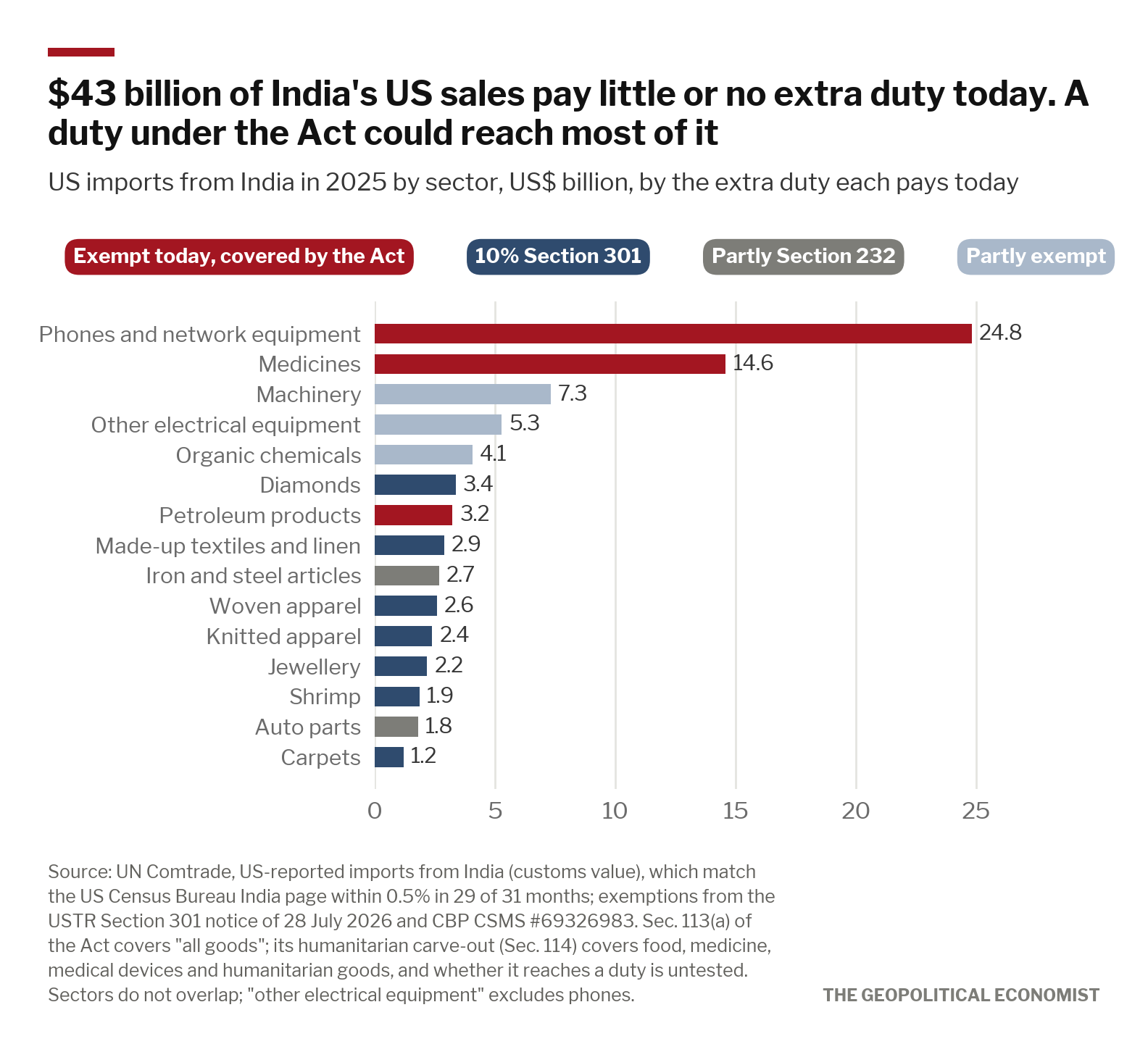
At 100 per cent the question is whether trade continues. In 2025-26 an extra 25 per cent on top of a 25 per cent reciprocal tariff, 50 per cent in all, cost Indian diamonds and jewellery three-quarters of their US sales, as the next section shows. At 110 per cent, the price of an Indian shirt, carpet or bracelet to an American importer more than doubles while the same goods from Vietnam, Bangladesh or Türkiye pay 10 to 12.5 per cent. Trade would continue only where there is no substitute at any price, or where contracts cannot be moved in time.
Phones are the largest exposure. Phones and network equipment, nearly all of it smartphones, are India's largest export to the United States: $24.8 billion in 2025, with 59 per cent of the line's exports going to the US. They were exempt from the 2025 duties and pay no extra duty today, and the Act names no product exemptions. Under the order they would pay 100 per cent, while smartphones from Vietnam and China pay none. A line that more than doubled under the 2025 duties would become the one with most to lose.
Medicines and food are probably spared. The order makes its duties "subject to the exceptions set forth in section 114", which names "agricultural commodities, food, medicine, medical devices". That would cover India's $14.6 billion of medicine sales to the US and, on its plain words, shrimp, rice, spices and other food. US imports from India in chapters 1 to 24 (food and farm goods) were $5.9 billion in 2025 and in chapter 30 (pharmaceutical products) $15.1 billion. Take those out and the duty would reach about $83 billion of the $104 billion, four-fifths of the total. How Customs would draw the line between medicines and the chemicals that make them, and between food and goods that contain it, will not be known unless the duty is switched on.
Fuel and metals. India's $3.2 billion of petroleum products would move from no extra duty to 100 per cent, at a time when Washington is licensing Russian diesel into its own market. Steel derivatives that pay 50 per cent under Section 232 would pay 150, because the order stacks its duty on top.
How we rate exposure. The brief rated each sector by a mechanical rule: high where at least 30 per cent of exports go to the US and US sales fell by more than 10 per cent in 2025-26, or fell by more than half, or where the sector is exempt today and sends more than half its exports to the US. With the order now pointing to the Sec. 114 exception, we move medicines from medium to low and shrimp from high to low, both flagged until a duty is applied. Phones, diamonds, jewellery, apparel, home textiles and carpets remain high. The ratings and their inputs are in the dataset.
What happened last time?
Washington has taxed Indian goods over Russian oil once before, by executive order. From 27 August 2025 a 25 per cent duty was added on top of a 25 per cent reciprocal tariff, 50 per cent in all on goods that were not exempt. It was lifted from 7 February 2026 on a finding that India "has committed to stop" importing Russian oil.
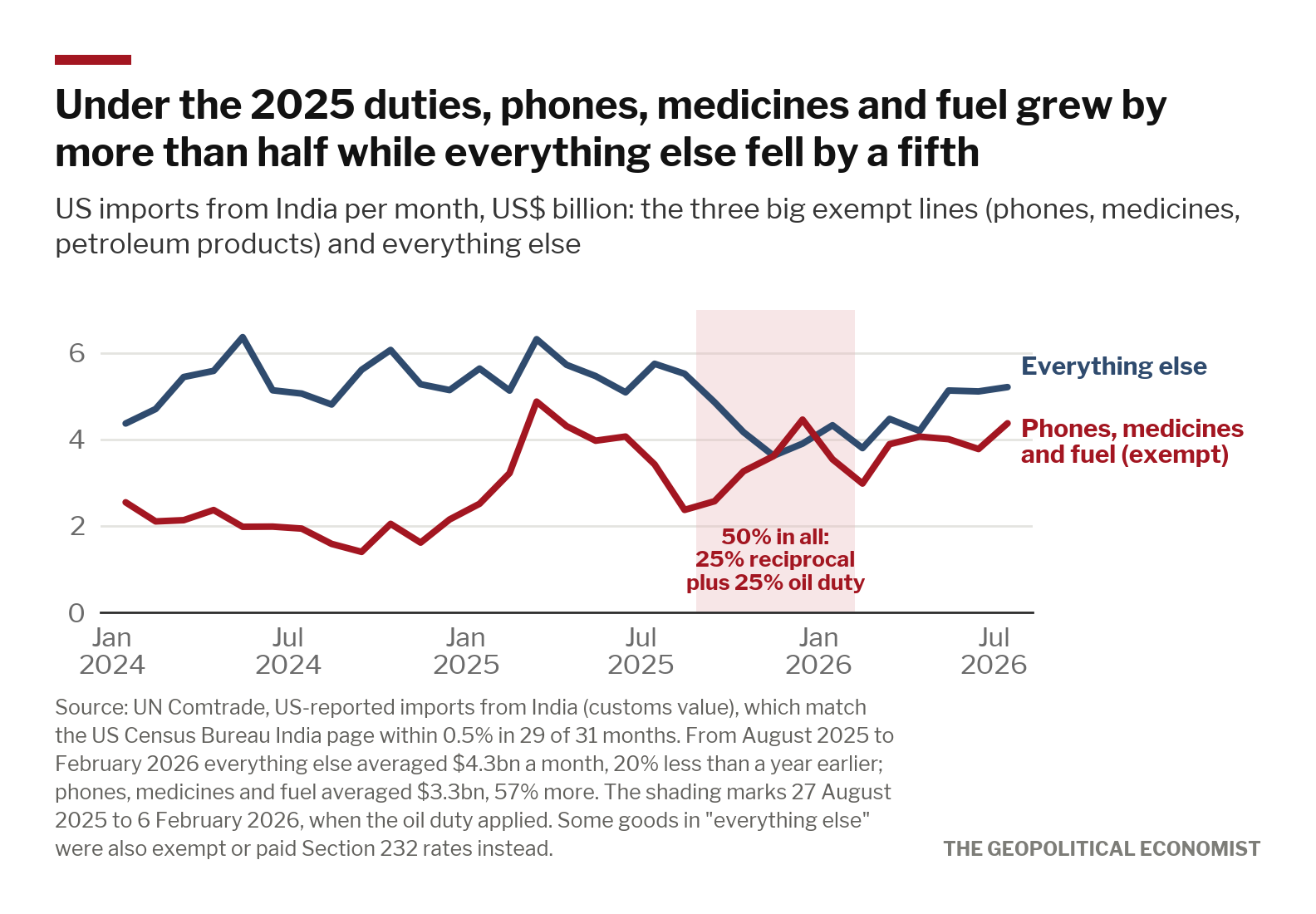
From August 2025 to February 2026, US imports of Indian phones, medicines and fuel rose 57 per cent on a year earlier, to $3.3 billion a month, while everything else fell 20 per cent, to $4.3 billion a month. Total imports from India were roughly flat, up 1.5 per cent, because phones made up the loss.
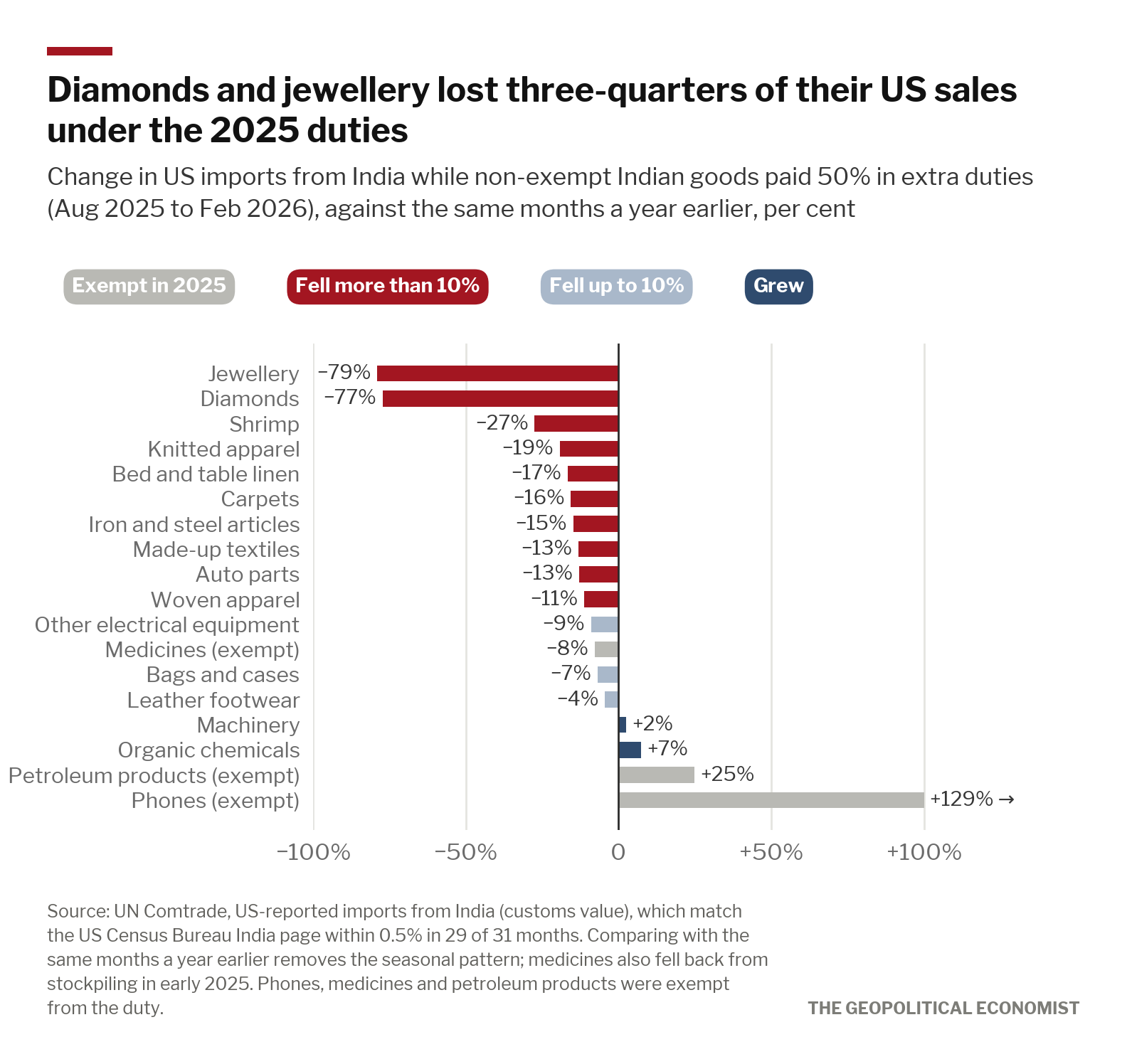
The losses were concentrated. US imports of Indian jewellery fell 79 per cent on the year and diamonds 77; the US share of India's diamond exports fell from 36 per cent in 2024-25 to 15 per cent in 2025-26, as sales moved to the UAE and Hong Kong (ICRIER). Shrimp fell 27 per cent, knitted apparel 19, bed linen 17 and carpets 16.
Since then. Under the 10 per cent Section 301 duty, US imports from India were $9.17 billion in August 2026, 16.2 per cent above August 2025, when the 2025 duties began, and $68.0 billion in January to August, 7.2 per cent below the same months of 2025. India counts its exports to the US up 11.1 per cent in April to September. The lesson of 2025 holds: exempt lines grow, price-sensitive lines with close rivals lose, and the total hides both. The difference now is that the largest exempt line, phones, would not be exempt.
What can businesses do?
These are options, not advice. Which of them suit a firm depends on its contracts, its products and its buyers.
Indian exporters.
- Know who pays. A duty is paid by the importer of record. Under a delivered-duty-paid contract that is often the exporter or its US arm. Check, contract by contract, who would carry a new duty and whether price can be reopened.
- Know whether you are inside Sec. 114. Medicine, medical-device and food exporters should be able to show, line by line, that their goods fall within the exception the order cites. Producers of pharmaceutical ingredients, which sit in a grey area, have the most reason to prepare.
- Watch the switch, not the calendar. The waiver has no end date. The signposts under "What to watch" come before a change; a duty could follow within days, or ten days if the Act's justification requirement applies.
- Price the alternative markets. The US share of each sector's exports, in the table above, is the measure of how much a switch would cost. Phones, carpets, bed linen and made-up textiles send more than 40 per cent of their exports to the US; they have the most to gain from any market they can add now.
US buyers of Indian goods. The same contracts, seen from the other side: the cost of a second source in Vietnam, Bangladesh or Mexico against the cost of a 100 per cent duty for as long as it lasts, and what can be shipped while the waiver holds.
Lenders and investors. Exposure is concentrated by sector, not spread across Indian exports. The sectors rated high above are the ones in which a change in Washington would move orders, receivables and working capital first. We give no view on any company or security.
What to watch
| Date | What | Why it matters |
|---|---|---|
| 21 October | Rubio at Jamnagar, after talks in Mumbai | The official who holds the waiver power, at the refinery that buys most Russian crude after Vadinar |
| Late October | November-delivery Russian cargoes load for India | The first full test of "new purchases" after 18 October |
| 3 November | US midterm elections | Fuel prices are the backdrop to the waiver |
| 4 November | US trade data for September | US imports from India in the last full month before the deadline |
| Mid-November | India's trade data for October; CREA's analysis for October | India's exports to the US, and its Russian crude purchases in the first month after the deadline |
| About 15 December | End of the 60-day review Rubio described | Waiver kept, narrowed or ended |
| January 2027 | A new Congress meets | Hearings, letters, and any attempt to legislate around the waiver |
| 7 April 2027 | The Russian diesel licence (GL 135) expires | The administration's own Russian energy exception |
| About 14 April 2027 | First redetermination of the five largest importers, if the order counts as the initial imposition of duties (Sec. 113(e)) | The list could be redrawn, by name |
| 18 September 2031 | The tariff authority expires (Sec. 203) | The end of the risk under this Act |
| Signpost | Points to | Where to check |
|---|---|---|
| A signed India–US trade agreement | A | The Commerce Ministry (PIB); USTR |
| Officials singling out China or evasion facilitators | B | The White House; USTR; Treasury |
| A justification sent to the six committees under Sec. 113(g) | C or D | Committee statements; press reports |
| An amended order or a Federal Register notice naming India | C or D | The Federal Register; the US tariff schedule |
| Officials citing India's February 2026 pledge | C | USTR; the White House |
| India's Russian crude climbing back towards 2 million barrels a day | C or D | Kpler figures as reported; CREA and KSE monthly editions |
| Russia breaking off talks over Ukraine | D, for every top buyer | The White House; the Kremlin |
The tracker logs each of these as it happens, and the Graham Act page of our Third-Country Sanctions Monitor follows the Act's sanctions side.
Method, data and limits
Every figure in this report was checked against the source it links to.
The law and the order. Every statement about the Act quotes the enrolled text of H.R. 5334, and every statement about the order quotes the text published by the White House, not a memo or a news report. Dates derived from them are counted from enactment on 18 September 2026 and from the order of 16 October 2026. The certification and report the President sent Congress under Sec. 115 have not been published, and we have not seen them.
Statements by officials. Quotations are taken from the reports linked to them. Rubio's 60-day review is his description, reported by Reuters and AFP; the order itself sets no period.
Oil. Every figure for India's Russian crude names its tracker: the KSE Institute's monthly Russian Oil Tracker, built on Kpler data; CREA's monthly analyses; and Kpler or Bloomberg tanker figures as reported in the press. Trackers differ by source, by basis (cargoes loading for India against cargoes discharged in India) and by date of publication, so the same month can carry more than one figure. We keep them apart and never average them.
Trade. US imports from India are US-reported figures from UN Comtrade at customs value, which match the US Census Bureau's India page within 0.5 per cent in 29 of the 31 months from January 2024 to July 2026; August 2026 is from the Census Bureau's page. Export shares are India's own figures from the Commerce Ministry's TradeStat. The two do not match, so we use US data for what the US bought and Indian data for how much each sector depends on the US. The four-fifths estimate in the section on exports takes US imports from India in 2025 in chapters 1 to 24 and chapter 30 as covered by Sec. 114. It leaves medical devices in, so it slightly overstates the trade a duty would reach, and it would understate it if Customs read the exception narrowly.
Scenarios. Built by listing who holds the decision and what each wants, the uncertainties that matter most, and the public signs that would come before each outcome. The likelihoods are our judgement on the evidence to 21 October 2026. After the review we will publish which scenario happened and what we got wrong, as we did for the first decision.
What this report cannot tell you. What the administration will decide; how US Customs would apply the Sec. 114 exception line by line; how much of a duty importers or exporters would absorb; and how trade would move at 100 per cent, a rate with no precedent in the 2025-26 record, which stopped at 50.
Data, scripts and charts. The tables, the scripts that build them and the charts are published in the dataset, with a method note for each file. The charts are our own, drawn from those tables, and were first published with the brief.
Glossary
- Ad valorem. A duty charged as a percentage of the value of the goods.
- MFN rate. The most-favoured-nation duty: the ordinary US tariff that applies to a good from any trading partner without a special arrangement.
- Section 301. The trade law under which the US Trade Representative set a 10 per cent duty on Indian goods from 24 July 2026, with exemptions covering about 45 per cent of India's exports to the US.
- Section 232. The national-security trade law under which the US charges its own rates on steel, aluminium, autos and their parts, instead of the Section 301 duty.
- Waiver (Sec. 115). The President's power to suspend any duty or sanction under the Act by certifying to Congress that doing so is in the national interest. It has no time limit and Congress has no vote on it.
- Termination (Sec. 117). Ending a duty or sanction for a country that has stopped the conduct behind it. Unlike a waiver, it waits 30 days for a possible joint resolution of disapproval.
- Covered country (Sec. 113(c)). A top-five importer of Russian crude or gas by volume in the twelve months before enactment that knowingly makes new purchases from 18 October 2026, or a top-five facilitator of Russian oil sanctions evasion.
About this report
Version and corrections. Version 1.0, 21 October 2026. Corrections are welcome at [email protected], with the line and your source. Each change will be noted here with its date and logged on the tracker. We will update the report after the US trade data of 4 November and at the end of the review.
How to cite. Vikas, "Will the US Switch On Its Waived 100% Russian-Oil Tariff, and Which Indian Exports Would Pay?", research report, version 1.0, The Geopolitical Economist, 21 October 2026, https://geopoliticaleconomist.com/articles/india-russian-oil-tariff-full-report.
India and the Russian-oil tariff, a research project:
- Will the US Put a Tariff on Indian Goods Over Russian Oil, and Who Would Pay? (the brief, 4 October 2026)
- Will the US Switch On Its Waived 100% Russian-Oil Tariff, and Which Indian Exports Would Pay? (this report)
The live position is on the Russian-Oil Tariff Tracker.
Comments
No comments yet. Be the first.
Comments are closed on this article.